locations · South Africa
PLC Training in Cape Town: Courses and Practical Skills
Compare PLC training in Cape Town: local course enquiries, practical skills, online preparation, software choices, costs and a packaging portfolio task.
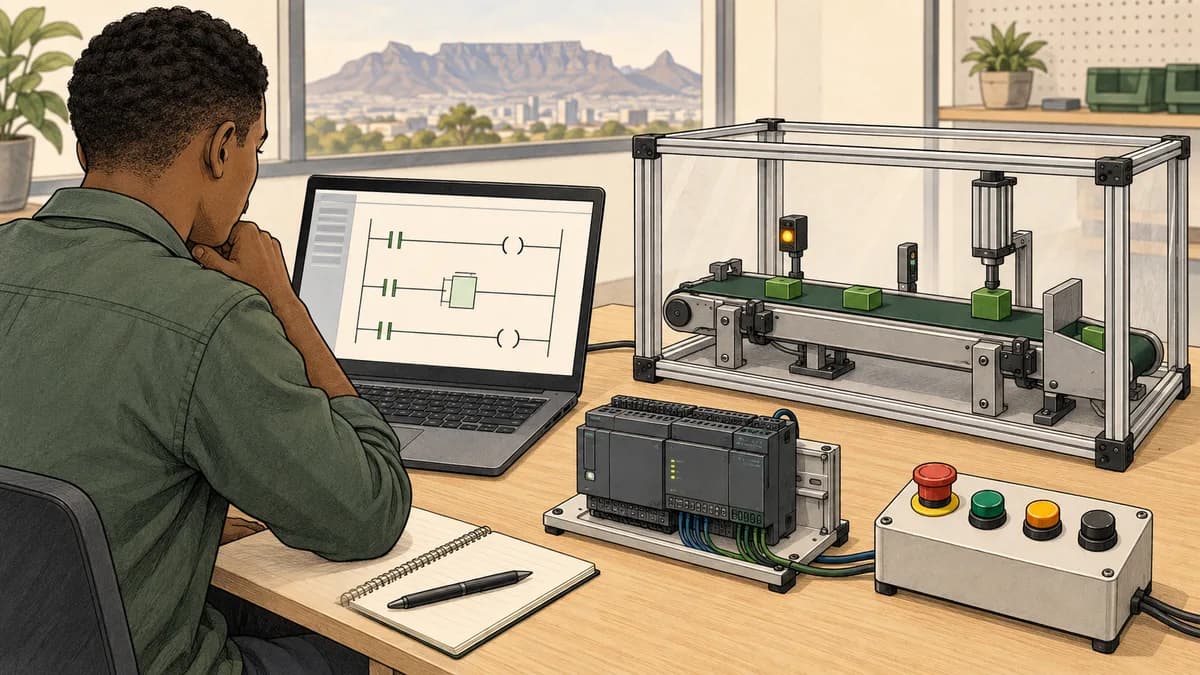
PLC training in Cape Town should give you a clear route from understanding a control task to demonstrating it on the equipment or learning environment you paid to use. Start with the required skill, then compare the syllabus, venue, individual practice time and assessment. A city name on a course landing page is not evidence of a local laboratory, a current intake or a particular employer's preferred controller.
This guide covers local course enquiries, online preparation, platform selection and a practical packaging change exercise. It also separates Cape Town from the wider Western Cape when discussing industrial locations. The aim is to help a learner or training buyer make a defensible purchase without relying on invented salary bands or regional brand rankings.
This site is commercially connected to PLC Simulator. Its PLC curriculum overview can help you identify foundation practice before a practical class. Check current lesson access on the product site; educational simulation does not establish competence on an employer's machinery.
Where to enquire about PLC courses in Cape Town
Northlink College's 2023 occupational programmes brochure lists PLC Automation among its skills courses. That is historical evidence of a listed offering, not confirmation of a September 2026 class, fee or controller model. Use the college's current course and campus contacts to ask which campus handles the enquiry and whether the relevant practical course is running.
Festo's PLC111 introductory course page, checked on 12 September 2026, lists a Cape Town session for 21–23 October 2026 and says dates may change. Confirm availability, venue and price directly before making travel arrangements. This is a published schedule, not a reserved place or our endorsement of a particular class.
Send a precise question: “I want beginner PLC programming with individual controller access. Is the PLC Automation skills course currently available, at which campus, with which software, and how is practical work assessed?” A written answer lets you distinguish a current offer from an old brochure or a general electrical programme.
For any college, university or private provider, separate three possibilities. A formal engineering programme may include control subjects within a larger qualification. A standalone short course may teach a narrow practical task. An employer course may be arranged privately for a specific group. None of these automatically includes the access, timetable or credential of the others.
Check the actual teaching venue
A provider's administrative address can differ from the laboratory. Ask for the practical venue, class start and finish times, parking or public transport arrangements, and the contact responsible for a cancelled session. For learners travelling from Bellville, the northern suburbs, the southern suburbs or Atlantis, the journey can change which timetable is workable.
Do not choose an evening class using only a daytime travel estimate. Check the route at the relevant times and plan for the last practical session ending late. These are personal planning checks, not a claim about a fixed Cape Town journey duration. A cheaper course can become unsuitable if you repeatedly miss the first hour of supervised work.
Match the course to the control task
Write one sentence describing the outcome you want. “I want to understand a packaging counter and document a recipe change” is more useful than “I want advanced automation.” It identifies the programming, data and testing work the course must cover. A maintenance learner might instead need to trace a missing sensor signal without changing the program.
| Your immediate objective | Evidence to request from the course |
|---|---|
| Start learning programming | A small program you create and explain yourself |
| Support an existing machine | Guided diagnostics on the relevant controller and software |
| Work with an operator screen | A tag mapping task with data type and status checks |
| Prepare for a college assessment | Alignment with the actual module and assessment requirements |
| Develop an employee team | Individual tasks and review criteria matched to job responsibilities |
Ask how much of the timetable is explanation, demonstration, individual practice and assessment. These categories can overlap, so request a sample daily plan rather than adding promotional percentages. Four people watching an instructor connect to one controller is different from four people each completing a connection task.
The PLC course requirements guide helps you check prerequisites. If a course assumes electrical drawing skills, basic computer file management or previous vendor software experience, resolve that before booking. A beginner label is not a reliable substitute for a written entry requirement.

Choose Siemens, Allen-Bradley or another platform from evidence
Cape Town is not a single controller installation. A regional food-processing label cannot prove that every plant uses Allen-Bradley, and a coastal or marine project cannot prove that Siemens is the right first purchase. Identify the controller family and engineering software from a current role, an authorised equipment list or the course's actual laboratory specification.
For Siemens enquiries, ask which controller family, engineering software version and software licence are included. For Allen-Bradley enquiries, ask the same questions about the actual controller and programming environment. For an imported machine, the name on the machine's sales brochure may not identify its controller, HMI or drive. Each needs its own check.
If you have no target equipment yet, begin with transferable concepts: Boolean conditions, scan behaviour, data types, timers, counters, states and documented tests. Then use a vendor-specific class to learn that platform's project structure, connection workflow and diagnostics. The Siemens and Allen-Bradley comparison for South African learners explains how to make this decision without treating popularity as a qualification.
A good purchasing question is: “Which task will I be able to repeat independently in the named software after this course?” Ask the provider to demonstrate a representative exercise. A long list of brand logos says little about individual access, depth or whether the instructor covers the version you need.
Understand Atlantis and the wider Western Cape context
The Atlantis SEZ's own overview describes a green-technology manufacturing zone in the Western Cape, approximately 40 km from Cape Town. This gives a specific industrial context for enquiries about manufacturing-related learning. It does not establish a standard PLC brand for tenants, a public training intake or an open vacancy.
Freeport Saldanha's overview identifies its focus on oil and gas, maritime fabrication and repair, and related support services. Saldanha is a separate location from Cape Town. A job or practical course there needs its own travel and accommodation assessment; describing it as an ordinary Cape Town classroom would mislead a learner.
Use these locations to frame questions about tasks rather than to predict hiring. A manufacturing role could involve machine sequences, quality records, drives or operator interfaces, but the actual vacancy and equipment determine the required depth. An industrial zone's investment announcement is not a promise of a placement after training.
If your interest is processing or packaging, the food and beverage automation training guide gives a more focused route into batch records and data quality. For an energy-related objective, read the power generation training guide. These sector guides complement a local course search; they do not replace the provider's current syllabus.
Coastal panel questions a useful course should teach you to ask
A Cape Town address does not set a universal enclosure rating. The public scope of IEC 60529 identifies it as a classification of degrees of protection provided by electrical enclosures. The required rating for a particular installation still needs a documented equipment and environment assessment. This guide does not prescribe IP67 within an arbitrary distance of the sea.
For a learning exercise, examine the manufacturer's enclosure and component documentation, the intended environment, cable entries and maintenance information. Record what is known and what needs a competent designer's decision. Do not turn a photograph of a cabinet into a claim that its assembled protection has been verified.
Similarly, a lower installation altitude does not by itself establish that a drive needs no derating. The selected product's operating conditions and instructions govern the assessment. Ask a trainer to show how to locate the relevant manual and revision, then distinguish a documented limit from an assumption. This is a research and interpretation task, not a live installation instruction.
The panel layout fundamentals guide develops the drawing and documentation side. A useful beginner deliverable is a labelled conceptual panel layout with an explicit list of unresolved design decisions. A neat illustration is not a manufacturing drawing or evidence that a real panel is safe to energise.

A practical packaging change exercise for your portfolio
The following is a fictional software exercise. It is not a plant recipe, a safety function or a validated food-production procedure. It gives a Cape Town learner a concrete way to compare courses that advertise programming, troubleshooting and documentation. The task is to change a simulated carton target while keeping the acceptance rules clear.
Revision A counts qualified item events for a carton with target six. Revision B changes the target to eight. The design accepts a new target only while the exercise is idle, with the carton count at zero. During an active carton, the stored target remains unchanged. This prevents a mid-carton edit from silently changing the result the learner is trying to explain.
Define a qualified item event as a single event supplied by the test fixture. This exercise does not claim to solve physical sensor bounce or prove that scan-based logic catches every real item. If you later implement edge detection in vendor software, that implementation needs additional timing and input tests of its own.
Write the expected result before changing the program
| Test | Starting condition and action | Expected educational result |
|---|---|---|
| A1 | Revision A, new carton, six qualified events | Count six and carton complete |
| B1 | Revision B, new carton, six qualified events | Count six and carton still active |
| B2 | Continue B1 with two more qualified events | Count eight and carton complete |
| B3 | Active carton at count three; request target ten | Stored target remains eight; request is refused or deferred explicitly |
| B4 | Completed carton receives another item event | Completed count remains eight under this exercise's rule |
| B5 | Authorised exercise reset after completion | Count zero; a new carton can be prepared |
| B6 | Idle at zero; request target zero | Invalid target rejected; previous valid setting retained |
For this exercise, a valid target is an integer from one to twenty. That range is a declared classroom choice, not an industry packaging standard. Test both valid endpoints, values outside the range and a non-integer request. State whether a refused request produces a message; do not let the display imply a change that the stored value did not accept.
Keep the “requested target” and “active target” separate in the record. If the operator-facing test screen shows ten while the active carton still uses eight, the learner should explain both values and their status. A screen that only shows the requested number can make correct internal behaviour look like a fault.
Review what changed and what still needs checking
A1 is a baseline test for Revision A, not a required passing result for Revision B. Under B, six events must leave the carton active. The review therefore needs to update the expected result deliberately. Reusing an old screenshot labelled “all tests passed” would conceal the actual requirement change.
Run unchanged behaviours again where they can be affected: initial state, valid target acceptance while idle, rejection during a carton, completion handling and reset. Keep one record per test with the program revision, starting conditions, event sequence, expected result, observed result and reviewer note. If you have not executed a test, label it planned rather than passed.
This exercise can be implemented in an educational environment and then adapted under instruction to a vendor tool. The PLC program testing overview describes the product's learning context. It does not establish that a browser project imports into a particular native controller project or meets a site's commissioning requirements.

Compare the complete cost of a Cape Town practical course
Request a written quotation showing tuition, tax treatment, assessment charges, software access, manuals and any controller or training-kit requirement. Add your own travel, meals, accommodation where relevant and time away from work. Separate a refundable deposit from a fee and a loaned kit from equipment you must buy.
A quotation should say whether you retain software access after the class. A temporary training licence can be sufficient during attendance but leave you unable to repeat the work at home. Ask whether there is an approved practice alternative and whether your laptop meets the requirements. Do not buy a licence from an unofficial source to make a course appear cheaper.
Compare like-for-like learning outcomes. A two-day troubleshooting course for experienced electricians is not automatically better value than a longer foundation course for beginners. The useful question is whether the time, prerequisites and assessment fit your starting point. Use the South African PLC course cost guide to structure the comparison without treating illustrative amounts as live Cape Town provider prices.
For a company booking, ask about group size and individual practical time. If two learners share a station, request the rotation plan and what each learner submits. A team attendance certificate cannot show which person completed the diagnostic task. Agree on the evidence before purchasing rather than trying to reconstruct it after the class.
Plan online, evening or weekend preparation
Online preparation can reduce the time spent learning basic notation during an expensive practical session. Start with one small logic task, save your work, describe its inputs and outputs, and test a normal case plus an exception. The objective is to arrive able to ask specific questions, not to claim that home practice is equivalent to supervised industrial work.
For evening or weekend PLC training in Cape Town, confirm that the advertised format applies to the course you want. A provider may offer some subjects part-time while its PLC laboratory runs during working hours. Ask whether missed sessions can be repeated and whether assessments are scheduled separately. These details matter especially for shift workers.
Plan study around available access rather than an arbitrary promise of becoming job-ready in a set number of weeks. If you can only use a vendor laboratory once a week, prepare the test cases beforehand and use the session for tasks that need that environment. Keep reading, documentation and generic practice for time at home.
If your connection is limited, ask the provider which activities require a continuous connection and whether its materials can be downloaded legitimately. Do not assume that a browser-based product works offline. Test your device and connection before a paid assessment, and keep a local copy of your own permitted notes and project descriptions.

Build evidence that a reviewer can actually assess
A small portfolio should make your contribution clear. Include the task statement, a simple input/output description, the program or permitted excerpts, the test record and a short reflection on a failed case. For the carton exercise, show the change from six to eight and explain why the old six-event completion expectation no longer applies.
Label guided examples as guided. If an instructor supplied most of the code, describe the part you changed and the tests you designed. A reviewer can still learn a great deal from an honest explanation of a narrow contribution. Claiming ownership of an entire supplied project makes the evidence less useful.
Use invented equipment names and synthetic data for public work. For employer projects, obtain permission before sharing code, drawings, addresses, screenshots or process information. A private technical interview can use a clean fictional exercise instead. The portfolio's purpose is to demonstrate reasoning without exposing someone else's installation.
Questions Cape Town learners ask about PLC training
Which PLC course in Cape Town is best for a beginner?
Choose a course with explicit beginner prerequisites, individual practice and a task you must explain yourself. Confirm the current venue and intake directly. A historical college brochure or a search result ranking cannot establish that a course is the best fit for your background, timetable and equipment objective.
Can I learn PLC programming without buying a controller?
You can practise programming concepts in an appropriate educational environment before buying hardware. Check which languages, exercises and account features are available. Later, a role involving physical equipment needs supervised work with the relevant controller, wiring, engineering software and site procedures.
Is an online PLC certificate an NQF qualification?
The delivery format alone does not answer that question. Ask who issues the credential, its exact title, assessment requirements and any claimed registration details, then verify those claims with the relevant official source. A course completion certificate should be described by what it actually represents.
Should I choose Allen-Bradley for food processing in Cape Town?
Choose it when the target course, role or authorised equipment information calls for that platform. An industry label alone is insufficient. If you have no identified controller requirement, start with transferable programming concepts and compare the practical access available from the courses you can attend.
Can this training guarantee a job or a salary increase?
No such outcome is established here. Compare current vacancies by duties, experience, qualifications, location and working conditions. A course can help you develop evidence of a skill, but it cannot make every applicant meet an employer's requirements or establish a reliable city-wide salary premium.

Prepare your enquiry and your first practical task
Send each shortlisted provider the same short brief: your current experience, the task you want to learn, your available dates, the platform if known and your need for individual practice. Request the syllabus, current venue, full quotation and assessment description. Save the response date so that an old offer does not become an assumed future promise.
Then prepare the fictional carton-change exercise or another task that matches your objective. Write expected results before coding, keep revisions distinct and record what you have actually tested. That preparation gives you a concrete basis for comparing Cape Town PLC training and a useful starting point for the practical learning you buy.