plc-training · South Africa
PLC Programming Courses & Training in South Africa
Compare PLC programming courses and training in South Africa by platform, practical hours, fees and outcomes, then build job-ready skills in a simulator.
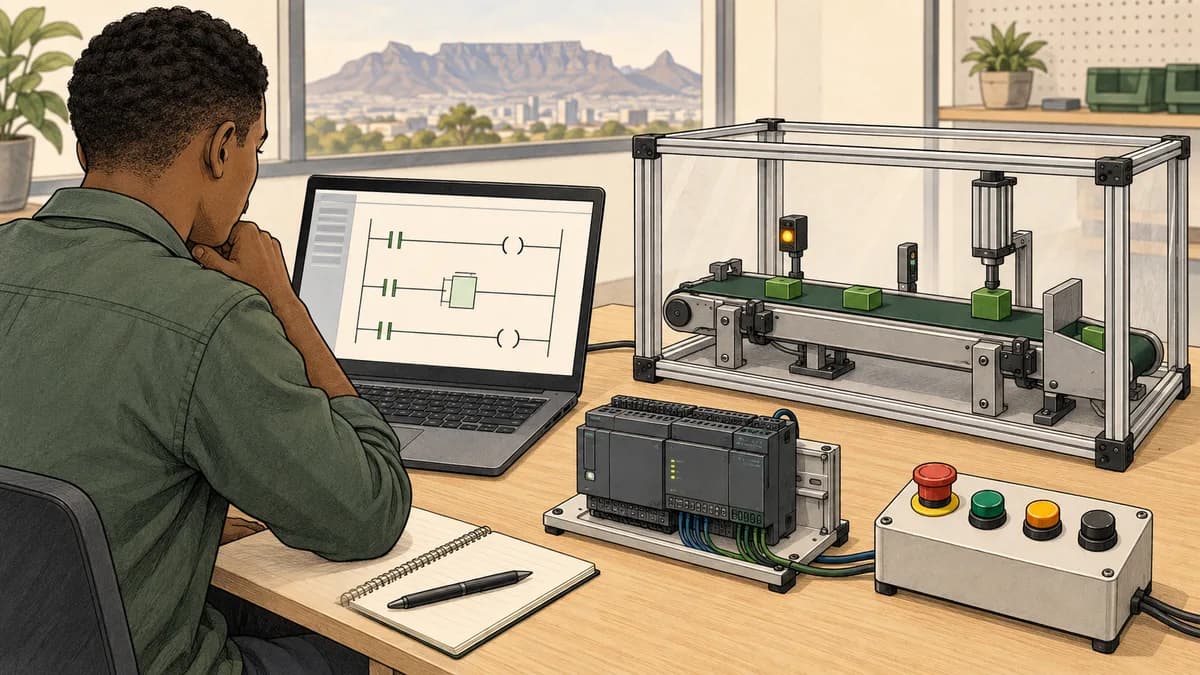
PLC programming courses in South Africa can help you learn to write control logic, diagnose faults and work towards a technical role. Choose a course by its prerequisites, controller platform, individual programming time, assessment and access to practice after the course. A completion certificate records attendance or achievement under that provider's rules; it does not automatically establish an accredited qualification or permission to work independently on industrial equipment.
This guide helps you compare classroom, online and simulator-based PLC training, plan a useful learning sequence and ask providers questions that reveal what you will actually do. Our PLC programming course overview explains the learning path offered through this site. For hands-on software practice, explore the beginner PLC browser demo.
Which PLC training route fits your goal?
Start with the outcome you need. A maintenance electrician who must interpret an existing program needs a different first course from a beginner who has never worked with a digital input. An instrumentation learner may need analogue scaling and process behaviour before advanced machine sequencing. An employer introducing a new controller family may need platform migration training rather than another general introduction.
| Your starting point | Useful first emphasis | Evidence to request |
|---|---|---|
| New to industrial control | Inputs, outputs, Boolean logic and scan behaviour | A small program you build and explain yourself |
| Electrical maintenance experience | Reading logic, permissives, diagnostics and restart behaviour | An assessed fault investigation with a written explanation |
| Instrumentation background | Scaling, alarms, trends and loop interaction | A process example with units and abnormal conditions |
| Existing PLC programmer | Target platform, project structure and diagnostics | A migration or commissioning exercise using the relevant software |
| Training manager | Baseline assessment and role-specific exercises | Individual results, trainer feedback and an agreed follow-up plan |
Use the industrial automation course guide if your goal spans controllers, drives, instrumentation and supervisory systems. The PLC technician training pathway focuses more closely on the maintenance and diagnostic responsibilities that surround programming.
What a PLC programming course should teach
A programmable logic controller reads inputs, executes a configured program and updates outputs. Real controllers also have tasks, communications, diagnostics and platform-specific execution rules. A beginner's scan-cycle model is useful, but it should develop into an understanding of the actual controller you will use.
Inputs, outputs and the meaning of a condition
You should be able to distinguish a physical device, an input channel, a program variable and a condition evaluated in logic. These are connected concepts, not interchangeable labels. A proximity sensor can detect an object while the program still interprets the situation incorrectly because the wrong address is used or the condition is inverted.
Ask for exercises where you predict the result before running the program. If a start input is true and a required permissive is false, explain why the run request remains false. Then change one condition and observe the result. This habit produces a testable explanation instead of trial-and-error editing.
Ladder logic, timers and counters
A useful introductory syllabus includes series and parallel conditions, output instructions, memory, edge detection, timers and counters. Instruction names and detailed behaviour differ between controller families, so a course should identify the platform used for every worked example.
A timer lesson should cover more than setting a delay. What starts timing? What resets the timer? What happens if the enabling condition disappears halfway through? Is elapsed time retained, and under which conditions? A counter exercise should explain whether the instruction counts transitions or a sustained condition. Repeatedly incrementing a value on every scan is a different operation from counting passing boxes.
Sequences and abnormal conditions
After individual instructions, build a process with named states. A simple training conveyor might wait for a start request, run until a simulated object arrives, pause for an inspection interval and then return to a ready state. Explain which conditions permit each transition and what happens when an expected signal never arrives.
A course becomes more useful when it asks about interruption. How does an operator cancel the sequence? Does a reset acknowledge a fault, restart the sequence, or both? Which values should persist? These are design questions that a copied rung cannot answer. Practise them in an educational simulation before transferring knowledge to supervised hardware work.

A practical learning sequence from beginner to independent practice
The following sequence is a planning framework, not a promise that everyone becomes competent in a fixed number of days. Progress depends on your starting knowledge, feedback and how much independent work you complete between lessons.
- Describe the process in plain language. Identify the inputs, outputs, normal operating states and conditions that prevent operation. Keep the example small enough to explain without a diagram.
- Create an input and output list. Give each signal a clear name and record whether it is simulated or connected to training hardware. Include the meaning of true and false where ambiguity is possible.
- Write the smallest working program. Implement one behaviour, predict the result and test it. Avoid combining several new instructions before you understand the first one.
- Add a timed or counted behaviour. Record its reset conditions and test short interruptions as well as normal completion.
- Introduce an abnormal condition. Use a simulated missing sensor or an impossible sequence of inputs. Explain the observation before changing the logic.
- Review restart behaviour. Test stopping, resetting and starting again. Record assumptions about initial state rather than relying on whatever values happen to remain in memory.
- Hand the project to another learner. Ask them to operate it from your instructions and explain one rung. Confusing names and missing assumptions usually become obvious here.
For a structured remote routine, use the online PLC training guide. Short, repeated sessions can fit around shifts, but they still need a defined exercise and a way to check the outcome. Watching several hours of demonstrations without writing a program does not provide the same evidence of understanding.
Online PLC training or a classroom course?
Online learning is useful when you need flexible study times, repeated access to examples or an affordable way to explore the subject before choosing hardware. Check whether the course includes individual feedback, access to the required software and exercises that you complete yourself. A collection of recordings and a live instructor-led course are both described as online training, but their support models differ substantially.
Classroom training can provide access to physical equipment, immediate questions and supervised practical work. Its value depends on what happens during the session. Ask how many learners share each workstation, whether everyone creates a project and whether the final exercise is assessed individually. Group observation of an instructor's demonstration is useful preparation, but it should not be confused with your own programming time.
Simulation and hardware practice develop overlapping but different skills. A learning simulator can help you reason about conditions, sequences and fault hypotheses. It does not reproduce every firmware feature, network configuration, electrical fault or commissioning procedure. Hardware training adds physical interfaces and platform-specific workflows, subject to the provider's equipment and supervision.
A sensible blended approach is to use simulation for preparation and repetition, then book a hardware course whose equipment matches your next task. That is an option to compare, not a universal rule that classroom training must come later. A learner with employer-funded access to a suitable practical course may benefit from starting there.

Choosing Siemens, Allen-Bradley or another controller platform
Choose a platform from evidence about your intended work. Ask your employer which controller families, programming environments and software versions are installed. If you are seeking a first role, review relevant vacancies and ask prospective training providers which platforms their practical exercises actually use. A broad claim that one brand dominates an entire province is not enough to justify a purchase.
Siemens PLC training is relevant when your target equipment uses Siemens controllers. Ask which CPU family and engineering environment the course covers, whether software access is included and whether the exercises use simulation, hardware or both. Learning general ladder logic is useful preparation, but it does not by itself teach the complete TIA Portal workflow.
Allen-Bradley PLC training should identify the controller and development environment rather than simply promising Rockwell exposure. A course on a different controller generation may still teach transferable concepts, but you should understand what additional learning your workplace platform requires.
The same questions apply to Mitsubishi, Omron and Delta. Compare addressing, instructions, project organisation, communications and diagnostic tools. Start with one platform deeply enough to build and explain a project, then compare how a second platform expresses the same behaviour. Memorising menu names across several products is less useful than understanding the control problem.
An educational simulator may offer familiar syntax styles without being a vendor emulator. Before subscribing, distinguish practice with a language dialect from opening a native vendor project, running the original firmware or connecting to an industrial controller. Use the PLC simulator comparison guide to make that distinction explicit.
For primary-source descriptions, consult Siemens SIMATIC and TIA Portal training and Rockwell Automation certificate programmes. Siemens describes virtual, training-centre and company-based learning formats; Rockwell sets out distinct certificate pathways. Confirm regional availability and prerequisites with the provider before treating an international programme description as a local booking offer.
How to compare course fees and the total cost of learning
A quoted course fee is only one part of the decision. Ask whether VAT, software licences, practical equipment, assessments, materials and continued access are included. For in-person training, add transport, accommodation where necessary and time away from work. For remote training, check computer requirements and whether sessions are live at times you can attend.
Compare the same unit of value. A five-day workshop, a series of individual online lessons and a self-paced subscription have different cost structures. Dividing price by advertised hours is a starting point, but it does not reveal how much individual practice or feedback you receive. Ask for a sample exercise and the assessment criteria before committing.
Use a simple written comparison with these fields: total payable amount, controller platform, individual practical hours, software access duration, support, assessment method and evidence awarded. Leave a field blank when the provider has not answered it. A missing answer is a follow-up question, not an assumption that the item is included.
For a more detailed comparison, read PLC course prices and buying questions in South Africa. If considering our learning software, check the current PLC simulator plans and included features directly. Prices are presented by the product site; currency conversion and payment-provider charges can affect the final rand amount.
If you are planning study after school or technical college, compare PLC training after N3 with the matric and PLC course entry guide. Electricians can use the electrical trade upskilling plan and electrician-to-control-engineer pathway to distinguish practical development from further education and professional registration.
For a later career decision, the contracting versus permanent employment guide examines cash-flow assumptions, while the South African versus overseas automation career comparison provides a broader decision worksheet. Neither decision should rest on a course provider's earnings promise.
Certificates, accreditation and entry requirements
Ask exactly what is awarded. An attendance certificate, a provider's assessed completion certificate, professional development recognition and a registered qualification are different things. A provider should be able to identify the awarding body, qualification or programme reference where applicable, assessment requirements and the scope of any claimed approval.
Do not infer that a course is accredited because it teaches a recognised controller brand or uses the word certification. Equally, a short course can still be useful for a specific skill without being a full qualification. Judge the claim accurately and match it to the outcome you need. If an employer requires a particular credential, obtain that requirement before choosing training.
Entry requirements also vary. Some introductory programming courses accept complete beginners; hardware-focused courses may expect electrical knowledge or prior technical study. Tell the provider what you have actually done: read circuit diagrams, used a multimeter under supervision, programmed another language, completed relevant subjects or maintained machinery. This is more informative than describing yourself only as a beginner.
If you have N3, N4 or another technical background, request a syllabus comparison rather than assuming automatic entry or credit. For a longer educational route, compare the mechatronics study pathway and instrumentation training options with the requirements published by the relevant institution. PLC practice can complement those routes without replacing their formal practical and assessment components.

Finding relevant training across South Africa
For Johannesburg, Pretoria and the wider Gauteng area, compare travel time with the actual number of supervised practical sessions. A nearby provider is valuable when it offers the platform and feedback you need; proximity alone does not establish course quality. Ask whether the advertised city refers to a permanent venue, scheduled rented classroom or online service area.
For Durban, Cape Town, Gqeberha and other centres, the same principle applies. Confirm dates and venue before arranging transport or accommodation. If local hardware options are limited, ask whether an online theory component can be combined with a clearly scheduled practical block. Do not assume a training website has a local campus merely because a city appears in its page title.
Learners in smaller towns can begin with software practice while investigating regional providers, colleges or employer-supported training. Plan around a suitable computer, reliable access to the course material and any live-session requirements. Ask about recordings, download access and what happens if you miss a session; these arrangements should come from the provider rather than from a general training guide.
Employers should specify the site equipment and the role being trained. A packaging maintenance team, a water-process operator and a new controls engineer may share introductory concepts but require different examples and assessment. Our training-centre guide explains how to organise repeated software practice around instructor-led teaching.
What good PLC fault-finding training looks like
Fault finding begins with a clear expected behaviour. In a simulated conveyor exercise, suppose the conveyor should run only after a start request and a valid process permissive. The simulated output remains false. Before changing the program, record the start input, permissive state, internal run request and final output condition. That separates an absent request from a blocked request and from a later condition that prevents the output.
Next, formulate one hypothesis. Perhaps the program references a different sensor variable from the one being changed in the exercise. Check the mapping and repeat the same test after correcting it. Changing several conditions simultaneously makes it difficult to know which observation supports the explanation.
Finally, test a second case that could disprove your conclusion. If the corrected mapping works only while a temporary value is manually held true, the original fault may not be resolved. In an educational simulator, deliberately explore these cases and record what happened. Work on real equipment requires the site's authorised procedures, competent supervision and an understanding of the consequences of changes.
A useful assessment rewards evidence and reasoning as well as a working result. Ask whether learners submit observations, an explanation and a repeatable test. The PLC troubleshooting guide develops this approach, while communication troubleshooting covers situations where data exchange adds another layer to the investigation.

Build a portfolio that demonstrates what you learned
Keep the PLC programming cheat sheet available as a reference while practising, then explain the program in your own words.
Keep a small number of clearly explained projects. For each one, include a process description, signal list, program version, normal test cases, abnormal test cases and a short account of a mistake you corrected. Screenshots can support the explanation, but a screenshot of a working rung does not establish how you tested it.
A beginner's portfolio might contain a start-stop exercise, a timed sequence and a counted-batch example. Extend one project by adding an alarm or an interruption condition instead of collecting many nearly identical programs. State whether each project used an educational simulator, vendor simulation software or supervised training hardware.
Separate your own work from supplied examples. Credit the starting exercise and explain your modifications. Remove employer-specific information unless you have permission to share it. A fictional training process can demonstrate your reasoning without exposing plant configuration or confidential material.
Use your portfolio to guide the next course purchase. If you can build normal sequences but struggle to diagnose unexpected behaviour, seek assessed troubleshooting. If your logic is sound but you have never configured a real controller, seek supervised platform-specific practical work. The next step should address an observed gap.

Questions learners ask before choosing a PLC course
What should PLC programming classes include?
Ask for individual programming time, a tutor's review of your reasoning and an exercise you must diagnose without copying the demonstration. For evening or weekend classes, confirm how you can practise between sessions and get feedback on a failed test. Compare those arrangements with the online and classroom options above; a timetable alone does not show the depth of learning.
Can I learn PLC programming without owning a PLC?
Yes, you can practise many programming concepts in a suitable simulator. Check which instructions and process behaviours it supports and whether exercises provide feedback. Physical wiring, real communications and platform commissioning require additional learning; a software-only project should be described accurately when presenting your experience.
Which PLC course is best for a beginner in South Africa?
Choose one that states its prerequisites, gives you individual programming tasks and assesses a project you can explain. The best fit depends on your goal, access to feedback and target equipment. Ask for the first practical exercise and the final assessment rather than selecting solely from a brand name or certificate image.
Can an electrician move into PLC maintenance through a short course?
A short course can develop useful logic-reading and diagnostic skills, particularly when it builds on existing electrical knowledge. It does not establish every competence needed for independent plant work. Agree with your employer which tasks you may perform and what supervised practice or further training is required.
Should I learn PLC and SCADA together?
Begin with enough PLC knowledge to understand where values and commands originate. Then add supervisory tags, displays, alarms and trends. A combined course can work if it gives each part sufficient practical attention. Read the SCADA learning guide to compare that scope with a controller-only introduction.
How long does it take to become confident?
There is no reliable universal duration. Track milestones instead: explain a rung, create a sequence from a written requirement, test abnormal conditions and diagnose an unfamiliar simulated fault. A course timetable describes scheduled instruction; confidence needs repeated work and feedback beyond the timetable.
What should I ask before paying a deposit?
Request the exact platform, dates, delivery format, total price, refund or rescheduling terms, software requirements and assessment method in writing. Confirm how much independent practice is included and what evidence you receive. If accreditation matters, verify the precise claim with the relevant awarding or recognising body.
Start with one exercise and a clear next step
Write a short learning brief: your current experience, intended role, target controller if known, available study time and one practical outcome. Use it when comparing providers. Then complete a small exercise and identify where you need help: interpreting conditions, using instructions, testing behaviour or navigating a particular platform.
You can explore the simulator curriculum and compare the available learning tools with that brief. For the broader sequence, return to the PLC programming course pathway. Choose the next lesson because it helps you solve a specific control problem and explain the result.