plc-training-online · South Africa
PLC Course Online: Practical Training for SA Learners
Choose a PLC course online in South Africa with useful exercises, tutor feedback and clear software requirements. Compare formats, costs and study plans.
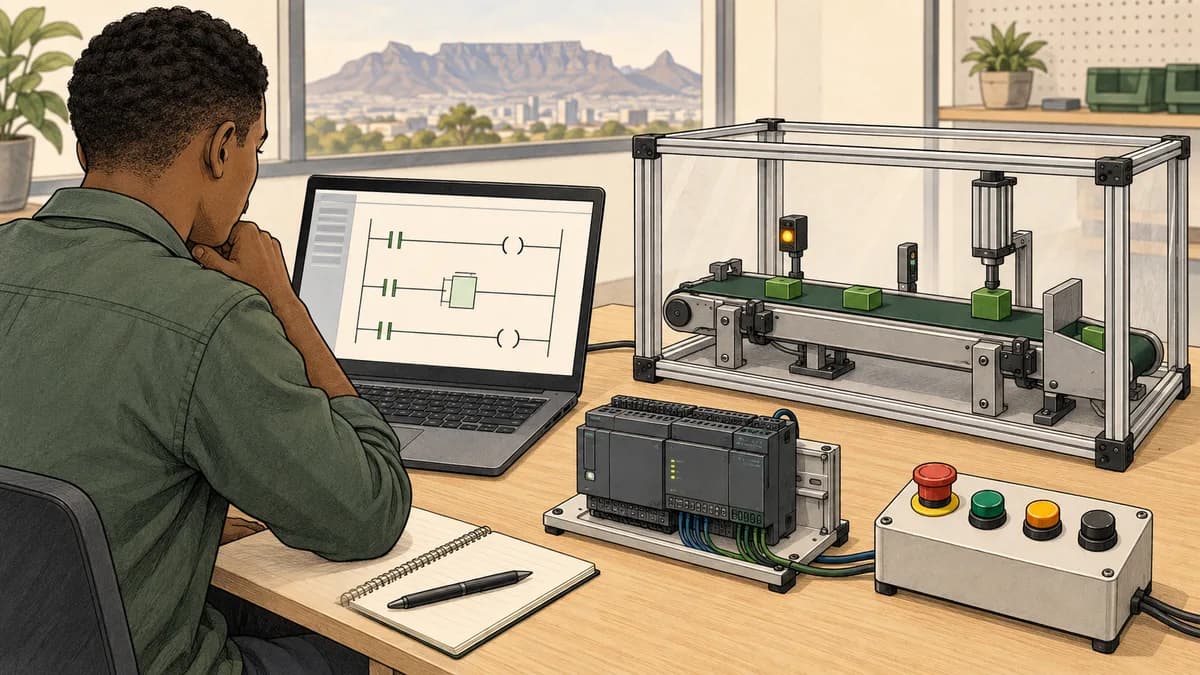
A PLC course online can help you learn to read, write and test control logic without owning a physical controller. Choose a course that makes you attempt exercises, inspect results and explain mistakes. Check separately whether it teaches a particular vendor's engineering software, gives access to remote equipment or provides live tuition. Those capabilities are not implied by the word “online”.
For South African learners, the main choices are live online teaching, recorded lessons with exercises, vendor learning services and interactive simulator practice. Each can contribute to a useful study plan. The right combination depends on your starting knowledge, equipment requirements, schedule and need for feedback. Physical wiring, measurement and workplace commissioning require additional practical learning appropriate to the task.
This site is commercially connected to PLC Simulator. You can inspect its guided PLC curriculum as one practice option. This guide also explains how to evaluate other formats and where an educational simulation's scope ends.
What does “online PLC training” actually mean?
Start by asking how the teaching is delivered and what the learner does. A video library, a live class and a remote connection to a training rig can all be advertised as online courses while offering very different experiences. Request a sample activity before assuming that their syllabuses or certificates are comparable.
| Format | What to investigate | A useful question before enrolling |
|---|---|---|
| Live individual or group teaching | Schedule, class size, practical environment and feedback | Will the instructor review my own project during the session? |
| Recorded course | Exercise files, software requirements and support | Can I attempt the task before viewing a worked solution? |
| Vendor learning service | Exact product family, course prerequisites and available delivery modes | Does this module cover the engineering environment used at my workplace? |
| Interactive educational simulator | Supported instructions, execution model, feedback and saved work | What does the exercise test, and which hardware behaviours are outside its model? |
| Remote hardware lab | Booking, equipment, access method and supervision | What can each learner do on the rig, and what happens if the connection fails? |
For a named South African example, School of IT's PLC course advertises individual live online teaching. Siemens lists its regional training contacts through SITRAIN's regional directory, including South Africa. Confirm the particular offer, availability and practical access directly; a provider's broader catalogue does not establish the scope of every module.
This page focuses on choosing and using remote learning. For the wider decision between course levels, brands and practical pathways, start with the South African PLC training guide. If your goal spans instrumentation, drives, HMI or robotics, compare the scope against the industrial automation course guide as well.

What a beginner curriculum should let you demonstrate
A useful beginner course moves from simple observations to small programs that you can explain. It should not require you to accept a large finished project as proof that you understand the underlying logic. Ask for the learning sequence and a representative assessment from near the beginning and end.
First, you should be able to explain a Boolean input, an output condition and the difference between a program variable and a physical device. An input named StartRequest is a logical value in an exercise. Its name alone does not specify electrical wiring, contact hardware or a safety function.
Next, you should read a short logic expression and predict its result for several input combinations. The ladder logic foundations lesson includes a virtual example with explicit assumptions. A course should make those assumptions visible instead of relying on a familiar-looking diagram to imply unspecified behaviour.
Then introduce state: a previous output value, a timer's elapsed value or a counter's stored count. Ask how the exercise starts, what happens when it resets and how simultaneous conditions are handled. These questions reveal misunderstandings that may remain hidden when you only test the expected normal sequence.
Finally, practise a small fault investigation. Identify what was expected, what was observed and which evidence would distinguish two plausible explanations. A strong answer may be “I cannot yet tell from this information.” That is more useful than changing several things until the display happens to look right.
A sample lesson you can use to evaluate a course
Use this fictional software-only task as a course-selection exercise: a virtual indicator should turn on exactly when both StudyEnabled and SamplePresent are true. There is no retained state, no physical output and no timer. At every evaluation, the indicator is assigned the result of StudyEnabled AND SamplePresent.
| StudyEnabled | SamplePresent | Expected indicator |
|---|---|---|
| False | False | False |
| False | True | False |
| True | False | False |
| True | True | True |
Before running anything, write the expected results. Implement the condition in the learning environment, test each combination and record the observed value. If your answer differs, identify whether you entered the wrong input, used the wrong operation or misunderstood the display. Change one relevant thing and repeat the case.
Now modify the brief: the indicator should turn on when either input is true. Predict which rows change before editing the program. The middle two rows become true; the first remains false and the last remains true. This small variation checks whether you understand the condition rather than remember the appearance of one solution.
For a further question, ask what happens if SamplePresent stops updating. The original Boolean exercise contains no freshness information, so its two variables cannot distinguish a current true value from a stale one. You would need an expanded brief and additional information. A good instructor or course should acknowledge that limitation rather than pretend the truth table diagnoses a communication failure.
This task is deliberately modest. A course demonstration does not have to be complicated to reveal whether the interface, explanation and feedback suit you. You can explore a more contextual exercise through PLC Simulator's motor-control learning preview, while retaining the distinction between an educational model and physical equipment.

Simulation scope: what transfers and what must be checked
Logic reasoning can transfer between learning environments, but a program that works in one simulator is not automatically a validated project for a physical controller. Instruction details, task scheduling, data types, retained values and communications depend on the implementation and configuration. Learn the common ideas, then verify the target system's actual behaviour.
The scan-cycle explanation is a useful companion when a lesson refers to a scan or evaluation step. Ask whether the simulator updates inputs at a defined point, how it evaluates program order and what its displayed values represent. If the course uses a simplified model, that can be educationally useful as long as the simplification is explicit.
For timers and counters, confirm the named instruction, time units, reset behaviour and conditions under which state changes. A timer demonstration in one tool should not become a blanket claim about every vendor's instruction. Use the relevant vendor documentation when moving to a native engineering environment.
The same applies to wiring illustrations. A virtual connection can support learning about signal paths, but it does not validate a physical terminal assignment, protective arrangement or measurement procedure. Use the equipment documentation and supervised training for actual work. Do not treat a successful browser exercise as permission to modify a plant.
The product's PLC dialect learning overview can help you understand its educational language coverage. It does not turn the browser into every vendor's native development package or guarantee that a project can be downloaded to a matching controller.
Should you learn Siemens, Allen-Bradley or general logic first?
If an employer has named a controller family and engineering software, make that requirement part of your course selection. A general introduction may still help you prepare, but confirm where you will learn the actual project workflow. Ask about software version, supported hardware and the practical tasks included.
If you have no target platform yet, begin with concepts you can demonstrate in a suitable learning environment: Boolean conditions, state changes, timers, counters and small sequences. Keep a note of which behaviours are assumptions of that environment. Later, compare those assumptions with the platform you choose.
Our Siemens training guide and Mitsubishi PLC learning guide explain different platform questions. Use a specific employer requirement or a current job description to inform your next step. Do not infer a whole city's installed controller base from a few advertisements or an unsupported market-share claim.
A useful vendor-transition exercise is to take one small task you already understand and reproduce it in the new environment. Document the variable declarations, instruction choice, initial state and test results. If the result differs, investigate the documented behaviour instead of assuming the new tool is wrong because the old example looked familiar.
A flexible study plan for a working learner
The following four-stage plan is a suggested structure, not a promise that every learner reaches a particular standard in four weeks. Move on when you can explain and repeat the task. Your available time, starting knowledge and access to feedback determine the pace.
In the first stage, set up access and complete a simple input-to-output exercise. Learn how to start, stop and reset the software example. Keep a short note of the controls you used and any account or device requirements. Resolve basic access problems before paying for a long commitment.
In the second stage, practise combinations and a small stateful task. Predict each result, test it and explain the difference between current inputs and stored state. Return to one task without opening the previous solution. This gives you evidence about what you can reproduce independently.
In the third stage, introduce one timer or counter using the tool's documented instruction. Test the boundary condition, reset and an interrupted sequence. Keep the brief small enough that you can identify why a result changed. Several unrelated instructions in one copied project make errors harder to interpret.
In the fourth stage, write a new brief, implement it and ask someone to review the evidence. If no instructor is available, use documented exercise checks and retain questions for later feedback. Independent practice can reveal a gap, but an automated pass does not necessarily explain every assumption you made.
For a shift worker, reserve short predictable study sessions and one review slot rather than assume every evening will be free. A self-paced system may help with irregular hours; live instruction may provide useful accountability. Ask how a course handles missed sessions, extensions and support across time zones.
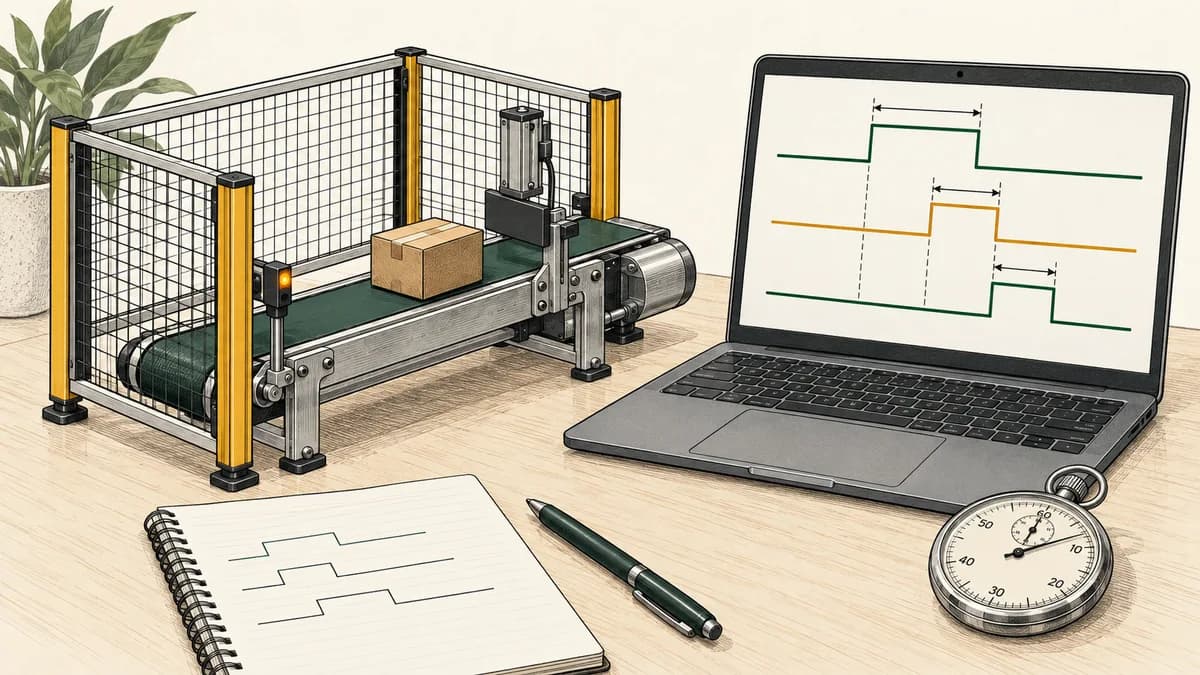
Device, internet and access checks for South Africa
Test the actual learning environment on the device and connection you intend to use. A page loading successfully on a phone does not establish that a diagram editor is comfortable there. Check whether the provider requires a laptop, a particular operating system, a browser version or locally installed engineering software.
If you use an employer's computer, confirm installation and account permissions through the appropriate company process. A native engineering package may have different requirements from a browser lesson. Do not arrange training around an installation you have not confirmed can be completed.
Data use varies with video, remote desktop, asset downloads and interactive content. This guide does not supply an unmeasured megabyte-per-hour estimate. Try a representative session and inspect your own data usage if you need a capped-data budget. Check whether recordings have lower-resolution options or materials can be downloaded lawfully for later reading.
For live teaching, ask which time zone the timetable uses and how connection interruptions are handled. Learners joining from Johannesburg, Cape Town, Durban or another South African location should still confirm the stated session time, particularly with an overseas provider. A calendar invitation is more reliable than assuming that “evening” refers to your local evening.
For self-paced exercises, find out what happens to unsaved work if a session closes. Practise saving or exporting a small project where the product supports it. A downloadable handbook is not the same as an offline simulator; check those capabilities separately if connectivity is a deciding factor.
Feedback and assessment: what to look for
Feedback should help you decide what to investigate next. “Incorrect” is less useful than a result showing that the output remained true after a specified input changed. Ask whether the course explains the test conditions and whether you can repeat a failed case after making a change.
Automated checks are valuable for defined behaviours, but their scope matters. Passing a finite test set does not prove that a program handles every possible state or is suitable for a real installation. Keep the written task and assumptions alongside the result. If an important case is absent, add it to your learning review rather than treating the score as a universal approval.
Human feedback can address your explanation, debugging approach and unresolved questions. Ask whether tutor support reviews your own work, answers general questions or only discusses the supplied solution. Also confirm expected response arrangements; do not assume an on-demand instructor is included in a self-paced subscription.
The fault-finding workflow guide offers a structure for recording observations and hypotheses. Use it to improve the explanation attached to an exercise. A portfolio becomes more informative when it shows the original brief, a failed test, the reasoning behind a correction and a repeatable result.
Fees, subscriptions and course completion records
Compare the complete learning purchase. Live teaching may be quoted for a block of hours; a recorded course may provide time-limited access; a subscription may renew monthly or annually. Include any required software and practical access before deciding which headline amount is lower.
The PLC course price and budgeting guide provides named published examples and fictional total-cost calculations. For this product, check current PLC Simulator pricing. Confirm billing currency, period, checkout taxes and the plan containing the exercises you need. A displayed annual-plan monthly equivalent should not be mistaken for monthly billing.
Ask what happens after the teaching period ends. Can you revisit lessons, keep your own project files or access feedback? Does ongoing practice require renewal? These questions affect a learner who intends to study between shifts or return to a topic several months later.
A completion record describes a particular learning activity. Ask who issues it, what assessment it represents and whether the organisation requesting evidence accepts it. This site's associated simulator is an educational practice product; do not describe its completion records as a South African formal qualification or as proof of authorisation to work on machinery.

Questions about learning PLC programming online
Can a complete beginner take a PLC course online?
Yes, if the course teaches the required foundations and provides a usable practice environment. Request its prerequisites and a sample lesson. Start with a small condition you can predict and test. If the opening material assumes electrical drawings or a particular engineering package, arrange that preparation before starting the main course.
How long does it take to learn PLC programming remotely?
There is no single reliable duration for every learner and role. Define a first outcome, such as explaining and testing a small ladder routine, then review your progress against that task. Writing a simple exercise, navigating a vendor package and diagnosing workplace equipment are different milestones with different practical requirements.
Can I study part-time while working shifts?
A self-paced format can fit irregular availability, while a scheduled live course requires agreed attendance. Ask about access expiry, missed sessions and tutor availability. Plan time for both attempts and review; watching lessons during spare moments may not provide the uninterrupted attention needed to test your own project.
Is an online PLC certificate enough to get a job?
A certificate alone does not establish that you meet a particular role's requirements. Read the vacancy and ask what evidence is relevant. A clear project explanation can support a discussion of your learning, but experience, qualifications and supervised practical skills may also be required. This guide does not promise employment from course completion.
Can I learn without installing TIA Portal or Studio 5000?
You can begin general logic exercises in a suitable browser environment. If your objective includes using a named vendor's engineering workflow, you will need appropriate access to that environment later. Check the course's software requirements and licensing arrangements rather than assuming an educational simulator includes the native package.
Should I combine videos with a simulator?
That can be useful when the video explains a task and you then attempt it independently. Pause before the solution, predict the result and test your own work. Confirm that the instructions and behaviour shown are supported by your chosen environment. Record differences instead of silently copying an incompatible example.
Does remote training cover instrumentation and SCADA too?
Only if the specific course includes those topics at the depth you need. A PLC introduction may mention analogue inputs or HMI screens without providing a full instrumentation or supervisory-control course. Compare the syllabus with the SCADA learning guide and choose additional practical topics deliberately.
Can a training centre use online practice between classes?
Yes, where the product's access, reporting and lesson scope suit the programme. Trial it with a small representative task and review learner evidence before adopting it more broadly. The training-centre guide explains how to connect software exercises with teaching and practical assessment without overstating what progress records prove.

Choose your next learning step
Write down the task you want to perform, the environment you need and the evidence that would show progress. Compare courses against those three items. Use a sample lesson to check access and feedback, and clarify software, payment and completion terms before enrolling.
Then complete one small exercise and explain it in your own words. Retain the starting assumptions, test cases and any unresolved question. That record gives an instructor something specific to review and gives you a more useful next step than simply collecting another course certificate.