brands · South Africa
Allen-Bradley PLC Training: Studio 5000 and Course Choice
Choose Allen-Bradley PLC training in South Africa by controller, software and practical task. Compare course paths, simulation and the evidence to retain.
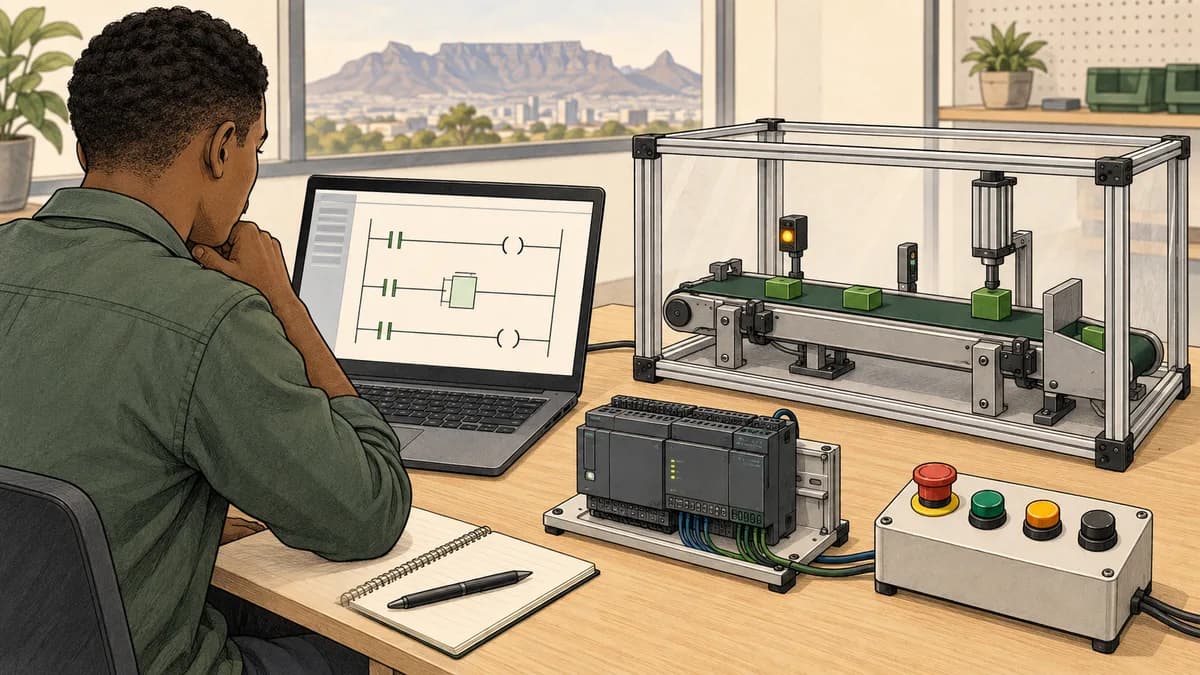
Allen-Bradley PLC training should start with the controller family and task you need to learn. A course on CompactLogix or ControlLogix programming is different from a Micro800 course, and a maintenance course is different from a project-development course. Ask for the engineering software, controller generation, prerequisites and practical assessment before comparing prices or certificates.
For South African learners, the useful decision is whether you need general control-logic practice, a particular Rockwell engineering workflow or supervised work on installed equipment. A city or industry name alone does not tell you which platform an employer uses. Request the equipment details or read the specific vacancy and project requirements.
This site is commercially connected to PLC Simulator and is not an official Rockwell training provider. Its Allen-Bradley-style learning dialect offers educational instruction practice. It does not replace Studio 5000, reproduce every controller behaviour or provide a native project you can assume is ready for download.
Identify the controller before choosing the course
The Allen-Bradley name covers multiple controller families and engineering environments. Write down the actual catalogue number and firmware revision where these are available through your authorised workplace records. Avoid buying a course based only on a photograph of the brand logo.
| Learning target | Main question for the provider | Evidence to request |
|---|---|---|
| CompactLogix or ControlLogix project work | Which controller and Studio 5000 Logix Designer version are used? | A syllabus naming project structure, tags, programming and testing tasks |
| Micro800 programming | Which supported software and controller revision does the course use? | Exact environment, project exercises and compatibility requirements |
| Existing MicroLogix or SLC installation | Does the course address the actual installed platform and software? | Relevant maintenance and documentation scope, without assuming Logix examples apply unchanged |
| HMI or supervisory work | Which HMI product and controller interface are included? | Tag, communication and display exercises for the named environment |
| Drive or network diagnostics | Which devices and diagnostic tools are used? | A bounded practical task and its prerequisites |
Rockwell's Micro800 family selection guide documents Connected Components Workbench in that ecosystem. Rockwell also publishes a FactoryTalk Design Workbench getting-started guide for Micro800 development. This is why a training enquiry should name the actual environment and revision rather than assume that every Allen-Bradley controller uses Studio 5000.
For supported operating systems, firmware and software combinations, consult Rockwell's Product Compatibility and Download Center. The newest available software is not automatically the correct choice for an existing project. Confirm the target combination before installing software or arranging a training session.
Choose a training outcome: maintenance or development
A maintenance learner may need to navigate an existing project, locate a tag, interpret a diagnostic condition and explain the evidence behind a fault hypothesis. A developer may need to organise a new project, define interfaces, implement a sequence and test behaviour against a requirement. Those outcomes overlap but are not identical.
Ask a maintenance provider how learners distinguish commanded state from observed feedback. A command to run does not prove a motor is running. A displayed value does not prove it is current. A course should teach how to identify what each piece of information means and what further evidence is needed.
For development, ask whether you create a bounded task independently or mainly follow a completed example. Request a test case that changes an input unexpectedly, a reset condition and a documented initial state. A project that works only when started in the instructor's preferred sequence gives limited evidence of understanding.
The South African PLC training guide can help you specify the broader level. If the task also includes instrumentation, drives and networking, compare the industrial automation course pathway so that the PLC module is placed within the actual learning requirement.

Official Rockwell training and certificate information
Rockwell's certificate programme page, checked on 11 September 2026, lists defined training paths and course codes. One listed foundation course is CCP146, Studio 5000 Logix Designer Level 1: ControlLogix System Fundamentals, shown as two days. Use the current path and course descriptions to identify the module relevant to your goal.
A course code is more useful in an enquiry than “Allen-Bradley advanced certificate”. Ask the provider for the exact title, prerequisites, assessment and document issued. Confirm any official delivery or partner claim directly through the relevant Rockwell channel. This guide does not invent alternative credential names or certify a provider's authorisation.
For a South African quotation, request the specific delivery location, timetable, complete payable fee, software access and equipment allocation. Confirm whether the published course duration means scheduled teaching days and how much independent practical time each learner receives. An international catalogue entry is not a confirmed local seat or a rand quotation.
A course completion record, a vendor certificate path and a formal South African qualification serve different purposes. Ask the employer or institution requesting evidence what it accepts. Do not assume an expensive certificate carries a particular hiring advantage, or that a software subscription satisfies an occupational programme's requirements.
Studio 5000 learning: navigate the project before editing it
For a Logix course, learn how the project is organised before focusing on a large instruction library. You should be able to identify tasks, programs, routines and relevant tags, then explain where a small piece of logic is executed. A variable's name is not enough to establish its meaning or update behaviour.
Ask the instructor to show a small example with a clear execution context. When does the task run? Which routine contains the logic? What information is read, and where is the result written? If a value is changed elsewhere, how do you find that use? These questions make a project easier to reason about than simply memorising toolbar locations.
Treat online work and project transfers as separate practical topics requiring the appropriate environment and authorisation. The words upload, download and online edit should have a clear meaning in the course. Do not use a general learning article as a procedure for changing a running production controller.
For study records, retain the project version, test brief and relevant observations. If an exercise uses an export format, ask what is included and how it is intended to be imported. Do not assume a text export is interchangeable with every property of the native project. Keep workplace files confidential and use neutral training projects for public portfolios.
Tags, scope and reusable structures
A meaningful tag name can make a program easier to read, but it does not guarantee correct behaviour. Define the tag's type, scope, source and purpose. For example, distinguish a request from feedback and a current observation from a retained status. A name such as MotorReady is incomplete unless the surrounding requirement explains what “ready” means.
Controller and program scope affect how data is organised and accessed. A beginner should be able to locate the intended tag and explain the scope used in the exercise. Avoid treating every similarly named tag as the same value. The Logix tag-scope guide is the dedicated follow-up topic.
User-defined types can group related information, while Add-On Instructions can encapsulate reusable behaviour. They solve different organisational questions. Grouping fields does not define a complete equipment-control policy, and wrapping a routine does not automatically make it reusable without clear parameters, state and tests.
Use the Studio 5000 Add-On Instruction guide when your next task involves a reusable instruction. Ask how two instances retain separate state and how changes to a definition are reviewed. Start with a small example whose behaviour you can explain before building a broad library.
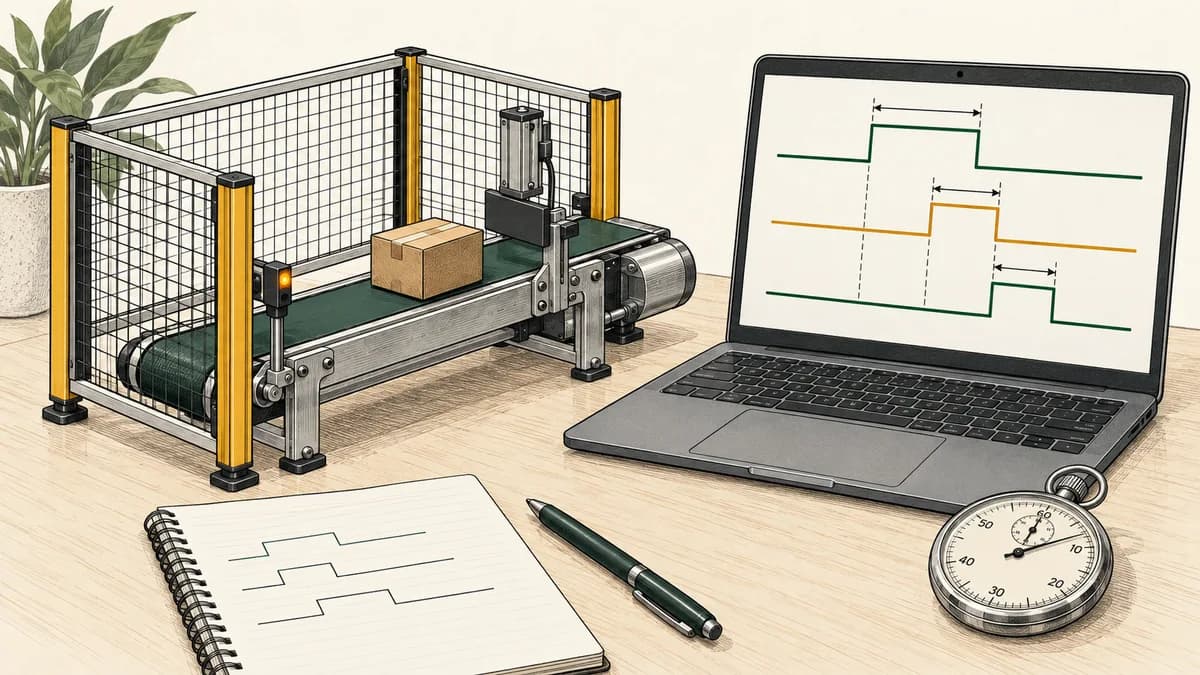
A worked diagnostic exercise: command and feedback disagree
This fictional software-only example tests reasoning about elapsed time and observations. It does not control a motor, define a safety function or reproduce a particular Logix timer instruction. Assume the software evaluates once every 100 milliseconds, starting with elapsed time zero and a false warning.
The brief is: while RunRequest is true and RunningFeedback is false, accumulate the evaluation interval. Otherwise reset elapsed time to zero. After updating elapsed time, set Warning true when elapsed time is at least 300 milliseconds. Warning is not latched; it clears whenever the elapsed time resets. All values are invented for the exercise.
| Evaluation | RunRequest | RunningFeedback | Elapsed after evaluation | Warning |
|---|---|---|---|---|
| 1 | False | False | 0 ms | False |
| 2 | True | False | 100 ms | False |
| 3 | True | False | 200 ms | False |
| 4 | True | False | 300 ms | True |
| 5 | True | True | 0 ms | False |
| 6 | True | False | 100 ms | False |
| 7 | False | False | 0 ms | False |
The warning first becomes true on evaluation four. When feedback becomes true, the elapsed value resets and the warning clears. When feedback becomes false again, accumulation begins from zero. If your result warns immediately on evaluation six, investigate whether you retained time contrary to the brief.
Now ask what the warning proves. It proves only that the model observed the stated disagreement for its defined evaluations. It does not identify a failed motor, contactor, sensor, network or power supply. Those are possible topics for a separate evidence-based investigation, and the model contains no physical measurements to distinguish them.
Also ask what happens if the feedback value stops updating while remaining true. This brief contains no freshness flag or timestamp, so it cannot identify that failure. A course should help you recognise missing information rather than claim that a plausible feedback bit proves the equipment is healthy.
The 100-millisecond evaluation interval and 300-millisecond threshold are teaching assumptions. Do not apply them as plant settings. In a native controller exercise, verify task scheduling, timer behaviour, initial state and diagnostic requirements using the relevant documentation. The timer and counter learning guide provides a related conceptual topic.
What an emulator or simulator adds
An educational simulator can make it convenient to practise supported instructions and repeat a small task. A vendor emulation product addresses a different engineering environment. Compare the actual controller models, software revisions, supported behaviours and licensing conditions instead of treating all products called “simulator” as equivalent.
Rockwell's FactoryTalk Logix Echo product information describes controller emulation and integration with simulation environments. Check the supported controller and version for your intended project. Do not assume a trial is a permanent free tier or that every controller feature is available in every licence.
For our associated product, inspect the Allen-Bradley-style learning dialect and guided curriculum. Treat them as preparation and repetition within the documented educational model. They do not provide Studio 5000 software, an ACD-file compatibility guarantee or controller firmware.
A useful transition task is to take a small requirement you understand, recreate it in the authorised vendor environment and compare the observed results. Record differences rather than assuming the browser's behaviour must be the target controller's behaviour. Hardware configuration, electrical interfaces and commissioning require further practical work.

HMI, networks and drives: define the boundary of the PLC course
A broad course title may mention FactoryTalk, EtherNet/IP, PowerFlex drives or distributed I/O. Ask which product and task those terms refer to. An overview slide is different from an independently completed configuration or diagnostic exercise.
For an HMI lesson, ask how the display connects to the intended controller information and how communication or data-quality problems are represented. The FactoryTalk View tag-binding guide is a focused follow-up. A screen showing the expected number does not by itself establish that the data source, update behaviour and operator meaning are correct.
For networks, request the devices, addressing context and diagnostic evidence used in the practical task. A communication issue should not automatically be treated as a logic error. The industrial networking training guide helps separate protocol study from controller programming.
For drives, identify the actual drive family and interface. Do not assume every PowerFlex model has the same built-in network features or configuration workflow. The variable-speed drive training guide explains how to ask about control mode, feedback and supervised practical scope.
Planning attendance in South Africa
Learners searching in Johannesburg, Pretoria, Cape Town, Durban, Gqeberha or Bloemfontein should confirm the venue for the specific intake. A national provider website does not establish that a particular course runs in every city. Ask whether teaching is in person, live online or self-paced and where any hardware assessment occurs.
For travel, obtain the actual dates and daily timetable before booking accommodation. For remote learning, test the required software and connection on the device you intend to use. Confirm installation permissions if you rely on a company laptop. A video-call connection is not the same requirement as a native engineering package or remote lab.
The course-price and budgeting guide provides a way to itemise tuition, travel and access costs. Its named general PLC examples should not be presented as official Rockwell prices. Request a quotation for the exact course and compare the complete payable amount with its practical scope.

Use the local enquiry guide that fits your travel plans: Allen-Bradley training in Johannesburg, Pretoria or Bloemfontein. For coastal options, compare Cape Town Allen-Bradley training, Durban and Port Elizabeth–Gqeberha. Confirm the current provider, venue and platform before arranging attendance.
If the controller family is unresolved, the CompactLogix, ControlLogix and MicroLogix comparison explains why similarly branded controllers can require different software and learning routes.
Questions about Allen-Bradley PLC training
Should I learn CompactLogix or ControlLogix first?
Choose the equipment relevant to your intended work and the course's prerequisites. Both names cover multiple generations, so ask for the exact controller and engineering environment. The CompactLogix and ControlLogix comparison helps organise the selection questions without assuming one platform suits every project.
Is Micro800 training the same as Studio 5000 training?
No. Identify the software and controller supported by the particular course. Connected Components Workbench and FactoryTalk Design Workbench are relevant Micro800 environments, while Logix training has its own engineering workflow. Shared logic concepts do not make project files, instructions or configuration procedures interchangeable.
Can I start without buying Rockwell software?
You can begin general logic study and suitable educational exercises without purchasing a native engineering licence. If your goal includes a particular Rockwell workflow, arrange legitimate access to the required software through an appropriate course or licence. Check trial conditions and compatibility before relying on them for a study plan.
Is the latest Studio 5000 version always the best training choice?
The useful version is one that supports the intended controller, firmware and learning task. Existing projects may have specific compatibility requirements. Ask the provider how its environment relates to the equipment you need to use and consult the official compatibility information rather than treating a version number as a quality score.
Does passing a simulator exercise make the program ready for a plant?
No. It shows performance against a defined educational model and test set. A physical application requires its own requirements, equipment checks and appropriate validation. Retain the simulator's assumptions and state clearly what has not been tested on the target system.
How long does Allen-Bradley training take?
A published course duration describes that module's schedule, not a guaranteed time to competence. Your starting knowledge, intended role and access to practice affect the pathway. Define a first task you can explain and repeat, then review what further vendor or practical learning is needed.
What evidence should I keep after a course?
Retain a neutral brief, relevant tag definitions, program explanation, test cases and observations. Identify the software version and any assistance used. Keep confidential workplace code out of public portfolios. A clear account of one failed test and its correction can support a useful discussion of your reasoning.
Is ISA CCST an Allen-Bradley certificate?
No. Do not confuse independent controls-study material or an ISA credential with a Rockwell course certificate. Check the issuer and requirements for the exact programme you are considering. This site does not issue official Rockwell credentials or determine whether a document satisfies your employer's requirements.

Choose one learning task and verify its scope
Start with the controller family, software environment and task you need to demonstrate. Compare a relevant course with your current knowledge and available practice access. Ask for the assessment and software requirements before paying.
Then attempt a small exercise, retain its assumptions and explain the result. If you need further guidance, use the failure or unanswered question to make the next enquiry specific. That creates a clearer learning path than collecting broad brand claims or assuming a certificate proves every skill the job requires.