brands · South Africa
CompactLogix vs ControlLogix: Selection Guide for SA
Compare CompactLogix and ControlLogix for South African projects: I/O, software, motion, availability, costs, training and a worked requirements exercise.
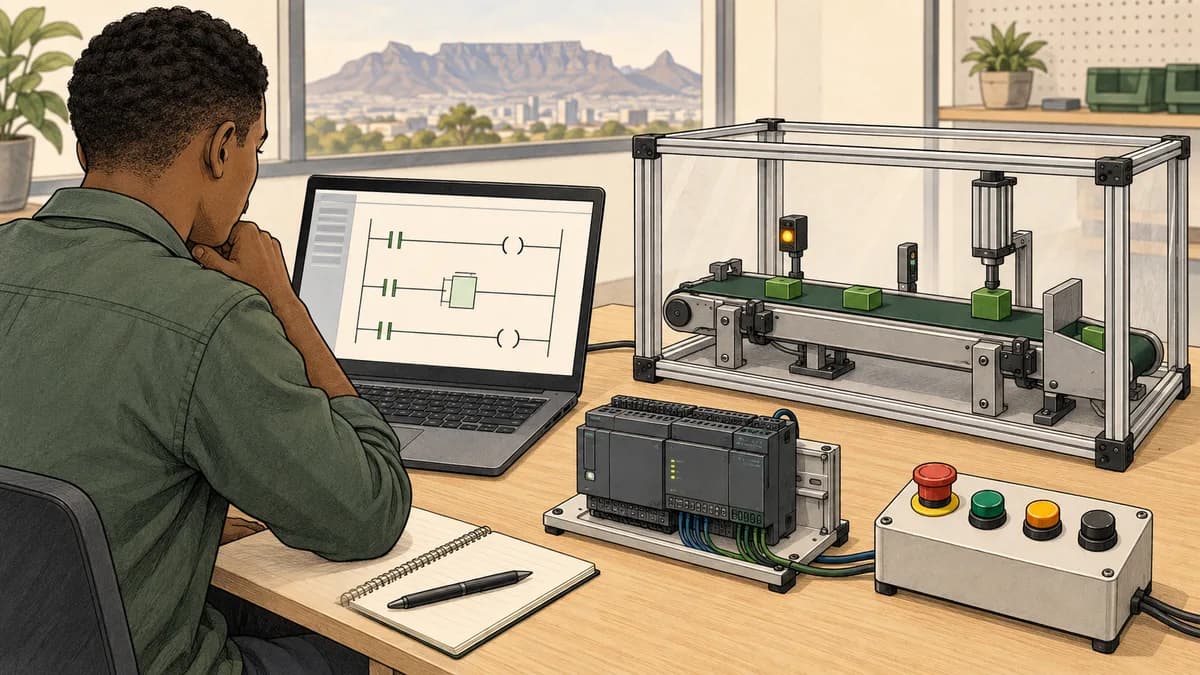
CompactLogix and ControlLogix are Allen-Bradley controller families. The useful comparison is between specific controllers and complete systems: I/O architecture, supported devices, application memory, motion, availability, software compatibility and maintenance requirements. A family name alone cannot tell you which controller belongs in a South African panel or which training course you should book.
This guide focuses on how to compare a CompactLogix 5380 proposal with a ControlLogix 5580 proposal. Older generations and newer platforms require their own documentation. It includes a fictional requirements exercise, a procurement checklist and questions that learners can take to a training provider. It is a selection study, not an approved plant design or a claim that every application needs the larger controller.
CompactLogix vs ControlLogix: the practical difference
The CompactLogix 5380 uses a compact architecture with compatible local Compact 5000 I/O. A ControlLogix 5580 system uses a 1756 chassis architecture and can combine controller, communication and other supported modules. Both also require attention to distributed I/O and networks; counting the modules immediately beside the CPU does not describe the complete application.
Rockwell's CompactLogix and Compact GuardLogix selection guide separates generations, standard and safety controllers, networking, motion and local I/O. Its published comparison lists no controller redundancy for the 5380 and 5480 families. That is more precise than saying that no CompactLogix product has ever had any backup arrangement.
The ControlLogix 5580 and 5570 selection guide describes chassis systems and supported high-availability architectures. It also directs readers to separate documentation for ControlLogix 5590. Keep the generation in your search and quotation: a document about one family is not a specification for every product with the ControlLogix name.
| Selection question | Evidence to request |
|---|---|
| What controller is actually proposed? | Complete catalogue number, series and firmware |
| What connects locally? | Compatible I/O list and power calculation |
| What connects over a network? | Device inventory, topology and supported limits |
| What must happen after a failure? | Availability requirement and documented architecture |
| What software is required? | Supported release, licence scope and workstation requirements |
| Who will maintain it? | Skills, backups, spares and support arrangements |
Use the Allen-Bradley learning guide for the broader learning route. This comparison is the point where general familiarity becomes a documented set of requirements.

Read the complete catalogue number before comparing specifications
Similar-looking part numbers can describe different capacities or capabilities. Preserve every suffix when requesting a quotation or researching a controller. Do not shorten a safety model into a standard-controller name, mix a maximum across a family with an individual model, or copy a memory figure from an unrelated generation.
For example, Rockwell's current 5069-L320ERMS2 product cut sheet identifies a Compact GuardLogix 5380 model with 2 MB standard memory, 1 MB safety memory, 40 EtherNet/IP nodes, a maximum of 16 I/O modules and eight integrated-motion axes. These are that catalogue number's published attributes, not universal CompactLogix values. They also do not establish that a complete proposed application meets every engineering requirement.
That example shows why a table headed only “CompactLogix L3” is too broad for purchasing. A figure labelled I/O modules is not a count of field signals. A network-node limit is not automatically a count of every tag, connection or device you might draw. Ask which resource each limit measures and how the proposed architecture consumes it.
Save the source, document revision and date alongside each specification. Where the configurator, distributor quotation and application documentation appear to disagree, raise the discrepancy before accepting the design. A newer web page does not necessarily explain the firmware fitted to a controller already on a shelf.
Studio 5000 is engineering software, not the controller firmware
Studio 5000 Logix Designer is the engineering application used with supported Logix controllers. Controller firmware is software running in the controller. The project target, controller revision and installed engineering software must be compatible. Describing both controllers as running “Studio 5000 firmware” confuses two different parts of the system.
Use Rockwell's Product Compatibility and Download Center to investigate the actual product and version combination. Record the outcome in the project handover. A statement that an engineer owns Studio 5000 does not establish that their installed release can open, edit and download the particular project under consideration.
For training, request the controller model and engineering-software release before booking. Ask whether each learner will create a project, explain its organisation, observe a test and recover from an intentionally introduced error. If the course uses older hardware, that can still be relevant to an installed base, but the provider should explain which lessons transfer and which procedures differ.
A browser learning environment can help with logic and test reasoning. Explore the Allen-Bradley learning dialect in PLC Simulator as preparation. Treat its supported educational behaviour separately from native Logix project compatibility, hardware configuration and commissioning. Practising a condition in a browser does not prove that an imported application will compile for a specific CPU.
Build the I/O inventory before choosing a chassis
Start with a signal schedule that separates digital inputs, digital outputs, analogue channels, special-purpose signals and safety-related functions. Record the signal type, required module characteristics, physical location and proposed grouping. A total such as “96 I/O” hides information needed to select modules and distribution.
Consider a fictional machine with 40 digital inputs, 24 digital outputs and eight analogue inputs. That is 72 field signals, but it does not establish the number of modules. Channel density, spare capacity, electrical characteristics and the separation of functions all affect the module list. A module with unused channels may still be necessary because those channels cannot serve a different signal type.
Next, identify remote stations and their communication adapters. A compact controller can communicate with distributed equipment; a chassis controller does not require every signal to terminate in its own chassis. The selection question is whether the proposed arrangement is supported and meets the application's needs, not whether a photograph contains more modules.
Power and installation requirements belong in the same review. Ask for the calculation, module compatibility and installation documentation rather than relying on a visual resemblance between connectors. Existing 1769 hardware, 5069 hardware and 1756 chassis modules should never be treated as interchangeable simply because the quotation calls all of them Allen-Bradley I/O.

Compare memory, motion and networks as separate constraints
A controller can have enough memory but still fail a networking or motion requirement. Conversely, a large headline capacity does not tell you whether a project uses the right data structures, task arrangement or communication design. Avoid reducing the comparison to one number such as memory or an unsupported “milliseconds per thousand instructions” benchmark.
For memory, obtain an application estimate with its basis. Explain whether it comes from an existing project, a representative prototype or an early allowance. Record the intended expansion and what remains unknown. Memory reserved for a different purpose should not casually be added to the application's usable capacity.
For motion, list the required axes and the intended control method. Identify the drives, controller support and engineering tools. The word motion on a brochure does not establish every requested combination. Keep standard automation and safety-related motion requirements distinguishable so that an ordinary axis count is not mistaken for a complete safety assessment.
For networks, draw devices and links, then identify the resource limits that apply. Include HMIs, remote I/O, drives and controller-to-controller exchanges as appropriate to the proposed system. The produced and consumed tag guide addresses one specific exchange mechanism. It does not replace the network design or the compatibility check for each endpoint.
Availability and safety answer different questions
Availability asks whether the system can continue its required service. Safety asks whether risk is reduced appropriately through the complete safety design and lifecycle. A redundant controller arrangement does not automatically satisfy a safety requirement, and a safety-capable controller does not automatically provide the availability architecture the customer expects.
Rockwell's 5580/5570 guide distinguishes standard ControlLogix redundancy from Logix SIS architectures and refers to the associated manuals. Use those references for the actual proposal. Do not promise a universal switchover time, assume every firmware supports the same configuration, or specify redundancy merely because a facility operates around the clock.
Write the customer's requirement in operational terms first. Which failure must be tolerated? What interruption is acceptable? What happens to communications and outputs during the transition? How will the behaviour be demonstrated? Who accepts the result? These questions expose whether “redundancy required” is a developed requirement or an undefined preference.
For a learner, the valuable exercise is to identify missing evidence. It is not to improvise a redundant plant controller from two devices and a heartbeat bit. The introduction to PLC troubleshooting helps organise observations, while the approved vendor architecture and competent engineering review determine what belongs on the real system.
Worked exercise: choose evidence before choosing hardware
The following fictional screening model teaches requirement handling. Its numbers are invented and do not describe CompactLogix, ControlLogix or any purchasable controller. Use labels Candidate A and Candidate B so that a classroom result cannot be mistaken for a vendor recommendation.
The study requires at least 12 compatible local modules, 30 supported network nodes and six supported motion axes. It also requires a documented availability feature, represented only as a Boolean for this simplified exercise. In a real proposal that feature would need a detailed architecture and acceptance criteria.
| Study item | Candidate A | Candidate B |
|---|---|---|
| Compatible local modules | 16 | 20 |
| Supported network nodes | 40 | 60 |
| Supported motion axes | 8 | 8 |
| Required availability feature documented | No | Unknown |
Candidate A passes the three numerical checks but fails the stated availability requirement. Candidate B passes the numerical checks, but its availability evidence is missing. The correct overall outcomes are “does not meet stated requirements” for A and “unresolved evidence” for B. Neither is an approved selection.
This is deliberately different from awarding three points out of four and choosing the higher percentage. A mandatory requirement is a gate. A missing answer is not a pass, and an unsupported answer should not be converted into a reassuring estimate because the deadline is near.

Extend the study with boundary and missing-data cases
Now give Candidate B a valid document that explicitly supports the required availability feature for the proposed configuration. In the fictional model, B passes all four checks. The conclusion is only that B passes this limited screening set; it does not establish price, installation suitability, safety, lifecycle support or an approved detailed design.
Change the local-module requirement from 12 to 20. B still passes that boundary because its stated capacity equals the requirement. Change it to 21 and B fails. A controller need not exceed a requirement to satisfy an “at least” comparison, but any engineering allowance must already be included in the requirement rather than silently added after evaluation.
For a separate growth exercise, suppose a team plans 12 modules and explicitly requires a 25 percent allowance. Multiplying 12 by 1.25 gives 15 modules. A different plan of 13 modules gives 16.25, which requires 17 whole modules when the policy says to round upward. This is an arithmetic teaching policy, not a universal recommendation for spare capacity.
Test missing and invalid inputs too. An absent node limit is unresolved. A negative capacity is invalid data. A number copied from another catalogue number is evidence for a different candidate. If the requirement revision changes, save a new evaluation rather than overwriting the old conclusion without explanation.
A useful record contains the candidate identity, requirement revision, evidence revision, each individual result and the overall decision. Use the PLC program testing learning page to practise the habit of defining expected results before observing behaviour. Keep this paper selection model separate from actual controller performance testing.
What should a South African quotation include?
Request a complete scope in rand, with the tax treatment stated. Separate hardware, engineering software, configuration work, training, commissioning and support. Ask which items are supplied locally, which require ordering, and how long the quote and availability statement remain valid. An unsourced fixed price for a generic CompactLogix or ControlLogix panel is not a useful purchasing baseline.
Ask for the exact bill of materials, compatible accessories and proposed substitutes. A cheaper total may omit software, communication equipment, terminal kits, installation work or the training needed to maintain the system. Compare equivalent scopes before treating the difference as a saving.
For an existing installation, include migration effort. Review drawings, the original project, firmware information, third-party devices, replacement strategy and test access. Keeping the same brand does not mean that changing controller generations is a drop-in operation. A quotation should say which existing components are retained and how their compatibility will be established.
Local support is a question to verify, not a claim to infer from a city name. A team in Johannesburg, Durban, Cape Town, Pretoria, Gqeberha or Bloemfontein should ask about response arrangements, travel, remote support boundaries and available spares. The South African PLC training cost guide helps separate learning expenses from hardware-project costs.
Choose training by the task you need to perform
A maintenance learner may need to identify the controller, open the correct project, trace a signal and explain a fault observation. A programmer may need to develop routines, manage data and test changes. A person comparing systems needs architecture and documentation skills in addition to editing logic. A course title that contains both controller families does not guarantee equal depth in all these tasks.
Ask for an assessment example. Useful evidence might include a learner-created signal list, a documented compatibility check and a test report that identifies a failed requirement. Watching the instructor download a prepared application is a different learning activity from independently producing and explaining one.
Before advanced instruction, check your ability to distinguish a request from a command and a command from feedback. Review Logix tag scope and data organisation and Add-On Instruction fundamentals when those concepts appear in a syllabus. Their relevance depends on the task, not on a promise that every routine transfers unchanged between targets.
Training centres should specify learner access, workstation setup, project retention and assessment criteria. The institutional training guide provides a route for considering complementary practice. Completion of a learning exercise is evidence of that exercise; it is not manufacturer certification, an occupational qualification or approval to commission a safety function.

Questions people ask about CompactLogix and ControlLogix
Which is better for a beginner in South Africa?
Choose the learning environment that matches your target work and gives you individual practice with clear feedback. Fundamental logic and testing skills are useful across the families. If an employer or college uses a particular generation, confirm it and learn that environment. A larger controller is not automatically a better teaching tool.
Can I move a CompactLogix program into ControlLogix?
Treat it as a compatibility and migration task. Review the target, firmware, I/O configuration, instructions, data, communications and any special features. Shared Logix concepts help, but they do not guarantee an unchanged application. Preserve the source and verify the proposed target in the appropriate engineering environment before planning a controlled test.
Does a ControlLogix controller always include safety?
Do not infer a safety capability from the family label. Identify the exact model and the documented architecture for the intended function. The complete safety application has requirements beyond an individual CPU's marketing description. An ordinary selection comparison cannot certify that application.
Is CompactLogix enough for a small factory?
“Small factory” is not a technical requirement. Develop the signal inventory, communication needs, performance requirements, availability expectations and expansion plan. A physically small system can have demanding motion or availability needs; a large building may contain several independent control systems. Compare the documented requirements with a specific proposal.
Can I learn without buying a controller immediately?
You can begin with logic exercises, data organisation, documentation reading and test design. Then add supervised access to the relevant vendor environment and hardware when your learning objective requires it. Budget for the software and practical access explicitly. Do not assume a browser simulator reproduces every native hardware or firmware behaviour.
Should I ask an AI assistant to select the part number?
Use it to organise questions and explain terminology, then verify the answer against the manufacturer's documents and the actual application. A useful prompt includes the proposed generation, requirements and unknowns, and asks for an evidence checklist. A confident part number without a traceable compatibility review is not a purchasing decision.
Produce a selection note that another person can review
Finish your study with a concise recommendation and an evidence table. State the requirements that are met, those that fail and those that remain unresolved. Link to the relevant source revision and preserve the exact model identity. Include the alternatives considered and the reason each was retained or rejected.
Keep commercial preferences separate from mandatory technical requirements. If two systems pass the documented technical screen, compare supported lifecycle, maintenance fit, complete cost and delivery terms. If neither passes, revise the proposal or obtain the missing evidence rather than using a weighted score to conceal the failure.

For your learning portfolio, include the fictional four-check exercise, the boundary cases and a short explanation of why unknown evidence prevented approval. That demonstrates disciplined reasoning without pretending to have designed a production plant. For an actual project, the selection note is one input to the controlled engineering, review and acceptance process.