industrial-automation-course-online · South Africa
Industrial Automation Course Online: South African Guide
Choose an industrial automation course online with useful projects, feedback and clear practical scope. Compare formats and test a sample dashboard model.
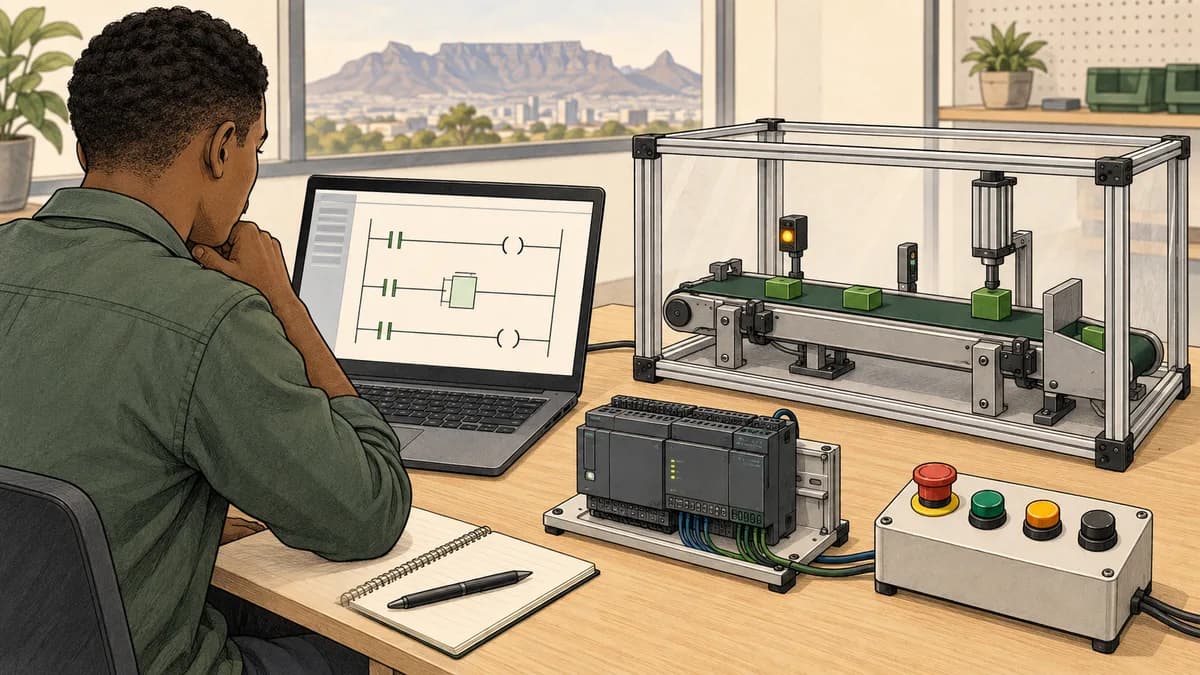
An industrial automation course online should give you a clear account of what you will learn, practise and have assessed. PLC programming, instrumentation, HMI configuration, networks and motion are related subjects, but a course title does not establish how deeply each is covered. Start with your intended task and compare the actual exercises.
Online learning can include self-paced reading, recorded demonstrations, live instruction, simulated projects or access to a remote environment. Those formats produce different kinds of evidence. A learner who watches a network demonstration has not necessarily configured that network, and a successful simulated calculation does not prove a physical instrument is calibrated.
This website is commercially connected to PLC Simulator. Its PLC practice curriculum is an independent learning option for part of the automation subject. We do not claim that one simulator replaces every software tool, practical facility or assessment in a broader course.
Choose a course from the task you need to perform
Write a specific learning objective before comparing providers. “Explain how an instrument value becomes an HMI display” is more assessable than “learn all automation.” “Create and test a small PLC sequence in the named vendor environment” gives a provider a clearer target than “become job-ready.”
Then identify the evidence you need. A written calculation can establish understanding of a formula. A project file can show an implementation. Observed tests can demonstrate behaviour in a stated environment. Equipment work requires evidence from the actual practical setting and conditions, with appropriate supervision and authorisation.
Use the broader industrial automation courses guide to compare formal, vendor and short-course routes. This page focuses on delivery and assessment online, including a fictional data-handling exercise that you can use when discussing a syllabus with a provider.
Online formats are not interchangeable
| Format | A useful learning activity | Question to resolve before booking |
|---|---|---|
| Recorded course | Pause and review an explanation, then attempt your own exercise | Is there feedback on submitted work? |
| Live remote class | Ask questions while completing a scheduled activity | How much individual practice is included? |
| Browser-based curriculum | Repeat supported exercises and inspect results | Which features and lessons are included in your access? |
| Remote software environment | Work in the supplied engineering tools | What software, targets and access periods are provided? |
| Blended programme | Connect online preparation with supervised practical tasks | Which outcomes are assessed in each setting? |
A course may combine several formats. Ask the provider to describe a typical practical session from the learner's perspective: what you open, what you change, what you submit and how the result is reviewed. This reveals more than the total number of videos or the phrase “virtual lab.”
For self-paced options, confirm whether support is included and how you ask a technical question. For scheduled classes, check attendance requirements and session times for the actual dates in South African time. Access to recordings does not necessarily replace a required live assessment.

Official learning platforms show why scope matters
Festo's 2026 LX content catalogue distinguishes theory content from eLab activities involving learning equipment or simulation. Its learning portal also identifies equipment requirements for particular activities. An online course catalogue can therefore include tasks whose practical requirements go beyond a laptop alone.
Siemens describes its SITRAIN access learning membership with digital courses and a Virtual Exercise Lab using pre-installed software. Confirm the relevant membership or course conditions, available exercises and access arrangements before assuming every lesson provides the same lab facility.
These are official examples of delivery approaches, not a ranking of every provider available to South African learners. Ask for current pricing, prerequisites and the exact course offered. A platform's broad catalogue does not establish that one subscription includes every tool or that a particular intake has places available.
Map the syllabus to a practical result
For PLC programming, ask whether you will build from a requirement and test more than the normal path. For instrumentation, ask whether the course distinguishes signal conversion, data quality and physical calibration. For HMI work, ask how learners verify the displayed value against the intended source.
Networking should include a clear account of the data being exchanged and the environment used to observe it. Drives and robotics need their own platform and practical scope. A module mentioning a subject does not demonstrate that the course assesses every task associated with it.
Our instrumentation courses guide, industrial networking guide and robotics training guide provide routes for exploring these additional subjects. Use them to identify questions and prerequisites rather than treating every subject as mandatory in the same introductory purchase.
Worked project: a fictional dashboard with a missing sample
Imagine a software-only training dashboard displaying a fictional tank's fill percentage. No sensor or physical tank is connected. A supplied data record contains a raw value and a Boolean quality flag. The raw range is defined for this exercise as 0 to 1000, representing 0 to 100 percent.
The learning goal is to convert valid data and preserve uncertainty when the data cannot support a current reading. This connects three course topics: numerical scaling, conditional logic and display interpretation. It does not design a tank control system, alarm function or equipment fallback.
The input RawValue is a finite number already supplied by the model. SampleValid indicates whether the sample is declared valid. A reading is accepted only when the flag is true and the value lies within the inclusive range from 0 to 1000. Invalid samples produce an unavailable current reading, not an invented zero percent.
Write the data contract
| Item | Meaning in this exercise |
|---|---|
| RawValue | Fictional supplied value, with a stated range of 0–1000 |
| SampleValid | Boolean quality flag provided with the sample |
| CurrentPercent | Accepted value divided by 10, otherwise unavailable |
| LastAcceptedPercent | Most recent accepted percentage, initially unavailable |
| Display status | Current reading available, or current reading unavailable |
CurrentPercent and LastAcceptedPercent are deliberately separate. The former represents the current accepted sample. The latter may be useful historical context after a failed sample, but must not be presented as a fresh current measurement.
There are no timestamps in this initial model. It therefore cannot establish how old the last accepted value is. If a course adds freshness or timeout behaviour, require an explicit clock, timestamp relationship and test cases. A label saying “last accepted” does not itself calculate age.

Calculate the accepted value
For an accepted sample, use:
CurrentPercent = RawValue / 10
LastAcceptedPercent = CurrentPercent
For a rejected sample, CurrentPercent is unavailable and LastAcceptedPercent remains unchanged. The display must identify the current reading as unavailable. A programming environment may represent unavailable data using a separate validity flag and a numeric field; the conceptual unavailable value here is not a claim about a native PLC data type.
The endpoints matter. Raw zero is a valid zero-percent reading when the quality flag is true. Raw 1000 is a valid 100-percent reading. Raw 1001 is rejected under this exercise's rule, even though dividing it by ten would produce a mathematically possible number.
A poor implementation might convert every raw input first and show the result without quality information. Another might substitute zero when a sample fails. Both can create a plausible-looking display while losing the distinction between a real zero reading and missing evidence.
Follow a sequence of six records
Start with no last accepted value. Each row is one supplied record, not a physical scan duration or network packet captured from equipment.
| Record | Raw value | Sample valid | Current percent | Last accepted percent | Current status |
|---|---|---|---|---|---|
| 1 | 250 | True | 25 | 25 | Available |
| 2 | 500 | True | 50 | 50 | Available |
| 3 | 750 | False | Unavailable | 50 | Unavailable |
| 4 | 1100 | True | Unavailable | 50 | Unavailable |
| 5 | 0 | True | 0 | 0 | Available |
| 6 | 1000 | True | 100 | 100 | Available |
Record three demonstrates that a plausible raw value is not enough: its supplied quality flag is false. Record four demonstrates the independent range check. Record five demonstrates why invalid data must not be confused with a valid zero.
If a learner reports 75 percent for record three, inspect whether the quality flag was used. If the learner reports 110 percent for record four, inspect the range condition. If record five still shows unavailable, inspect whether zero was incorrectly treated as a missing value.
The table localises questions within the stated learning model. It does not identify the cause of a real transmitter or communication failure. Actual equipment can require different validity, diagnostic and range handling according to its documentation and application requirements.
Add boundary and starting-state tests
Test raw values of -1, 0, 1, 999, 1000 and 1001 with a true quality flag. The accepted percentages should be unavailable, 0, 0.1, 99.9, 100 and unavailable respectively. Then test an in-range value with a false quality flag.
Also start a fresh exercise with a rejected first sample. Both the current reading and the last accepted reading should remain unavailable. This catches an implementation that invents a historical zero simply because a numeric variable was initialised to zero.
Decide how the display communicates missing information without relying on colour alone. A visible text status and an explicit label for the historical value help a reviewer understand what is current. The exercise does not prescribe an operational HMI alarm philosophy or a safety response.
What to submit for assessment
Submit the requirement, data contract, conversion rule, six-record trace and boundary results. Include the initial state and the environment used. If you implement a display, show both a valid zero and an invalid sample so the assessor can see that they are distinguishable.
Write one limitation you have not solved: no real instrument, no calibration, no timestamp-age calculation or no physical communication test. This is useful technical reporting. It prevents a software model from being represented as a complete industrial integration project.
An instructor can extend the work by introducing explicit timestamps and a documented freshness rule in a separate version. The learner should update the requirements and expected results before changing the implementation. That is deeper learning than simply adding a trend graphic to an unexplained number.
Choose product practice for the relevant part of the course
Independent PLC Simulator sensor lessons are a relevant learning route when studying how inputs are interpreted. Check the particular lesson and its supported behaviour; the dashboard exercise above is a specification in this article, not a claim that an identical ready-made product scenario exists.
For supervisory topics, use our SCADA training guide to compare the additional software and skills involved. A PLC practice curriculum should not be described as full access to every SCADA package, historian, robot simulator or vendor engineering environment mentioned in a broad automation syllabus.
Ask the provider to state what learners must install and what runs remotely. Confirm licences, account access, saving and whether project files remain available after the course. A working demonstration on the instructor's computer is not evidence that your own setup is ready.

Match the route to your starting knowledge
An electrician may already have relevant control-circuit experience, but that does not establish familiarity with a specific PLC project or data-handling rule. An instrumentation technician may understand measurements while needing practice with program structure or display mapping. Use a sample task to establish the gap instead of deciding from the job title alone.
The electrician learning guide and instrumentation-technician guide provide different worked examples. Choose the concepts you cannot yet explain reliably. Avoid paying to repeat material solely because it appears early in a generic syllabus, while also avoiding assumptions that your background covers an untested prerequisite.
Engineering and mechatronics students can use online work to connect theory with a clearly documented implementation. The mechatronics course guide discusses broader study routes. A small project with requirements and tests can complement formal education without claiming to replace its practical or assessment requirements.
For a maintenance role, identify the controller, engineering software and diagnostic task used in the intended training. Vendor-specific navigation and supported behaviours require their own practice. General reasoning helps you ask better questions, but does not make different project files or software tools interchangeable.
Organise study by review points
Begin with variables, expressions and the distinction between a source value and a display. Your first review point is predicting a small rule's result before executing it. Our home PLC learning plan provides a more detailed beginner sequence if those foundations need work.
Next, complete the dashboard exercise and explain the valid-zero, invalid-quality and out-of-range cases. The review point is reproducing the results and explaining why unavailable is different from zero. Continue only when your notes make that distinction clear.
Then add a target-specific topic from the selected course: HMI configuration, a network diagnostic task, a drive interface or another relevant objective. Record what was simulated and what was observed in an actual tool or supervised equipment setup. Do not treat a fixed twelve-week schedule as a universal competence guarantee.
Finally, ask for a review of a small integrated project. The assessor should be able to identify the requirement, implementation, test evidence and limits. If the project remains too large to explain, reduce its scope until you can review the important behaviour thoroughly.
South African scheduling and access questions
For learners in Johannesburg, Pretoria, Cape Town, Durban, Gqeberha or a smaller centre, remote delivery can reduce some travel requirements. It does not remove the need for compatible equipment, connectivity or scheduled practical attendance where the course requires it.
Ask whether the quoted timetable uses South African time and whether sessions change around overseas daylight-saving dates. Confirm the actual dates rather than using a fixed time conversion copied from another intake. Also ask how a missed session affects assessment or completion.
For shift work, request the live-attendance requirements and the access period. A video library may fit flexible hours, while a remote lab may require a booking. Those arrangements can coexist in one programme, so check both before assuming the whole course is self-paced.
Plan for interruptions to connectivity and power. Keep your own requirements and test predictions accessible for offline study, but do not assume the provider's software, saving or authentication works without a connection. Test your actual device and access route before relying on it for an assessed session.

Compare cost and credentials separately
Request the course price alongside the access duration, support, practical facilities and assessment. Identify separate costs for software, exams, retakes, hardware or travel. The South African PLC course price guide helps structure those comparisons without inventing one standard fee for all online automation courses.
A longer video library is not automatically better value than a smaller course with useful feedback. Conversely, live instruction does not establish that each learner receives meaningful practical time. Compare the actual activity and review process against the skill you want to develop.
Ask who issues the final document and what it records. Attendance, private course completion, a vendor award and a registered qualification are different claims. Use the PLC certification guide to check the exact credential rather than inferring status from a logo or the word certificate.
For employer-funded learning, clarify any required approval or reporting evidence with the person responsible before booking. An online subscription does not automatically satisfy an external scheme, and this page does not make a universal eligibility decision for every training arrangement.
Questions to ask about online industrial automation courses
What is the best industrial automation course online for South Africa?
The best fit depends on your target task, starting knowledge, available equipment and required credential. Ask for a sample practical activity and assessment description. Compare that evidence with your goal rather than choosing from a broad title, a promised salary or an unsupported national ranking.
Can I learn automation online without owning a PLC?
You can study concepts and complete supported software exercises without owning a controller. The precise scope depends on the course. Check whether any lab activity requires equipment, remote access or later supervised practical work before assuming a laptop covers every outcome.
Is a virtual lab the same as a simulator?
The phrase can describe different arrangements. Ask whether you use simulated devices, remotely hosted engineering software or remotely accessible equipment, and what you personally control or observe. Record the environment with your results so the evidence is interpreted correctly.
Should an introductory course include robotics and SCADA?
It may introduce them, but depth should match the stated objective and available time. A focused PLC course can be a useful first step. If you need assessed robotics or SCADA skills, confirm the actual tools, exercises and prerequisites rather than relying on a module heading.
How can I tell whether I am learning rather than just watching?
Predict a result, build or analyse an exercise, test distinguishing cases and explain a discrepancy. The dashboard example provides a small model: valid zero, bad quality and out-of-range data must produce different interpretations. Feedback on that reasoning is more informative than a completed-video counter alone.
Will the course make me ready for independent plant work?
Online results demonstrate learning within their stated environment. Independent workplace responsibilities depend on the role, equipment, competence evidence and authorisation required. Ask the relevant employer or supervisor which additional training and assessment you need.

Make the next course enquiry specific
Send the provider a short learning objective and ask how its course assesses it. For example: “I want to trace a supplied value through validation, scaling and a display, including invalid and stale-data cases.” Request the relevant exercise environment, prerequisite knowledge and feedback arrangement.
Use independent PLC curriculum practice for the concepts it supports, and select further tools or supervised training for the remaining tasks. Keep each claim tied to what you actually built, observed and tested.