mechatronics-courses-south-africa · South Africa
Mechatronics Courses South Africa: 2026 Pathways
Compare mechatronics courses in South Africa across NCV, trade, certificate, diploma and degree routes, with entry requirements and practical outcomes.
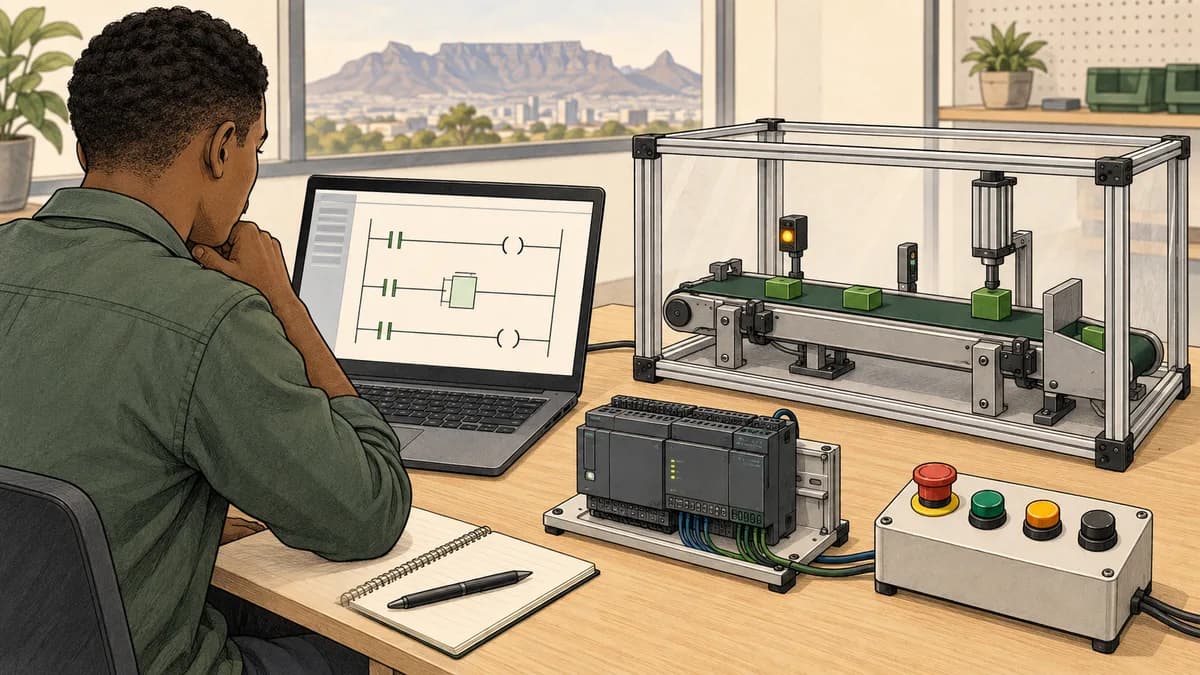
Mechatronics courses in South Africa range from NCV programmes and occupational training to higher certificates, diplomas and engineering degrees. The shared word hides major differences in entry level, mathematics, practical depth and professional outcome. A school learner choosing a three-year vocational route is making a different decision from an artisan choosing a part-time automation module or a matriculant comparing engineering degrees.
Your choice of route depends on your current qualification and the work you want to perform: operate and maintain automated equipment, qualify in a technical occupation, develop automation systems, or practise as an engineering professional.
If you want a shorter job-skills route focused specifically on PLCs, SCADA, instrumentation, drives and networks, compare the industrial automation courses guide before committing to a multi-year mechatronics programme.
For actuator and fluid-power learning, compare hydraulics and pneumatics courses in South Africa. Check the practical depth, electrical-control integration and individual assessment instead of assuming that a broad mechatronics module covers every maintenance outcome.
The South African pathway map
| Pathway | Common entry point | Typical duration | Main emphasis | Check before applying |
|---|---|---|---|---|
| NCV Mechatronics | Grade 9 or provider-specific equivalent | Levels 2–4 over three years | Vocational foundation, electrotechnology, computers and mechatronic systems | Campus availability and progression rules |
| Occupational or trade pathway | School or workplace entry requirements | Multi-year learning plus workplace and assessment | Installation, maintenance and commissioning competence | Current registration status, workplace access and assessment route |
| Short course or module | Artisan, technician, employee or student | Days to months | PLCs, pneumatics, robotics, drives or a defined subsystem | Whether it is standalone skills training or part of a formal programme |
| Higher certificate or diploma | Matric and provider-specific subject results | One to three years | Applied engineering and technician-level work | Accreditation, articulation and laboratory access |
| Engineering degree | Matric with required mathematics and physical science | Usually four years | Design, analysis, control, embedded systems and professional foundation | Programme accreditation and professional route |
Check the current provider prospectus and official qualification information for the intake year. A copied brochure or old search snippet does not establish that a programme is currently accepting new learners.
What mechatronics actually combines
Mechatronics involves the integration of mechanical systems, electronics, control and computing into a machine or process that can sense, decide and act.
A conveyor sorting station makes the integration visible. The mechanical design determines stiffness, motion and load. Sensors detect parts. Drives and actuators create movement. A PLC or embedded controller runs the sequence. An HMI exposes state and alarms. A network connects devices. Safety functions limit hazardous motion. Maintenance documentation allows the system to be supported after commissioning.
Look for projects where these subjects meet and one design choice affects the others. A faster actuator may change guarding and stopping-distance requirements. A different sensor may change mounting, wiring, program filtering and diagnostic behaviour.

Core curriculum to look for
Mechanical systems
Expect engineering drawing, materials, manufacturing, mechanisms, bearings, power transmission and basic machine design. Technician routes focus more on assembly, alignment and maintenance; degree routes add deeper mechanics and analysis.
Electrical and electronic systems
The course should cover circuits, motors, protection, control wiring, power electronics, sensors and signal conditioning. Learners must be able to connect a diagram to a physical circuit and measure it safely.
Pneumatics and hydraulics
Automated equipment often uses fluid power for clamping, lifting and fast linear motion. Training should connect valves, cylinders, pressure, flow, sensors and PLC commands. The sequence is incomplete if it ignores how the actuator actually behaves.
PLCs and control
PLC fundamentals, state-based sequences, timers, counters, analogue signals, HMI tags and industrial communication are central to industrial mechatronics. The PLC training guide, function block lesson and motion-control introduction provide a useful preview.
Embedded systems and programming
Some programmes use microcontrollers and general-purpose programming alongside PLCs. That is appropriate: products and smaller machines may use embedded control, while plant automation often uses PLCs. Learners should understand why a platform is selected rather than treating every controller as interchangeable.
Robotics and manufacturing
Industrial robotics, CNC, computer-integrated manufacturing and machine vision may appear at later levels. Confirm whether “robotics” means school-scale kits, mobile robots, simulation or industrial arms. The industrial robotics training guide explains the difference.
Systems engineering, safety and documentation
Requirements, interfaces, testing, risk controls and configuration management turn separate technologies into a supportable machine. The International Society of Automation is a useful vendor-neutral reference for automation and control professionalism, though each formal programme has its own approved curriculum and assessment rules.

NCV mechatronics
NCV provides a vocational alternative from a lower school entry point and progresses through levels with fundamental and vocational subjects. Current public-college pages show electrotechnology, computers, manufacturing and mechatronic systems in the programme mix. This route suits learners who want a structured technical foundation and are comfortable committing to an academic timetable.
Ask which campus actually offers the programme for the intake. Colleges may limit offerings according to enrolment and resources. Also ask about the practical equipment available, progression between levels and the route after Level 4. A programme title alone does not show whether the laboratory has enough working stations for regular practice.
Occupational and technician routes
Occupational mechatronics aims at installing, maintaining and commissioning integrated equipment. Workplace learning is therefore central rather than optional decoration. Confirm who arranges workplace exposure, how evidence is logged, where external assessment occurs and what happens if placement is delayed.
A part-time academy programme can suit employed learners because the workplace already supplies context. An unemployed learner needs a clearer placement plan. Do not assume the provider’s industry relationships automatically guarantee an individual placement; ask for the written process and responsibilities.
Higher certificate, diploma or degree
A higher certificate can bridge into applied technical study and may articulate into further programmes, depending on the institution and rules. For a diploma, inspect the particular applied curriculum, laboratory work and any workplace component; do not infer a professional category from the title alone. An engineering degree carries heavier mathematics, modelling, design and analysis.
Compare the curriculum rather than the word “mechatronics.” One programme may grow from mechanical engineering with added electronics and control; another may grow from electrical engineering with added mechanics and manufacturing. Both can be valid, but they shape electives, projects and early career fit.
For a professional engineering goal, verify the programme’s current accreditation and the registration pathway with the relevant official bodies. PLC Programming SA does not assess or certify that status.
Entry requirements and preparation
Mathematics matters throughout mechatronics because units, ratios, motion, signals, control and programming all rely on quantitative reasoning. Physical science supports forces, energy, electricity and materials. Entry thresholds vary, but meeting the minimum does not guarantee that the first semester will feel comfortable.
Before starting, revise algebra, trigonometry, units, scientific notation, basic circuits and logical reasoning. Build one small project that combines a sensor, decision and actuator. The project can be simulated; the goal is to experience interfaces and debugging rather than to buy an expensive kit.
Use a diagnostic exercise or the provider’s preparation material to identify your gaps. Existing electrical or mechanical experience can help, but it does not automatically grant exemptions. Confirm any recognition of prior learning with the institution rather than assuming that a job title allows modules to be skipped.
How to judge laboratory quality
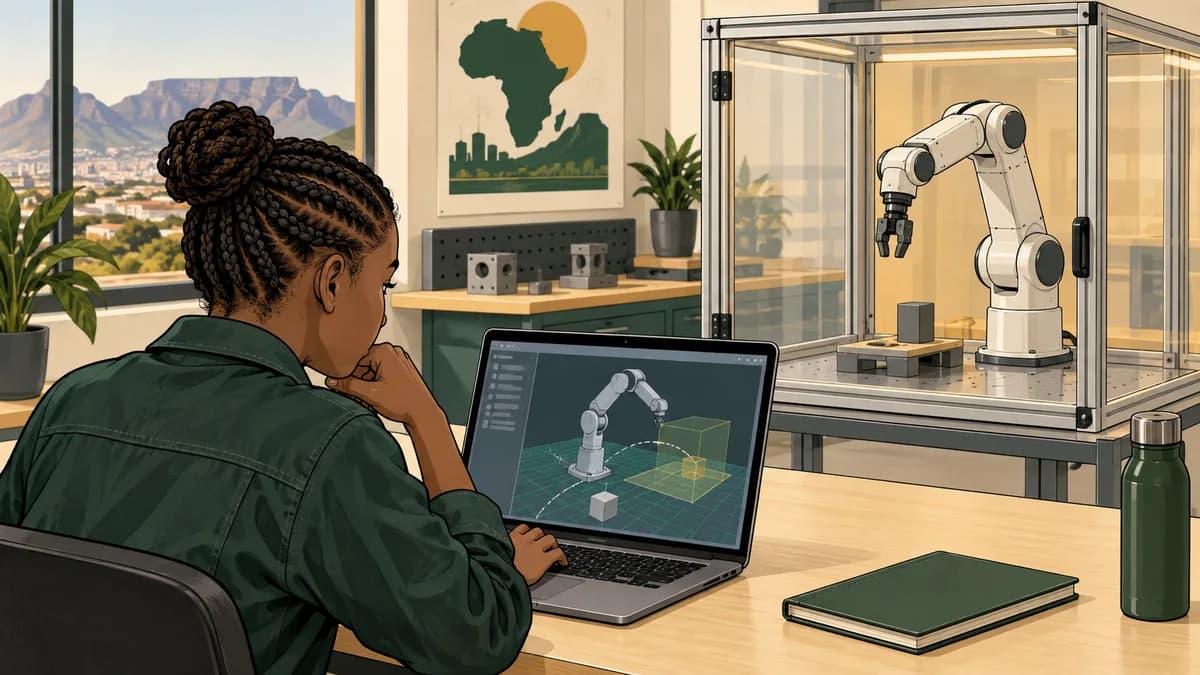
Ask for a normal timetable, not an open-day tour. How often does each learner use the PLC, pneumatic bench, robot, CNC system or instrumentation rig? Are practicals individual or group demonstrations? Which equipment is assessed? What happens when equipment is unavailable?
Strong laboratory work produces integration evidence: an I/O schedule, electrical drawing, pneumatic diagram, program, HMI, test plan, risk controls and fault report for one machine. A polished final video without those artefacts can hide copied code and uneven contribution.
Use four tests:
- Access: enough functioning equipment and software time for every learner.
- Integration: projects cross mechanical, electrical and control boundaries.
- Assessment: each learner demonstrates an independent task.
- Documentation: the work can be inspected, repeated and maintained.
Career outcomes without inflated promises
Mechatronics can lead toward maintenance, automation, commissioning, production support, robotics, machine building, field service and engineering design. The actual title depends on qualification level, workplace exposure and sector. A short course may strengthen an existing artisan role; it does not create the same eligibility as a multi-year formal programme.
Employers assess useful combinations. A learner who can read drawings, wire safely, diagnose a sensor, understand machine mechanics and trace PLC state is valuable because faults cross boundaries. The portfolio should show that integration. The PLC technician training path gives a narrower automation-focused route for learners who do not need the full mechatronics breadth.
A decision sequence
First, write the target role and the earliest job you could realistically enter. Second, list the formal requirement for that route. Third, compare only programmes that meet that requirement. Fourth, inspect laboratory access and workplace arrangements. Fifth, calculate total cost including transport, tools, data and time. Sixth, use free or low-cost practice to test your interest before paying a large deposit.
Do not begin with “Which college is best?” A provider can be strong for a degree learner and wrong for an employed artisan seeking a six-week automation bridge. Fit is specific to the pathway.
Questions for every provider
- What is the exact qualification or course title and current status?
- Which entry requirements apply to this intake?
- Which campus and timetable deliver it?
- How many practical hours does each learner complete?
- Which PLCs, robots, drives and fluid-power systems are used?
- Who arranges workplace learning?
- How is independent competence assessed?
- What further study or professional route is formally available?
Named programme examples to compare
Ekurhuleni West TVET College's Mechatronics Level 2 page, checked on 11 September 2026, lists an NCV route with Levels 2, 3 and 4 shown as one year each. The page lists Grade 9 or higher, ABET Level 4 or NQF Level 1 among its admission routes and identifies Germiston. It also warns that offerings and venues can change according to student numbers. Confirm the actual intake and selection process before making attendance arrangements.
Port Elizabeth TVET College's NCV Mechatronics page describes Levels 2–4 and publishes subjects including electrotechnology, computers, manufacturing and mechatronic systems. Use its subject list to compare the programme with your intended learning, then ask about current campus delivery and practical access. The provider describes both real and simulated workplace learning possibilities; do not turn that into a guaranteed individual workplace placement.
For a degree comparison, Stellenbosch University's Mechanical and Mechatronic Engineering FAQ explains the relationship between its two programmes and refers applicants to admission information for the four-year engineering programmes. It describes additional electronic-engineering study in the mechatronic route. This illustrates a different academic scope from a focused PLC module; verify the current prospectus and selection rules for your application year.
These are examples of distinct pathways, not a national ranking. The campus, intake, award and prerequisites matter more than the shared word “mechatronics”. A published programme page is a starting source for your enquiry, not proof of admission, funding or professional registration eligibility.

A worked integration case: a virtual inspection conveyor
Consider a fictional software-only conveyor study. A sensor marks a part's leading edge at a reference point. The conveyor is assumed to move at a constant 0.20 metres per second, and a downstream observation point is 0.60 metres away. Ignore acceleration, slip, part length and all physical delays for the first calculation. No actuator is commanded by this example.
Under these assumptions, travel time is distance divided by speed: 0.60 / 0.20 = 3 seconds. If the speed becomes 0.30 metres per second while the distance remains unchanged, travel time becomes 2 seconds. A fixed three-second expectation would no longer describe arrival at the observation point.
| Study distance | Assumed constant speed | Ideal travel time |
|---|---|---|
| 0.60 m | 0.20 m/s | 3.0 s |
| 0.60 m | 0.30 m/s | 2.0 s |
| 0.45 m | 0.30 m/s | 1.5 s |
| 0.60 m | 0 m/s | No arrival predicted by constant-speed travel |
The final row is not a very large valid time. At zero speed the division is undefined, and this ideal model predicts no travel. A learner should identify that condition explicitly instead of allowing an invalid calculation to become an apparently normal result.
Now discuss what the simplified calculation omits. The mechanical design affects actual movement. Sensor mounting affects where the reference event occurs. Controller sampling affects when an event becomes available to logic. A display may show an old speed value. These are different interfaces to investigate; the arithmetic alone cannot identify which one explains an unexpected observation.
Ask a course provider to use the case as an integration discussion. Can each learner draw the information path, name the assumptions and explain what additional evidence is needed? Can they distinguish a prediction from a measured result? A course that brings mechanics, signals and software together should make those questions visible.
Do not use the calculated times as machine settings, reject timing or safety limits. An actual application requires its own design, measurement, equipment-specific behaviour and appropriate validation. This example is a way to assess reasoning on paper, not an operating procedure.
For a related learning environment, inspect PLC Simulator's motor-control practice. The example above is independently calculated and is not a report of a product run. Use software practice for the specific concepts the environment supports, while planning the physical learning required by your programme.

Common questions about mechatronics study
Can I study mechatronics after Grade 9?
Some NCV routes publish Grade 9 entry options, as the named college examples show. Confirm the specific programme's requirements, selection process and current intake. That entry route should not be applied to a degree or diploma with different admission criteria. Keep the exact award and starting level in your enquiry.
Do I need mathematics or physical science?
Requirements differ by route and institution. Check the current subject and result requirements for the exact programme. Mathematics also supports practical reasoning about units, ratios, signals and movement, so preparation remains useful beyond meeting an admission threshold. Do not assume that one college's subject options apply to another institution.
Is mechatronics the same as robotics?
Robotics is one possible application within a broader field combining mechanics, electronics, computing and control. A programme may include robotics at a particular level, but the name alone does not establish industrial-arm access or vendor-specific programming. Compare the industrial robotics course guide if that is your immediate interest.
Can an electrician study mechatronics part-time?
Ask the provider about its timetable, prerequisites and recognition-of-prior-learning process where applicable. Existing experience may help you understand some topics, but it does not automatically exempt you from modules or assessments. For a narrower immediate gap, compare a focused automation course with the commitment of a complete formal programme.
Can I complete all the practical learning online?
Remote study can support theory, programming and suitable simulations. Confirm the actual laboratory, workplace and assessment requirements of the programme. A simulated result is not evidence that you completed a physical task. Ask where required practical sessions take place and who arranges any workplace component.
How do I compare Gauteng and Western Cape options?
Compare the actual campus and intake, then laboratory access, programme fit and complete attendance costs. An Ekurhuleni learner and a learner travelling to Stellenbosch may face different logistics, but those examples also represent different qualification routes. Compare like-for-like programmes before deciding that a difference in price or distance settles the choice.
Will a PLC course count towards a mechatronics qualification?
Only rely on credit or exemption if the receiving institution confirms it for the particular programme. A useful short course and formally recognised credit are different questions. Keep the syllabus and assessment evidence available for the institution to evaluate; do not assume an online completion record automatically transfers.
What should I show in a beginner project portfolio?
Keep a small brief, assumptions, drawings or models, program explanation and test record. Identify your own contribution and any supplied example or assistance. For the conveyor case, include the units, zero-speed condition and limitations. A reviewer can then assess the reasoning rather than infer competence from an attractive animation alone.
Turn the comparison into a learning plan
Choose a route that matches the award and practical capability you need. Confirm the current admission and delivery details, then prepare for the specific starting knowledge the institution expects. This site is commercially connected to PLC Simulator; its guided control curriculum can provide supplementary software practice where it fits your topics. It does not replace the formal programme or determine credit recognition.