industrial-robotics-training-south-africa · South Africa
Industrial Robotics Training South Africa: 2026 Guide
Compare industrial robotics training in South Africa by robot brand, operator or programming level, practical hours, safety content and career outcome.
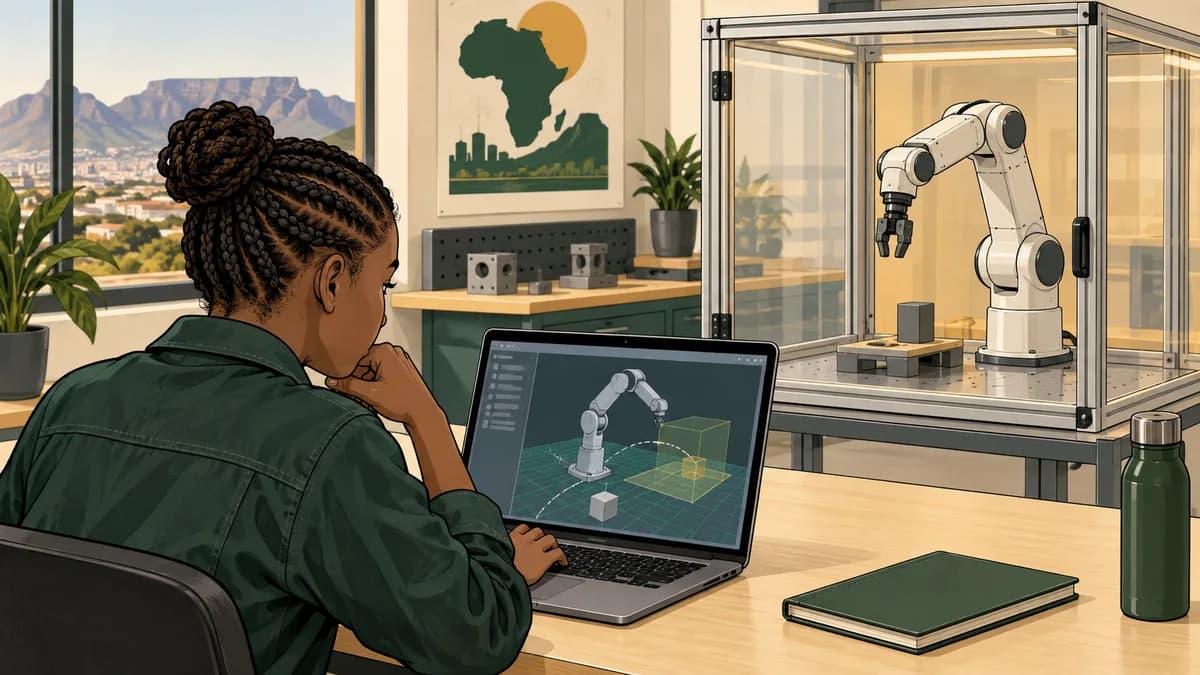
Industrial robotics training in South Africa can cover several distinct responsibilities: operating a robot safely, programming and recovering it, and integrating the robot into a production cell. Many search results use the word “robotics” for school coding, mobile robots or academic theory. Industrial learners need to confirm that a course uses a production robot or a clearly specified offline environment and teaches the safety, I/O and recovery work found in a factory cell.
This site is commercially connected to PLC Simulator. If you want software practice before choosing an industrial robotics class, explore the browser-based robot-programming course. Compare its educational scope with the manufacturer-specific robot, controller and supervision your intended work requires.
Compare the course level, controller generation and independent practical task before comparing provider names. Similar titles can refer to different levels of responsibility.
Industrial robotics is one branch of a larger controls stack. The industrial automation courses guide compares the PLC, SCADA, drives, instrumentation and network foundation that cell integrators need around the robot.
Choose the level before the brand
An operator course should address the tasks permitted for production use of a specified cell. Ask which operating modes, routine checks and recovery activities it covers, and which tasks remain outside the learner’s authority. Position changes, backups and service procedures should not be assumed to belong to every operator role.
A programming course goes further into coordinate systems, tool and work objects, motion instructions, speed and zone behaviour, branching, data, I/O instructions, routines and program testing. Learners should create and modify a program rather than only run one supplied by the instructor.
An integration course deals with the cell around the arm: safety functions, guarding, PLC handshake, fieldbus, end effectors, sensors, conveyors, vision, cycle-time design and acceptance testing. This level assumes the learner already understands operation and basic programming. Confirm the prerequisites rather than assuming a short programming course provides a complete integration pathway.
| Level | Typical role | Independent outcome | Evidence to request |
|---|---|---|---|
| Operator | Operator, setter, maintenance assistant | Demonstrate the specified permitted operating tasks | Task-specific checklist and supervised assessment |
| Programmer | Robot technician, automation technician | Create and test a bounded robot task | Working program, tool data and test record |
| Service | Electrical or mechanical robot technician | Diagnose controller, axis and peripheral faults | Diagnostic worksheet and safe restoration task |
| Integrator | Controls engineer, system integrator | Connect robot, PLC, safety and peripherals | Cell narrative, I/O map, risk controls and acceptance test |

What a practical robotics course should teach
Robot anatomy and controller boundaries
The learner should identify axes, motors, brakes, mastering references, controller, teach pendant, safety chain, end effector and dress pack. Training must explain what can be checked by an operator and what requires an authorised service procedure. Industrial robots can store energy and move with high force; confidence without boundaries is dangerous.
Coordinate systems and motion
Joint-based jogging and Cartesian reference frames are different concepts. World, base, tool and work-object references affect how positions and motions are interpreted, with terminology depending on the controller. A course should show how the selected reference affects jogging and a fixture change. The course should make learners switch frames deliberately, explain tool-centre-point data and its verification requirements and explain the effect of linear versus joint motion.
Program structure
Good training moves beyond recording positions. Learners should separate initialisation, production sequence, recovery and reusable routines. They should use readable names, comments and controlled data rather than a long unstructured list of points. Program structure affects recovery time because a technician must understand where the sequence stopped and what is safe to repeat.
I/O and PLC handshaking
An industrial robot rarely works alone. A PLC and robot controller may exchange cycle requests, model selection, ready, busy, complete and fault information. Ordinary process handshake bits are not a substitute for validated safety functions. Training should teach a defined handshake with timeouts and recovery, not a loose collection of bits.
The PLC side is covered in the sequencer logic guide, communication troubleshooting lesson and first-fault exercise. The concepts can inform work across platforms, but the implementation and recovery rules must match the specific system.
Safety and risk reduction
An emergency stop is not a complete robot safety design. Industrial training should distinguish emergency stop, protective stop, enabling devices, guarded space, manual modes, speed limits, reset and restart prevention. Ask the provider which manufacturer instructions and applicable robot and machinery standards its training addresses. Cell design and work procedures require the appropriate competent assessment; a short course overview is not a complete safety design.
Fault recovery
For a course that includes recovery, ask which supervised or simulated cases learners practise, such as loss of part, interrupted cycle, failed gripper confirmation, position mismatch, program pointer error, communication loss and a stop caused by guarding. A recovery method must establish the physical state before resuming logic. Blindly pressing start is not a method.

Brand-specific training: ABB, KUKA, Yaskawa and others
Robot programming languages, controller generations and pendant workflows differ. ABB courses may focus on RAPID, RobotStudio and IRC5 or OmniCore workflows. KUKA courses may use KRL and KRC controller generations. Yaskawa, FANUC and other platforms have their own job structure, frames, recovery tools and service boundaries.
Choose the brand used by the workplace or sector you can access. If that is unknown, choose the course with the strongest practical assessment and available offline software, then learn transferable concepts consciously. Compare motion concepts, frames, I/O and state deliberately, then verify the chosen platform’s instructions and procedures. Familiarity with one interface is not proof of competence on another.
Controller generation matters as much as the logo. Ask whether the training environment matches current equipment, installed legacy cells or both. A course on an older generation can still be commercially useful if local plants run that generation, but the provider should say so plainly.
Online simulation versus a physical robot
Offline programming software is valuable for coordinate work, program structure, reach checks, collision review and cycle-time experiments. It lets each learner practise without waiting for a shared arm and makes repeated mistakes inexpensive. Ask how each learner receives an independent attempt and feedback in the proposed format.
A physical robot is essential for mastering, payload effects, cable behaviour, tooling, real safety devices, imperfect fixtures and the judgement required near moving machinery. Ask how offline preparation connects to supervised practical assessment and which simulated results require verification on the actual equipment.
Ask whether “online” means live instruction using the actual vendor simulator, recorded video, or remote observation of a physical cell. Those formats create different practical value. Also check licence access after the course; a project you cannot open at home has limited portfolio value.
Entry requirements
Operator courses may require only basic computer literacy and a role connected to the cell. Programming courses benefit from electrical control knowledge, Boolean logic and production experience. Integration courses should expect PLC programming, industrial networks, drawings and machine-safety foundations.
School leavers interested in industrial robotics should consider a mechatronics, electrical or automation route rather than treating a short robot course as a complete occupation. The mechatronics courses guide compares the formal pathways that provide the broader base.
Experienced artisans may bring relevant foundations. Electricians already bring safe work, signals and control circuits; millwrights bring machine behaviour and mechanical recovery. Both need structured robot frames, program flow and controller diagnostics. Assess each learner’s starting knowledge, including mechanical limits, payload and tooling, rather than inferring it from a job title.

How to compare practical hours
Course duration is not practical duration. Lectures, demonstrations, independent attempts and equipment sharing affect how the scheduled time is used. Ask for the number of learners per robot, the number of offline stations, the final independent task and the assessment rubric.
An assessment should name the permitted tasks, conditions and supervision. Request the rubric for your course level instead of assuming that every operator programme includes position changes or that every programming course covers cell recovery design.
Portfolio evidence must be safe and lawful. Do not copy a real factory program or photograph restricted cells. Build a neutral training cell, remove provider-owned templates if required, and record your own control narrative, I/O map and test results.
South African attendance and equipment fit
For a learner in Gauteng, Cape Town, Durban, Gqeberha or another location, start with the confirmed venue and dates of the specific course. Add travel and accommodation where necessary. Ask whether the provider can deliver the required software component remotely and where the supervised hardware sessions take place.
Use the equipment in your intended workplace to inform the technical enquiry. Automotive assembly, packaging, materials handling and other applications can require different tooling and process knowledge. These are possible learning contexts, not a claim about regional job numbers or which brand dominates a province.
A preparation sequence to adapt
Begin with the course prerequisites: Boolean logic, program state and relevant electrical or mechanical foundations. Then study a small software sequence with request, busy, complete and fault states. Learn the named robot’s frames and programming concepts through suitable manufacturer material. Record questions about the controller and tool configuration for the instructor.
Before hardware sessions, agree on the practical tasks and supervision with the provider. Do not turn a paper cell design or a simulated path into a claim of a validated installation. Progress through the preparation at a pace supported by your understanding; this is not a fixed timeline to competence.
Preparation does not replace supervised robot training. It can help you identify foundational PLC and sequence questions before the hardware sessions.
Questions to ask a robotics provider
- Which robot, controller generation and software release are used?
- Is the course operator, programmer, service or integration level?
- How many learners share each robot and offline station?
- Which safety and recovery tasks are assessed?
- Will I create a program independently?
- Does the fee include software access and assessment?
- What certificate is issued and what exactly does it verify?
- May I retain a neutral portfolio project?
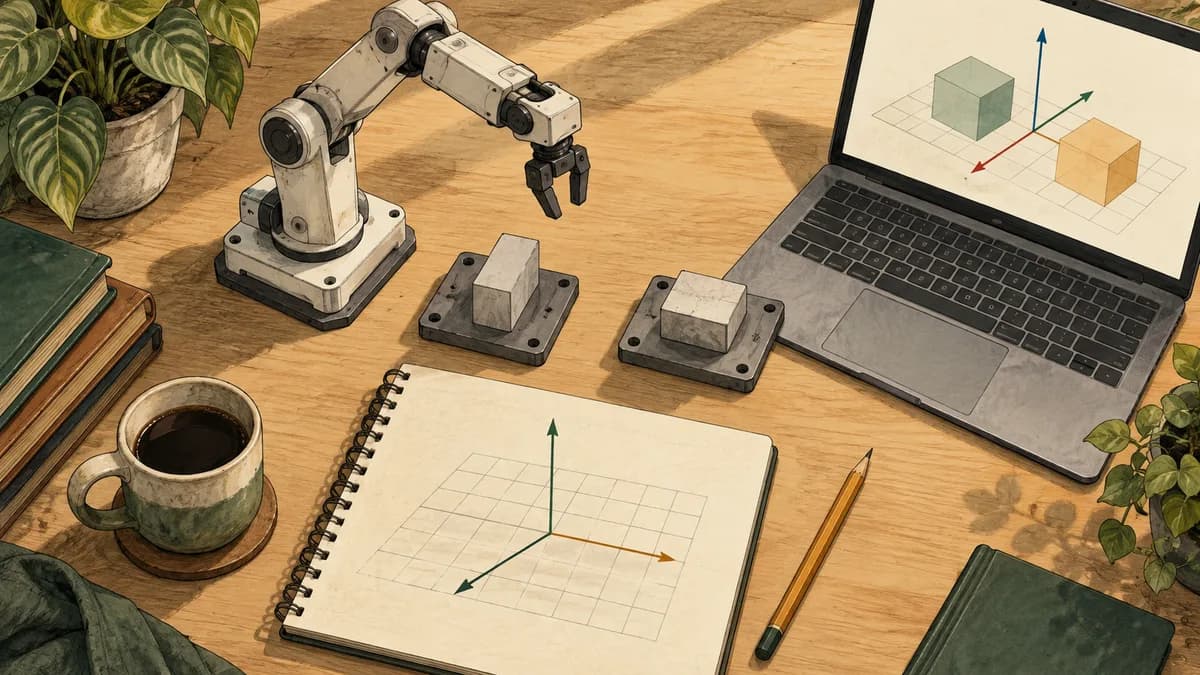
A coordinate exercise to ask a course provider about
Use this fictional two-dimensional example to check whether a course teaches frame reasoning. It describes points on paper, not robot motion instructions or a safe path. Ignore height and orientation for this first exercise. All distances are in millimetres, and the fixture axes initially point in the same directions as the world axes.
Suppose a fixture origin is at world coordinates (400, 200). A study point has fixture coordinates (50, 30). Because the axes are aligned, its world coordinates are (450, 230): add the fixture origin to the local point. A second local point at (100, 30) becomes (500, 230).
| Fixture origin in world coordinates | Local study point | Resulting world point |
|---|---|---|
| (400, 200) | (50, 30) | (450, 230) |
| (400, 200) | (100, 30) | (500, 230) |
| (420, 190) | (50, 30) | (470, 220) |
| (420, 190) | (100, 30) | (520, 220) |
The last two rows move the fixture origin by (+20, −10), without rotating its axes. Both world points move by that same amount, while the local coordinates stay unchanged. A learner should be able to explain why editing every local point would be a different modelling choice from updating the fixture reference.
Now consider a separate case: return the origin to (400, 200) and rotate the fixture axes 90 degrees counter-clockwise in this ideal two-dimensional plane. A local displacement (x, y) becomes a world displacement (−y, x). The local point (50, 30) therefore becomes world point (370, 250), not (450, 230).
A course can use this example to ask you to identify the reference frame, predict the change and explain the assumption that failed when simple addition no longer worked. The calculation is independently checked for this guide. It does not verify a vendor project, a robot's reach, joint configuration, tool orientation, collision clearance or the path between points.
In a real robot application, reaching an endpoint and choosing a suitable motion are separate questions. Two paths with the same endpoints can pass through different space. Ask the course how its software and supervised practical work address frames, tool data, motion type and the limits of simulation. Do not treat the paper calculation as instructions for moving an arm.
Manufacturer resources and local course enquiries
The official ABB RobotStudio tutorials provide manufacturer material for programming and simulation. The page includes tutorials relating to licensing and the 2026 software trial. Check your actual software entitlement and course requirements; the availability of a tutorial does not establish permanent free access to every software feature.
ABB also provides an education resource overview. Use it to investigate the available learning formats and equipment options. An international education page is not a confirmed South African intake, a quotation or evidence that a particular independent provider is an authorised partner.
A local example is Jendamark’s 2026 KUKA training catalogue, checked on 11 September 2026. It lists training in Montana Park, Pretoria, a minimum of four participants and per-person prices excluding VAT. Its course summary lists Programming 1 KRC4 as five days at R25,225.50, with listed prices valid through 31 December 2026. Treat this as an advertised example and obtain a current quotation. The detailed Programming 1 section also contains KRC2/KSS 5.x wording beneath a KRC4 heading, so confirm the actual controller and software version before booking.
For a local course, ask the provider to name the exact robot and controller, software release and instructor-led practical tasks. Request current dates and a written quotation instead of relying on an old downloadable schedule. If you need ABB, KUKA, FANUC or Yaskawa training for an employer's equipment, supply the installed model and controller details with the enquiry.
Keep the provider's claims separate from your own assessment of fit. A vendor partnership, certificate or training photograph may be relevant, but each needs its specific meaning confirmed. Ask what you will attempt independently and what evidence the instructor will review.

Questions about robotics training in South Africa
Can a beginner start with industrial robot programming?
A suitable introductory course can teach foundations, but its entry requirements matter. Ask whether it assumes electrical drawings, programming concepts or experience around a production cell. An operator introduction, an offline programming course and an integration module can begin at very different levels even when all use the word “beginner”.
Is RobotStudio training the same as training on a physical ABB robot?
They can overlap in programming concepts, but the environment and practical tasks differ. Ask which controller is simulated, what hardware sessions are included and which work is assessed under supervision. Software practice does not automatically provide experience with physical tooling, calibration, servicing or a particular installation's operating procedures.
Should I learn PLC programming before robotics?
It depends on the course and your intended role. An integration task may require understanding the exchange of requests, acknowledgements and states between the PLC and robot controller. A focused robot programming lesson may teach its own prerequisites. The PLC training guide can help you define the surrounding control-logic gap without assuming every learner needs the same sequence.
How much does an industrial robotics course cost?
Obtain a current quotation for the exact level, equipment and delivery format. Include any required software, travel and accommodation, and confirm tax treatment and assessment charges. The course budgeting guide provides an itemised comparison method; its PLC provider examples should not be presented as robotics course prices.
Can I study robotics online from Cape Town or Durban?
Remote learning may cover appropriate theory and software exercises, subject to the course's device and access requirements. Check whether teaching is live, recorded or based on remote equipment. For physical practical work, confirm the actual venue and attendance dates. A nationally marketed course does not necessarily run hardware sessions in every city.
Does a robotics certificate allow me to work on any robot?
Do not infer broad work authorisation from a course certificate. Ask what the document records and what your employer or site requires for the particular task. Robot model, controller, tooling, cell conditions and work procedures affect the practical scope. Service training and ordinary production operation should not be treated as interchangeable responsibilities.
Can I practise robotics without buying an industrial arm?
Yes, suitable educational software and offline learning can support selected programming and frame exercises. Confirm the tool's scope and licence terms. The browser robot-programming course overview is an educational starting point to compare with vendor-specific learning. It is not a substitute for the manufacturer's engineering environment or supervised work on equipment.
What should a robotics portfolio contain?
Use a neutral learning project with a written brief, assumptions, frame definitions, a program explanation and test records. Identify the software and assistance used. Distinguish simulated results from physical observations and avoid sharing confidential workplace programs. A clear explanation of one bounded task is more assessable than an unexplained recording of an arm moving.
Choose the next course around a specific task
Write the task you need to learn and the equipment it relates to before requesting course recommendations. Ask the provider to show how the teaching, practical access and assessment address that task. Keep software preparation, physical practical work and workplace authorisation distinct in your plan.
After training, review one small exercise and explain the result without relying on the supplied solution. Record the questions you still need an instructor or supervisor to resolve. This gives you a useful basis for the next learning step and for a candid discussion of what you can demonstrate.