locations · South Africa
PLC Training in Durban: Courses and Diagnostic Skills
Compare PLC training in Durban: course dates, practical access, Pinetown enquiries, software checks, costs and a beginner conveyor diagnostic exercise.
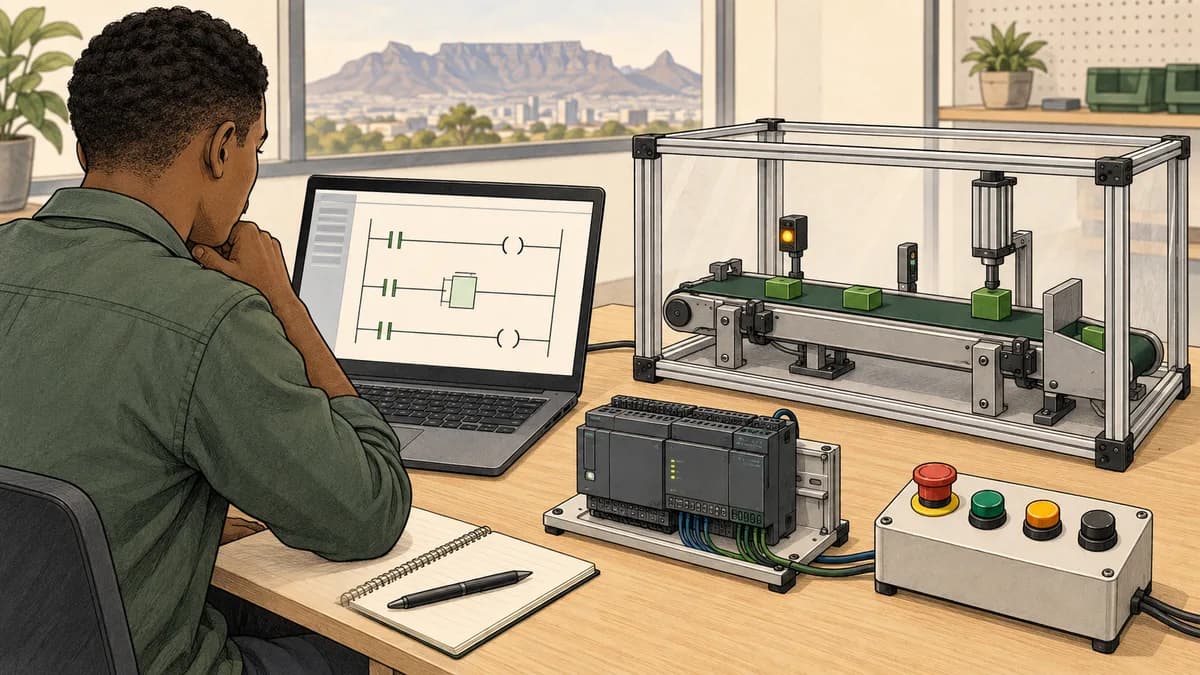
PLC training in Durban is easiest to compare when you know whether you need beginner programming, maintenance diagnostics, a formal engineering study route or instruction for a named controller. Ask for the actual venue, current course dates, individual practical access and assessment task. A general promise of “industrial automation” does not tell you what you will be able to demonstrate after attending.
This guide helps learners in Durban, Pinetown and the surrounding eThekwini area evaluate courses and prepare useful practical work. It includes a fictional conveyor diagnostic exercise that separates a symptom from a confirmed cause. It does not rank every local employer's controller brands or promise a salary increase from a certificate.
This site is commercially connected to PLC Simulator. You can inspect its PLC curriculum for educational preparation. Check the current access conditions and exercise scope on the product site. Browser practice is preparation for further learning, not authorisation to troubleshoot or modify a live industrial installation.
A published Durban PLC course to check directly
Festo's PLC111 introductory course page, checked on 12 September 2026, lists a Durban session for 16–18 September 2026. The provider states that dates may change. Confirm a place, venue and quotation directly before arranging leave or travel.
The page describes a three-day introduction covering program structure, inputs and outputs, timing, counting and fault analysis. It identifies Windows PC experience as a requirement and introductory pneumatics as advisable. Ask which controller and software the booked class uses, how stations are shared and how individual work is assessed. A published syllabus does not establish your place on the course.
College enquiries need a programme and campus check
Elangeni TVET College's official site lists several campuses, including Pinetown and a Mpumalanga campus in Hammarsdale, as well as an Artisan and Skills Development Centre in Inchanga. Here, “Mpumalanga campus” refers to the college's Hammarsdale location in KwaZulu-Natal, not a course in Mpumalanga province. Confirm the campus and programme together when making an enquiry.
The existence of an engineering or skills department does not confirm a standalone PLC short course with an open intake. Ask the institution for the exact programme name, entry requirements, current application route and the part of the syllabus that covers programmable control. Keep a formal qualification enquiry separate from a request for a short practical refresher.
If you are already employed, an employer-arranged course may be another route. Ask whether the proposed venue has the required training equipment and whether each learner gets hands-on time. A meeting room with a projector may support theory, but it does not by itself provide the practical environment described in a course proposal.
Decide whether you need programming or diagnostics first
Programming and maintenance diagnostics overlap, but their first learning tasks differ. A new programmer needs to turn a clear requirement into a small, testable sequence. A maintenance learner may first need to read existing logic, identify relevant signals and record what changed before a stoppage. Neither task starts with guessing the most popular brand in Durban.
| Learner situation | A useful first assessed task |
|---|---|
| New to PLCs | Explain inputs, outputs and a simple sequence in a learning model |
| Electrician moving into controls | Trace a documented signal path and distinguish physical from software evidence |
| Experienced technician changing platform | Navigate the named software and reproduce a diagnostic task |
| Engineering student | Link a control requirement to program structure and test cases |
| Team supervisor | Review individual evidence and identify further supervised practice needs |
Ask a provider to describe what happens when a learner gets a task wrong. Useful feedback identifies the mistaken assumption, gives the learner another attempt and records the corrected result. A demonstration that always works gives less information about how you will learn to investigate a difficult problem.
For prerequisites, use the PLC course entry requirements guide. A trade background can help with some tasks, but it does not automatically establish familiarity with project files, data types or a new vendor environment. Conversely, computer experience does not establish electrical competence or permission to work inside a panel.

Use Durban's industrial geography carefully
Dube TradePort's official overview describes manufacturing, assembly and logistics facilities in Dube TradeZone and locates its cargo facilities at King Shaka International Airport in La Mercy. That provides a specific context for researching industrial work north of central Durban. It does not establish the control platforms of every tenant or a guaranteed training-to-employment route.
Pinetown, Hammarsdale, central Durban and the airport precinct are different destinations for a learner planning attendance. Obtain the actual teaching address instead of assuming that a course marketed to Durban learners is delivered near your workplace. Check travel at the relevant start and finish times rather than relying on an undated regional estimate.
Richards Bay is a separate KwaZulu-Natal location, not an adjacent Durban classroom. If a provider combines several regional dates on one page, make sure the quotation identifies the city you are booking. The Richards Bay training guide addresses that location separately; a province-wide search can otherwise mix unsuitable venues into your shortlist.
For automotive-related learning, use the automotive assembly training guide to consider sequence and interface tasks. For water-related work, the water and wastewater guide introduces measurement and data-quality questions. These are learning contexts, not evidence that a particular local employer is recruiting beginners or using a specific controller family.
Select a controller course from the actual equipment
If you are learning for an existing machine, obtain an authorised description of the controller family, engineering software, firmware and HMI. Keep photographs, addresses and project files private unless you have permission to share them. The trainer can often identify whether a course matches your needs from a clean list of models and versions.
Do not infer a controller from the industry alone. A statement such as “all municipal water uses one brand” cannot guide a reliable purchase without equipment evidence. A plant can also contain several generations of control systems. An introductory class for one current product may not teach the connection and diagnostic workflow of an older installation.
When comparing Siemens, Allen-Bradley or Schneider options, ask for a representative project task in the advertised software. Confirm whether you will create a project, work online with a training controller, inspect an existing project or only watch a demonstration. These are different forms of access and should be reflected in the syllabus and price.
If you do not yet have a target platform, practise logic, state, timing and documentation first. Then choose a vendor course using a concrete role or study requirement. The TIA Portal and Studio 5000 comparison helps you ask version and workflow questions without making a Durban-wide claim about brand market share.
A fictional conveyor fault investigation for a course interview
Consider a software-only training conveyor with a request signal, a simulated ready signal, an internal run command and a simulated movement indication. The exercise produces no physical outputs. Its purpose is to practise evidence gathering and explain why a visible symptom is not the same as a confirmed fault cause.
The declared rule is simple: the internal command is true when both Request and Ready are true. Movement is a separate feedback input supplied by the fixture. There is no claim that this rule is suitable for a real conveyor, implements a safety function or diagnoses a motor. Real equipment needs a much larger design and an authorised investigation process.
Distinguish the four observation layers
| Layer | Question in this fictional exercise | What the observation cannot prove alone |
|---|---|---|
| Request | Did the learning model receive a request? | That the field operator pressed a working physical device |
| Ready | Is the fixture's ready condition true? | That every real machine permissive is satisfied |
| Command | Did the declared Boolean rule produce true? | That an output circuit delivered power |
| Movement | Did the fixture supply movement feedback? | That a real conveyor is mechanically healthy |
A learner who sees Command true and Movement false should record that mismatch. It is not enough to write “motor failed.” The simulated fixture could deliberately withhold feedback, the mapping could be wrong or the exercise could be paused. Those are hypotheses to investigate in the learning environment, not instructions to bypass a physical condition.
The PLC troubleshooting guide develops a disciplined observation sequence. Use its method to state the symptom, identify the evidence available, separate assumptions and choose the next permitted check. In a training course, the instructor should be able to explain which observations are intentionally available and which require another tool.

Work through all eight input combinations
With three independent Boolean inputs there are eight possible combinations. The command depends only on Request and Ready. Movement does not feed back into that command in this deliberately small model. Checking every combination makes that dependency visible and prevents a learner from accidentally adding an unrequested condition.
| Request | Ready | Movement | Expected command | Record |
|---|---|---|---|---|
| False | False | False | False | No request and not ready |
| False | False | True | False | Feedback exists without a command |
| False | True | False | False | Ready but no request |
| False | True | True | False | Feedback exists without a command |
| True | False | False | False | Request present, ready absent |
| True | False | True | False | Request blocked; feedback still needs explanation |
| True | True | False | True | Command present without feedback |
| True | True | True | True | Command and feedback both present |
The table is an expected-result specification. It does not claim that these cases were run on a particular controller or on a Durban training rig. If you implement it, record your own environment, revision and observed results. An expected table and an execution record serve different purposes.
For a second exercise, add a data-quality flag to Movement. When that flag is false, display “movement status unavailable” rather than treating the value as a confirmed stop. Keep the original Boolean value in the diagnostic record with its quality status. This teaches the distinction between a valid false value and missing or untrusted information.
Do not immediately add a timeout, automatic restart or fault reset. Each changes the requirements and needs its own timing and state definition. A course that encourages you to make those changes should first explain the new expected behaviour. More logic is not automatically a better diagnosis.
Present the result as a short technical handover
Write a one-page handover with the model's purpose, signal meanings, Boolean rule, eight expected cases and your observed results. Include one example where the command and feedback disagree. Explain what you can conclude and what remains unknown. That is stronger evidence of reasoning than a screenshot with an unexplained red indicator.
The product's PLC program testing page provides context for educational testing practice. Check the current tools and account access before planning a course around them. This example does not claim native project import, automated certification evidence or a substitute for a site's acceptance testing.

Ask about environmental documentation without inventing maintenance rules
A useful Durban course can teach learners to find the correct equipment manual and identify what information a qualified reviewer needs. It should not turn the city's coastal location into an arbitrary universal panel rating, a fixed terminal-tightening interval or a blanket instruction to fit a particular protection device to every installation.
For a classroom document review, record the equipment model, manual revision, specified operating conditions, enclosure information and the relevant maintenance instructions. Mark unanswered questions clearly. The activity is about using evidence; it is not permission to inspect energised equipment, change connections or substitute a generic internet rule for the manufacturer's requirements.
The same care applies to fault causes. Humidity, contamination or damaged components may be hypotheses in a real investigation, but a PLC symptom alone does not establish them. Ask the trainer to show how evidence supports or rules out each hypothesis in an authorised training scenario. Avoid presenting a guessed environmental cause as a measured finding.
Compare course fees and practical access together
Ask for a quotation that identifies tuition, assessment, materials, software access and any equipment charge. Check whether tax is included, when payment is due and what happens if the provider changes the date. A published course date close to your intended booking requires direct confirmation before you commit to non-refundable travel.
Add the cost of attendance from your own circumstances: transport, meals, accommodation if needed and agreed time away from work. Keep these estimates separate from the provider's fee. The PLC course price comparison guide explains how to compare scope without presenting illustrative budgets as current Durban market prices.
For shared equipment, request an individual rotation plan. A pair can learn effectively together if both people perform the task and explain the result, but a single group submission may hide who did the work. Ask whether the instructor reviews each learner's program or diagnostic record and whether there is time to correct a failed attempt.
Software access after the course also matters. If the training licence expires at the end of attendance, plan how you will retain permitted notes and continue suitable practice. Do not assume that a vendor project can be opened by any free simulator. Ask the provider which supported options apply to the exact software and project version.

Build a route that fits shift work and existing experience
For a shift worker, a course plan needs confirmed attendance dates and assessment arrangements. An online component may be self-paced, live or a mixture. Ask which sessions are compulsory and whether a missed practical can be repeated. “Flexible learning” should be translated into a timetable you can actually follow.
Before the practical class, practise file management, naming signals and explaining a small truth table. During supervised access, concentrate on tasks that need the equipment: the permitted connection workflow, observing the training system and using the named software's diagnostic tools. Afterward, revise your notes and repeat only the work your access and competence permit.
An experienced electrician may move quickly through some physical concepts while needing time for data structures or project navigation. A student may be comfortable with programming but unfamiliar with drawings and equipment boundaries. Ask for a prerequisite check instead of choosing solely from a beginner, intermediate or advanced label.
Questions about PLC training in Durban
Are there current beginner PLC course dates in Durban?
The Festo introductory page cited above lists a September 2026 Durban session as checked on 12 September. Dates and availability must be confirmed directly. Do not treat this article as a live booking system; use the provider's current response for your purchase decision.
Can I study PLC programming in Pinetown or Hammarsdale?
Local college campus information provides a starting point for enquiries, but it does not establish that every campus offers the same PLC course. Ask for the programme, campus, practical equipment and intake together. Also compare employer-arranged or online preparation options if a suitable local class is unavailable.
Which PLC brand should a Durban beginner learn first?
Use the equipment named in your target role or course when you have that evidence. Otherwise begin with transferable logic and testing skills, then choose a platform with accessible practical instruction. No verified city-wide brand ranking is established by this guide.
Does a short course make me qualified to commission machinery?
A course can teach and assess particular tasks, but the certificate's scope must be read accurately. Employment requirements, supervision, competence and site authorisation remain separate questions. Do not describe attendance or an educational simulation result as approval to work independently on an industrial installation.
What should I show in a beginner portfolio?
Show one understandable task with your own contribution, expected results, observed results and an explanation of a failed or ambiguous case. The conveyor evidence exercise above is suitable as a fictional starting point. Label it as educational work and keep employer information out unless sharing is authorised.

Make your Durban course enquiry specific
Tell the provider your background, available dates, intended task and target equipment if known. Request a current syllabus, practical address, complete quotation and individual assessment description. Save the response and check any changes before attendance. This makes the course comparison concrete and reduces the chance of buying a programme that assumes skills you have not yet developed.
Prepare a small diagnostic record before the first session. If you can distinguish a request, a command, feedback and data quality, you have useful questions to bring to practical training. Continue building that evidence carefully, with the learning environment and limits stated clearly, as you develop the skills required for your next role or study assessment.