compare · South Africa
TIA Portal vs Studio 5000: A Practical Training Guide
TIA Portal vs Studio 5000 for South African learners: compare project structure, block instances, online edits, simulation and local course requirements.
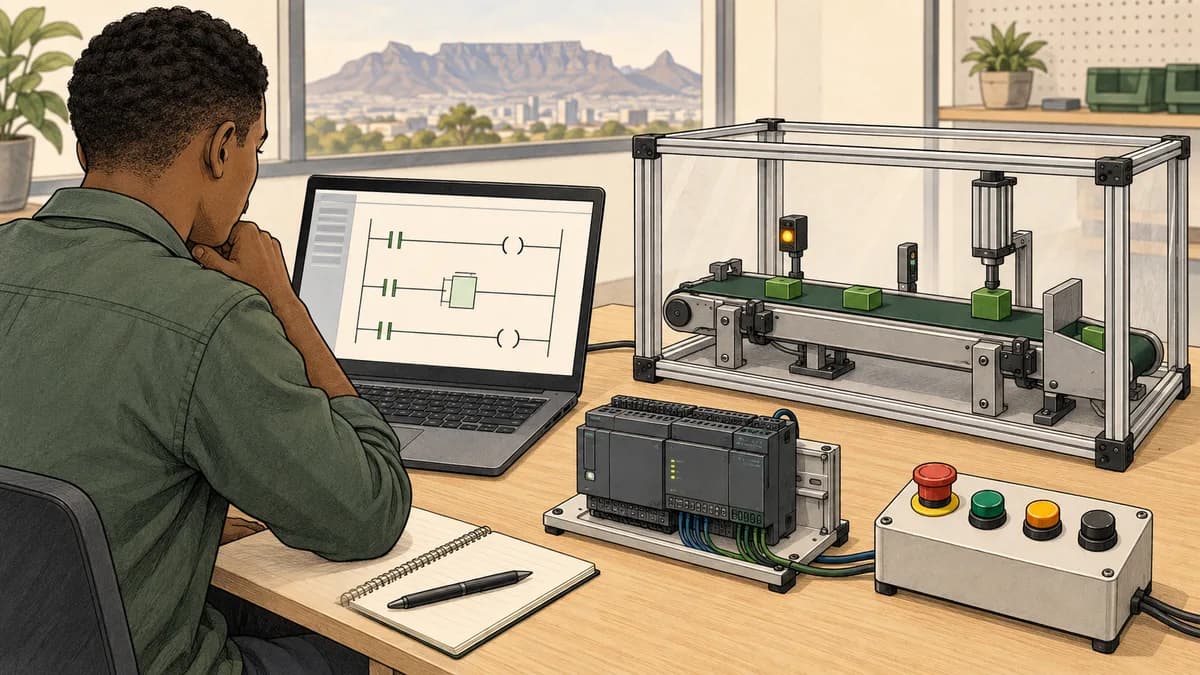
TIA Portal vs Studio 5000 is a choice about the controller project you need to understand, maintain or develop. For a South African learner, the useful comparison starts with the exact equipment and course access available to you. A brand logo, a city name or a claim that one editor is easier does not establish which software your next assignment requires.
TIA Portal is Siemens' engineering environment; STEP 7 provides PLC programming within it. Studio 5000 Logix Designer is Rockwell Automation's programming application for supported Logix controllers. Both require you to understand execution, data ownership, diagnostics and controlled changes. Learning those ideas helps you move between platforms, but a project file, instruction or qualification does not become interchangeable because the underlying control problem looks similar.
This guide compares engineering workflows and proposes a small, reproducible learning exercise. For the broader employment decision, use our Siemens versus Allen-Bradley guide for South African learners.
This site has a commercial connection to PLC Simulator. Its educational exercises do not provide vendor engineering licences or reproduce every native controller behaviour. The illustrations are conceptual learning scenes, not screenshots of either application.
Quick comparison: what should a learner investigate?
| Question | TIA Portal with STEP 7 | Studio 5000 Logix Designer |
|---|---|---|
| Which target can I use? | Confirm the CPU, firmware, STEP 7 edition and project version | Confirm the Logix controller, firmware and software edition/version |
| How is execution organised? | Trace the relevant organisation blocks and their block calls | Trace tasks, scheduled programs and routine calls |
| Where does reusable logic keep state? | A function block uses instance data | An Add-On Instruction call uses instance data supplied through a tag |
| What should I inspect before a change? | Compile results, online/offline differences and load preview | Verification results, online/offline differences and the applicable edit state |
| What can simulation establish? | Behaviour supported by the selected simulator and target | Behaviour supported by the selected emulator and target |
| What makes a course relevant? | Access to the actual STEP 7 workflow and required equipment | Access to the actual Logix Designer workflow and required equipment |
These are comparison questions, not a declaration that every Siemens or Allen-Bradley controller uses these tools. An older machine may require a different engineering package. Ask for the controller catalogue number and existing project version before buying a course or software licence.
Start with compatibility rather than the newest release
Write a short environment record before installing anything. Include the engineering application version, controller model and firmware, required device support, simulator version, operating system and licence entitlement. Add the HMI or drive engineering package when it forms part of the exercise. A course that names only “Siemens software” or “Allen-Bradley software” leaves too much unresolved.
For an existing project, ask whether you will open a copy, migrate that copy or work in the original release. Keep an untouched archive before experimenting. Being able to open or convert a project does not establish that the converted project can be returned to an older application unchanged. Record which version produced each saved archive and which dependencies another learner needs to reopen it.
Treat laptop specifications the same way. Compare the published requirements for your chosen combination, then consider the additional memory and storage used by virtual machines, HMI applications and simulation. A blanket claim that one IDE works comfortably with half the RAM of the other is not a benchmark. If a provider supplies a remote workstation, establish whether access continues after the taught sessions.
For Johannesburg, Pretoria, Durban, Cape Town or a remote South African classroom, location affects attendance and access arrangements. It does not prove the installed controller population of every nearby factory. A named employer's equipment list or an actual project requirement is more useful than a national brand stereotype.

Project structure: follow the execution path
A good first exercise is to explain how a particular output calculation is reached. Opening a routine or block in the editor does not demonstrate that the controller executes it. Trace the scheduling and calls, then explain which conditions can prevent that path from running.
In STEP 7, organisation blocks provide entry points for the relevant execution events. Follow their calls into functions and function blocks, and identify the data used along the way. Siemens documents the block categories in its STEP 7 block folder reference. Keep execution order separate from the folders used to make the project tree tidy; a convenient visual grouping is not an execution schedule.
In Logix Designer, inspect the task, the program scheduled within it and the program's main routine, then follow calls to other routines. Rockwell describes program-scoped tags, a main executable routine and optional subroutines in its program structure reference. The project is not simply a flat list where every visible routine runs automatically.
During a course demonstration, ask the instructor to leave a calculation in an uncalled block or routine. Predict the symptom before observing it: the code can look plausible while the expected update never occurs. Then restore the intended execution path and record what changed. This tests your understanding more directly than memorising the position of an editor button.
Tags, data blocks and reusable instances
Separate three questions when reading either platform: what logic is defined, where its state lives, and who can read or change that state. Giving two machines different names does not guarantee that their logic uses different storage. Conversely, sharing one reusable definition need not mean sharing all runtime values.
Siemens describes an FB call as an instance, with its working data held in instance storage. A single instance can have its own DB; a multi-instance stores its data within another FB's instance. These arrangements are documented in STEP 7 basics of instances. For a beginner's comparison, identify the individual state used by two calls before exploring more complex nesting.
Rockwell's Add-On Instruction usage reference explains that an AOI call takes a tag for its instance data. An AOI is a reusable instruction definition, not a third general tag scope alongside controller and program scope. Inspect the instance argument and parameter behaviour instead of assuming that an AOI is identical to a Siemens FB in every detail.
Likewise, symbolic access does not remove the need to consider data layout and external interfaces. When a project changes, investigate who consumes the affected values: another block, an HMI, a reporting application or a communications mapping. Renaming a field or changing its type can have consequences beyond the code currently open in the editor.

Worked exercise: two independent counters using one definition
This is a deliberately small fictional state model, not a claim about the built-in counter instructions in either vendor's software. Its purpose is to reveal accidental sharing of instance data. You can first solve it on paper, then implement an equivalent custom exercise in an authorised training environment using the relevant documentation.
Define a reusable operation with two Boolean inputs, Increment and Clear, and one stored integer, Count. On each call, Clear has priority and sets Count to zero. Otherwise, a true Increment adds one. If neither applies, Count holds its value. Every true Increment in this model adds one per call; it is not an edge detector. The short sequence below never approaches an integer limit.
Create instances A and B, each starting at zero. Call A and then B exactly once per row. The table shows both stored counts after both calls have completed. Unlisted Clear inputs are false.
| Row | A inputs | B inputs | Expected A count | Expected B count |
|---|---|---|---|---|
| 1 | Increment true | Hold | 1 | 0 |
| 2 | Hold | Increment true | 1 | 1 |
| 3 | Increment true | Increment true | 2 | 2 |
| 4 | Clear true | Increment true | 0 | 3 |
The final row matters: clearing A must not erase B's history. Explain which instance DB or instance tag holds each count in your implementation. Capture the relevant call arguments together with the observed values, so a reviewer can connect the result to the storage choice.
Now consider a faulty paper model where both calls use the same Count. After A increments in row 1, B's hold call leaves that same storage at one. There are no longer two independent histories. In row 4, A clears the shared value and B then increments it to one; B's intended accumulated value of three has been lost.
This failure is about storage ownership, not which vendor has the better editor. Repeat the exercise with A clearing while both Increment inputs are true: A should still become zero because the stated rule gives Clear priority. Also try a row where neither instance changes. A useful test includes cases that expose coupling and priority, rather than only a happy path where both instances happen to have equal values.
Keep the expected table separate from the implementation. If you discover a mismatch, record the row, expected state, observed state and cause. Do not change the expectation merely to match the output. Our PLC programming language comparison helps distinguish how a rule is expressed from what that rule is meant to do.
Cross-references and diagnostics: investigate a specific symptom
A meaningful debugging comparison starts with the same question in both environments: why did this value change, or why did it fail to change? Find its declaration, inspect the execution path and identify relevant writers. Then observe a controlled input sequence and explain the result.
Cross-references are useful evidence, but the absence of an obvious direct write is not a complete investigation. Consider parameters passed by reference, indirect addressing, communications and operator writes where the project uses them. Ask which additional diagnostics or application records are needed. A screenshot of a green rung cannot explain every source of a changing value.
For the two-instance exercise, a good diagnostic record contains the input sequence, the selected instance, the stored count and the call being monitored. Watching the wrong instance can make correct logic appear faulty. Write down whether the editor is displaying offline code, online code or a particular runtime instance, rather than relying on colour alone.
The same discipline applies when a sensor value looks wrong. Separate a simulated input assumption, a mapped controller value and the physical measurement they would represent on real equipment. Our PLC troubleshooting guide develops that investigation. In a software-only lesson, the evidence concerns the programmed model; it does not confirm a physical sensor, wiring circuit or machine response.

Online editing: compare change consequences, not slogans
Neither “TIA always stops the CPU” nor “Studio changes anything without interruption” is a useful rule. The permitted change depends on the target, software and firmware, project state and type of modification. Learn to recognise what the engineering environment is proposing before treating a change as ready to execute.
For supported S7-1200, S7-1500 and S7-1200 G2 workflows, Siemens explains that modified objects can sometimes be downloaded in RUN. The engineering system checks whether STOP is required and reports the result in the load preview. Complex programs can also encounter limits. Read the documented RUN download conditions for the selected target; do not generalise from one successful edit.
Rockwell's ladder editing in RUN reference distinguishes accepting a pending rung edit from executing the changed rung. In its described replacement workflow, the original remains executed until the changes are tested. That distinction alone shows why “the editor accepted it” is insufficient evidence about running behaviour.
For a training comparison, prepare a proposed logic change and explain the expected behavioural difference, the affected values and the recovery plan. Capture the relevant preview or edit state in the isolated exercise. This is not a procedure for making live production changes: a plant's authorisation, process conditions and change controls determine whether and how such work proceeds.
Data preservation deserves a separate check. A downloaded modification can affect current values differently from a simple value adjustment. Siemens' STEP 7 V21 change notes describe a conditional Keep actual values capability for optimised DBs on S7-1500 firmware V4.1, with exclusions including certain type and structural changes. That is a specific capability with restrictions, not a promise that every DB edit preserves every value.
PLCSIM, PLCSIM Advanced and Logix Echo
Choose a simulator by the exact exercise and supported target. Record what it models and what the lesson assumes. Do not treat every Siemens simulator as the same product, or assume that one Rockwell emulation package covers every controller project.
Siemens' STEP 7 and WinCC licensing documentation distinguishes licensed STEP 7 editions and documents a 21-day trial. It also describes starting STEP 7 online simulation without an additional S7-PLCSIM licence. This does not establish that STEP 7 Basic is permanently free or that PLCSIM Advanced is included in every entitlement. Obtain the actual software and simulation rights in the course quotation.
Rockwell's FactoryTalk Logix Echo product page lists supported controller families and describes capabilities including snapshots. Its advertised Echo trial is a separate product offer; it does not establish a matching Studio 5000 licence term. Check the precise controller and revision combination before planning an exercise around an existing project.
A simulated result can demonstrate an expected state transition under the supplied assumptions. It cannot, by itself, prove physical stopping distance, electrical installation quality, network performance under plant conditions or a safety function's compliance. Label omitted devices and substituted signals in the exercise report. That makes the simulation useful evidence without giving it a scope it has not earned.
For earlier practice, PLC program testing exercises can help you work through expected results and fault cases. This educational practice is distinct from learning the native TIA Portal or Studio 5000 download and diagnostic workflow.

Choosing TIA Portal or Studio 5000 training in South Africa
Ask a prospective provider to show the actual learner task, not only a list of software names. Will you create a project, trace its execution, test two reusable instances, diagnose a seeded fault and explain a proposed change? Establish whether each learner performs these tasks or mainly watches the instructor.
Request a written breakdown of tuition, software access, equipment access, assessment and any additional charges. Where a price is quoted in rand, establish whether VAT is included and when the quotation expires. For an overseas software offer, distinguish the supplier's currency from an illustrative conversion. Avoid choosing between platforms using unsourced licence prices presented as permanent local facts.
For classroom training, confirm the venue, dates, workstation arrangements and learner access to the training equipment. For online training, check session times, bandwidth needs, remote access arrangements and the process for recovering an interrupted exercise. These practical details matter whether you study in Gauteng, KwaZulu-Natal, the Western Cape or elsewhere in South Africa.
Course completion, vendor training attendance and a formally recognised qualification are different claims. Ask exactly what the provider issues and which assessment supports it. A course code alone does not establish an advanced level, accreditation or eligibility for a separate professional certification. Match prerequisites to your current knowledge rather than buying the longest certificate list.
Use our PLC training options to organise the broader learning decision. A sensible sequence is to learn control fundamentals, practise a documented exercise, then add the native platform required by your target work. The structured simulator curriculum can support the fundamentals stage; it does not replace a vendor engineering licence or supervised equipment experience.
Questions learners ask before committing
Is TIA Portal easier than Studio 5000 for a beginner?
The answer depends on the project, instruction and prior experience. Compare whether you can explain execution, locate state and diagnose a controlled fault after a lesson. Familiarity with one editor can make it feel easier without demonstrating that it is universally easier to learn.
Can I convert a Siemens FB directly into a Rockwell AOI?
Treat the control requirement as the starting point for a new implementation. Review parameter passing, stored state, execution conditions, instruction behaviour and data types. Similar reusable-block concepts do not establish automatic source compatibility. Use a shared expected-results table to assess both implementations.
Does learning Studio 5000 cover every Allen-Bradley PLC?
No. Confirm the controller family and required engineering software. A course on a supported Logix controller should not be assumed to teach the tools or migration issues of every older Allen-Bradley system. The same caution applies to assuming one TIA Portal course covers every Siemens installation.
Can I learn without owning a physical PLC?
You can practise documented software and simulation exercises where access is available. Record their limits and keep physical commissioning as a separate learning requirement. Before paying, confirm that the course supplies the necessary native software access if native engineering skills are part of its promise.
Which software should I learn for a South African PLC job?
Start with the controller and project requirements in the roles you actually want. Separate required experience from preferred experience, and avoid counting repeated advertisements as independent demand. A city or industry label alone cannot settle the decision for every employer.

Finish with a project another learner can inspect
A strong comparison portfolio contains an environment record, a short requirement, the execution path, identified instance storage, expected test results and observed evidence. Include a failed case and its correction. Keep the original archive and describe any conversion or dependency needed to reopen the final project.
For the example here, the decisive evidence is that A can reset while B retains its independent history, and that you can explain why. Add the change-review notes and simulator limitations. Those records show transferable engineering reasoning while making clear which native environment you actually used. They give an instructor or prospective employer something concrete to discuss beyond a screenshot and a claim of proficiency.