compare · South Africa
Siemens vs Allen-Bradley SA: Which PLC to Learn First?
Siemens vs Allen-Bradley SA training: compare course access, software licensing, target jobs and practical skills to choose which platform to learn first.
Siemens vs Allen-Bradley SA training is best decided by the work you want to do, the equipment you can access and the learning support available to you. Start with the exact controller and task where those are known. If you are still exploring a career, gather evidence from relevant vacancies and course descriptions before making an expensive commitment.
There is no dependable national brand percentage established by this guide. It does not claim that every South African mine, beverage plant or automotive supplier uses the same platform. A city, industry label or employer's parent country is not a substitute for the equipment list at the actual site.
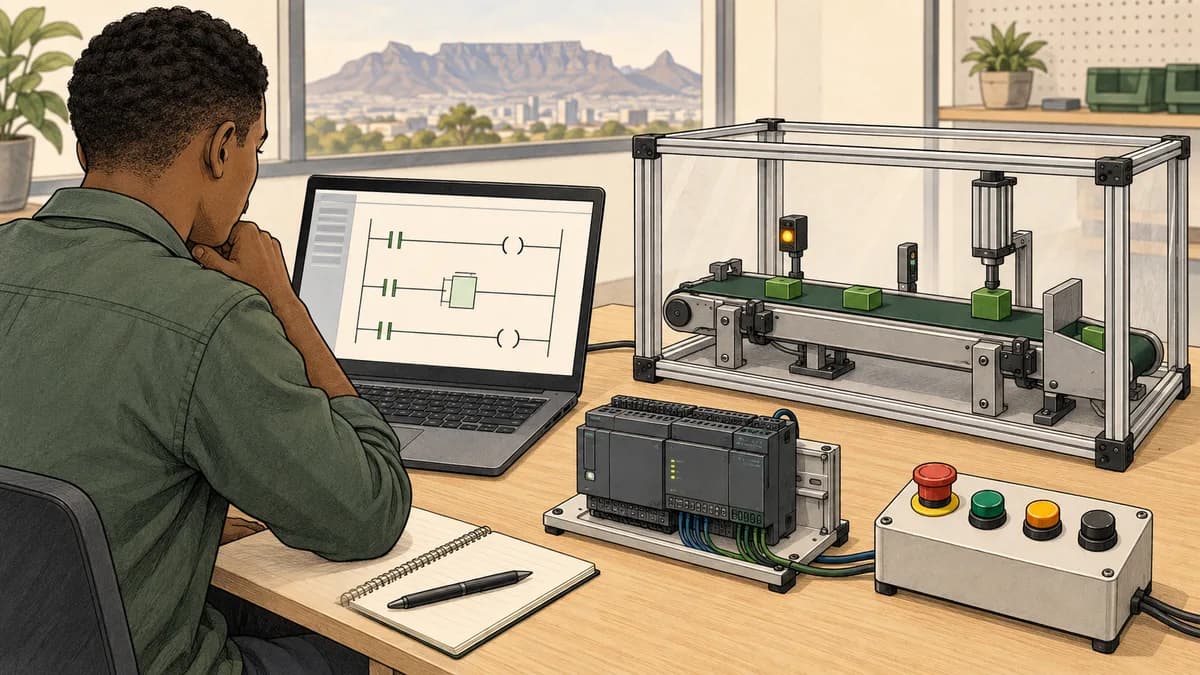
This site has a commercial connection to PLC Simulator. Its educational practice can help build PLC reasoning, but it does not supply Siemens or Rockwell engineering licences, reproduce every controller behaviour or guarantee a native project suitable for a plant. The illustrations are conceptual learning scenes rather than screenshots of either vendor's software.
Choose the first platform around a concrete opportunity
If your employer has identified a specific system you will maintain, that is strong evidence for the first platform to study. Obtain the controller family, engineering software and version, plus the tasks your role will involve. A maintenance technician reading an existing project may need a different course from a developer designing a new machine.
If you have no employer access yet, consider the opportunities you can realistically pursue. Include location, travel, entry requirements, practical experience and the work itself. A vacancy that mentions a familiar brand may still require qualifications or experience you do not currently have.
| Your situation | Evidence to collect | Sensible first learning focus |
|---|---|---|
| Employer specifies an installed platform | Equipment list, project version and assigned tasks | That supported platform and the relevant work |
| College or training centre provides a lab | Actual software, equipment and individual practice time | The available lab, if it meets your learning objective |
| Target vacancies name a platform | Current, deduplicated requirements from suitable roles | Skills repeatedly requested in that selected opportunity set |
| No target platform or lab yet | Course access, costs, prerequisites and support | PLC fundamentals plus an accessible practical environment |
| Already competent on one platform | Specific gaps in the next role or project | A defined second-platform task rather than starting over |
Do not turn this table into a permanent rule about your career. Review the choice when your responsibilities, access or target opportunities change. The first platform is a starting point, not a commitment to avoid every other environment.
Brand names do not identify one programming environment
A course advertised as “Siemens PLC” or “Allen-Bradley PLC” needs a more precise description. Product families and generations use different software and project structures. Ask for the exact equipment and environment rather than assuming one brand always means one editor.
The Siemens PLC training guide helps you compare the named controller, TIA Portal or other relevant environment, and course outcomes. The Allen-Bradley training guide makes the equivalent distinction between the controller family and the software used to work with it.
Why an older or smaller platform can still teach useful concepts
Inputs, outputs, state, timing, data interpretation and systematic fault investigation remain useful learning topics. Studying them on one supported platform can prepare you to ask better questions on another. That does not make the native project files, instructions or configuration interchangeable.
For example, a learner can explain why a command and feedback differ without claiming expertise in every vendor's diagnostic tool. Preserve that distinction in a CV or portfolio: describe the concept demonstrated and name the actual environment used.
Ask which generation the course prepares you for
The newest available product is not automatically the correct training target for an existing site. Equally, a low-cost course on older equipment may leave a gap if your intended role uses a different project model. Ask the provider how the course relates to the target equipment and what additional practice would be needed.
Request a sample exercise or syllabus detailed enough to show the work. A list of brand logos does not tell you whether you will configure a controller, write a routine, investigate a fault or merely watch a demonstration.

Correct the free-software assumptions before planning a budget
Siemens' STEP 7 and WinCC licensing documentation for TIA Portal V21 identifies licence requirements for STEP 7 Basic and Professional. It describes a time-limited trial expiring after 21 days. STEP 7 Basic should therefore not be advertised as a permanent free TIA Portal edition.
Rockwell's Micro800 selection guide lists Connected Components Workbench Standard as free and Developer as paid, with different capabilities. This is a Micro800 learning route; it is not the same product as Studio 5000. The guide also distinguishes limited simulator access from the full version.
These examples show why the question “Which brand has free software?” is too broad. Identify the product, edition, intended controller, permitted use and current access terms. An engineering editor, controller emulator, remote lab and educational browser simulator are different resources.
Build an access plan that lasts beyond a trial
Before activating a trial, confirm that your computer meets the documented requirements and that you can use the available period productively. Arrange the lessons, project files and support you need. Do not assume an expired trial can be treated as a permanent learning licence.
If access comes through a provider, ask whether it is limited to scheduled sessions and whether you may continue practising afterwards. Clarify who supplies the software, whether installation is required and what happens if the lab is unavailable. Record these answers before comparing course prices.
For related foundations, the guided PLC learning curriculum provides an educational route through supported exercises. It is not a replacement for native software access when the outcome requires that software.
Research relevant South African opportunities without inventing market share
Use a saved list of current opportunities that you could plausibly pursue. Record the source, capture date, location, job title, experience requirements and exact platform wording. Separate essential requirements from preferences and from broad descriptions of the employer's equipment.
Deduplicate repeated advertisements before counting them. The same role may appear through more than one recruiter or job board. Keep the evidence that supports your deduplication decision and avoid treating every search result as a separate employer demand.
Fictional vacancy-classification exercise
Suppose a learner creates the following eight unique teaching records. These records are invented to explain a research method; they are not current South African advertisements or a survey of the market.
| Fictional record | Platform wording category | How to record it |
|---|---|---|
| A | Siemens required | Siemens-specific requirement |
| B | Siemens required | Siemens-specific requirement |
| C | Siemens required | Siemens-specific requirement |
| D | Allen-Bradley required | Allen-Bradley-specific requirement |
| E | Allen-Bradley required | Allen-Bradley-specific requirement |
| F | Either platform accepted | Alternative requirement, not two separate jobs |
| G | Siemens preferred | Preference, not an essential requirement |
| H | No brand named | Unknown platform requirement |
There are three Siemens-specific requirements, two Allen-Bradley-specific requirements, one either-platform record, one preference and one unnamed record. Among these eight fictional records, the first two categories are 37.5 percent and 25 percent respectively. Those percentages describe only the invented dataset.
If record D appears again on another site and is confirmed to be the same vacancy, the collection has nine captured listings but still eight unique opportunities. Counting the duplicate would distort the comparison. Likewise, assigning record F to both brands without explaining overlap would make simple totals misleading.
Interpret the evidence at the right scale
A small, selected list can inform your next learning decision, but it is not a national installed-base survey. It also does not show which course will get you hired. Eligibility, experience, location, duties and application quality still matter.
Review the actual job requirements alongside your skills. If all suitable roles require maintenance experience you lack, choosing a brand alone does not close that gap. The PLC course requirements guide helps connect prerequisites and learning access to the next practical step.

Compare official courses by outcomes and prerequisites
Siemens' South African TIA-PRO1 course description names basic automation knowledge as a prerequisite and describes practical work with the TIA system model. That is more useful for choosing a starting point than assuming every course labelled Part 1 requires no prior knowledge.
Rockwell's certificate programme information identifies defined training paths and course codes, including ControlLogix fundamentals. Check the current description of the individual course, its prerequisites and local delivery arrangements before treating a path as a single interchangeable course.
Separate course attendance from demonstrated competence
Ask what assessment occurs and what the resulting document represents. A record of attendance, a provider's completion certificate and a qualification or professional credential can have different requirements and meanings. Verify the particular claim with the issuing organisation.
Do not assume a vendor course guarantees employment or automatically gives permission to modify production equipment. The useful question is what you will be able to demonstrate afterwards, and what supervision or further practice your intended role requires.
Request the same information from each provider
Provide a short description of your current knowledge and target task. Ask for the course syllabus, prerequisites, software and equipment, individual practical time, assessment and continuing access. Confirm the complete price and what is excluded.
For face-to-face training, include travel and time away from work. For online training, include suitable connectivity, computer access and the proposed practical environment. The cheapest advertised fee may not be the lowest complete cost, but the highest price is not proof of the best fit either.
Learn transferable PLC reasoning on the first platform
The first objective is to explain a small process clearly. Identify the inputs, outputs, states and expected responses before writing logic. Distinguish a physical device from a program variable and an operator request from confirmed equipment feedback.
Practise tracing why a condition is true or false. Record expected results for normal operation and defined abnormal cases. These habits transfer more reliably than memorising where a button appears in one software version.
Use a small project with explicit boundaries
Choose an educational task whose behaviour you can describe completely, such as a simulated conveyor request and status display. Define the intended start, stop and reset behaviour within the model. Do not present a classroom sequence as a validated machine safety function.
Keep a table linking each requirement to the relevant logic and a test. If a result differs from your expectation, preserve the observation and investigate the reason. Avoid changing several unrelated conditions until the animation looks right.
The PLC program-testing resource supports this way of organising educational evidence. It does not prove that a project can be downloaded unchanged to either vendor's controller.

What needs to be relearned on the second platform
A second platform brings its own project organisation, data types, task behaviour, instructions, configuration and diagnostic workflow. Treat those as things to verify rather than assuming identical names mean identical semantics. The same process requirement can be implemented differently in two supported environments.
Start with a small, already-understood requirement and reproduce its intended behaviour using the second platform's documented features. Compare the test results and explain any differences. Do not time yourself and declare one brand inherently easier from one unfamiliar exercise.
Transfer requirements and tests before transferring code
A clear requirement and its acceptance cases can survive a platform change even when the source project cannot. Recheck the exact meaning of instructions, variable scope, timing and retained state. Use the relevant vendor documentation and supported project configuration.
Reuse is valuable when its limits are understood. A library or function block may depend on a controller family, language feature, firmware or surrounding convention. Do not promise that every reusable block moves between products without rework.
Choose the second platform when it solves a real gap
There is no universal five-year deadline for learning another brand. An immediate mixed-platform assignment may justify it early; a specialist role may require deeper knowledge of the first platform. Use the work and available practice to decide the next step.
Breadth is useful when supported by evidence. Two brand names on a CV do not substitute for a clear explanation of the tasks performed, the environments used and the limits of the experience.
Online changes and recovery are engineering questions
Do not choose a platform solely from claims that one can always be edited while running and the other must always stop. Permitted changes depend on the controller, software, configuration and specific edit. A change being technically possible does not make it appropriate during production.
For a real task, use the vendor's procedure and the site's authorised change process. Establish the expected effect, backup, verification and recovery plan. A beginner comparison should not encourage live edits as an informal test of which brand feels better.
Power restoration also requires application-specific decisions. Retained values, initialisation, operator authority and feedback availability must be reviewed for the actual process. Do not assume a well-written project should always restart equipment automatically after an interruption.
Learn to describe a recovery requirement
In a teaching exercise, state which information remains valid after a simulated restart and which must be re-established. Identify whether operator action is required before the sequence continues. Record the expected states and compare the observed behaviour.
This exercise teaches requirement clarity. It does not establish the behaviour of every Siemens or Allen-Bradley controller, or validate a machine's restart protections. Keep the model and production responsibilities distinct.

Make local support and hardware access concrete
For training in Johannesburg, Pretoria, Durban, Cape Town or elsewhere, ask who supplies the actual lab and who responds when it fails. Confirm support hours, booking requirements and replacement arrangements rather than inferring them from a vendor's national presence.
For a workplace project, obtain a quotation and service scope for the exact equipment and location. An office address does not establish a guaranteed response time, parts availability or support for an older product. Keep promises from suppliers in the project record.
If considering used hardware for learning, verify the exact model, condition, required software, supported accessories and safe training arrangement before buying. A low controller price can leave substantial missing costs. Avoid treating second-hand availability as a reliable national price benchmark.
A practical first-platform decision record
Write a one-page decision with your target task, current knowledge, platform evidence, access arrangement, total learning cost and expected practical outcome. Include unresolved questions and the date you will review the choice. This turns a broad brand debate into an action you can assess.
For example, employer access to a supported lab and a relevant mentor may make one course more useful than a distant course with a lower fee. Another learner may have no employer access and need a structured introduction before a vendor-specific lab. The relevant evidence differs, so their decisions can reasonably differ too.
Define completion by observable work
Choose a small set of tasks you can demonstrate: explain the project structure, trace an input to a decision, interpret a timing instruction, diagnose a defined mismatch and document a change in a training environment. Name the actual tool used for each task.
At the review date, assess those outcomes rather than only counting lessons watched. If you have a gap in foundational logic, address it directly. If the gap is native software access, plan that access rather than assuming more generic exercises will reproduce the missing environment.
Show employers the work behind the brand name
A portfolio should explain the process, assumptions, program organisation, tests and observed results. Label simulation clearly and identify any physical equipment used. Include enough evidence for a reviewer to understand what you personally did.
Do not invent customer installations or imply that a generic simulator exercise was commissioned on a named vendor's production controller. You can still present useful learning honestly: the value lies in clear reasoning and repeatable evidence.
The PLC portfolio guide helps organise those records. It also supports a more productive interview discussion than claiming that a certificate or brand choice guarantees a salary band.

Questions about Siemens and Allen-Bradley training in SA
Which brand should a South African beginner learn first?
Start with a known employer requirement or an accessible, relevant learning environment. If neither is known, research suitable opportunities and build PLC fundamentals while clarifying the practical route.
Is TIA Portal Basic permanently free?
Do not assume that. The Siemens licensing documentation cited above identifies STEP 7 Basic licence requirements and a limited trial. Verify the edition and access terms before building your study plan around it.
Is Micro800 practice the same as Studio 5000 practice?
No. It can develop useful PLC concepts, but the environment and controller target differ. Describe the actual software used and obtain appropriate native practice for a Studio 5000-specific outcome.
Does either brand guarantee a higher salary?
A brand name alone does not establish pay. Compare actual roles, responsibilities, qualifications, experience and stated compensation. This guide provides no invented salary premium for either platform.
Must I learn both brands before applying for work?
Use the requirements of the roles you can reasonably pursue. Demonstrable competence in a relevant task matters more than adding unsupported claims of broad experience. Learn a second platform when it addresses an identified need.
Can an AI assistant choose my course?
Give it your target tasks, current knowledge, location constraints and the actual course descriptions. Ask for a source-backed comparison with missing information marked clearly. Confirm access, prerequisites and assessment directly with the provider before paying.