for · South Africa
PLC Training for Electricians in South Africa
PLC training for electricians in South Africa: connect drawings to input states, test a logic example and choose practical courses for your next step.
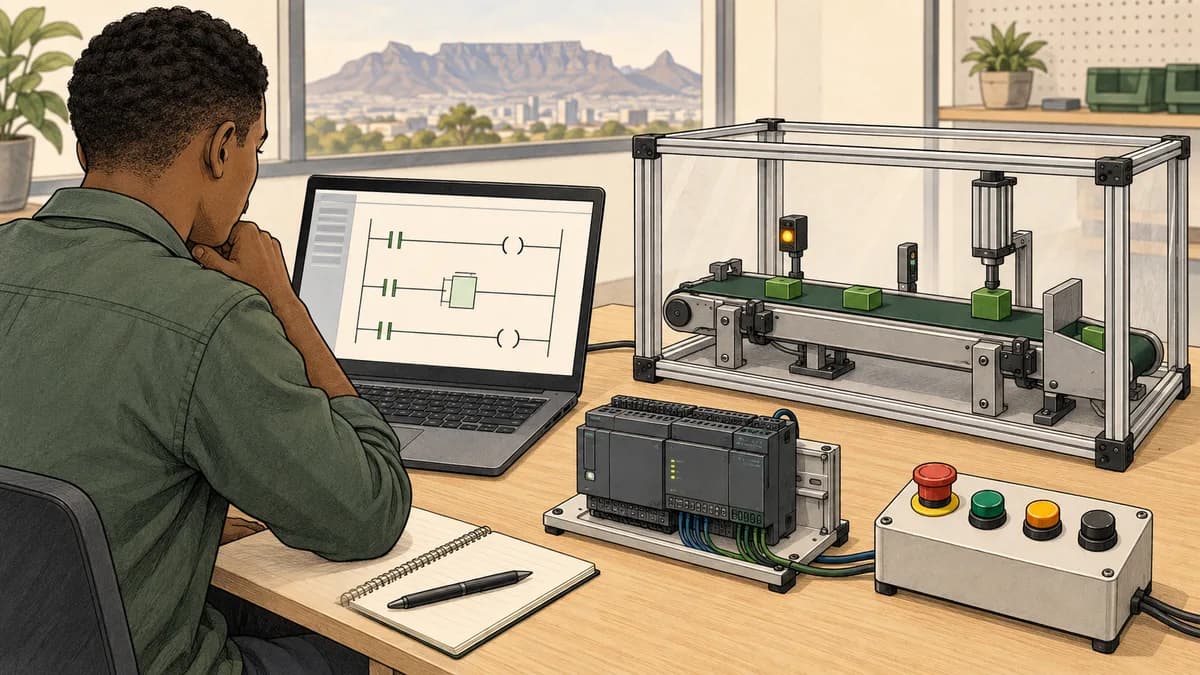
PLC training for electricians should connect the electrical systems you already understand to the software decisions you need to explain. Start by identifying your actual experience: building services, installation, industrial maintenance, motor control or an apprenticeship each provides a different starting point. You do not need to pretend you have commissioned a production line to begin learning PLC logic.
A useful first outcome is modest and testable: given a small program, explain what each input means, predict its response, test that prediction and record the result. From there, choose the vendor software and supervised practical training relevant to your intended work. Completing an online exercise does not establish competence to alter machinery or electrical installations.
This site is commercially connected to PLC Simulator. The PLC wiring practice preview offers a way to explore educational connections and logic. Its diagrams and virtual results are learning aids, not installation drawings or evidence that a physical circuit is safe.
Start with the electrical experience you actually have
An installation electrician may be comfortable with drawings, protective devices and testing records but have little experience with automatic sequences. A maintenance electrician may already read machine documentation and recognise sensor or contactor problems, while needing help with tags and software versions. An apprentice may need a slower introduction to both electrical terminology and computer project management.
Use a short baseline exercise before choosing a course. Can you follow a labelled signal from a device description to an input list? Can you distinguish a command from evidence that an action happened? Can you save a project copy with a meaningful filename? These questions locate learning needs more accurately than a broad beginner or advanced label.
| Existing experience | Useful connection to PLC learning | Additional skill to practise |
|---|---|---|
| Reading circuit drawings | Following references and identifying device purpose | Separating a physical contact from a software instruction |
| Recording electrical test results | Keeping observations and conditions together | Writing expected and actual software states |
| Maintaining motor circuits | Recognising commands, indications and process conditions | Distinguishing an output command from running feedback |
| Working from job cards | Describing a fault and documenting work | Recording program version, test case and unresolved uncertainty |
| Limited computer project work | Following a repeatable procedure | File organisation, backups and identifying the active project |
Treat this as a learning map, not a ranking of trades. If the electrical foundation itself needs attention, compare industrial electrical training routes in South Africa before combining several unfamiliar subjects in one short course.
The important difference: contact, input bit and instruction
A contact in an electrical drawing describes a physical device or connection. An input value in a PLC project is data. A ladder contact-style instruction evaluates a specified value. Similar-looking symbols can therefore refer to different things, and the relationship depends on the documented circuit, input configuration and program.
Rockwell's XIC instruction documentation describes an instruction that tests a Boolean data bit. With a true incoming rung condition, a true bit passes a true condition onward. The XIO documentation describes the complementary test: under the same incoming condition, a false bit passes a true condition onward. Read the applicable controller documentation when implementing either instruction.
Neither symbol, by itself, tells you whether a physical pushbutton is pressed. You need the signal definition. Nor does changing a software instruction establish fault tolerance or a safety function. Those questions involve the complete design and its verification, not just a Boolean expression.
Use the contacts and coils reference alongside ladder logic fundamentals, but write the meaning of each tag in ordinary language before drawing rungs. A tag called Input3 is harder to reason about than a documented input with a clear meaning, source and expected states.

Worked exercise: decode an inverted virtual sensor signal
This example deliberately uses a virtual box detector and a screen indication. It does not operate a motor, stop circuit or protective device. Its purpose is to practise translating an agreed signal meaning into a logical condition.
Imagine a training model supplies two Boolean values. RawClear is true when the model reports that the detection position is clear, and false when it reports a box present. DataValid is true when the model says that this information is valid. These meanings are assumptions of this exercise; they are not a universal sensor convention.
The required display has three possible messages: Position clear, Box present and State unknown. Unknown must remain distinct from clear. If the information is invalid, the display must not confidently report either physical state.
The rule is simple: first test validity. When DataValid is false, show State unknown regardless of RawClear. Otherwise, a true RawClear means Position clear and a false RawClear means Box present. There is no memory, counting, timing or output actuation in this example.
| Case | DataValid | RawClear | Expected display | Reason |
|---|---|---|---|---|
| A | True | True | Position clear | Valid information reports a clear position |
| B | True | False | Box present | Valid information reports the opposite of clear |
| C | False | True | State unknown | The raw value is not accepted as current information |
| D | False | False | State unknown | A false raw value without validity does not establish a box |
Now express only the Box present indication as a Boolean condition: BoxShown = DataValid AND NOT RawClear. In the named Rockwell instruction vocabulary, testing DataValid with XIC and RawClear with XIO in series expresses that condition, assuming the rung's incoming condition is true. This is an instructional translation of the stated data meanings, not a wiring recommendation.
Test all four combinations before adding anything else. The BoxShown results should be false, true, false and false for cases A through D. For the clear indication, use ClearShown = DataValid AND RawClear; its results should be true, false, false and false. For unknown, use UnknownShown = NOT DataValid; its results should be false, false, true and true.
The useful extra check is that exactly one of these three indications is true in each case. A display with both Box present and Position clear would contradict the requirements. A display with neither message when data is invalid would hide uncertainty from the learner.
What an electrician should explain after this exercise
Explain why an instruction that tests for a false bit can be correct even though the desired message sounds positive: Box present. The explanation is the documented meaning of RawClear, not an assumption about whether a physical device has normally open or normally closed contacts.
Next, rename RawClear to RawPresent without changing the expressions. The program now disagrees with the new name in the valid cases. That deliberately introduced documentation error shows why naming, comments and signal definitions belong in the review. A program can execute consistently and still communicate the wrong meaning.
Finally, remove the validity condition in a copy and repeat case D. The simplified expression would report a box even though the exercise says the state is unknown. Record that failed test, restore the condition and explain the correction. You have produced evidence of reasoning, not merely a screenshot with a green rung.

Learn the software workflow as its own subject
Being comfortable with electrical work does not automatically make a new engineering application familiar. Give project handling its own practice session. Create an educational project, save it, close it, reopen it and identify the version you intended to use. Keep the original exercise separate from your modified copies.
In vendor training, ask the instructor to demonstrate how the offline project, connected controller and observed values are identified. Monitoring a value, editing a project and transferring a program are different operations. The course should make those differences explicit before asking learners to perform them on training equipment.
For self-study, keep everything in a software-only environment until you have an appropriate supervised practical setting. Do not turn an unfamiliar button in an engineering package into an experiment on production equipment. Learning the interface is a valid objective by itself; it does not need a running plant to make it worthwhile.
A repeatable file routine can be short: retain the supplied exercise, create a named working copy, write the intended change, record the test and save the reviewed result. If you cannot tell which file produced a screenshot, the evidence is difficult for another person to assess.
Understand execution without assuming every PLC is identical
The familiar input–logic–output cycle is a useful introductory model. Real controllers can also have multiple tasks, interrupts, communication updates and I/O timing that requires platform-specific explanation. Avoid assuming that every value changes once at the same point in a universal scan.
Start with the scan cycle learning guide, then ask a precise question in your chosen vendor course: when does this task execute, and when is the value being monitored updated? That is more useful than memorising a single scan-speed number for all controllers.
In the virtual detector exercise, each test evaluates a fixed pair of inputs. It intentionally avoids timing assumptions. When you later add event counting or delays, document the evaluation order, starting state and reset behaviour. A test that works only because a hidden value happened to be retained is not a clear demonstration.
The product's scan-cycle highlighting feature can support introductory observation. Its educational execution view should not be treated as a timing measurement of a different manufacturer's controller.
Build a learning sequence around observable outcomes
Use the following sequence as an editorial study plan, adapting the pace to your starting point. It is not a promise that a set number of evenings produces workplace competence.
- Define signals. Create a small input list with names, meanings and both Boolean states. Complete the virtual detector table without relying on the appearance of a contact symbol.
- Read simple conditions. Explain series and parallel logic in words, then predict all input combinations for a small example. Distinguish what the expression means from how a field device might be connected.
- Handle project files. Reopen a saved exercise and reproduce a previous result. Demonstrate that the notes and screenshot refer to that version.
- Introduce state. Study a virtual start-and-stop example and document initial state, simultaneous requests and what happens after a reset. Keep it separate from physical motor protection design.
- Add time or events. Use the timers and counters guide to compare a delayed condition with an event count. State what resets each result.
- Practise diagnosis. Introduce one documented software fault in a copy, predict its effect and prove the correction with a repeatable test.
The motor-control practice preview can provide a next educational context after the input-state work. Keep virtual commands, displayed feedback and actual machinery clearly distinguished in your notes.

Choose a South African course by task and access
Searches such as PLC courses for electricians in Johannesburg, Durban or Cape Town express a practical constraint: reaching the training matters. Location does not establish syllabus quality. Ask which sessions are physically delivered at the named venue, which are remote and whether the advertised date is a confirmed intake.
For learners travelling from another town or province, calculate transport, accommodation, time away from work and access to follow-up practice. A short course with a lower headline fee can become a more expensive choice after these costs. Conversely, a nearby class is not good value if it omits the controller or diagnostic task you need.
Use PLC course prices in South Africa for the fee-comparison framework and online PLC training options for delivery questions. Request a written quotation describing VAT treatment, software access, equipment sharing, assessment, cancellation terms and what remains available after the course.
If you work shifts, ask about attendance requirements before paying. A recorded presentation, live tutorial and supervised practical session are different commitments. Confirm whether a missed practical can be rescheduled and whether help is available during the hours you can study.
For electrical contractors considering a move into industrial maintenance, choose introductory logic and documentation before an advanced commissioning syllabus. For an established maintenance electrician, a course on the installed controller's diagnostic workflow may be more relevant. For apprentices, coordinate the additional learning with the actual training programme and supervisor rather than treating a short course as a substitute.
Siemens, Allen-Bradley or another platform?
Select a brand using evidence from the role or equipment you are targeting. An authorised asset list, an employer's stated requirement or a provider's precise syllabus is useful. A general claim that a whole South African industry uses one manufacturer is not enough.
Compare Siemens PLC training, Allen-Bradley course choices and Mitsubishi PLC learning routes where relevant. Confirm the actual controller family and engineering software within the brand. Familiarity with general ladder conditions does not remove the need to learn project structure, addressing, diagnostics and version compatibility in the chosen environment.
Use troubleshooting practice to improve the explanation
A strong diagnostic answer separates observations from conclusions. “The display says unknown” is an observation. “The detector is broken” is a conclusion that the virtual example does not support. In case D, the agreed model only establishes that the information is invalid.
Build a short fault record with four fields: expected behaviour, observed behaviour, evidence inspected and next justified test. For the renamed-tag error, the evidence includes the signal definition and test table. The correction is to reconcile the documented meaning and expression, then repeat all cases, not just the one that initially looked wrong.
On physical equipment, diagnostic work also depends on authorisation, applicable procedures, equipment documentation and the person's competence. A screen indication alone does not justify live electrical investigation or a program change. Your course should teach where software observation ends and another authorised procedure begins.
The PLC troubleshooting guide supports the reasoning side. During provider assessment, ask learners to explain why they chose a test and what its result would rule out. Repeatedly changing conditions until an output appears gives much weaker evidence than a small, justified sequence.

Keep a portfolio that shows your own reasoning
Use fictional projects or material you are permitted to share. Do not include employer programs, network details, passwords, production settings or customer drawings in a public learning portfolio. You can demonstrate the same reasoning with an invented box detector and a complete test record.
A useful entry contains the problem statement, signal definitions, program or logic representation, expected cases, observed results, one corrected error and a brief explanation of the limits. State the software environment and whether the result came from simulation. Avoid captions that imply a real machine was commissioned when the work was entirely virtual.
For this exercise, a reviewer should be able to reproduce all four rows and see why invalid data produces an unknown state. Add a second version only when it demonstrates a meaningful extension, such as recording transitions separately from the current indication. Ten nearly identical screenshots do not explain as much as one complete, reproducible example.
If you later undertake supervised hardware training, document that experience separately with the provider's actual assessment description. Keep attendance, course completion, assessed practical work and any formal qualification distinct. Do not imply that a simulator completion record confers an occupational registration or manufacturer credential.
Common questions from electricians considering PLC training
Can an electrician learn PLC programming without previous coding?
Yes, introductory logic can be learned without a prior software-development course. The practical starting point is understanding Boolean values, following a project workflow and testing assumptions. Electrical experience may provide useful context, but the amount of additional study depends on the person and the work being targeted.
Do I need a PLC at home to start?
A physical PLC is not necessary for the software-only exercises described here. A simulator allows repeated logic tests without buying training hardware. Hardware configuration, electrical installation and real communication faults require additional learning opportunities; virtual practice should not be presented as proof of those skills.
Is a PLC course the same as an electrician qualification?
No. A PLC short course or simulator curriculum has its stated learning scope and assessment. If formal recognition is important to your objective, request the exact qualification or programme identifier, awarding body and provider status, and verify those details with the relevant body before enrolment. This site's educational material does not award an electrician qualification.
How long before I can apply for controls work?
There is no reliable universal timetable. Compare a specific vacancy with your existing experience, training and demonstrable gaps. Use applications honestly: describe completed virtual projects as virtual projects and supervised practical experience as supervised experience. A course duration is not an employment guarantee or a measure of independent workplace competence.
What if I am comfortable with wiring but struggle with computers?
Separate computer handling from logic practice. First learn to open, save and reopen a small project. Then change one named value and record the result. Ask the provider whether introductory software navigation is included and what computer access you need outside class. This is a prerequisite question, not a reason to hide uncertainty.
Can I study PLCs part-time while working shifts in South Africa?
Part-time study can fit around work if the delivery format and support hours fit your schedule. Confirm which activities are asynchronous and which require attendance. Plan sessions around a complete small task, such as testing the four input combinations, and retain notes so the next session starts from a known state.
Where should I begin if my goal is better maintenance fault finding?
Begin with signal meanings, project identification and observation before complex sequences. Complete the detector exercise, then practise explaining a command and its separate feedback. When choosing a vendor course, ask for relevant diagnostic exercises and supervised assessment on the named platform, rather than selecting solely by the number of topics advertised.

Your next practical step
Write the two input definitions and predict the four display results before opening a simulator. Reproduce them, save the evidence and explain the deliberately introduced error to someone else. This gives you a concrete baseline for deciding what help to buy next.
Browse the product's PLC learning curriculum and current access and pricing for the available practice scope. Choose a further course when you can name the missing capability: vendor project handling, supervised equipment work, a diagnostic method or a relevant formal pathway. That makes the purchase serve a specific learning need.