brands · South Africa
Siemens PLC Training South Africa: TIA Portal & Prices
Compare Siemens PLC training in South Africa by TIA Portal version, course prices, practical projects and assessment, with a route to simulator practice.
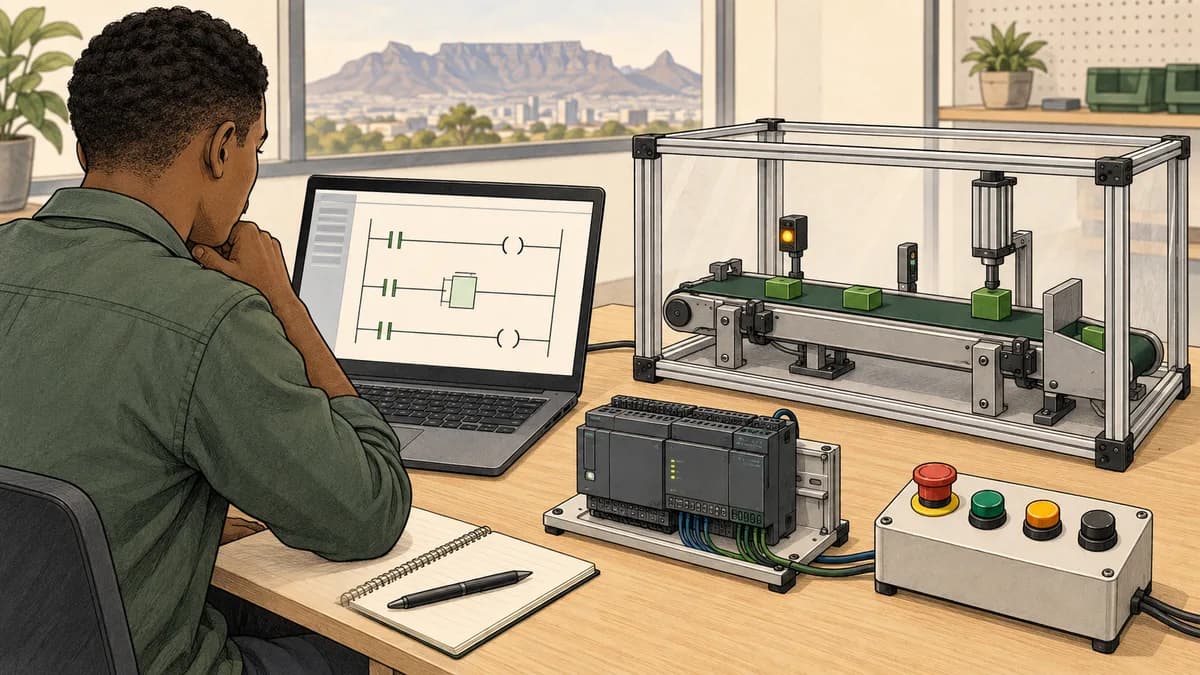
Siemens PLC training in South Africa should match the controller family, engineering software and task you need to perform. A beginner programming course should teach you to configure a learning project, interpret inputs and outputs, write and test logic, organise data and explain diagnostic observations. A maintenance course may emphasise reading existing programs and investigating faults. Ask providers to name the course, prerequisites, software version and practical assessment before comparing prices.
This is an independent learning guide. For official training, consult the South African SITRAIN catalogue. For preliminary practice, the Siemens-style educational programming environment explains the browser product's supported notation. That environment is a learning tool; it does not reproduce Siemens firmware or replace TIA Portal.
Which Siemens PLC course should you choose?
Start with the work you expect to do after training. If you want to build small programs, look for an introductory programming route with individual exercises. If your employer wants you to diagnose an existing installation, ask about service and troubleshooting content for its exact platform. If your work involves migration, motion or safety engineering, a general introduction is only a prerequisite to the more specialised learning you will need.
| Your goal | Questions for the provider | Evidence to request |
|---|---|---|
| Learn PLC programming from the beginning | What electrical and logic knowledge is assumed? | A beginner project and its assessment brief |
| Maintain an existing machine | Which controller and software versions are used? | A structured diagnostic exercise |
| Move from another PLC platform | How are data, block structure and instruction differences taught? | A comparison exercise with stated limitations |
| Work on a legacy installation | Does the course use STEP 7 Classic, TIA Portal or both? | A supported project and compatibility discussion |
| Develop HMI skills | Which WinCC product and target are included? | A tag, display and alarm exercise |
| Train a team | How is individual competence assessed? | Per-learner work and instructor feedback |
The official TIA Portal Programming Part 1 course document for South Africa is a useful reference when comparing a provider's proposed introductory scope. Read the current document and ask how the advertised exercises relate to your starting level. A course code is more useful than the vague promise of “complete Siemens training”.
Siemens PLC training prices in South Africa
There is no single price for Siemens PLC training. A digital learning subscription, a scheduled instructor-led module and a workplace programme purchase different services. Request the current fee for the exact course and date, then establish what is included. Avoid treating a subscription price as the price of a classroom programming course.
Ask whether the quotation includes VAT, course materials, engineering-software access, simulation, physical equipment, assessment and any retake. If travel is involved, budget transport and accommodation separately. If you will practise afterwards, find out what access continues and what must be purchased independently. An attractive course fee may leave a substantial practice gap if access ends immediately.
For a self-funded learner, first identify the skill you cannot obtain from documentation and independent practice. You may need instructor feedback on diagnostics, access to the required software or a supervised hardware exercise. Spend against that gap. The South African PLC course price guide provides a broader comparison framework; obtain current supplier quotations before making a purchasing decision.
Choosing a platform for Johannesburg, Durban or Cape Town work
Choose your first platform using evidence from the employers, equipment and roles you are targeting. A city name does not establish the controller inside a particular plant. Johannesburg, Pretoria, Durban, Cape Town, Gqeberha and other industrial areas contain varied installations, including machines supplied by different original equipment manufacturers.
Create a small job-requirements table from current vacancies you would realistically apply for. Record the named controller, engineering software, required experience and additional skills. Separate explicit requirements from a generic mention of PLCs. Do not convert a handful of adverts into a national market-share estimate.
If you already work at a site, ask the authorised technical lead which platforms and versions the team supports. A useful learning plan can then prioritise the current equipment and identify a later migration skill. For regional course questions, the Durban Siemens training guide and Sasolburg Siemens training guide sit within this topic cluster; verify specific providers, availability and employment requirements directly.

Understand the controller family before buying software
Siemens training can involve S7-1200, S7-1200 G2, S7-1500 or older controller families. Do not assume that similar names mean identical instruction support, engineering requirements or simulation options. Record the CPU's exact order number and firmware for a real training target, and check the relevant Siemens compatibility information.
For a beginner, the important first distinction is between the physical controller, its configured hardware, the program and the engineering environment. The CPU executes the program under its operating model. The engineering software is where you configure and develop the project. A simulator offers a supported model of some controller behaviours. Each part has its own version and limits.
Legacy learning deserves its own scope. If a course is intended for an existing S7-300 or S7-400 project, ask what engineering environment and project archive it uses. A modern TIA Portal introduction may not teach the workflow needed for that specific installation. Likewise, do not infer a product's lifecycle status from a broad statement that all older controllers are discontinued.
Use the S7-1200 and S7-1500 comparison to organise the questions. For an actual selection, confirm current specifications and compatibility against the exact hardware. Memory, interfaces and supported functions are model-dependent details, not values to memorise from an unsourced overview.
What a useful TIA Portal introduction should teach
Project structure and configuration
You should be able to find the configured device, program blocks, tags and diagnostic tools in the project you are studying. More importantly, explain how those parts relate. A tag name does not prove that the intended physical input is configured correctly, and a program that compiles does not prove that the machine will behave as required.
Begin with a small, documented training project. Record its software version and target configuration before changing it. Save the supplied baseline and keep your learning changes identifiable. When using another person's project, ask which version is required instead of opening and upgrading the only copy without a recovery plan.
The TIA Portal basics guide develops this orientation. Menu locations and supported operations can change between releases, so follow the documentation for the version in front of you. Siemens already publishes S7-PLCSIM V21 documentation; course material describing V20 as an unreleased future version needs review.
Compile, simulate and explain
Learn to distinguish a compile error from a behavioural error. A compile error can reveal an invalid type or unavailable symbol. A behavioural error can remain in a project that compiles successfully: the condition is inverted, a state is reset at the wrong time or the program assumes a feedback signal that never arrives.
For each exercise, state the initial condition and expected result before running it. Change one input or condition and observe the relevant values. Explain a disagreement using the program's state and execution order. Repeatedly editing until an output appears teaches less than a small test whose result you can defend.
Data and reusable blocks
A course should explain how temporary values, persistent state and reusable logic are organised in its target environment. Ask the instructor to show the same function used for two separate simulated devices and explain which data belongs to each instance. This makes accidental state sharing easier to recognise.
Treat retention as a configured behaviour that must be understood and tested, not as a blanket property of every data block. Restart assumptions matter in even a small learning project. Record which values you expect to initialise, retain or be recomputed, then verify that expectation in the supported environment.

LAD, FBD and SCL: learn the reasoning behind the notation
Ladder diagram, function block diagram and structured text can express related control ideas in different forms. Siemens uses SCL for its structured-text language. The languages available to you depend on the controller, engineering product and configuration. Ask a course provider to identify the actual languages you will use rather than promising every language on every controller.
For introductory discrete logic, a small ladder example can make conditions and output evaluation visible. For arithmetic or data handling, a short text expression may be clearer. The useful question is whether another person can understand and maintain the result under the project's conventions. There is no defensible rule that every South African plant should replace ladder with one other language.
Practise translating a simple requirement into words before choosing the notation. For a fictional process, “a run request is accepted only when the process is ready” is clearer than beginning with an unexplained network of contacts. Then define what ready means and how the run state changes. Use the structured text learning guide when you are ready to compare textual expressions with graphical logic.
A worked training brief: simulated transfer conveyor
The following is an educational exercise brief, not a machine-control design or validated safety function. It deliberately uses a small number of signals so the learner can explain every state. Implement it only in a suitable learning environment, then compare the target platform's instruction behaviour with its documentation.
The fictional conveyor has a Start request, a Stop request and a ProcessReady condition. The required Run state starts false. A Start request may set Run only when ProcessReady is true and Stop is false. Stop or loss of ProcessReady clears Run. When ProcessReady returns, the conveyor must remain stopped until a fresh Start request is made.
That last sentence exposes an important ambiguity. Does Start mean a level that can remain true, or a new event? Define it in your exercise. If the request remains held while readiness returns, a simple level-sensitive implementation may start automatically and violate the stated requirement. The learner must explain the difference and test the chosen interpretation.
| Test case | Initial condition and change | Expected result under this brief |
|---|---|---|
| Valid start | Stopped, ready, no Stop, then a fresh Start | Run becomes true |
| Start blocked | Stopped, not ready, then Start | Run remains false |
| Stop request | Running, then Stop | Run becomes false |
| Readiness lost | Running, then ProcessReady becomes false | Run becomes false |
| Readiness restored | Stopped after readiness loss; no new Start | Run remains false |
| Conflicting requests | Start and Stop presented together | Run remains false |
Retain the requirement, the program and the test observations. Ask a second learner to change the event order without seeing your expected results first. If you disagree, trace the sequence and identify the assumption rather than simply changing the final output. This makes the exercise useful preparation for a code review.
For an accessible introduction to related concepts, try the browser motor-control demonstration. Its existing exercise may use different conditions from this brief; compare them explicitly instead of assuming that every demonstration implements this exact sequence.

Analogue scaling: check the range, units and quality
A useful Siemens training course should teach learners to read the channel configuration and documentation before converting a raw value. Do not apply one raw range to every module and input mode. Record the configured signal type, nominal representation, engineering range and diagnostic handling for the exercise.
For a purely mathematical example, suppose a training model explicitly defines raw values from 0 to 10000 as representing 0 to 10 bar. Under that declared model, raw 2500 represents 2.5 bar and raw 7500 represents 7.5 bar. These are invented exercise values, not an assertion about a Siemens analogue module. The calculation is a proportion between the two stated ranges.
Then ask what should happen when the input is outside the declared range or its quality is invalid. Clamping a displayed number into range can hide a fault if the program treats the clamped result as a valid measurement. Keep the numeric conversion and the quality decision distinct in your explanation. The scaling and resolution guide develops the underlying reasoning.
PLCSIM, PLCSIM Advanced and browser practice
Use Siemens' documentation to determine which simulator supports your target CPU, firmware, engineering version and required interfaces. Product capabilities change, so statements copied from an older comparison can be misleading. A tool that supports code testing for one configured controller does not automatically support every communication, hardware or technology function you need.
The current S7-PLCSIM Advanced manual is the place to check its supported scope and restrictions. Confirm the applicable licence and system requirements before buying or installing software. Do not treat virtual testing as proof of physical network performance or equipment behaviour.
Browser practice serves a different learning step: you can investigate the concepts that the educational environment actually models. Check supported instructions, scan behaviour and exercise rules. Rebuild a suitable small example in the required Siemens environment when you have access, then document differences. This transfer task is more informative than assuming a program can be copied unchanged between tools.
The PLC simulator comparison guide helps you decide which kind of environment fits your present task. For a closer look at the learning product's execution view, examine the scan-cycle highlighting feature.

Build a portfolio that demonstrates Siemens learning
Choose a small set of projects you can explain completely. For each, identify the environment and version, the requirement, the initial state, the tests and the result. Separate work performed in an educational simulator from work performed in TIA Portal or on supervised training equipment. An employer should not have to infer the environment from a cropped image.
Include at least one failed test and the reasoning that led to the correction. For example, document how an interrupted sequence revealed an unstated restart assumption. Show the revised requirement and the new regression case. This demonstrates a disciplined learning process without implying experience commissioning production machinery.
If your project includes an HMI, explain where a displayed value originates and how its quality is handled. If it includes communication, distinguish a successful connection from a correctly interpreted value. The WinCC Unified learning page and industrial networking training guide provide related study routes.
Common questions about Siemens PLC training
How should I compare Siemens PLC training courses?
Compare the exact course code, controller family, software version, prerequisites and individual practical assessment. A programming introduction, a service course and a migration workshop solve different problems. Ask each provider for one representative learner exercise and the software access included after the course; this makes competing quotations easier to assess against your actual work.
Can I learn Siemens PLC programming online in South Africa?
Yes, online instruction and supported software practice can help you learn programming concepts and the engineering workflow. Check which software, instructor access and practical assessments are included. Outcomes involving physical equipment still need the appropriate supervised practical work.
Should I learn S7-1200 or S7-1500 first?
Choose according to the course target and the equipment relevant to your next role. Foundational reasoning about signals, state and tests is useful across projects, while hardware configuration and supported functions differ. Ask for the exact CPU generation and software requirements before buying a training kit.
Is TIA Portal the same as a PLC simulator?
No. TIA Portal is an engineering environment, while simulation products provide supported virtual controller behaviour. A browser educational simulator is another type of tool with its own scope. Identify the environment required by the learning outcome before comparing product names.
Does an independent course issue a Siemens certificate?
Do not assume so. Ask who issues the certificate, what assessment it represents and how any claimed authorisation can be checked. This website is an independent learning resource. Official SITRAIN arrangements must be confirmed with Siemens or the relevant authorised provider.
How long does Siemens PLC training take?
The answer depends on your starting point and required outcome. Completing an introductory module is different from independently maintaining a complex installation. Use staged demonstrations of competence, such as explaining a program and passing changed test cases, instead of promising a universal number of weeks.

If your choice is still open, compare CODESYS, TwinCAT and STEP 7 by engineering environment, runtime and target requirements before committing to a platform-specific course.
Your next learning step
Choose one outcome, such as testing a start-stop sequence or interpreting a small analogue calculation. Complete it in a suitable learning environment, record the limits of that environment and identify the Siemens-specific knowledge still missing. Then compare a current course against those gaps.
Start with the Siemens-style simulator overview for educational practice, or use the official SITRAIN catalogue above when your next step requires vendor instruction. A useful learning plan connects the course, your practice and a result you can explain.