brands · South Africa
Siemens PLC Training in Durban: Courses and Worked Tests
Explore Siemens PLC training in Durban: local course enquiries, online TIA options, practical access and worked moving-median tests for measurement data.
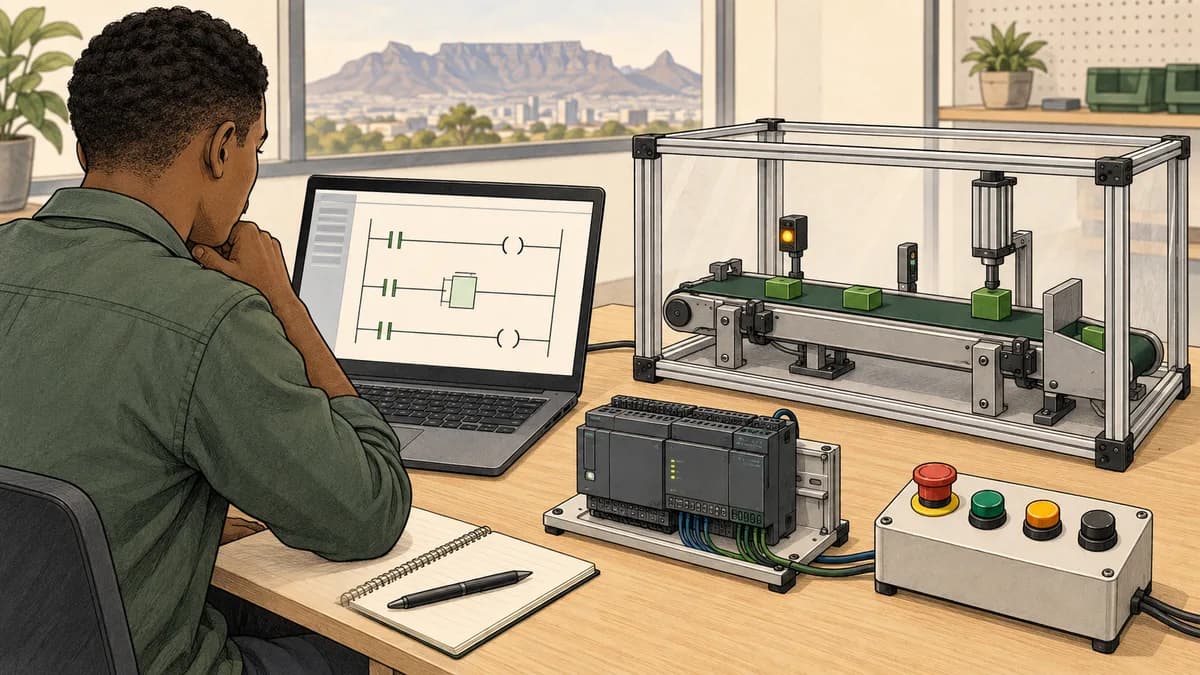
Siemens PLC training in Durban is most useful when the course matches the system you need to understand and gives you enough individual practical work. Start by distinguishing general PLC foundations, TIA Portal programming and service or maintenance training. A Durban address and a PLC course title do not, by themselves, confirm Siemens equipment or a particular TIA software version.
This guide compares enquiry routes checked on 12 September 2026 and develops a worked classroom exercise on a moving median. The exercise teaches arrays, input quality and diagnostic reasoning. It is a fictional software model, not a Siemens filter instruction, a native project or a control strategy approved for real machinery.
We operate PLC Simulation Software and may benefit when readers use it. The product links below support general learning and testing. They do not establish Siemens authorisation, native TIA project compatibility or access to the vendor's engineering software.
Durban enquiries: general preparation and native Siemens training
Tekmation's website lists its address as Unit 3 Chamberlain Park, Huletts Street, Jacobs, Durban. Its 2026 course catalogue lists a five-day basic PLC short course at R5,000–R8,000 and a five-day intermediate PLC course at R10,000–R15,000. The catalogue also lists advanced PLC study covering further data, analogue and networking topics, with pricing on enquiry.
The checked catalogue does not identify those PLC courses as Siemens-specific. Ask which controller, engineering software and individual practical arrangement apply. Treat the published ranges as enquiry information, and request the current price, tax treatment, dates and inclusions in writing. General foundations may be useful preparation, but they should not be described as confirmed TIA Portal training without that evidence.
For a manufacturer-led route accessible from Durban, the checked SITRAIN South Africa TIA-PRO1 outline describes a five-day online programming course, with a listed fee of R31,110. It requires basic automation knowledge and includes practical work on a TIA system model. Confirm the current intake, quotation and remote practical access; the outline is not a Durban classroom booking.
Our Durban PLC training guide provides the wider local context. Use the specific enquiry routes above to obtain a matching offer rather than assuming that an old Pinetown course calendar proves a future class is scheduled. Published locations, course outlines and confirmed bookings are three different pieces of evidence.

Choose programming, maintenance or foundations deliberately
A programming course should help you turn a requirement into a documented program, choose data types and prove expected results. A maintenance course should help you inspect an existing project, follow a signal and diagnose a fault. Both need basic logic, but the time spent on project creation versus existing-system investigation may differ substantially.
The SITRAIN South Africa service-course outline describes TIA-SERV1 for maintenance, service and operator audiences, using a practical S7-1500 system model. Compare that learning objective with the programming route. Ask the provider which current South African offering fits your role and whether a local, online or arranged onsite format is available.
If you are beginning without PLC knowledge, establish the prerequisites before paying for a broad course. Being comfortable with a laptop is useful, but it does not establish that you can read a Boolean condition, interpret a data type or explain an input's physical meaning. The PLC course requirements guide helps you identify what to prepare.
If your intended work involves an existing S7-300 or S7-400 installation, give that information to the provider. A course centred on a newer target can still teach useful principles, but it may not cover the source project and diagnostics you need. The STEP 7 migration guide explains why the engineering environment and the hardware replacement decision must be distinguished.
Compare the complete offer, including practical access
Ask how many learners share each engineering station or remote hardware session. A demonstration can communicate a concept, but an assessment should give each learner a chance to make a change, observe its result and explain a defect. A course with extensive equipment photographs may still offer limited individual access.
Request the software release, selected CPU and licence arrangement. For remote delivery, establish whether the provider supplies an engineering desktop, requires a local installation or uses another setup. Ask whether you can reopen your training work after the course and which tools are needed to do so.
Compare cost using the South African PLC course price guide. Include travel within the Durban area, time away from work, software requirements and any follow-up practical sessions. The lowest tuition figure is not necessarily the lowest cost for the outcome you need, but a higher fee also does not automatically establish better teaching.
Confirm the assessment and certificate wording separately. Ask who issues the document and what successful completion demonstrates. A short-course certificate, a vendor assessment and an occupational qualification serve different purposes. Do not assume that a provider's general accreditation statement applies to every individual short course in its catalogue.

Prepare to follow a value through a program
Before the moving-median exercise, practise locating a variable, its declaration and the block that uses it. The TIA Portal basics guide explains the distinction between project objects, tags, compilation and observed behaviour. A correct-looking screen does not prove that the program is receiving the intended source value.
The exercise uses a sequence of measurements supplied by the test. Each observation has a value and a quality flag. The value must be an integer from zero through 100, and quality must be good. These choices make the arithmetic easy to review; they are not a Siemens analogue-input range or a specification for a particular sensor.
A moving window needs memory across calls. Decide which instance owns that history and ensure that two independent measurement channels do not accidentally share it. The function-block instance guide develops the same ownership issue using a different exercise.
Write the filtering requirement before choosing a library or instruction. A median and an arithmetic mean answer different questions. The median of three sorted values is the middle value; the mean is their sum divided by three. One may be useful for a specified task, but neither is automatically the correct choice for every measurement or control loop.
Worked requirement: median of the latest three accepted observations
Keep a window containing up to three accepted observations in arrival order. A valid observation is appended. If the window already contains three observations, remove the oldest before appending the new one. When fewer than three are available, report warming up and do not publish a valid median.
When the window contains three, sort a copy numerically and return its middle value. Preserve the original arrival order in the stored window so that the next call removes the oldest observation, not the smallest. This distinction is central to the exercise and catches a subtle implementation mistake.
An invalid observation clears the entire window and produces invalid status. The next valid observation therefore starts a new warm-up sequence. This reset policy is deliberately chosen to avoid mixing accepted data from before an invalid interval with new data after it. A different application could choose another policy, but it would need its own tests.
The model has no timestamps and no guarantee about the physical time covered by three samples. A three-observation window can span milliseconds or minutes depending on how observations arrive. Do not describe it as a fixed-duration filter unless timing becomes an explicit part of the requirement.
| Call | New observation | Stored window, oldest first | Status | Median |
|---|---|---|---|---|
| 1 | 10, good | 10 | Warming up | Unavailable |
| 2 | 11, good | 10, 11 | Warming up | Unavailable |
| 3 | 90, good | 10, 11, 90 | Valid | 11 |
| 4 | 12, good | 11, 90, 12 | Valid | 12 |
| 5 | 13, good | 90, 12, 13 | Valid | 13 |
| 6 | 14, good | 12, 13, 14 | Valid | 13 |
The large value 90 is still an accepted observation because it lies within the stated domain and has good quality. The median's behaviour does not prove that 90 was an instrument fault. It only shows how this mathematical operation treats the values in the current window.

Compare the median with the mean and a sustained change
At the third call, the mean of 10, 11 and 90 is 37, while the median is 11. At the fourth call, the mean of 11, 90 and 12 is 113 divided by three, approximately 37.67, while the median is 12. Those differences illustrate the algorithms; they do not establish which output a real process should use.
Now test a sustained high value with the sequence 10, 10, 90, 90, 90. The first complete window has median 10. The next window, 10, 90, 90, has median 90. The final window remains 90. The median does not permanently ignore a changed condition; the composition of the window determines the result.
This sequence also shows why filtering can delay a displayed change. Whether that delay is acceptable depends on the application. Do not insert a filter into a protection or control path merely because it makes a trend look smoother. The classroom objective is to understand the effect and its assumptions before deciding whether a separate engineering requirement calls for it.
Try three equal values, such as 40, 40 and 40. The median is 40. Try two equal values and one different value: 20, 20 and 80 gives 20. Equality is normal input, not an error. A sorting method that assumes every number is distinct can fail an otherwise simple measurement task.
Test invalid data and the warm-up sequence
After a valid window has produced median 13, supply a bad-quality observation with value 15. The window must clear and the result becomes invalid. A display may retain a separately labelled last-good value if another requirement defines that behaviour, but it must not present the old median as a current valid result.
Then supply good values 20, 21 and 22. The first two calls report warming up with no valid median. The third reports valid median 21. This sequence proves that the program did not reuse two old observations from before the invalid interval to produce an immediate result.
Test values -1, 101, 12.5 and missing input. Each is invalid under the input contract and clears the history. In a native project, a fixed integer variable cannot represent every malformed upstream input directly; validation must occur at the interface where those possibilities exist, or an explicit validity indication must carry the failure.
Distinguish invalid from warming up. Invalid means the most recent observation failed validation. Warming up means the new valid sequence has fewer than three accepted observations. Both lack a valid median, but they explain different next actions to the learner or operator reviewing the training display.

Diagnose the sorted-window mistake
The stored order represents age. Sorting that storage in place changes which observation appears oldest. To see the defect, use the sequence 90, 10, 11, 12. After the first three values, the correct median is 11 and the arrival-order window is 90, 10, 11.
When 12 arrives, the correct algorithm removes 90, leaving 10, 11 and 12, whose median is 11. An incorrect implementation that had sorted the stored window into 10, 11, 90 removes 10 instead. It then considers 11, 90 and 12 and returns 12. The defect is in history management, not the definition of a median.
This is a strong assessment case because the earlier sequence 10, 11, 90, 12 may not reveal the same mistake immediately. A learner who tests only increasing values can miss an age-order defect. Select a sequence that separates chronological order from numeric order.
For an isolated test, capture the stored window as well as the reported median. An incorrect internal state can temporarily produce the correct visible result. Observing both helps locate the first divergence and avoids patching a later symptom with an unrelated comparison. The PLC troubleshooting guide develops that evidence-led method.
Check independence and changes to the requirement
Create two fictional channels with separate histories. Channel A receives 10, 11 and 90, giving median 11. Channel B receives 70, 71 and 72, giving median 71. Interleave their calls and verify that each result remains the same as when tested alone. This checks ownership as well as arithmetic.
If both channels use one shared history, the interleaved values create windows that belong to neither source. The result may still be inside zero through 100 and look plausible. A range check cannot detect that the data came from the wrong channel; the test must compare the intended histories.
If you change the window size to five, revise the specification before modifying the code. Warm-up now needs five accepted observations, the selected sorted position changes and the response to a sustained change differs. Do not simply change an array length and assume that the previous expected results remain valid.
If you add timestamps, define acceptable age, gaps and ordering. An observation with good numeric quality may still be too old for the new requirement. The present exercise does not claim to solve those timing questions. Keeping the scope explicit makes it easier to add a meaningful extension later.
Make the practical assessment useful after the course
Submit the requirement, window policy, initial conditions, test sequences and actual results. Include the sustained-change case, invalid recovery and the 90-first sequence that catches in-place sorting. Explain one defect you introduced deliberately and which observation proved it was present.
For a native Siemens course, identify the TIA version, selected CPU or simulator and the declarations that hold the history. Ask the instructor to assess the block call and instance selection, not only the final arithmetic. A working mathematical model is preparation; native compilation and execution need their own evidence.
PLC Structured Text practice supports array handling, comparisons and conditional updates. PLC program testing practice supports repeatable expected-result checks. Neither link means this article's model is already provided as a native Siemens exercise in the product.
For a Durban training team, the same brief can establish who needs foundational support and who is ready for more advanced diagnostics. Learners who can explain the sorting defect may benefit more from native integration work than another introductory demonstration. The training-centre guide helps compare supplementary practice with existing teaching resources.

Questions about Siemens PLC courses in Durban
Is the local Tekmation PLC course confirmed as Siemens training?
The checked catalogue lists general PLC courses without identifying the controller brand. Confirm the exact equipment and software with the provider. Its Durban location and PLC offering are useful enquiry facts, but they do not establish a particular TIA course.
Can I attend Siemens training online from Durban?
The checked South African SITRAIN programming outline describes online delivery. Confirm current dates, access requirements and how you personally complete practical tasks. Online live training should not be assumed to be self-paced or available at any hour.
Should I choose TIA-PRO1 or service training?
Choose from the work you need to perform. Programming focuses on constructing and documenting application behaviour, while service training focuses more on understanding and diagnosing an existing system. Ask the provider to match the current syllabus to your experience and intended role.
Does a moving median remove every bad measurement?
No. It returns the middle value of the selected window. It can reduce the effect of an isolated extreme value in the example, but cannot establish that a reading is false or guarantee the correct process value. Quality, timing and application requirements remain separate questions.
Why must I keep arrival order as well as sorted values?
Arrival order identifies the oldest observation to remove. Numeric order identifies the median. Sorting the stored history in place can mix those purposes and remove the wrong value on the next call. Sort a copy or use another method that preserves age information.
What should I learn after this exercise?
Study native diagnostics, data acquisition and HMI presentation according to your course route. The WinCC Unified screen guide helps separate current valid data from unavailable or historical values. Keep each extension small enough to test and explain before adding another.