brands · South Africa
Siemens PLC Training in Sasolburg: Courses and Flow Tests
Compare Siemens PLC training near Sasolburg, regional course codes, practical access and worked flow-total tests with timestamps, data gaps and recovery.
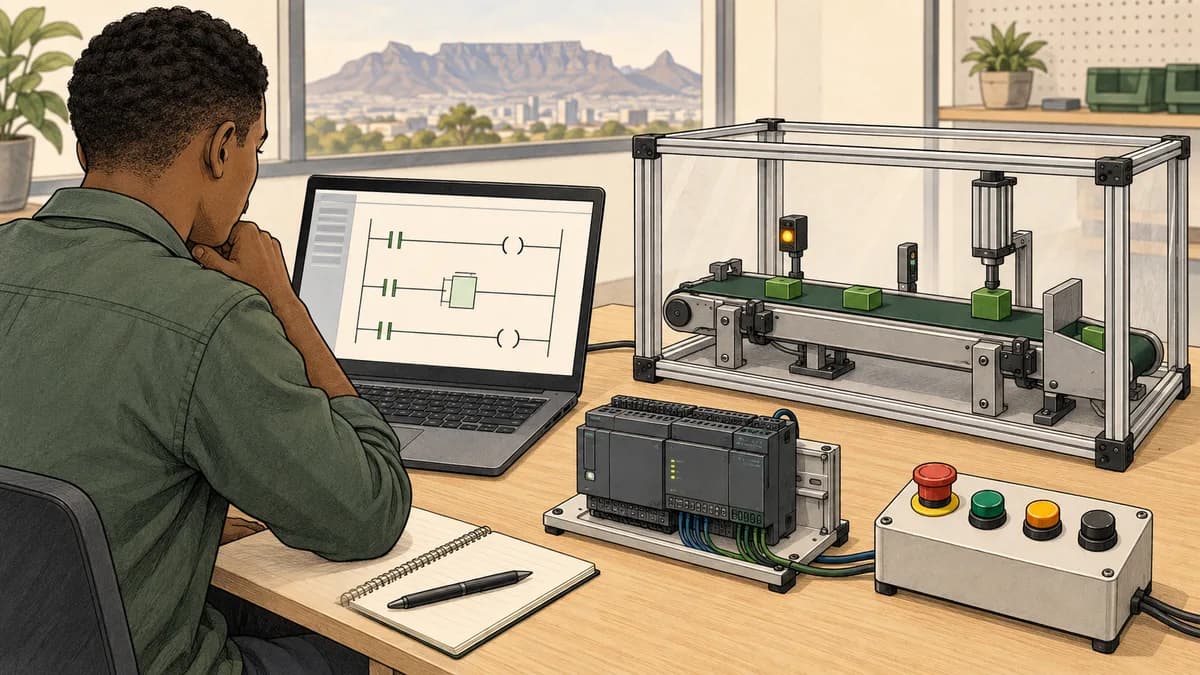
Siemens PLC training in Sasolburg should start with the equipment and task you need to understand. A maintenance technician reading an existing S7 program, a beginner learning TIA Portal and an engineer working with a distributed control system need different practical work. The useful question is which course provides that work, with the correct software and individual access.
This guide checks a regional Vanderbijlpark training route and explains how to compare its course offers. It also develops a fictional flow-total calculation with irregular timestamps. That exercise makes a useful test of units, data quality, retained state and recovery. It is an educational specification, not a commissioned process-control design or a native Siemens project.
We operate PLC Simulation Software and may benefit from the product links. Those links support general programming practice; they do not imply Siemens authorisation, native TIA project compatibility or a confirmed training venue in Sasolburg.
Siemens course enquiries near Sasolburg
The Onetrust Siemens course price list, downloaded on 13 September 2026, identifies locally presented courses in Vanderbijlpark. It lists TIA-PRO1 programming part one as five days at R31,110 per person, TIA-SERV1 service and maintenance part one as five days at R26,745, and TIA-TRB troubleshooting as three days at R16,083. These listed prices exclude VAT. The document states that local courses have no minimum candidate count, while on-site training requires at least three candidates.
These are published enquiry details, not a booking confirmation. Ask for the next actual intake, delivery address, equipment, software release and dated quotation. A regional provider offering on-site delivery does not establish that a public classroom is currently scheduled in Sasolburg.
The separate Onetrust industrial automation price list lists MA-INTRO-TIA, a three-day introduction, at R9,350 excluding VAT, and FA-PLC-ONE, a five-day Siemens service and maintenance course, at R19,800 excluding VAT. These are different course codes from the Siemens catalogue above. Compare the syllabus, delivery arrangement and assessment before treating them as interchangeable products. The downloaded document is labelled version 1.2; request confirmation of its current commercial validity.
For a manufacturer course comparison, the SITRAIN South Africa TIA-SERV1 outline describes a five-day service course requiring basic automation knowledge, with practical work using a TIA system model. Use the outline to compare the kind of fault-finding practice offered. It is not evidence of a Sasolburg intake.
Our South African PLC course price guide explains how to compare quotations with different inclusions. Save the actual offer alongside the course code: a search snippet, an undated screenshot and a confirmed quotation have different evidential value.
Choose a route for the work you expect to do
For a first programming course, prioritise the relationship between physical signals, tags, execution order and program state. You should be able to explain why a value changed and reconstruct the sequence that produced it. Starting with a large process example can hide missing foundations behind impressive graphics.
For maintenance learning, request diagnostic exercises in which the symptom has more than one plausible cause. A displayed zero might be a real measurement, an invalid signal converted to zero, an incorrect address or a stale display. The exercise should require evidence that distinguishes those possibilities. Repeatedly downloading a known-good program is not a substitute for investigating the fault.
For brownfield work, record the exact controller family and engineering environment before booking. A STEP 7 Classic installation and a new TIA Portal project may require different access, project files and training objectives. The STEP 7 Classic migration guide separates source-project preparation from later hardware or program changes.
For a distributed control system role, ask about the specific system and engineering workflow named in the job or workplace requirement. Do not infer that every Siemens PLC short course covers PCS 7, process libraries or operator-system engineering. You need an explicit syllabus and an explanation of what each learner will build or diagnose.
Sasolburg learners comparing regional travel with remote study should obtain a daily timetable, practical-access arrangement and fallback plan for a missed session. Travel cost is only one part of the decision. A course with suitable individual engineering time can be more valuable than a convenient venue where most students watch the instructor.

Questions that make a quotation usable
Ask the provider to identify the controller order number or training model, software version, licence arrangement and number of learners per workstation. Request the prerequisite knowledge in practical terms: reading electrical diagrams, using Boolean logic, interpreting a watch table or navigating an existing project. An informal claim that a course is suitable for everyone leaves you unable to prepare.
Separate attendance evidence from assessed ability. Ask what the final assessment involves, whether each learner completes it independently and whether feedback identifies mistakes. If a particular qualification or professional recognition matters to your employer, obtain the precise award and recognition details from the responsible organisation. A branded course name alone does not answer that question.
For a company group in Sasolburg, provide a fictionalised equipment brief with the required tasks and current knowledge. Keep production programs, network details and confidential records out of an initial public enquiry. A trainer can propose an appropriate learning route from a controlled description without receiving unrestricted access to a working installation.
If the quotation includes on-site delivery, ask who supplies the training hardware, licences and isolated classroom environment. Agree how practical exercises will be separated from operational work. The course should have a clear educational scope and an assessment plan before anyone assumes that a training day includes live changes.
The PLC course prerequisite guide helps turn these answers into a preparation list. Use it to identify what you can practise independently and what requires an instructor or the actual vendor environment.
Worked exercise: totalising a flow value with timestamps
Consider a fictional classroom data stream. Every accepted record contains a timestamp in seconds, a flow rate in litres per minute and a Boolean quality flag. The timestamp is a non-negative whole number. The rate is a finite number from zero to 120 inclusive. The quality flag must be true before the record can contribute to the result.
The exercise estimates accumulated litres using the previous accepted rate across the interval ending at the new record. This is a left-rectangle calculation: the model assumes the older measurement applies until the newer timestamp. That assumption is deliberately visible. It is not proof that the real flow stayed constant between observations.
The calculation is:
Added litres = previous rate × elapsed seconds ÷ 60.
Initial total is zero and there is no baseline. The first valid record establishes the timestamp and rate but adds no volume. A later valid record contributes only when its timestamp is strictly greater than the baseline and the interval is no more than five seconds. After that contribution, the new record becomes the baseline.
The five-second limit is a fictional data-acceptance rule, not a Siemens default or a recommendation for a physical process. It helps the learner distinguish a plausible interval from a gap the exercise refuses to estimate. A real application would require its own measurement, sampling and uncertainty requirements.
Define invalid handling before doing any arithmetic. Bad quality, a malformed value or an out-of-range rate clears the baseline and leaves the accumulated total unchanged. A duplicate or backwards timestamp also clears the baseline. A valid record arriving after a gap longer than five seconds becomes a new baseline without adding volume. These choices avoid silently bridging a period the model has rejected.

Calculate the first sequence by hand
Start with a valid record at time zero and rate 60 litres per minute. The total remains zero because there is no earlier interval to estimate. At time two, accept a rate of 90. The previous rate was 60 and the elapsed time was two seconds, so the contribution is 60 × 2 ÷ 60 = two litres.
At time five, accept a rate of 30. The model uses the previous rate of 90 over the three-second interval. That contributes 4.5 litres and raises the total to 6.5. At time six, accept zero flow. The previous rate of 30 contributes another half litre, producing seven litres.
At time eight, accept a rate of 120. Because the previous rate was zero, the two-second interval contributes zero and the total stays at seven. The newly accepted rate affects the next interval. This distinction is the central test of the chosen integration rule.
| Time, seconds | New rate, L/min | Rate used for interval | Contribution, litres | Total, litres |
|---|---|---|---|---|
| 0 | 60 | No baseline | 0 | 0 |
| 2 | 90 | 60 | 2 | 2 |
| 5 | 30 | 90 | 4.5 | 6.5 |
| 6 | 0 | 30 | 0.5 | 7 |
| 8 | 120 | 0 | 0 | 7 |
An implementation that uses each new rate for the preceding interval would produce a different answer. It would add three litres at time two, 1.5 at time five, zero at time six and four at time eight, ending at 8.5 litres. That is not a rounding issue: it is a different assumption about which measurement represents the interval.
A useful assessment asks the learner to identify this difference before editing code. Changing the expected answer to match an implementation conceals the defect. The requirement must establish whether the older rate, newer rate or another estimation method is intended.
Invalid data and recovery without invented volume
Continue from the seven-litre total at time eight. Receive a bad-quality record at time nine. The total remains seven and the baseline is cleared. A valid record at time ten with rate 60 establishes a new baseline; it does not estimate the missing period. A valid record at time twelve with rate 60 adds two litres, producing nine.
Now receive a valid record at time twenty with rate 30. The eight-second gap exceeds the fictional maximum of five. The total stays nine, and time twenty becomes the new baseline. A record at time twenty-two with rate 30 then adds one litre, producing ten.
This result should carry diagnostic context. Ten litres is the model's accumulated accepted-interval estimate. It does not include the rejected periods. Calling it a complete physical production total would be misleading. A display or report should preserve the fact that a gap occurred, even after valid sampling resumes.
Test duplicate timestamps separately. If time twenty-two arrives again, the interval has no positive duration and the baseline clears under this specification. The next valid record only establishes a baseline. This is intentionally stricter than ignoring a duplicate. Neither behaviour should be assumed without a stated requirement because each affects recovery.
A native PLC numeric tag may not represent missing or malformed data in the same way as a software test harness. Translate those tests into the actual input interface, validity flag and data type. The classroom model makes the contract visible; it does not claim that every abnormal test value can be written directly into a Siemens numeric variable.

Tests that expose unit, timing and state mistakes
At a constant rate of 60 litres per minute, two accepted seconds represent two litres. Omitting the division by 60 would incorrectly add 120. A unit label beside a variable does not perform a conversion; the arithmetic and documentation must agree.
Test the interval boundary with fresh state. A baseline at time zero and rate 120, followed by a valid record at time five, adds ten litres. A follow-up at time six instead exceeds the five-second rule and adds none. The second case re-establishes a baseline. It must not be described as zero physical flow during the gap.
Test rate boundaries independently: zero and 120 are valid; negative values and values above 120 are invalid. A fractional rate such as 30.5 is valid here, while a fractional timestamp is rejected because this particular contract uses whole seconds. That is a specification choice, not a universal requirement for timestamp processing.
Use two independent streams to test stored state. Stream A with 60 at time zero and another valid record at time two totals two litres. Stream B with 120 at time zero and another record at time three totals six. Interleaving their calls should preserve those results when each has its own baseline and total. Sharing one state object would mix the streams.
The TIA Portal function block and instance guide explains why reusable logic needs deliberate instance ownership. The data conversion reference is useful when selecting representations and checking the boundary between stored values and engineering units.
For an independent numerical check, test constant rates of 0, 1, 30.5, 60 and 120 over intervals of one through five seconds. Each result should equal rate multiplied by interval and divided by 60. The local reference model passes these cases and the recovery sequences above. This is model verification, not evidence that a native TIA implementation has been compiled or tested.
Turn the exercise into a course assessment
Ask each learner to submit a requirement sheet, expected-result table and explanation of the recovery policy. Include the initial total, initial baseline state, input sequence and output after each accepted or rejected record. A final total alone cannot show whether the implementation accidentally crossed a data gap and later cancelled the error.
Require a visible distinction between baseline established, interval accumulated, invalid record and excessive gap. Those states help an assessor understand why the total stayed unchanged. If the learner chooses different display wording, the underlying reasons should remain distinguishable.
Then change one requirement: allow a maximum interval of four seconds instead of five. The learner should identify which tests change and why. The five-second boundary case becomes a gap; a three-second interval remains acceptable. Changing every expected result would suggest that the relationship between the requirement and tests is not understood.
Discuss reset as a separate extension. Who may request it, what evidence records it and whether it clears the baseline are additional requirements. The worked model above has no operational reset command. Adding one casually can discard accumulated evidence or connect an old baseline to a new total in an unexpected way.

Study around travel and shift commitments
Prepare with Boolean conditions, numerical units and a short handwritten trace before paying for advanced instruction. Then use instructor time for the vendor-specific tasks that independent reading cannot demonstrate: project structure, actual diagnostics, supported data types and the course's practical equipment.
For learners travelling from Sasolburg to a regional class, ask when the practical sessions start and finish, whether a missed exercise can be repeated and what access remains afterwards. Do not assume that a course licence transfers to the learner's own computer. Confirm the arrangement before planning evening practice.
The TIA Portal basics guide provides a starting framework for tags and project work. Follow it with analogue signal interpretation and PLC troubleshooting methods so that a calculation is connected to the quality of the input it receives.
For general practice between classes, review the product's PLC data type learning material and PLC program testing material. Check the current lesson and plan details before buying. These resources complement a learning route; the native Siemens environment is a separate requirement where the course calls for it.
Training managers can use the training-centre planning guide to structure an evaluation around one small cohort and observable assessment outcomes. Ask learners to explain an unexpected result, not just reproduce a screenshot of the expected one.
Questions about Siemens PLC training in Sasolburg
Is a Siemens classroom in Sasolburg confirmed here?
No. The checked regional price lists identify Vanderbijlpark delivery and an on-site enquiry option. Ask for an actual Sasolburg venue, date and written booking confirmation if local attendance is essential. A provider's willingness to travel is not the same as a scheduled public class.
Which course code should a beginner request?
Request a prerequisite assessment and distinguish an introductory TIA course from programming part one or service and maintenance. The listed codes represent different offers. Describe what you can already do with diagrams, Boolean logic and software navigation so the provider can recommend an appropriate entry point.
Does Siemens PLC training automatically include PCS 7?
No. Obtain the specific system name, software environment and practical objectives in the syllabus. General PLC logic remains useful background, but it does not establish that a short course covers distributed control system engineering or the workflow required by a particular role.
Why does the flow exercise discard intervals after bad data?
Its declared policy refuses to estimate across a rejected measurement period. The accumulated value stays available, but the baseline clears and recovery starts with a new valid record. This makes missing evidence visible. A different application may need another policy supported by its measurement requirements.
Can I use this total as a real production or billing measurement?
The example is a fictional classroom calculation with deliberately simplified timing and quality rules. Its verified arithmetic does not establish instrument accuracy, completeness, traceability or suitability for an operational measurement. Use it to demonstrate reasoning and test design during training.
What should a useful learner portfolio contain?
Include the course and software context, requirements, expected results, observed evidence, one investigated defect and the remaining limitations. Clearly label simulations and fictional data. A reviewer should be able to reproduce the reasoning without assuming that the work was carried out on a live installation.
