brands · South Africa
S7-1200 vs S7-1500: G2, Features and Capacity Checks
Compare S7-1200, S7-1200 G2 and S7-1500: model-specific memory, I/O, motion, OPC UA, complete costs and worked capacity checks with explicit reserve rules.
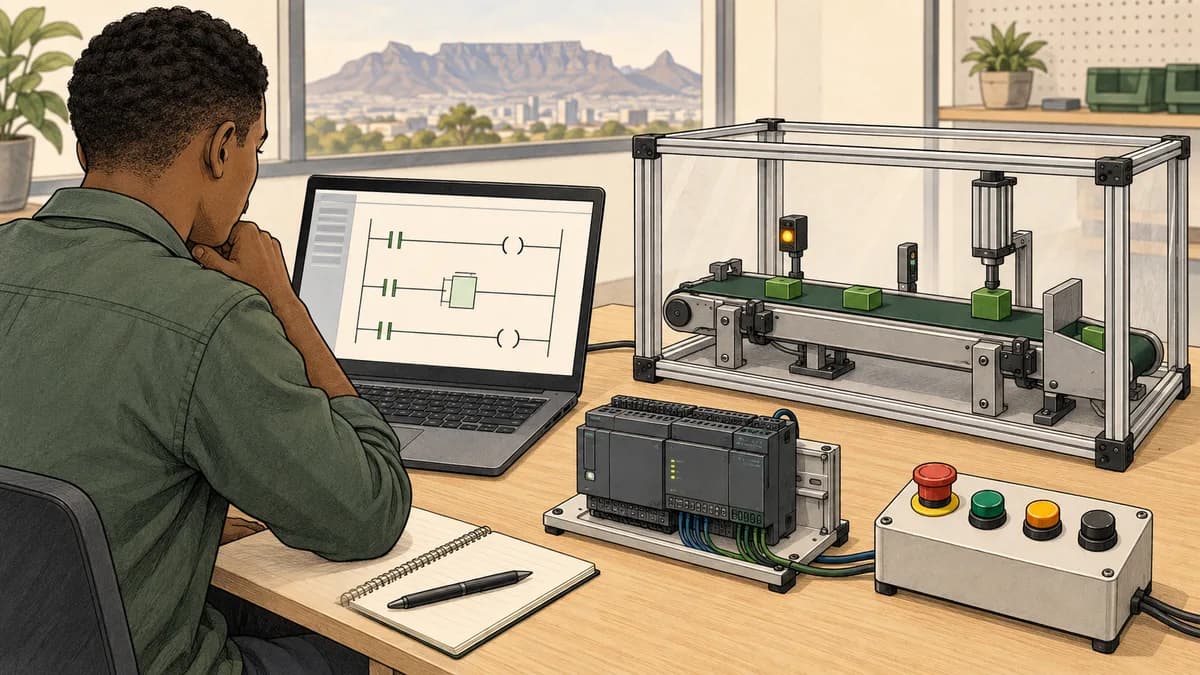
Choosing between an S7-1200 and an S7-1500 requires more than an I/O count or a claim that one family is always faster. Identify the exact CPU, firmware, engineering version, required functions and complete system arrangement. Also distinguish the original S7-1200 generation from S7-1200 G2: their memory and expansion arrangements are not interchangeable.
This guide compares selected documented examples and develops a fictional capacity exercise for South African learners, training departments and prospective project buyers. Sources were checked on 12 September 2026. The exercise teaches selection arithmetic; it is not a hardware quotation, an approved bill of materials or a benchmark of Siemens controllers.
We operate PLC Simulation Software and may benefit when readers choose it. The product links support learning about data and testing. They do not establish hardware compatibility, native TIA Portal execution or approval of a controller for a real installation.
Start with the application requirements
Write down the required signal types, communication partners, update intervals, retained data, motion functions and operator interfaces. State which requirements are mandatory and which are future possibilities. A long wish list without priorities can make every controller seem inadequate, while a short list that ignores communications can make an unsuitable CPU appear sufficient.
Separate a training purchase from an application selection. A learner may need access to the CPU used by a course or employer, even if a different device would be attractive for a new project. A training centre may value consistent software and enough stations for individual practice. A production design needs a broader engineering assessment of the complete system.
Do not use “under 150 points” or “above 200 points” as a universal decision boundary. Signals differ in type and location, and distributed I/O changes the relationship between point count and local module count. A small application can require a specialised function, while a larger signal count may be straightforward if its timing and communication requirements are modest.
For learners comparing courses, ask for the complete model designation and the practical work performed on it. A syllabus labelled S7-1500 does not tell you which CPU, firmware or technology functions you will use. The Siemens learning hub connects the programming and local training topics that follow the hardware decision.

Distinguish three documented examples
The following examples illustrate why generation and model matter. They are selected reference points, not a ranking of every Siemens CPU. Check the current product data for the exact order number and firmware before purchasing or designing a system.
| Example | Documented memory distinction | What to investigate next |
|---|---|---|
| Original S7-1200 CPU 1214C with the documented V4.6 update | 150 Kbytes work memory | Installed firmware, expansion and required functions |
| S7-1200 G2 CPU 1214C | 250 Kbytes program and 750 Kbytes data work memory | G2 modules, software version and feature support |
| S7-1500 CPU 1511-1 PN, 6ES7511-1AL03-0AB0 | 300 Kbytes program and 1.5 Mbytes data work memory | Full configuration, motion resources and interfaces |
Siemens' S7-1200 V4.6 release description documents the increased work-memory values, including 150 Kbytes for the original 1214C. Therefore, an older brochure and a later firmware-specific table can legitimately show different capacities; identify the context before deciding that one is simply wrong.
The G2 1214C specifications separately list program and data memory, 14 digital inputs and ten digital outputs. They also describe up to ten SM-plus-CM expansion modules, with a maximum of three communication modules/processors. Do not transfer the original generation's physical module arrangement to G2.
For the selected 1511-1 PN, the Siemens equipment manual provides the model-specific memory and interface data. Keep program memory, data memory, load storage and retentive capacity as separate entries in your selection sheet. Adding unlike memory figures into one impressive total can hide the limit that actually matters.
Count the right I/O and expansion resources
Separate digital inputs, digital outputs, analogue inputs and analogue outputs. Then add the electrical and functional details needed by the application. An analogue voltage channel is not automatically suitable for every current loop or temperature sensor. A relay output is not a substitute for a required high-speed transistor pulse output.
For local expansion, count physical modules as well as signal points. For distributed I/O, identify the supported device arrangement, communication load and diagnostics. Space in an I/O address area does not establish that the desired physical configuration is supported. Likewise, a spare module position does not prove that power and environmental limits remain acceptable.
The Siemens G2 migration guideline highlights changes between the original S7-1200 and G2, including analogue provision through optional modules or boards. A familiar CPU name should not lead you to assume that every onboard channel remains available in a replacement arrangement.
For a course enquiry, ask learners to produce an I/O schedule from a fictional process diagram. The assessment should reward identifying signal types and missing information, not merely choosing the CPU with the largest number. The analogue signal guide provides useful preparation for that exercise.
Check communications by role and version
A network connector is not a complete communication specification. List whether the controller must act as a server, client, I/O controller or another defined role. Record the partner device, data volume, update expectation and recovery requirement. Two Ethernet ports on an internal switch do not necessarily represent two independently configured interfaces.
The claim that only the S7-1500 supports OPC UA is incorrect. Siemens' V16 runtime-option history documents S7-1200 OPC UA server support from firmware V4.4. Confirm the specific CPU, engineering configuration, licence and supported function scope rather than treating that family-level fact as a finished design.
G2 also needs version-specific checking. The migration guideline notes that OPC UA is not supported with TIA Portal V20 and G2 firmware 1.x, while Siemens' V21 OPC UA documentation includes G2. Use the release and CPU documentation applicable to your target; do not carry an early-generation limitation forward indefinitely or infer universal support from a section heading.
For an actual selection, prove the required interaction with a representative test. Reading a few tags in a demonstration does not establish acceptable behaviour at the intended load or after a connection interruption. The industrial protocol comparison and communication troubleshooting guide help turn a protocol name into testable requirements.

Treat motion capability as more than an axis count
State what each axis must do. Independent positioning, speed control, synchronisation and more complex coordinated functions are not interchangeable requests. Then identify the required controller variant, technology objects, drive interface and timing. A generic claim of “supports motion” does not answer these questions.
The selected 1511-1 PN manual lists 1,120 motion-control resources, with different costs for different technology objects. For example, positioning and speed-controlled axes do not consume the same number of those resources. The manual also notes that technology objects affect program cycle time. Resource arithmetic therefore needs to be considered alongside performance and supported functionality.
Do not extrapolate that example to every S7-1500 or turn it into a universal number of axes for the family. Technology variants and other models have their own limits. A quoted maximum may also depend on the object mix and operating conditions. Use the motion-control fundamentals guide to define the task before reading a capacity table.
For a training purchase, determine whether you need conceptual motion exercises, native configuration or individual drive access. A general logic station can teach valuable prerequisites, but it does not demonstrate hands-on work with the exact servo and controller arrangement in a motion course. Ask for the practical assessment and equipment list together.
Worked selection exercise: budget an abstract resource pool
The following resource model is entirely fictional and deliberately uses its own numbers. It is not the Siemens motion-resource table above. Its purpose is to teach how a mixed workload, reserve requirement and unknown compatibility affect a selection decision.
A candidate has 100 capacity units. A type-P operation uses 12 units, a type-S operation uses five units and a type-D diagnostic group uses three units. Required counts must be non-negative integers. The design must leave at least 20 units unused, so the maximum permitted used capacity is 80.
The workload contains four P operations, four S operations and four D groups. Its use is four times 12, plus four times five, plus four times three: 48 plus 20 plus 12, or 80 units. It leaves exactly 20 unused and passes the capacity rule at the boundary.
| Workload | Used units | Unused units | Capacity result |
|---|---|---|---|
| P4, S4, D4 | 80 | 20 | Pass |
| P4, S5, D4 | 85 | 15 | Fail |
| P5, S4, D4 | 92 | 8 | Fail |
| P4, S4, D5 | 83 | 17 | Fail |
| P3, S4, D4 | 68 | 32 | Pass |
| P0, S0, D0 | 0 | 100 | Pass |
A workload can fit inside the absolute capacity and still fail the reserved-capacity rule. The 85-unit case is not acceptable merely because it is below 100. The reserve is a stated requirement, so the decision must compare against 80 rather than the physical maximum alone.

Separate reserve of capacity from extra demand
“Twenty percent spare” needs a precise definition. In this exercise it means at least 20 percent of the candidate's total capacity remains unused. For capacity 100, that is 20 units, leaving at most 80 used. It does not mean multiplying current use by 1.2 and checking whether that fits.
For example, a workload using 83 units has 17 percent of the total capacity unused and fails the stated rule. Multiplying 83 by 1.2 gives 99.6, which would fit inside 100 under a different “20 percent additional demand” rule. Both calculations can be mathematically correct while answering different requirements.
Compare a second fictional candidate with capacity 120 using the same resource costs. A 20 percent unused-capacity requirement reserves 24 units, so it permits 96 used units. The 92-unit workload passes with 28 unused; a 97-unit workload fails because only 23 remain. State the denominator so a reviewer can reproduce the decision.
Do not treat the chosen reserve as a universal engineering standard. It is an exercise assumption. A real design needs an appropriate margin based on growth, uncertainty and the resources being assessed. Program memory, task timing and network capacity may need separate allowances rather than one percentage copied into every row.
An unknown mandatory function cannot receive a passing score
Add a second rule: the candidate must have confirmed support for a required interface. Its status can be confirmed, unsupported or unknown. Capacity passing plus confirmed support makes the candidate eligible for the next assessment stage. Unsupported fails the requirement. Unknown remains unresolved and cannot be counted as a successful selection.
With the 80-unit workload, candidate A has enough capacity but unknown interface support. Candidate B has the same capacity and confirmed support. B proceeds; A needs evidence. Giving A half a point for uncertainty and adding it to a scoring spreadsheet can conceal a mandatory missing fact.
If candidate B's support later proves unsupported for the installed firmware, the decision changes even though its capacity calculation does not. This is why source dates, exact versions and the test evidence belong beside the requirement. A sales description at family level may not resolve a version-specific dependency.
Keep price outside the mandatory gate. A lower price cannot compensate for a required function that is absent. Once candidates meet the hard requirements, compare cost, maintainability, training access and supplier support. The selection process should make that order visible rather than produce a single unexplained numerical ranking.

Test the selection model before using it as a worksheet
Reject negative counts, fractional counts and missing values. Do not silently round 4.5 operations down to four. If a specification contains a fractional count, clarify what was intended before calculating capacity. Similarly, do not treat an empty compatibility field as confirmed support.
Test the exact capacity boundary and the immediately failing cases. For the first candidate, the valid 80-unit workload passes and an 81-unit workload fails. One way to obtain 81 is six P operations and three D groups: 72 plus nine. This checks the rule without relying only on the original example's larger five-unit changes.
Test monotonicity under the exercise assumptions. Adding a non-negative number of operations cannot reduce resource use. Increasing capacity while keeping the same percentage reserve and confirmed compatibility cannot make a previously eligible workload fail. If a worksheet does either, inspect its formulas and cell references.
A correct worksheet is still not proof of a valid hardware design. Its result is only as complete as its input requirements and supported resource model. Native tools, representative measurements and model-specific documentation are needed to evaluate actual CPU performance, interfaces and configuration limits.
Compare cost over the complete learning or application route
Request a complete quotation rather than a CPU-only price. Include required modules, power supplies, connectors, memory cards, engineering licences and any runtime options. For a course, include the software and equipment access needed to repeat the work after the classroom session.
Avoid an unsupported rule that an S7-1200 installation always costs a particular percentage of an S7-1500 installation. The bill of materials and commercial terms determine the comparison. A device with more onboard functions may reduce some extras, while a required special function can change the whole arrangement.
For South African buyers, obtain current rand pricing, tax treatment, lead time and support terms from the supplier. If a quote uses foreign currency, record the conversion basis and validity date. The PLC course price guide covers training comparisons; it does not substitute for a current hardware quotation.
Consider the cost of learning and maintenance as well. A team may need instruction on a new generation's configuration or migration differences. The STEP 7 migration guide explains why moving an engineering project and replacing hardware are separate work items. Plan the assessment effort alongside the purchase.
Build evidence that matches the decision
A useful selection record contains the requirements, exact candidate identifiers, supporting sources, unresolved items and the reason each candidate passed or failed. Add a representative test plan for timing, communications and recovery where these are important. Leave no mandatory requirement hidden in an informal conversation.
For learners, the fictional resource exercise can become a portfolio item. Show the boundary calculation, the two reserve interpretations and the unresolved compatibility case. Explain why a candidate with enough nominal capacity can still fail. That demonstrates reasoning more clearly than repeating a list of processor specifications.
PLC data-type practice supports interpreting numerical requirements and representations. PLC program testing practice supports boundary cases and defect diagnosis. Neither link provides a native Siemens capacity estimator or certifies a chosen controller.
Training departments can use the selection brief before committing to lab equipment. Ask learners to identify missing evidence, not just select the largest model. The training-centre guide helps evaluate supplementary practice, while TIA Portal basics prepares learners to inspect the eventual configured project.

Questions about S7-1200 versus S7-1500
Is S7-1200 G2 the same as the original S7-1200?
No. Treat it as a distinct generation with its own specifications, expansion arrangement and software requirements. A familiar CPU number does not establish identical onboard functions or compatibility with the old modules.
Is S7-1500 always the correct choice above 200 I/O points?
No universal point-count rule establishes that. Assess signal types, local and distributed configuration, timing, communications and required functions. The actual supported arrangement matters more than a single total.
Does S7-1200 support OPC UA?
Siemens documents server support on the original family from firmware V4.4. G2 support also needs version-specific checking. Confirm the exact CPU, firmware, engineering version, licence and required profile before relying on the feature.
Can I compare CPUs using only bit-instruction speed?
No. A single instruction figure does not establish complete application response. Program structure, communication work, technology objects and I/O behaviour affect the result. Use representative native measurements for a performance requirement.
Does an F or T requirement matter when choosing a CPU?
Yes. Required fail-safe or technology functions need the appropriate supported variant and complete system design. A family name alone does not establish those capabilities, and a general programming exercise does not validate a safety function.
Which platform should I learn first?
Use the controller required by your course, intended work or available practical environment as a starting point. Learn requirements, data types, logic and testing so those skills transfer. Choose a second platform or generation from a specific gap rather than assuming the most expensive CPU automatically provides the best learning route.