locations · South Africa
PLC Training in Richards Bay: Courses and Study Planning
Compare PLC training in Richards Bay: local engineering contacts, course scope, practical assessments, travel costs and a worked record-checking exercise.
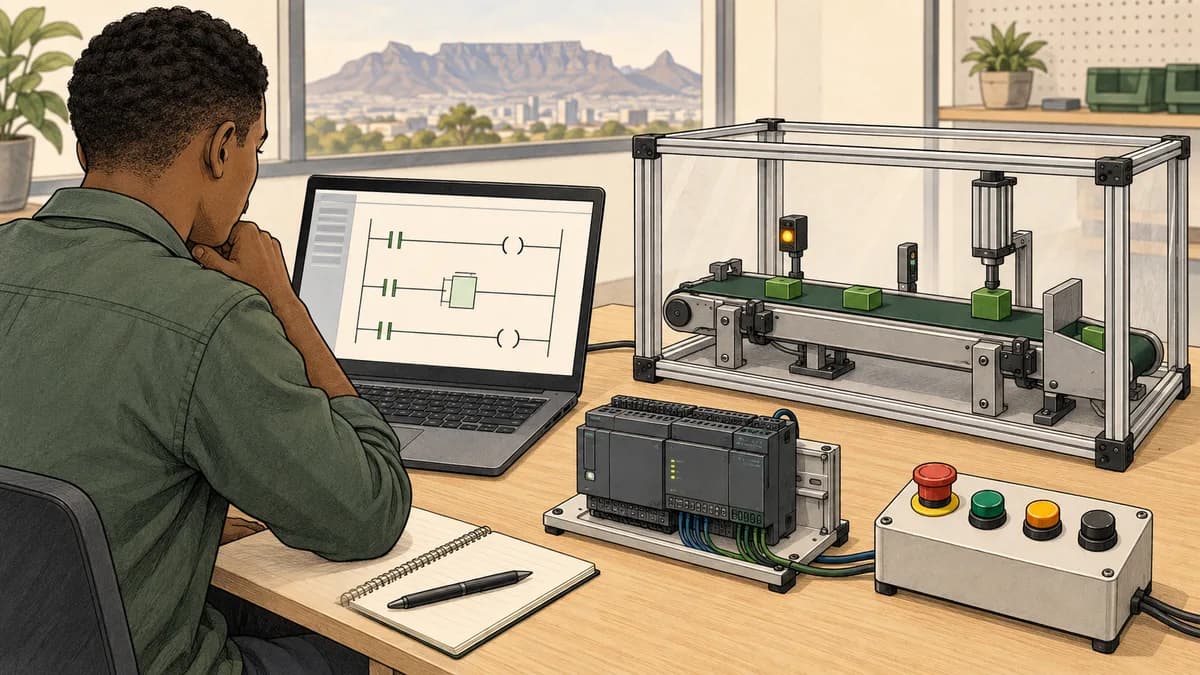
PLC training in Richards Bay should help you build a defined practical capability: understand basic logic, trace a signal, diagnose a sequence or work in a particular controller environment. Compare local engineering study contacts, specialist short courses, employer-arranged training and online preparation by that outcome. A course title, an industrial-zone address or a certificate image does not establish what you will personally learn to do.
This guide covers Richards Bay and nearby study planning, with wider KwaZulu-Natal options where travel is useful. It includes a fictional stores-record exercise that develops a valuable automation habit: reconcile identities, units and events before trusting a total. The exercise is educational and read-only; it is not a production inventory system or a procedure for operating industrial equipment.
Local engineering study and training enquiries
uMfolozi TVET College and Richtek
uMfolozi TVET College publishes campus and central-office information for the Richards Bay area. Its website includes a September 2025 notice about part-time engineering study at Richtek campus. That notice is a dated enquiry lead, not confirmation that the same intake or timetable is open now.
Ask the college for the current engineering programme, admission requirements, campus and practical syllabus. If you specifically want PLC training, request the controller details and individual practical arrangements rather than inferring them from the word engineering. Also distinguish a formal study programme from a stand-alone short course for an employed technician.
The central office is not automatically the location of your workshop. Confirm the teaching address attached to the programme and the times you need to attend. If you are planning around shifts, ask whether practical sessions, assessments and any supplementary sessions follow the same timetable. A dated written response makes the travel and study commitment much easier to compare.
University of Zululand engineering routes
The University of Zululand engineering department identifies Richards Bay campus as its location and lists electrical engineering among its programmes. This is a local higher-education route to investigate. It does not establish a current open-enrolment PLC short course or mean that a degree programme and a short practical course serve the same purpose.
If your goal is a formal engineering qualification, use the university's current admissions information and programme requirements. If you already have an engineering background and need a controller-specific skill, ask whether there is a suitable current short programme or practical training contact. Keep those enquiries separate so that a broad university curriculum is not mistaken for a quick vendor course.
Employer-arranged specialist training
For a group with a defined equipment need, on-site training can be worth enquiring about. Bosch Rexroth Africa's training page describes hydraulic and pneumatic training, including arrangements at a customer's site on request. That establishes an enquiry option for those subjects; it does not confirm a public PLC class in Richards Bay.
Specify whether you need fluid-power principles, electrical control, controller programming or diagnosis of an integrated training model. Ask which parts of the proposed course cover each subject and which equipment is included. A course that develops hydraulic understanding may complement PLC learning, but the two should not be presented as interchangeable qualifications or practical outcomes.

Use local industry information to frame learning questions
The Richards Bay Industrial Development Zone identifies sector interests including metals beneficiation, agro-processing, marine development and energy. Its pages include investment opportunities as well as organisational information. An identified priority sector is not proof that every proposed project is operational, recruiting or using the same control platform.
Use that context to ask better training questions. If you are interested in materials handling, ask whether a course includes counting, sequence diagnosis and clear distinctions between requests and feedback. If you are interested in process-related work, ask about measurement quality, units, trends and the limits of a displayed value. Those are learning questions; they do not establish a particular employer's equipment or vacancies.
Avoid assuming that one manufacturer dominates every local plant. Where you have an authorised workplace training plan, record the controller family, engineering package and task you need to perform. Where you are exploring possible roles, compare several current descriptions and keep the dates with your notes. Choose specialist training from that evidence rather than a province-wide salary or brand claim.
The KwaZulu-Natal PLC training guide provides a wider planning route, while the Durban PLC course guide is useful if you are comparing a confirmed course there. Richards Bay and Durban are separate travel decisions. Use the actual venue and timetable when calculating the commitment instead of treating the whole coastal region as a single local classroom market.
What practical course depth should mean
A beginner course should help you explain why a condition is true, how a small sequence changes state and what evidence supports a displayed result. Ask whether you will predict behaviour before running the example. That simple step reveals whether you understand the logic or are following a set of clicks without a clear expectation.
For a diagnostic course, request examples that include incomplete or conflicting information. A valid zero, an unavailable reading and a value from the wrong signal should not all be handled as the same thing. Ask how learners document an unresolved case and what the instructor expects before calling a fault identified. The PLC troubleshooting guide develops that distinction between a symptom and a supported conclusion.
For a programming course, ask whether you will work from a written requirement, define input assumptions and test changes. A small well-explained exercise can provide stronger learning evidence than a large prepared project whose behaviour you cannot account for. Ask what each learner must complete independently and how feedback is given on a failed case.
If the course includes HMI or SCADA topics, distinguish screen design from tested data behaviour. A neat display is useful, but it should be clear which signal it represents, what unit it uses and what happens when the information is missing. The HMI tag-binding guide helps prepare questions about that connection.

A worked learning exercise: reconcile an item ledger
Imagine a fictional training store called BayStudy. Its opening balance is 120 items. It receives and dispatches items through a list of records. Every record has a unique identity, a direction, a non-negative integer quantity and the unit items. The model calculates an expected closing balance; it does not claim that a physical stock count has occurred.
The initial exercise assumes all four records are complete, authorised for the model and part of the same observation period. There are no hidden movements or measurement errors. These assumptions make the arithmetic easy to inspect before introducing more realistic uncertainty.
| Record | Direction | Quantity | Balance after record |
|---|---|---|---|
| M01 | Receipt | 40 items | 160 items |
| M02 | Dispatch | 35 items | 125 items |
| M03 | Dispatch | 25 items | 100 items |
| M04 | Receipt | 10 items | 110 items |
Receipts total 50 items and dispatches total 60. The expected closing balance is 120 + 50 - 60 = 110 items. Now introduce a separately supplied fictional count of 108 items at the same closing boundary. Define the difference as supplied count minus expected balance. The difference is therefore minus two items.
That result identifies a discrepancy under the stated assumptions. It does not establish theft, a sensor failure, a missed dispatch or any other cause. A useful learner answer says what differs and which evidence would be needed next. Guessing a plausible cause and presenting it as a diagnosis would go beyond the fixture.
Keep identity separate from quantity
Suppose M02 is delivered to the model twice with exactly the same direction, quantity and period. Under the exercise's rule, it is a duplicate of the same event and must not reduce the balance a second time. The expected closing balance remains 110. If the model instead subtracts both copies, it reports 75 and creates a false discrepancy.
Now change the second M02 record to 36 items. This is a conflicting record with an existing identity, not a harmless duplicate and not automatically a new dispatch. Mark the affected reconciliation unresolved until the conflict is clarified. Do not silently prefer the larger value, the last-arriving value or whichever value makes the total closer to 108.
If a correction is required, define how it is represented. For this exercise, preserve the original record and add a separately identified correction event with an explanation. The model needs an explicit rule for that new event type before accepting it. A learner should not invent correction semantics halfway through a test merely to make the arithmetic balance.

Test the boundaries of the data contract
A receipt of zero items is a valid zero-value event if it otherwise satisfies the exercise rules. It changes no balance. A missing quantity is different: there is no supported amount to add or subtract. Keep that record unresolved and avoid displaying a complete final balance as though the missing movement were known to be zero.
A quantity of 2.5 is invalid here because the model counts whole items. That does not mean fractional quantities are universally invalid in automation; it follows from this exercise's chosen unit and data contract. A different model measuring mass or volume would need a different representation and acceptance rule. The data conversion reference helps explain why units and representation belong in the requirement.
A record for another store must not be included simply because its quantity looks reasonable. Give each record the model identity or otherwise establish its scope. Likewise, a receipt outside the closing boundary belongs to another period. The arithmetic can be correct while the set of records being added is wrong.
If a proposed dispatch would make the calculated balance negative, mark it for review under this learning model's rules. Do not clamp the balance to zero, because that would discard the size of the inconsistency. Do not infer a physical impossibility from the record alone either; the opening balance or event history could be incomplete. The educational result is that the supplied ledger does not reconcile under its assumptions.
Expected review cases
| Case | Change to the fixture | Expected interpretation |
|---|---|---|
| L1 | Original four records | Expected closing balance 110 items |
| L2 | Compare a supplied closing count of 108 | Difference minus two; cause unknown |
| L3 | Repeat identical M02 | Ignore duplicate for the balance; retain evidence of receipt |
| L4 | Repeat M02 with quantity 36 | Conflicting identity; reconciliation unresolved |
| L5 | Add valid zero receipt | Balance unchanged |
| L6 | Add receipt with missing quantity | Incomplete evidence; do not substitute zero |
| L7 | Add movement for another store | Exclude from this model's ledger |
| L8 | Add movement outside the period | Exclude from this period's reconciliation |
These cases separate arithmetic, event identity and evidence quality. Ask a learner to explain why L3 can leave the result unchanged while L4 makes the result unresolved. Then change the quantities and see whether the explanation survives. The objective is a transferable reasoning habit, not memorising the number 110.
Use the exercise to assess a training offer
Ask whether a provider can show how learners work with input assumptions, duplicates, invalid values and a changed requirement. It does not need to use this exact ledger. A comparable exercise might involve a counter, a batch record or a simulated sequence. What matters is that the learner has to distinguish the event being represented from the number displayed on a screen.
If you implement the example in a learning environment, record the project name, revision, opening state and actual observations. Mark the table above as expected behaviour until you run it. Do not describe a desk calculation as a controller test, and do not imply that a generic simulator has validated a production inventory process.
For structured preparation, explore the PLC simulation curriculum. Use its current published capabilities to identify appropriate lessons and exercises. Where your objective includes a particular native software package or physical equipment, arrange that access as part of the wider training plan.
The PLC program testing guide is useful for organising expected results, invalid-input cases and checks after a change. Keep the conclusion proportional to what you actually tested. A working educational model is evidence of that model, not a guarantee of native project compatibility or workplace authorisation.

Plan costs, travel and follow-up practice
Ask for a dated quotation tied to the exact course and delivery mode. Check tax, materials, software access, assessment and reassessment charges. If the provider requires a laptop, establish the supported environment and installation arrangements before arriving. Also ask what practice access remains after the course so that follow-up work is feasible.
Calculate transport from your own location to the confirmed teaching venue. A local college programme, a specialist block in Durban and an employer-arranged course at your site have different cost structures. Compare tuition, travel, accommodation and time away from work in separate rows. The South African PLC course price guide explains those categories without treating one advertised fee as a national benchmark.
Ask how many learners share a station and how roles rotate. Working with a partner can support useful discussion, but each learner should still know which tasks they will perform and what they must demonstrate alone. A practical assessment that checks both people separately gives clearer evidence than a group project with no record of individual contribution.
Reserve time for preparation and a follow-up exercise. Before the course, identify concepts you cannot yet explain and ask for suitable preparatory material. Afterwards, rebuild a small task without the instructor's notes and record where you get stuck. Those gaps are useful information for the next study step, not a reason to claim that attendance automatically produced mastery.
For employers and colleges, use the training-centre planning guide to define a pilot around explicit outcomes. Decide what learners should be able to explain, which environment they will use and how feedback will be given. Keep educational practice separate from access to production projects and equipment.
Questions about PLC training in Richards Bay
Is there a local engineering study route in Richards Bay?
There are local contacts to investigate, including uMfolozi College and the University of Zululand's engineering department. Confirm the current programme, campus and admissions details. A local engineering offering does not by itself establish an open PLC short-course intake or a particular vendor laboratory.
Should I travel to Durban for a PLC course?
Compare the practical capability offered with your local options and the travel commitment. A course using the exact environment you need may justify travel. A general introduction that duplicates skills you can already demonstrate may not. Obtain the teaching address, dates and individual practical arrangements before deciding.
Which PLC brand should I learn for the Richards Bay industrial area?
Use the equipment requirements of the role or workplace you can verify. Industrial-zone sector descriptions do not establish a universal controller brand. If you are still exploring, build foundation logic and diagnostic skills, then choose a specialist environment from evidence in course syllabi and relevant role requirements.
Is hydraulic training a substitute for PLC programming?
It addresses a different subject, although the two can complement each other in an integrated learning plan. Ask how a proposed course divides fluid-power principles, electrical control and programming. The hydraulics and pneumatics course guide helps organise those questions before choosing a specialist block.
Can I study online while working shifts?
Online preparation can fit smaller study periods when the product supports your device and connectivity. Schedule time to explain and rebuild exercises, not just watch lessons. If your target capability requires native software or physical equipment, plan suitable practical access as well. The PLC training pathway provides a foundation sequence.
What should I ask an AI assistant when comparing local courses?
Give it dated syllabi, your existing skills, location and practical objective. Ask it to identify missing information about equipment, individual assessment and total cost. Require it to distinguish a current confirmed intake from a historical notice. Verify the answer with the provider before paying or arranging travel.

Prepare a course shortlist you can act on
Choose two or three relevant enquiries and send each the same description of your starting skills and intended outcome. Request the current syllabus, venue, practical access, assessment and full quotation. Compare those responses against the capability you want to demonstrate. That creates a clear next step and a more useful learning plan than a broad promise about local salaries or a single supposedly dominant PLC brand.