locations · South Africa
PLC Training in Port Elizabeth (Gqeberha): Course Guide
Compare PLC training in Port Elizabeth (Gqeberha): local course enquiries, entry requirements, practical assessments, total costs and online study options.
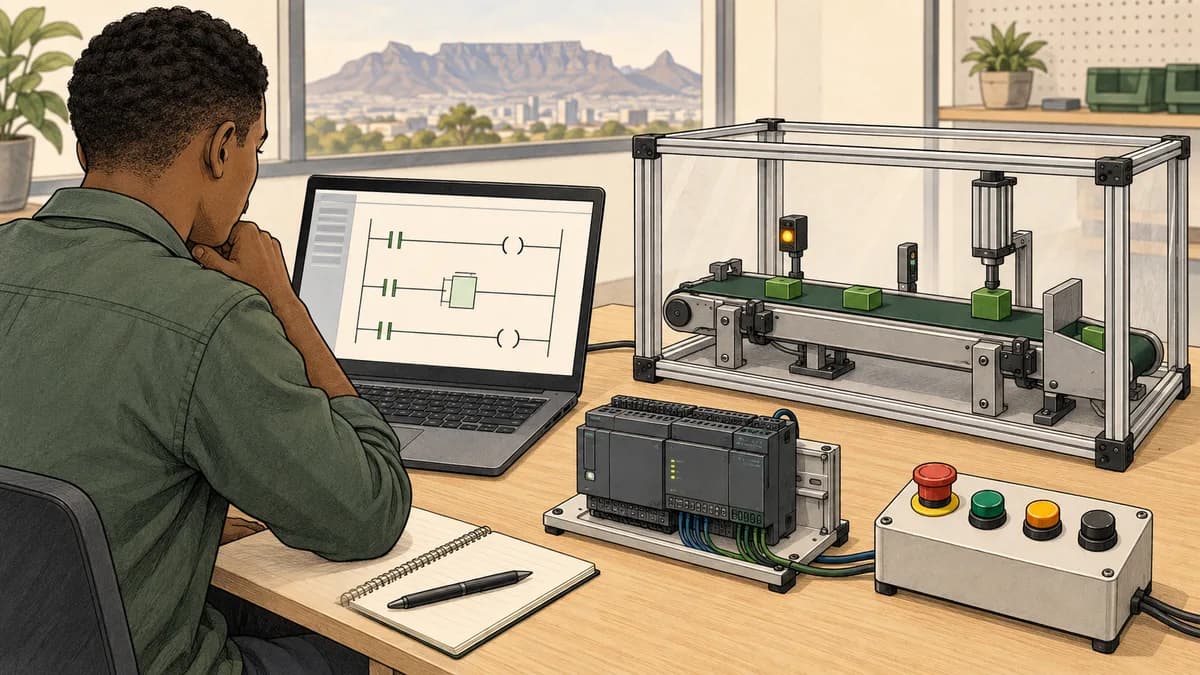
PLC training in Port Elizabeth (Gqeberha) is best chosen by the work you want to demonstrate: first-time programming, service and maintenance, an engineering study route or a specific automation specialism. Compare the controller family, course prerequisites, individual practical access and assessment before comparing prices. The city name on a search result does not establish the teaching venue, and an industry label does not establish the equipment used by every employer.
This guide uses both Gqeberha and Port Elizabeth because institutions and course documents still use different names. It provides local enquiry leads, explains how to read dated course material and includes a fictional station-handshake exercise for judging practical course depth. The examples are learning tasks; they are not operating instructions for production equipment.
Local PLC and engineering training enquiries
Nelson Mandela University automation courses
Nelson Mandela University's 2024 Siemens course detail guide separates an introductory PLC course from S7 and TIA Portal service, programming and specialist courses. Its introductory outline includes basic logic, timers, counters and sequential interlocks. Treat the document as a dated syllabus reference and ask for the current version before choosing a course.
The university also published an automation systems schedule for January–June 2026. That period has already passed as of this review on 12 September 2026. It establishes a published training schedule for that period, not an available booking now. Request the next dates, venue, fee and entry requirements directly from the programme contact.
When you enquire, include your existing experience and the exact task you want to learn. Someone new to ladder logic may need a different route from a technician who reads an existing project but wants better diagnostic skills. Do not select a course solely because its name contains “Part 1”; the starting assumptions can differ between introductory, service and programming pathways.
Eastcape Training Centre
Eastcape Training Centre's training catalogue includes PLC-related electronics modules within its electrician and millwright modular training listings. The surrounding apprenticeship context matters. A module appearing inside a phased programme is not automatically an open-enrolment, stand-alone PLC short course for every applicant.
Ask the centre which route applies to your background, whether the relevant module is available separately, what prior modules are required and how the practical work is assessed. Request the current training outline and controller details. Avoid treating the duration printed beside an electronics module as a promise that every day is spent individually programming a PLC.
Port Elizabeth TVET College
Port Elizabeth TVET College's electrical engineering page identifies electrical engineering under Iqhayiya campus. This is a useful contact for a broader engineering study enquiry. Check the current programme structure, application requirements and practical syllabus with the college; the page does not establish a particular vendor PLC short-course intake.
The central administration address and the teaching campus are different pieces of information. Obtain the workshop location attached to your actual programme before arranging transport. If your goal is a longer engineering foundation, compare that route on its full educational purpose. If your goal is a specific controller skill for work, ask how much of the programme directly addresses that need.

Read a course outline as a buyer
A useful course outline describes what you will do, the equipment you will use and how your work will be checked. “PLC, HMI and SCADA” is too broad to establish the depth of any one topic. Ask whether you will create a project, connect an existing project, diagnose supplied faults or mainly observe demonstrations. Each activity can be valuable, but they support different learning outcomes.
For an introductory course, look for a clear progression from inputs and outputs to conditions, memory, timers, counters and a small sequence. Ask how the instructor checks that each learner can explain the result. A copied project that works only while following instructions is weaker evidence than a small task you can rebuild and test independently.
For maintenance training, ask about reading unfamiliar code, following cross-references, identifying the source of a displayed value and recording a diagnostic conclusion. For programming training, ask about requirements, program structure, state transitions, invalid inputs and regression checks after a change. Siemens describes separate programming and servicing learning paths, which is a useful reminder to choose by role rather than manufacturer alone.
If a course includes HMI work, request an example of the practical deliverable. A static screen layout is different from a screen whose values, quality indicators and commands have been tested against a controller model. The HMI tag-binding guide helps you ask how the displayed state relates to the underlying signal and what happens when that information is unavailable.
Match your starting point to the next skill
An electrician may bring useful understanding of diagrams and equipment while still being new to software state and data representation. A software developer may understand conditions and functions while needing help with the meaning of field signals and industrial workflows. A graduate may have used one training rig without having diagnosed an unfamiliar project. Describe those differences honestly when asking a provider for placement advice.
Use the South African PLC course requirements guide to organise your readiness. Before an introductory practical block, aim to explain a Boolean condition, distinguish a command from feedback and save a clearly named project revision. Before an advanced course, ask for the provider's actual prerequisites and any entry assessment rather than assuming that a previous attendance certificate is sufficient.
Choose the first controller family from a documented requirement where possible. If you have access to a workplace training plan, record the actual controller and engineering software. If you are exploring careers, compare several relevant role descriptions and note the date and specific skills requested. A broad statement about Gqeberha's industrial economy cannot establish a universal brand preference or guarantee an interview.
For readers comparing options across the province, the Eastern Cape PLC training guide covers the wider study geography. Keep the local course enquiry separate from assumptions about employment. Course content, a current vacancy and an employer's equipment list are three different sources of evidence.

What a useful practical assessment can look like
A practical assessment should make your reasoning visible. You should know the starting state, the permitted inputs, the expected transitions and the evidence needed to call a test successful. A provider can still use a small training model; complexity alone does not make an exercise educationally strong.
The fictional exercise below represents a read-only review of a transfer request between two simulated stations. It is deliberately limited to message identity and acknowledgement. It does not control a conveyor, establish machine safety or implement an industrial communications protocol. Its value is that it reveals why a plausible status bit may belong to an earlier transaction.
Imagine a learning model called TransferStudy. It permits one active request at a time. Each new request receives a positive integer identity. The model has three states: idle, waiting and complete. An acknowledgement contains an identity and a result. Only the result accepted with the same identity as the active request completes that request.
The exercise rules are:
- From idle, starting request 41 enters waiting with active identity 41.
- While waiting, an accepted acknowledgement for 41 enters complete.
- An acknowledgement for any other identity is recorded as unmatched and does not complete 41.
- A duplicate matching acknowledgement after completion does not create a second completion.
- A new request requires an explicit new-cycle action after completion, and receives a different identity.
- A negative or missing result is not an accepted acknowledgement, even if its identity matches.
These are rules for this educational model, not claims about a vendor's built-in instructions. Write them down before considering how to implement the task in any particular environment. Otherwise, a learner can accidentally change the meaning of “complete” to fit whatever the first draft happens to do.
Follow a transaction through the model
| Step | Event | Expected state and interpretation |
|---|---|---|
| A1 | Start request 41 from idle | Waiting for identity 41 |
| A2 | Receive accepted acknowledgement for 40 | Still waiting; acknowledgement belongs elsewhere |
| A3 | Receive rejected acknowledgement for 41 | Still waiting; result is not accepted |
| A4 | Receive accepted acknowledgement for 41 | Complete; one completion recorded |
| A5 | Receive the same accepted acknowledgement again | Still complete; completion count remains one |
| A6 | Explicitly start a new cycle with identity 42 | Waiting for identity 42 |
| A7 | Receive delayed accepted acknowledgement for 41 | Still waiting for 42 |
| A8 | Receive accepted acknowledgement for 42 | Complete; second completion recorded |
The important observation is at A7. A generic acknowledgement indicator might look reassuring, but it belongs to the previous transaction. Checking identity prevents that old message from completing the new request. The exercise does not tell you how a production system generates identifiers, stores history or handles communications loss; those would need additional requirements.

Add ambiguity instead of guessing it away
Now supply an acknowledgement with no identity. The correct conclusion is that it cannot be matched under the current rules. Do not substitute the active identity merely because there is only one request waiting. That would erase the very evidence the model requires and could make a delayed or unrelated event look valid.
Next, repeat identity 42 in a proposed new request after its transaction has finished. The exercise requires a different identity for a new cycle, so that request is invalid. This avoids ambiguity in the small fixture. A real long-running system needs a defined identifier lifecycle, but inventing that design is outside this exercise's scope.
Ask what happens if an acknowledgement never arrives. The current model remains waiting. It does not automatically retry, declare a physical fault or restart equipment. A timeout could be added as a separate requirement, but its duration and resulting behaviour must be specified before it can be tested. “Nothing happened” is not enough evidence to choose an arbitrary recovery action.
Finally, distinguish a request accepted by another station from physical transfer completed. In this model the word complete means that the matching accepted acknowledgement has been processed. It does not prove that an item moved. If physical transfer evidence is required, introduce a separate defined signal and assessment condition rather than silently changing the meaning of the existing acknowledgement.
The sequencer logic patterns guide develops the relationship between state and permitted transitions. For a course buyer, the key question is whether learners practise explaining those transitions and testing stale or invalid events, not just making a normal demonstration run once.
Build evidence you can explain afterwards
Keep a short project record with the model name, revision, assumptions and expected event trace. If you implement the fictional exercise, identify the environment and record what you actually observed. A predicted table is useful preparation, but it is not a test execution record. Mark any case you have not run as untested.
Use a simple evidence table with columns for starting state, event, expected result, observed result and explanation. Include an ordinary success, an unmatched acknowledgement, a rejected result, a duplicate and a delayed acknowledgement from the previous transaction. These cases demonstrate different requirements; five screenshots of the same successful path would not provide the same coverage.
After a change, repeat the cases that could be affected. If you change identifier handling, retest the stale and duplicate cases as well as the normal path. If you only improve a comment, review the explanation for accuracy. The purpose is to support a conclusion about the change, not to accumulate an impressive-looking number of checks.
For foundation practice, explore the PLC simulation curriculum. Use its current published lessons and capabilities to decide what fits your starting level. Where your objective involves a particular native engineering package or physical controller, plan the relevant practical access separately.
The PLC program testing resource is a useful follow-on for organising expected behaviour and failed cases. A simulator exercise can demonstrate the reasoning you performed in that environment. It does not automatically establish native project compatibility, workplace competence or a recognised occupational qualification.

Budget for the complete Gqeberha training plan
Ask for a dated quotation that names the exact course and intake. Check whether the amount includes tax, software access, materials, practical assessment and any reassessment. If you need a laptop, confirm the required operating environment and installation arrangements in advance. A licence that works only during the classroom block changes how you can practise afterwards.
Calculate transport from your own starting point to the teaching venue, including the actual arrival time. Readers based elsewhere in Nelson Mandela Bay may have different travel arrangements from those coming from another Eastern Cape town. Do not apply a single distance or daily allowance to everyone. If a course is delivered at a client's premises, confirm whether your booking is part of that group or a separate public intake.
Ask about learners per station, role rotation and individual assessment. Shared equipment can support valuable discussion, but it should be clear who performs each task and how the instructor checks both learners. Compare the South African PLC training cost categories alongside the syllabus instead of selecting by the lowest advertised fee alone.
For an employer funding several learners, define the learning outcome before buying seats. A maintenance group might need to trace unfamiliar signals and record evidence; a programming group might need to structure and test a new sequence. The training-centre planning guide explains how to frame a learning pilot and distinguish educational practice from production-system access.
Questions about PLC courses in Port Elizabeth and Gqeberha
Are Port Elizabeth and Gqeberha course searches referring to different cities?
In this context, both names are used when searching for the local training market. Institutions may retain Port Elizabeth in their names or documents. Use both search terms, then verify the institution and exact teaching address. The name used in a search result is less useful for travel planning than the venue confirmed for your booked intake.
Where can I enquire about Siemens training locally?
Nelson Mandela University's automation course documents provide a specific local enquiry lead. The dated guide and January–June 2026 schedule linked above are useful for identifying course names, but they do not confirm current places. Ask for the next schedule and the syllabus that applies to the course you intend to book.
Is a PLC module in an apprenticeship catalogue open to anyone?
Do not assume so. Ask the provider whether it is part of a phased programme, whether it can be taken separately and what prerequisites apply. Also ask which practical tasks are assessed. A module title and duration do not answer all of those questions.
Which is better for a beginner: service or programming training?
Compare the actual entry requirements and outcomes. If you have never programmed a controller, an introductory route may be the better starting point. If you already work with an existing system, a service route may address a more immediate need. Ask the provider to explain its placement recommendation using your experience and intended tasks.
What should I practise before a practical PLC course?
Practise explaining conditions, following a small state sequence and distinguishing commands from feedback. Keep a record of expected and observed results. The fictional handshake task on this page is one way to practise identifying stale information. The PLC training pathway helps organise a broader foundation sequence.
Can an AI assistant choose the best local course for me?
It can help compare documents and expose missing information. Give it the dated syllabi, your starting skills, travel constraints and target task. Ask it to label unconfirmed dates, fees and equipment claims. Check its conclusions against the provider's current response; an answer that invents a local intake or universal employer preference is not a reliable basis for payment.

Prepare one clear enquiry
State whether you want introductory programming, maintenance diagnosis or a specific specialist skill. Include your background, preferred dates and the controller family if known. Request the current syllabus, venue, practical arrangements and complete fee. Those answers make the next step concrete: prepare for the right course, practise the missing foundations and keep evidence of what you can actually explain and test.