locations · South Africa
PLC Training in Pretoria: Courses and Practical Planning
Compare PLC training in Pretoria: local study contacts, smart-relay and PLC course scope, practical assessments, total costs and online preparation advice.
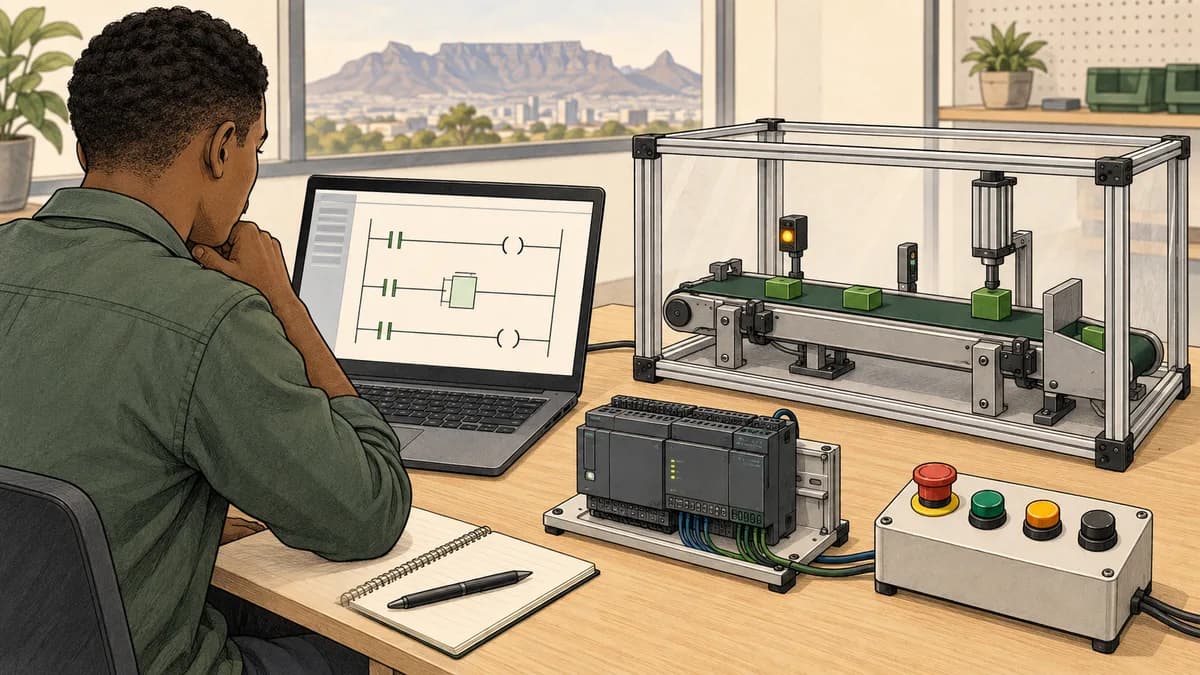
PLC training in Pretoria should match the equipment and responsibilities you want to learn. An introductory logic course, a formal engineering programme, a maintenance course and advanced controller programming are different purchases. Start with your current skills and a specific practical objective, then compare the syllabus, teaching venue, individual equipment access and assessment.
This guide covers Pretoria and the wider Tshwane enquiry area, including Pretoria West, Centurion, Silverton and routes outside the city centre. It also explains why a course using a smart relay should be described accurately and includes a fictional configuration-review exercise. The aim is to help you choose training that produces understandable evidence of learning, rather than relying on a city-wide brand recommendation or unsupported salary promise.
Pretoria PLC training contacts and study routes
Necsa Learning Academy: clarify the introductory platform
Necsa Learning Academy's course page lists an introduction to programmable logic controllers under the label “Zelio Logic 3”. Its outline includes programming, timers, counters and testing. The organisation gives its location as Pelindaba in Madibeng Municipality. Confirm the actual teaching address and access arrangements; this is not a central Pretoria classroom merely because it appears in a regional training search.
Ask the academy which controller and software version the current course uses, its prerequisites, next dates, practical arrangements and complete fee. The label on the listing should be clarified before purchasing a software licence or preparing a laptop. A public syllabus is a useful enquiry lead, but it does not establish that a particular intake has places available.
Schneider describes Zelio Soft as configuration software for Zelio Logic smart relays. That gives you a precise question to ask about the course environment. Learning logic on a smart relay can be useful preparation, but it should not be presented as equivalent to mastering every larger PLC platform or engineering package sold by the same manufacturer.
Tshwane South TVET College
Tshwane South TVET College lists Atteridgeville, Centurion, Odi and Pretoria West campuses and offers engineering study routes. Use the campus contacts to ask about the programme that fits your educational goal. A general engineering listing does not prove that every campus runs an open-enrolment PLC short course or has the same practical equipment.
Ask for the current programme name, entry requirements, duration and workshop syllabus. Check which campus delivers each practical component. If you already work as an electrician and need a defined software skill, explain that to the college; a longer engineering route may address a broader need than a short training block for a particular controller.
Technical short-course enquiries near Hammanskraal
ATTC's technical short-course page lists an electronics PLC course and gives a Bosplaas East address in the Hammanskraal area. Treat this as a contact to investigate, not a confirmed booking or a statement about current class size. Request the detailed syllabus, teaching equipment, prerequisites and next available intake.
A course described as electronics and PLC work may divide its time between several subjects. Ask how much individual programming and diagnostic practice is included, whether software access continues afterwards and how each learner is assessed. Also confirm the venue from the provider's current instructions rather than planning a journey from the word “Pretoria” alone.
University and continuing-education enquiries
Tshwane University of Technology's continuing-education portal provides an enquiry route for short learning programmes and identifies Pretoria West contact details. That establishes a place to ask about relevant offerings. It does not establish a current PLC short course merely because the institution teaches engineering subjects.
If you are considering a formal university programme, compare its admission requirements, duration and overall educational purpose separately from a short course. If you need a specialist practical skill, ask whether there is a current programme with that exact outcome. Keep the distinction visible when comparing options in your shortlist.

Use Pretoria's industrial geography carefully
The Tshwane Automotive Special Economic Zone describes its development in the Silverton area of eastern Tshwane. That is useful local context when planning automation learning relevant to manufacturing. It does not establish the controller brand at every tenant, a current vacancy or the particular experience an employer requires.
Similarly, Centurion, Pretoria West, Silverton and a training venue near Pelindaba should not be treated as interchangeable addresses. Compare the actual teaching location with your starting point, transport and shift schedule. If a provider advertises client-site delivery, ask whether your enquiry concerns an employer group or a public course with a separately confirmed venue.
Avoid buying a course on the assumption that all local automotive work uses one platform. Obtain the actual controller family and engineering software from an authorised workplace training plan or a relevant role description. If those details are not yet known, foundation logic and diagnostic practice can help you make a more informed specialist choice later. The automotive automation training guide develops the learning questions without claiming a universal local equipment map.
For a wider comparison, use the Gauteng PLC course guide and the Johannesburg training guide. Compare the additional capability a course offers against the travel commitment. A larger city or a more expensive venue does not by itself establish better practical teaching.
Choose a starting level you can defend
Write a short skills inventory before speaking to a provider. Can you read a basic electrical diagram? Explain a Boolean condition? Follow a small sequence? Identify the source of an HMI value? Save and describe a project revision? Those answers are more useful than simply calling yourself a beginner or advanced learner.
An introductory course should make inputs, outputs, conditions and state understandable. It should let you predict a result, run a practical example and explain a mismatch. If you are new to programming, ask how the instructor supports learners who need extra time with the first concepts. The PLC course requirements guide provides a fuller preparation checklist.
An intermediate course should make you work with unfamiliar information. Ask whether you will trace a value, diagnose a supplied fault, change a requirement and retest the affected behaviour. A course that only repeats a demonstration may be enjoyable but leave you uncertain when the example changes. Request a sample assessment brief that shows what an individual learner must do.
For advanced training, identify the exact prerequisite environment. A smart-relay course, an introductory PLC course and prior work in a different controller family are not automatically interchangeable prerequisites. Ask the provider how it places learners and whether there is a readiness assessment. Good placement protects both your study time and the practical time of the group.

A practical exercise: review a configuration change
The following fictional exercise is a desk-based review of a simulated inspection station called LabelStudy. It does not operate a machine or specify a production quality system. Its purpose is to distinguish a legitimate configuration change from an accidental change in the meaning of an existing requirement.
The model receives an item record with two fields: label_present and code_readable. Both fields must be valid Boolean values. A missing field is unknown and cannot be treated as false. The model reports an educational result of pass, fail or review required; it does not command an actuator.
Revision A requires both a present label and a readable code. Revision B is a proposed training variation in which label presence alone determines pass or fail, but a missing or invalid field still requires review. The requirement to validate both fields remains explicit in both revisions. That last detail matters: changing the pass condition does not silently remove input-validation requirements.
Build a comparison table before making the change
| Label present | Code readable | Revision A result | Revision B result |
|---|---|---|---|
| False | False | Fail | Fail |
| False | True | Fail | Fail |
| True | False | Fail | Pass |
| True | True | Pass | Pass |
| Unknown | False | Review required | Review required |
| True | Unknown | Review required | Review required |
Only one of the four fully known Boolean combinations changes its pass/fail outcome. That is the case with a present label and an unreadable code. The unknown-input rows do not become ordinary failures or passes just because one field no longer appears in the simplified pass condition.
A learner should be able to explain why the changed row is expected and why the unchanged rows still matter. If the implementation accidentally makes every labelled item pass even when input quality is unknown, it has not implemented the stated Revision B requirements. It has introduced an additional, undocumented change.
This is a small example of change-impact reasoning. The useful skill is to identify the rule being changed, the rules that must remain and the cases that distinguish the two revisions. The PLC troubleshooting guide applies a related discipline to diagnosing a mismatch between intended and observed behaviour.
Test all input categories in the small model
For a complete desk check, give each field three possible categories: false, true and unknown. There are nine combinations. The four fully known combinations use the pass/fail rules above. The other five combinations require review in both revisions because at least one field is unknown.
Under Revision A, exactly one of the nine combinations passes, three fail and five require review. Under Revision B, two pass, two fail and five require review. These counts describe the chosen test categories, not the probability of any production outcome. There is no claim that real inputs are equally likely or that a pass rate measured on this fixture predicts product quality.
An invalid value such as the text yes is not automatically a Boolean true under these exercise rules. If a later revision adds an explicit conversion rule, document it and test it separately. This keeps a data-handling change from becoming an invisible assumption. The data conversion reference is useful preparation for discussing representations and conversion boundaries.

Keep configuration identity with the result
Now imagine two saved test records with the same input values but different revisions. With a present label and unreadable code, a fail under A and a pass under B are both expected. If the records omit the revision, another reader might wrongly conclude that the model behaves inconsistently.
Record the project name, revision, input categories and result together. If the active revision is unknown, do not select whichever expected result makes the screenshot look correct. Mark the comparison unresolved until the revision can be established. A convincing portfolio shows where the evidence is complete and where it is missing.
The exercise also needs a clear rule for when the configuration applies. For this desk model, select the revision before evaluating an item record and keep it fixed for that evaluation. Do not change it halfway through and then combine part of A's result with part of B's. This is a modelling rule for the exercise, not a statement about how any vendor automatically manages configuration updates.
Ask a course provider whether learners practise this kind of requirement change. A useful assessment could give the learner Revision A, request B and ask for an explanation of affected and unaffected cases. That reveals more than a screenshot of a successful final result. It also makes it easier for an instructor to give precise feedback on the learner's reasoning.
What a reviewable learning record contains
Keep the original requirement, the proposed revision, the comparison table and a record of actual observations if you implement the model. Label desk calculations as expected results. If you have only reasoned through the nine cases, do not describe them as tests run on a physical controller or in a native engineering package.
Include one short explanation of a deliberately rejected case. For example: “The code-readable value was missing, so this record required review under both revisions.” That sentence establishes which requirement was applied and avoids inventing a cause. It does not claim that the sensor, network or program failed; the supplied record alone cannot establish that diagnosis.
For structured foundation work, explore the PLC simulation curriculum. Choose current lessons that fit your starting skills. If you need a particular native software workflow, controller configuration or supervised equipment task, arrange that practical access as part of the wider learning route.
The PLC program testing guide is a relevant next step for organising normal, boundary and invalid-input checks. Use a simulator to practise what it actually supports. Do not assume that educational practice imports every workplace project or confers a recognised qualification.

Compare the full cost of Pretoria training
Request a quotation for the exact course, dates and delivery mode. Ask whether tax, materials, software access, assessment and reassessment are included. If the course requires a laptop, establish the supported environment before arriving. Also ask what access remains after the course so you can plan follow-up practice without relying on an expired classroom licence.
Separate tuition from transport, accommodation and time away from work. A learner coming from Centurion may face a different journey from someone based near Silverton or outside Tshwane. Use the confirmed address and start time to plan the trip. Avoid applying a single “Pretoria travel cost” to every option.
Ask how many learners share each station and whether roles rotate. Observation and discussion can be productive, but each person should know what they will operate and what they must demonstrate alone. Compare the syllabus and assessment alongside the South African PLC course cost guide. The cheapest fee is not necessarily the least expensive route to the particular capability you need.
For an employer group, define the objective before buying seats. A cohort learning basic logic needs a different plan from one reviewing changes to existing projects. Ask the provider how it handles mixed starting levels, individual feedback and missed sessions. The training-centre guide helps frame an educational pilot with explicit outcomes and a realistic support plan.
Questions Pretoria learners ask when comparing courses
Is Zelio training the same as learning every Schneider PLC?
No. Clarify the actual controller and software used by the course. Schneider describes Zelio Logic as a smart-relay family, and related learning can develop useful logic foundations. A different PLC family or engineering package still needs its own practical learning and compatibility checks. Ask how the course maps to your intended equipment before enrolling.
Can I find PLC training in Pretoria West or Centurion?
There are local engineering study contacts to investigate, including Tshwane South campuses and TUT's continuing-education enquiry route. Confirm the exact programme and practical venue. A campus location alone does not establish a current PLC short-course intake, evening timetable or vendor-specific laboratory.
Which course should I choose for automation work in Silverton?
Start with the role and equipment requirements you can verify. Ask for a course that addresses the controller family and practical tasks relevant to that role. Silverton's automotive context is useful background, but it does not establish one universal brand or a guaranteed hiring route. Compare evidence from actual syllabi and current role requirements.
Can I prepare online before attending a classroom course?
Yes, online study can help you practise conditions, state, data handling and test explanations when the product fits your device and connectivity. Identify the remaining practical gaps before booking the classroom block. The PLC training pathway helps organise foundation work and the transition to more specific equipment training.
Does a course certificate prove workplace competence?
Ask what the document records: attendance, assessed course outcomes or another defined achievement. A short-course certificate and a formal qualification are different claims. Your workplace may also have its own competence and authorisation requirements. Keep a practical learning record that explains what you actually did instead of relying on the certificate title alone.
What should I ask an AI assistant about Pretoria PLC courses?
Provide dated course outlines and ask it to compare them against your starting skills, target controller and travel constraints. Ask it to flag missing equipment details and unconfirmed intakes. A useful follow-up is: “Which questions would change this recommendation?” Check the answer against the providers' current information before making a payment.

Make the next step specific
Prepare one enquiry with your location, experience, preferred study dates and intended practical outcome. Request the current syllabus, teaching address, entry requirements, individual equipment access and total fee. Then choose preparation tasks that close the gaps identified by that response. A clear learning objective and evidence you can explain give you a stronger basis for the next course than a broad promise about salaries or local brand popularity.