locations · South Africa
PLC Training in Johannesburg: Courses and Practical Evidence
Compare PLC training in Johannesburg: local course enquiries, software, practical access, costs and a project handover exercise for your first portfolio.
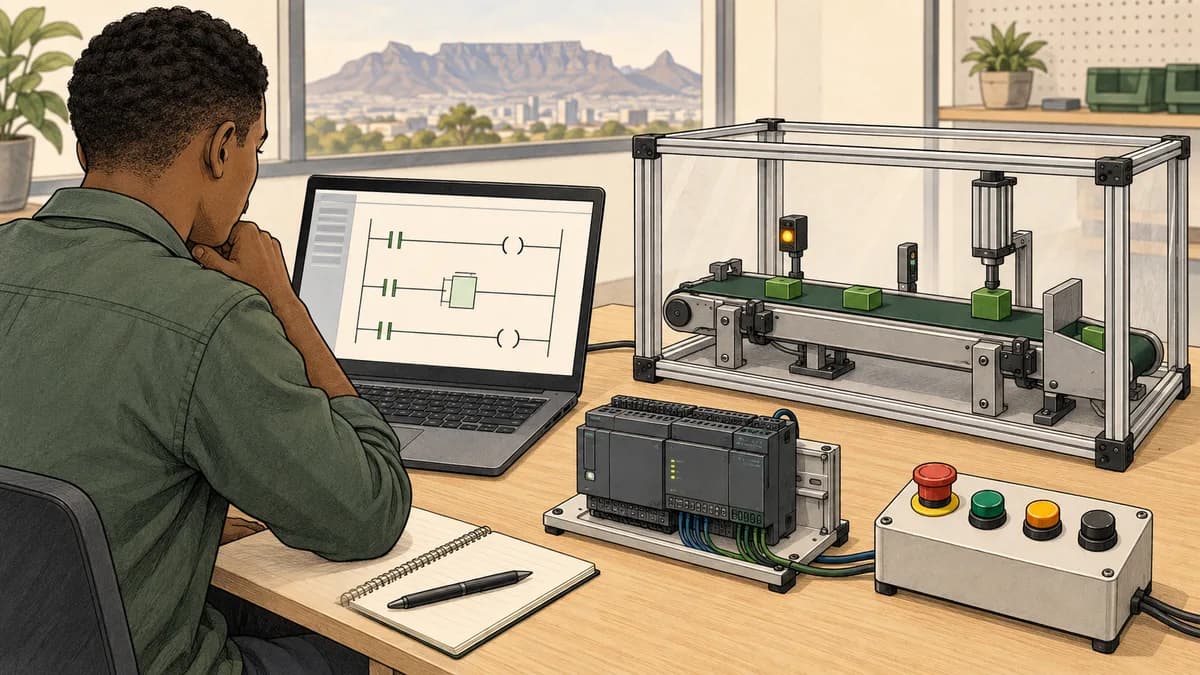
PLC training in Johannesburg should give you a practical skill you can explain and repeat in the environment you paid to use. Begin with your current experience and the task you need next, then check the provider's controller, software, venue and assessment. A Johannesburg search result can describe a local classroom, live online teaching or a course elsewhere in Gauteng.
This guide helps you compare those options and prepare a useful project handover exercise. It includes local education enquiry routes and explains how to evaluate claims about practical access. It does not promise a job, establish a city-wide salary range or assume that every Johannesburg industrial installation uses the same brand.
This site is commercially connected to PLC Simulator. Its curriculum overview can help you identify educational foundation practice. Check current lesson access on the product site. A browser exercise and a short-course record should be described by their actual learning scope, not as a substitute for equipment competence or formal qualification requirements.
Local course enquiries in Johannesburg
Resolution Circle publishes a PLC short-course page and Johannesburg contact information in Doornfontein. The page captured during our September 2026 review names Unitronics and VisiLogic in its practical course description. Ask the provider to confirm the current teaching venue, course version, intake and full quotation. A contact address and a course listing do not establish the exact laboratory used for your booking.
The distinction between platforms is material. Unitronics' VisiLogic product page identifies the software with its Vision and Samba controller series. A course in that environment is not automatically a TIA Portal or Studio 5000 course, even though programming concepts can overlap. Choose the practical environment that matches your learning objective.
Central Johannesburg TVET College describes engineering study among its fields and identifies campuses including Ellis Park and Riverlea. Use the college's official information to ask about a specific programme and campus. It is not evidence that every engineering student can book a standalone PLC bootcamp on a particular date.
South West Gauteng College's campus page lists locations including Molapo, Roodepoort, Roodepoort West and Technisa. Keep similarly named campuses distinct when making an enquiry. Ask which programme includes programmable control, what its entry requirements are and where the practical component is delivered. Do not assume every campus has the same syllabus or laboratory.
A useful first message to a provider
State your background, target task, available dates and preferred delivery format. For example: “I am an electrician with limited programming experience. I want to read a small PLC project, trace a missing signal and document a test in the named software. Which current course fits, and how much individual practical time is included?”
Request a sample syllabus and assessment description. If the provider proposes a different course, ask what prerequisite or learning objective drove that recommendation. Save the response date and any conditions. A current written answer is more useful than collecting undated course names from several directories.
Keep Johannesburg separate from a wider Gauteng search
Doornfontein, Soweto, Roodepoort and Randburg can produce different attendance plans for the same learner. Midrand and the East Rand may also appear in a Johannesburg course search. Confirm the address and check the journey at the actual class times. Living in the province does not mean that every practical venue is convenient or inexpensive to reach.
For a broader comparison, use the Gauteng PLC course guide. It provides a method for checking syllabus coverage and unknown information across several offers. This city guide focuses on local enquiries and the practical evidence a learner should bring away from the class.
Industrial geography also needs care. InvestSA's special economic zone overview identifies the OR Tambo SEZ at the airport and lists Tshwane Automotive SEZ separately. These are regional industrial contexts, not adjacent Johannesburg training rooms or proof that every tenant uses a particular controller. Check the actual location and task when researching a role.
Avoid choosing a course from a claim that one sector has the largest local investment or the strongest hiring demand unless the claim has current, relevant evidence. Your immediate decision needs the equipment and skills in a real role or assessment. A broad economic label cannot tell you which software version to install for a class.

What a beginner practical course should make visible
A useful introductory task has defined inputs, outputs or displayed values, a small requirement and expected tests. The learner should create or modify something, observe the result and explain a mistake. Merely watching an instructor run a finished demonstration does not establish what an individual can do afterward.
Ask whether each learner works at a station, shares equipment with a partner or only observes a group setup. Shared equipment can support good learning when the roles rotate and each person is assessed. The important point is to understand the arrangement before paying rather than interpreting total classroom hours as individual operation time.
| Question | Why the answer matters |
|---|---|
| Which project will I create? | Defines the practical output rather than a topic list |
| Which software version is used? | Helps check laptop and target-equipment fit |
| Who operates the training controller? | Clarifies individual access |
| What happens after a failed test? | Reveals feedback and correction time |
| What evidence may I keep? | Supports continued learning and a truthful portfolio |
| Which prerequisites are assumed? | Prevents an advanced course from becoming an expensive introduction |
The PLC course requirements guide helps you check starting knowledge. Ask about drawing interpretation, computer use and programming assumptions separately. An electrical qualification and experience using a spreadsheet do not automatically establish familiarity with a vendor's engineering project structure.
A project handover exercise for Johannesburg learners
The following exercise is fictional and read-only. It does not connect to or control machinery. It asks you to decide whether a test record belongs to the project revision being reviewed. This is useful preparation for a course because a working screenshot can become misleading when the underlying project changes.
Imagine a learning project called CartonStudy. Revision A uses a carton target of six. Revision B changes the target to eight and updates the operator display label. Each test record must identify the project, revision, test case, starting state, expected result and observed result. A reviewer should be able to tell which version was actually tested without guessing from the file modification time.
The acceptance rule is simple: a record supports Revision B only when its project identifier is CartonStudy, its revision is B and it documents the relevant test under the agreed starting conditions. A passing Revision A result can remain useful historical evidence, but it is not a passing Revision B result.
Compare five fictional handover records
| Record | Project and revision | Content | Review decision |
|---|---|---|---|
| T01 | CartonStudy A | Six events complete a carton | Historical baseline only |
| T02 | CartonStudy B | Six events leave the carton active | Relevant B evidence if observed as stated |
| T03 | CartonStudy B | Eight events complete a carton | Relevant B evidence if observed as stated |
| T04 | CartonStudy, revision missing | Screen says complete | Revision unknown; cannot assign it to B |
| T05 | OtherStudy B | Eight events complete a carton | Wrong project for this review |
The table deliberately separates a test's apparent success from its relevance. T01 can be a correct result for A while saying nothing about B. T04 might have come from B, but the missing revision prevents that conclusion. T05 shares a revision letter and a result with B but belongs to another project.
Do not edit T01's label to B after the change. Execute the appropriate test in the B environment and create a new record. Preserve the original observation. This teaches a simple but valuable habit: test evidence must follow the work it actually describes.

Make the handover package reproducible
Create a short project note containing the purpose, environment, revision and instructions for the educational fixture. Include the input assumptions and any instructor-supplied material. Keep the expected-result table separate from the observed-result record so that a planned test cannot accidentally appear as an executed pass.
Use a consistent file naming convention that you can explain, such as a project name, revision and document purpose. The exact convention is less important than avoiding several ambiguous files called “final.” A reviewer should not have to infer which copy was used because it has the newest timestamp or the most enthusiastic filename.
If you provide a project file, state the engineering software and version required to open it. Do not assume that a reader can use a generic simulator to open any vendor project. If sharing the native file is not permitted, use a clean fictional example and explain that limitation instead of distributing someone else's source.
The portfolio and CV guide explains how to describe contribution and evidence. For this exercise, your contribution might be the revision change, the expected tests and the handover review. You do not need to claim a full industrial commissioning project to show that you understand traceability.
Add an exception that changes the review outcome
Suppose T03 originally lacks the starting count. If the count was already two, six new events might reach eight without proving that a new carton completes after eight events. The missing initial state matters. Repeat the test from the declared initial condition and record it, rather than guessing that the observed final value proves the whole sequence.
Similarly, a screenshot showing “complete” may omit the active target or project revision. It can support a narrative but rarely contains every assumption. Add the necessary record fields and explain what the screenshot actually shows. More screenshots do not fix a missing test definition.
This is an educational evidence exercise, not a prescribed industrial change-control procedure. A real site may require additional approvals, backups, access controls and validation. A course should teach learners to recognise that boundary rather than presenting a classroom folder as sufficient for live plant changes.
Practise fault investigation alongside programming
A learner who can create a small program should also practise explaining a result that differs from the expectation. Begin with the symptom, the revision and the available observations. Record what you know, what you assume and the next permitted check. Avoid changing several things at once because that makes the cause of an improvement unclear.
The PLC fault-finding workflow guide develops this process. In the handover exercise, a failed test might be an incorrect active target, an unexpected starting count or a display linked to the wrong variable. These are hypotheses for a fictional fixture, not a diagnosis of a real Johannesburg installation.
The product's PLC program testing overview provides context for further educational practice. Verify the available tools and account conditions. This guide does not promise automated certification evidence, native controller validation or a particular export function.

Choose software depth from the next task
If the target role specifies Siemens, ask which controller family and TIA Portal or other engineering environment it uses. If it specifies Allen-Bradley, establish the corresponding controller and software. For a course using another platform, decide whether your current objective is transferable programming knowledge or direct practice in the target vendor tool.
The TIA Portal and Studio 5000 comparison helps frame those questions. It does not establish that one platform dominates all Johannesburg work. A city-wide recommendation based only on a sector stereotype can lead you to pay for a course that does not match the equipment you need to support.
After foundation work, add subjects deliberately. HMI mapping, industrial communications, drives and instrumentation each involve requirements beyond basic ladder notation. The industrial networking training guide is useful when a target task involves data exchange. Choose it because the task needs that knowledge, not simply because the phrase sounds advanced.
Ask a trainer to show how documentation informs equipment decisions
The public scope of IEC 60529 concerns classification of enclosure protection. It does not make a Johannesburg postcode a complete enclosure specification. In a classroom review, ask how the selected equipment documentation and installation conditions inform the required assessment. This article does not prescribe a universal IP rating or drive derating factor for the city.
A practical documentation exercise can identify the device model, manual revision, stated operating conditions and unanswered design questions. It should not instruct a beginner to modify a live panel or apply a generic factor to every drive. The useful skill is finding and interpreting the correct information under competent instruction.
The panel layout fundamentals guide gives further context for drawings and conceptual layouts. Keep a learning illustration separate from an approved construction drawing. A neatly drawn panel or a simulated response is not proof that an installation has been checked for energisation.
Compare the total course cost and the learning evidence
Request a written quotation covering tuition, assessment, software, manuals and any equipment charge. Check tax treatment and payment terms. Add your own transport, meals, parking and time away from work. Do not assume a price includes every assessment or that a regional venue means no meaningful travel cost.
Ask whether you may repeat a failed practical and whether that requires another fee or attendance date. Check what happens if the provider postpones the course or changes the venue. These details determine the real commitment, especially when you arrange leave or depend on a particular transport schedule.
Use the South African PLC course cost guide to compare scope. Avoid justifying a course with an unsupported salary band or a claimed automatic promotion. A better first question is whether the course develops a skill you need and produces evidence that a reviewer can assess.

Questions about PLC training in Johannesburg
Can I take a beginner PLC course in Johannesburg without experience?
Some courses are described for beginners, but check their actual prerequisites. Ask whether computer use, electrical fundamentals or prior programming are assumed and whether there is an entry exercise. A course title alone cannot establish that the pace and practical tasks fit your background.
Are there PLC courses near Soweto or Roodepoort?
The official college campus information cited above gives local enquiry routes. It does not confirm a current standalone PLC intake at every campus. Ask for the specific programme, controller and practical venue. Compare a suitable wider Gauteng option if the required course is not available locally.
Should I pay for Siemens training before learning ladder logic?
Use the named course's prerequisites and your current knowledge. If it assumes basic automation, prepare those concepts first or choose an appropriate introduction. When a specific role requires Siemens software, plan for that vendor environment as a separate practical requirement rather than assuming generic exercises cover it completely.
What should a Johannesburg PLC course certificate prove?
Read the issuer's exact description. It may record attendance, completion or assessed performance in a particular course. Ask for the assessment scope and verify any qualification or accreditation claim. Do not treat a short-course certificate as a universal licence to commission equipment.
How many projects should I put in a beginner portfolio?
Start with one project that a reviewer can understand and inspect. Include the requirement, your contribution, revision and test evidence. Add another when it demonstrates a different skill. Several unexplained copied projects are less informative than one clearly documented educational task.
Can a course guarantee a PLC job in Johannesburg?
No guarantee is established here. Employers assess their own requirements, which can include qualifications, experience, practical ability and working conditions. Training can help develop relevant evidence, but the outcome depends on the role and applicant rather than a course title or city keyword.

Build your shortlist around a concrete deliverable
Choose a practical outcome, identify the environment it needs and send the same brief to each provider. Confirm the current venue, timetable, complete cost and individual assessment. Use the response to eliminate mismatches and clarify unknowns before you pay.
Prepare a small revision-linked project record before attendance. Leave the course able to explain what you changed, which version you tested and what the evidence supports. That gives PLC training in Johannesburg a clear purpose and makes your next learning or employment conversation more specific.