plc-technician-training-south-africa · South Africa
PLC Technician Training South Africa: Skills and Courses
Compare PLC technician training in South Africa, course requirements and practical assessments. Learn diagnostic reasoning with a fault-finding example.
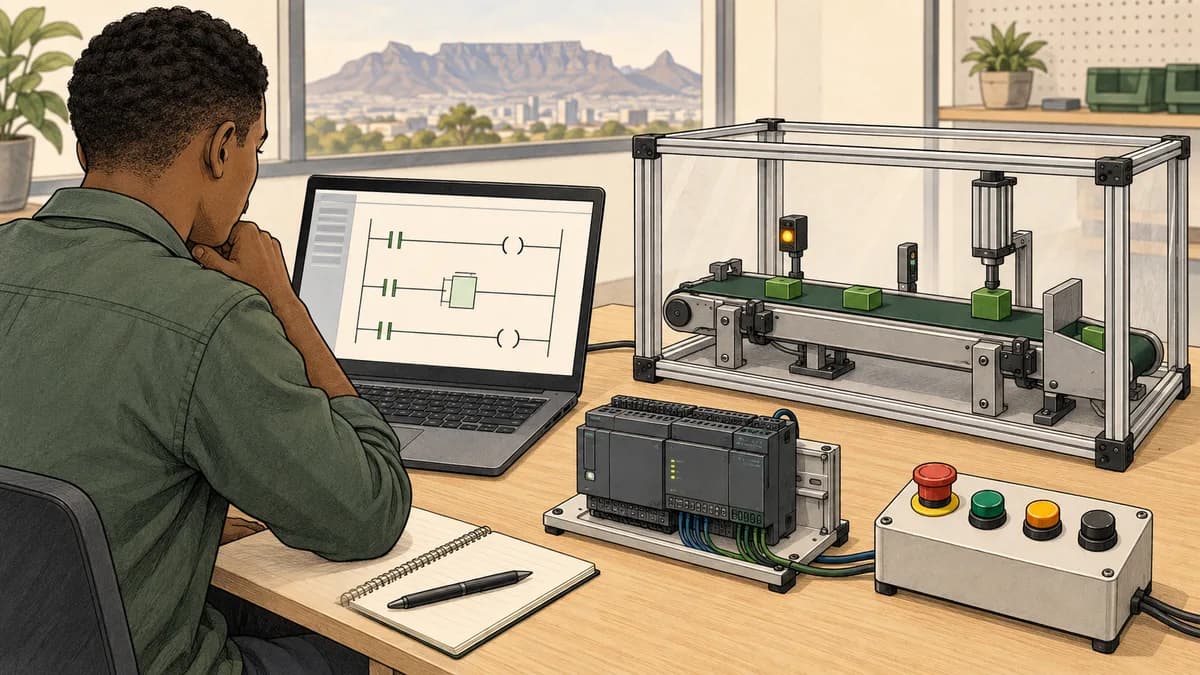
PLC technician training in South Africa should help you explain an observed problem, choose a useful next check and document the result. Programming matters, but a course built entirely around copying ladder diagrams leaves important gaps in diagnosis, project identification, signal interpretation and handover.
Choose a programme from the tasks you need to demonstrate. Reading an existing application, creating a new sequence and investigating an HMI value are different objectives. A beginner course can introduce them, while deeper vendor training and supervised equipment practice develop the platform-specific skills needed for particular work.
This website is commercially connected to PLC Simulator. We provide independent learning content, not an artisan trade test, professional registration or workplace authorisation. The PLC Simulator curriculum can support educational practice alongside other training. Its simulated results should be described as such.
What should a PLC technician course help you demonstrate?
Start with observable outcomes. Can you identify the project and controller being discussed? Can you distinguish an input value from the physical condition it represents? Can you explain why a program result differs from the requirement, or why a display differs from the program?
A useful assessment asks for a reasoned explanation, not simply the fastest change that makes a demonstration appear to work. Learners should record the symptom, relevant conditions, expected behaviour, observations, proposed explanation and verification. This makes their reasoning available for review and reduces reliance on memory.
The scope of a technician role depends on the employer, equipment and individual authorisation. Do not infer permission to perform an electrical task, change a production application or restart equipment from completion of a short PLC course. Ask a provider to state the boundaries of its practical work and the support supplied during assessment.
Build a curriculum around connected skills
Project identification and program reading
Learn to record the controller reference, engineering environment and project version. An apparently correct observation from the wrong project is not useful evidence. A course should explain how learners know which application and target they are viewing, and how they preserve the training version used for their results.
Then work on variables, Boolean conditions, stored state and execution order. The ladder logic foundations guide gives a starting point. Ask the instructor to distinguish a general learning model from the particular target's task, I/O update and instruction behaviour.
Signals, scaling and quality
A displayed number can look reasonable while representing the wrong range or an old sample. Learn to identify the units, configured range, data source and quality information before interpreting it. The instrumentation training guide provides a route into analogue signals and related course choices.
Physical measurement and wiring technique need an appropriate supervised setting. A software exercise can demonstrate a mapping or calculation error without establishing how a learner handles instruments, terminals or real equipment. Ask which of those outcomes the course actually assesses.
Commands, responses and diagnosis
A command, an observed response and a displayed status are different pieces of evidence. Training should help you trace their relationship and recognise missing information. A result that looks wrong may originate in configuration, data handling, program logic, presentation or equipment outside the application.
For motor and drive topics, use the variable-speed-drive training guide to identify additional learning requirements. A generic PLC course should not imply that it fully covers every drive, motion system or electrical procedure mentioned in its module list.
Networks, HMI and handover
Ask how learners investigate the path from a source value to a display. Identifying the intended device, variable, data type and update information is more useful than memorising a network diagram without understanding the data it carries. Our industrial networking training guide covers related prerequisites.
Documentation belongs inside the practical task. A useful handover states what was observed, what was changed in the training setup, which cases were repeated and what remains unresolved. The person reviewing it should not need to reconstruct the investigation from an unexplained screenshot.

Worked investigation: why does a practice display disagree?
Imagine a fictional software-only training dashboard. It shows whether a practice worksheet can be opened. There is no connection to a machine, actuator, safety system or production network. The exercise is designed to teach evidence handling and fault localisation.
Two Boolean inputs define the result. OpenRequested means the learner has requested the worksheet. WorksheetAvailable means the fictional exercise data says it is available. The rule is:
CanOpen = OpenRequested AND WorksheetAvailable
Here, true and false are represented as 1 and 0 in the tables. The rule has no stored state, timer, latch, permission hierarchy or physical output. Both inputs refer to the same evaluation in the ideal model. Those limits make it possible to check the logic independently before introducing a mapping or display defect.
Establish the expected behaviour first
| Open requested | Worksheet available | Expected can open |
|---|---|---|
| 0 | 0 | 0 |
| 0 | 1 | 0 |
| 1 | 0 | 0 |
| 1 | 1 | 1 |
Only the last combination permits opening in this fictional application. If the observed result is 1 when the request is 0, the result does not match this rule. That discrepancy does not by itself identify the cause: you still need to know what values the calculation actually used and whether the observation belongs to the same evaluation.
Write the expected result before looking at the displayed answer. This helps avoid changing the requirement to match whatever the existing program happens to do. If an instructor supplies a different requirement, update the table explicitly and keep the versions distinguishable.
Separate the observation points
For this exercise, the source record supplies WorksheetAvailable. A mapped application variable receives that value. The calculation uses the mapped variable together with OpenRequested. Finally, a display reads the calculation result. These are four observation points, even though the values may normally agree.
Record the source availability, mapped availability, request, calculated result and displayed result. Also record which evaluation each observation belongs to. In the fictional cases below, observations are deliberately supplied as synchronised, valid snapshots unless a row says otherwise. Real observations may require additional work to establish that relationship.
A learner should be able to explain the difference between “the source says 1” and “the program used 1.” The source could be correct while the mapped variable is wrong. Likewise, the calculation could be correct while the display reads a different variable or an earlier result.

Compare five deliberately different cases
| Case | Source available | Mapped available | Request | Calculated result | Display | Interpretation within this exercise |
|---|---|---|---|---|---|---|
| A | 1 | 1 | 1 | 1 | 1 | Values agree with the rule for this snapshot |
| B | 1 | 0 | 1 | 0 | 0 | Source and mapped value disagree; calculation matches its mapped input |
| C | 1 | 1 | 0 | 1 | 1 | Calculation disagrees with the stated rule and observed inputs |
| D | 1 | 1 | 1 | 1 | 0 | Display disagrees with the calculated result |
| E | Unknown | 1 | 1 | 1 | 1 | Current source-to-application agreement is not established |
Case A is consistent with correct behaviour for one combination. It does not prove that the other three combinations work. Repeat the truth table before describing the rule as fully checked within this small model.
In case B, changing the AND expression would address the wrong part of the evidence. The calculation produces 0 from its observed inputs, exactly as specified. Investigate why the mapped availability differs from the supplied source record. In a training file, that could be a deliberately wrong variable connection; the table alone does not prove the implementation defect.
Case C points to a disagreement between the stated rule and the calculated result. First confirm the project, evaluation and variables. If those observations are correct, inspect the implemented expression and any other assignment to the result. Do not claim the processor is faulty merely because a watched value is unexpected.
Case D places the visible disagreement after the calculation in this model. Check what the display reads and whether it represents the same evaluation. The evidence supports investigating presentation or update handling; it does not establish one universal HMI fault.
Case E is deliberately incomplete. A mapped value of 1 does not establish what the current source says. Preserve the uncertainty and obtain a valid current observation. Filling the unknown cell with an assumed 1 would turn an incomplete investigation into a misleading claim of agreement.
Choose a check that can distinguish explanations
Suppose case B is caused in the exercise by the mapped variable reading a different source field. Ask the instructor to provide two source records with deliberately different values, then observe which one the mapped variable follows. This is more informative than repeatedly opening the same screen when all source fields happen to match.
For case D, set up the four truth-table combinations in the training model and record both calculation and display results for each. If the display follows another variable, choose a combination where that variable differs from CanOpen. A test only distinguishes two explanations when they predict different observations.
Do not turn these software checks into instructions to force production I/O or bypass equipment conditions. Their purpose is to practise reasoning in a defined educational environment. An actual workplace investigation needs its authorised procedures, equipment context and appropriate supervision.
Write a useful investigation record
A completed record for case B might say: “In exercise version 2, evaluation 7, the source availability was 1 and the mapped availability was 0. Request was 1. The calculated and displayed results were both 0. The calculation matched its mapped inputs. The source-to-variable mapping remained under investigation.”
Notice that this record does not say the whole system is repaired. It states the observations and the remaining question. Once a deliberate mapping defect is corrected in the learning file, repeat all four Boolean combinations and the distinguishing source-field test before recording the new result.
Keep before-and-after evidence and identify the exact training change. A screen that looks correct once is less informative than a small set of repeatable results tied to a requirement. The same habit helps an instructor assess the learner's reasoning without making unsupported claims about workplace competence.
How simulation fits technician development
Simulation is useful for repeated logic practice, controlled fictional faults and reviewing why an expected result differs from an observation. It lets you repeat a small investigation while changing one condition at a time. The important output is an explanation supported by evidence, not the number of times a lesson was opened.
The independent PLC Simulator scan-cycle highlighting feature is relevant when learning to follow program evaluation. Use the feature for the behaviour it actually displays. It does not establish native equivalence with every vendor's task scheduling, communication or I/O system.
Supervised hardware training adds different evidence. Ask what each learner personally connects, configures, observes or documents, and which activities are instructor demonstrations. Neither format should be described as covering tasks it does not assess. Our online PLC training guide helps compare delivery arrangements.

Compare real course outlines, not just course titles
Festo South Africa's PLC111 introduction course describes a three-day programme with hardware/software familiarisation, logic and sequence work, timers, counters and fault analysis. It lists Windows PC experience as a requirement and recommends prior introductory pneumatics learning.
That is a useful example of an identifiable syllabus. It is not evidence that three days covers an entire technician role. Ask how the course's practical tasks match your starting level and which controller and software version the current delivery uses. Request the current fee and assessment details directly.
The same provider page lists regional dates in Johannesburg, Durban and Cape Town and says dates may change. Confirm a suitable future intake and available place before arranging travel. A published schedule is not confirmation of your booking or proof that every advertised location offers every course continuously.
Vendor-specific diagnostics courses are another option once the prerequisites match your experience. Start from the official vendor's regional training catalogue and compare the named target and outcomes. The Siemens training guide, Allen-Bradley training guide and Schneider training guide provide platform-specific enquiry routes without claiming a single brand is best for every South African learner.
Choose a route from your actual starting point
Electricians and millwrights
Use your existing evidence to identify what you already understand. Trade background alone does not tell a provider how confidently you read a particular PLC project, interpret an analogue value or investigate an HMI mapping. Ask for a prerequisite assessment or sample task rather than assuming every artisan needs the same short bridge course.
The PLC learning route for electricians and route for millwrights discuss different examples. Select the missing skills from your own experience. Keep physical work within your existing authorisation and the conditions of the supervised training setup.
School leavers and engineering students
A short PLC course can help you explore the subject, but compare it with the entry requirements and progression offered by a relevant formal programme. Ask the institution directly about admission, credit recognition, practical facilities and any workplace component. Do not infer those details from a private course certificate.
The engineering-student PLC guide focuses on requirements and project evidence. A small, well-explained learning project is a useful complement to formal study; it does not replace the educational and experience requirements of a separate qualification or registration route.
Maintenance staff changing platforms
Identify the platform-specific gap. You may understand diagnostic reasoning but need practice with a different project structure, instruction set or software version. Give the provider a sanitised target description and ask which tasks you will personally perform. Avoid sharing employer code or network details without permission.
If several colleagues need training, use the maintenance-manager training guide to structure objectives and assessment. A group booking should still identify individual practical opportunities and how the instructor will review each learner's results.

Certificates, professional registration and career evidence
Ask who issues the course document and what it confirms. Attendance, an internal assessment, vendor training and progress within a formal qualification are different claims. Request the exact programme information behind any accreditation or credit statement and verify it with the relevant issuing body.
A job description using the words PLC technician should not be confused with ECSA registration as an engineering practitioner. ECSA's candidate categories page includes Candidate Engineering Technician and describes candidate registration in terms of educational requirements and practical development under mentorship. A short PLC course does not itself establish that registration.
For a portfolio, use your own fictional examples or material you have permission to share. Include a requirement, project version, expected results, observations and a concise explanation of assistance received. Describe simulator work as simulator work. This makes the evidence easier to assess without promising a job, salary or promotion.
Plan learning in stages with review points
Begin with project identification and basic logic reading. Your first review point is explaining all four cases of a simple rule without relying on a highlighted answer. If that remains unclear, revisit variables and expressions before adding more equipment concepts.
Next, investigate mapping and presentation in a controlled exercise such as the worksheet example. The review point is choosing a test that separates two plausible explanations and recording what remains unknown. Add analogue, network and drive topics according to your intended role and access to appropriate instruction.
Finally, undertake a target-specific assessed task with the relevant provider or supervisor. Record the environment and the practical scope. Move to the next stage when the evidence supports it; this guide does not promise that a fixed number of weeks makes every beginner ready for independent workplace responsibility.
Questions before booking PLC technician training
How should experienced technicians choose PLC training?
Technicians with electrical or mechanical experience can begin with a diagnostic assessment rather than repeating every introductory topic. Ask the instructor to test project identification, signal interpretation and the distinction between a command and confirmed feedback. Use the resulting gaps to select modules, while retaining supervised practice for unfamiliar equipment and software. Existing trade experience is useful context, but it does not demonstrate competence on every controller platform.
How much does PLC technician training cost in South Africa?
There is no single price for the different routes described here. Request an itemised quotation covering tuition, VAT treatment, software access, equipment, assessment and any certificate charge. Include travel or computer requirements in your comparison. The PLC course price guide explains how to compare specific offers.
Can I study part-time while working shifts?
Potentially, if the provider's attendance and assessment requirements fit your roster. Confirm live-session times, practical dates, access duration and support arrangements before paying. Self-paced material and scheduled instructor-led training have different constraints, even when both are described as online.
Can I become a PLC technician from a free course?
Free learning can build introductory knowledge and help you test your interest. It does not establish every skill, qualification or authorisation an employer may require. Compare the tasks in your target role with the evidence you can demonstrate, then identify the additional formal or supervised learning needed.
Which PLC brand should I learn first?
Start with the controller used in your intended training task or workplace, if known. Otherwise choose an accessible learning environment and develop transferable reasoning while keeping its limits clear. Do not choose from an unsupported claim about which brand dominates a city or guarantees better pay.
What should a fault-finding assessment include?
It should provide enough information to establish the expected behaviour and ask the learner to investigate a discrepancy. Useful evidence includes observations tied to the correct project, a distinguishing test, a justified conclusion and a record of remaining uncertainty. The fictional cases above show how to assess that reasoning.
Will this simulator issue a trade qualification?
No. Independent simulator practice is educational work. It is not an artisan trade test, ECSA registration or permission to work on live equipment. Verify the exact credential and practical scope of any separate provider programme with its issuer.

Start with one investigation you can explain
Complete the worksheet truth table, compare the five cases and write a short record for one unresolved discrepancy. Ask another learner or instructor whether your proposed next check would distinguish the explanations you have listed. Improve the record until the evidence and its limits are clear.
Use the PLC practice curriculum for additional independent logic work, then select training for the target-specific gaps. A reproducible investigation provides a concrete foundation for the next course discussion.