for · South Africa
PLC Training for Millwrights in South Africa
PLC training for millwrights in South Africa: connect machine behaviour to logic, test a conveyor-speed model and choose courses for your learning needs.
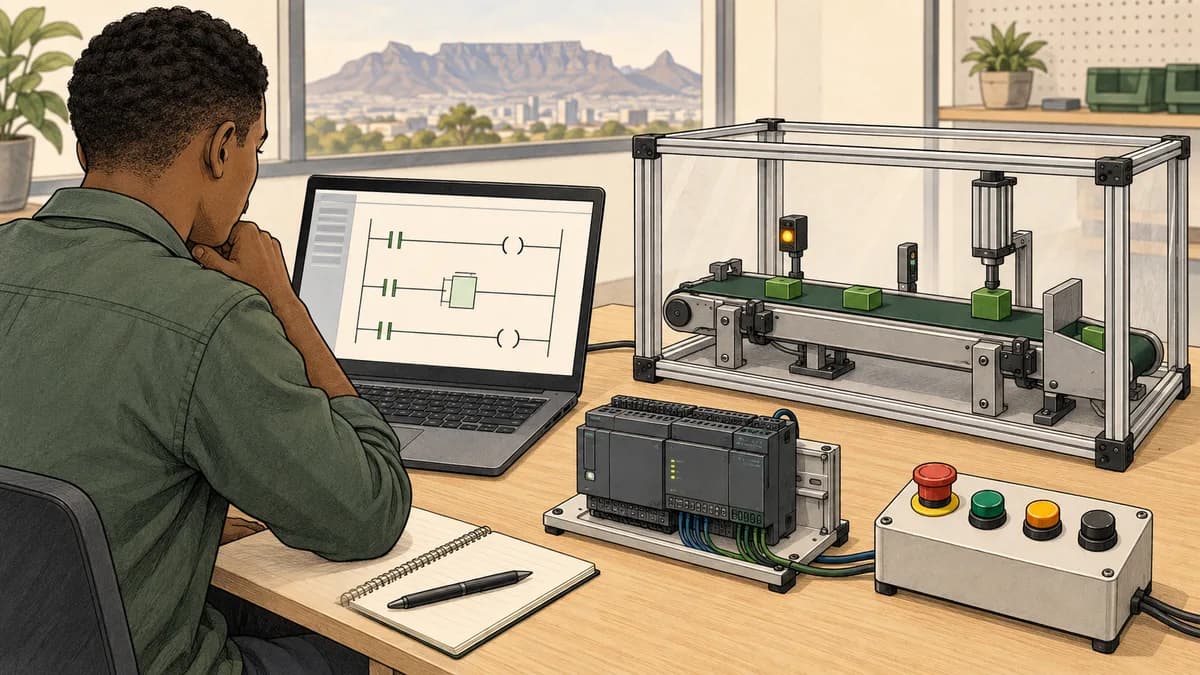
PLC training for millwrights should help you connect mechanical behaviour, electrical signals and software decisions without treating any one of them as the whole machine. Start with a task you need to explain: why a virtual conveyor has a particular speed, why a command is absent, or what evidence a controls specialist needs from a diagnostic handover.
Your starting point depends on your actual work. Some millwrights have extensive industrial control experience; others spend more time on mechanical maintenance, installation or a particular equipment family. A useful course identifies those differences instead of promising that a trade title guarantees rapid PLC competence.
This site is commercially connected to PLC Simulator. Its motor-control practice preview provides an educational software environment. Virtual commands and diagrams are learning aids, not commissioning records, installation instructions or permission to change machinery.
Map the machine knowledge you can already use
Mechanical experience can help you ask what motion or process result should follow a command. Electrical experience can help you follow documented signal paths. Software learning adds the ability to inspect the conditions and stored values that a program uses. The connection is useful when you keep the evidence at each layer separate.
For example, a displayed run command is evidence of a software decision. It is not automatically evidence of motor rotation, torque transmission or material movement. Equally, observing motion does not tell you every condition that permitted the command. Learning to distinguish those statements is a practical first step.
| Experience you bring | Connection to PLC study | Question to practise |
|---|---|---|
| Mechanical transmission knowledge | Relating rotational speed to a modelled process result | Which shaft does this speed value describe? |
| Electrical drawing reading | Connecting device descriptions with input definitions | What does a true value mean for this particular tag? |
| Maintenance reporting | Recording symptoms and work history | Which observation supports the proposed cause? |
| Equipment inspection | Distinguishing expected from observed behaviour | What part of the system is outside this software model? |
| Limited engineering software use | Learning project and version handling | Can another person reproduce this saved test? |
If electrical fundamentals need attention, use the industrial electrical training guide to compare appropriate preparation. If your work involves fluid power, the hydraulics and pneumatics training guide helps separate those learning needs from PLC programming itself.
Read a signal chain before drawing more rungs
Make a short chain of the values involved in an educational task: operator request, program condition, command, model response and displayed feedback. Write what each value means and where it comes from. Do not use the word feedback for a copy of the command unless you explicitly explain that it is only a command indication.
For a virtual drive exercise, RequestedSpeed might be the value entered by the learner. CommandedSpeed might be the program's selected value. ModelMotorSpeed might be the response supplied by the simulation. A calculated conveyor speed could then use a gearbox ratio and roller diameter. These values can disagree for several reasons, and the disagreement is the starting point for investigation.
The PLC troubleshooting guide supports this style of reasoning. Begin with the first documented boundary where expected and observed values differ. Do not jump from “the belt is slow” to “the PLC needs a higher speed setting” without understanding the intervening assumptions.
For physical equipment, observation, electrical testing, software monitoring and modification remain subject to the appropriate competence and site procedures. A course should make those boundaries clear. Familiarity with a machine does not remove the need to identify the correct project and authorised activity.

Worked learning case: motor speed is not conveyor speed
This exercise is a fictional calculation model. It has no physical motor, electrical connection, moving belt or drive parameter to change. Its purpose is to show how mechanical assumptions affect the interpretation of values in a PLC-related display.
Define a positive reduction ratio as motor-shaft revolutions divided by gearbox-output revolutions. In the model, output speed equals motor speed divided by that ratio. This relationship is consistent with the basic definition in Oriental Motor's gearhead selection explanation. The numerical cases below are our own educational examples, not manufacturer equipment specifications.
Assume that a roller is directly connected to the gearbox output and has a diameter of 0.10 metres. Assume no belt slip, no additional transmission stage and constant speed. The distance advanced per roller revolution is its circumference, pi multiplied by diameter. Convert revolutions per minute to revolutions per second by dividing by 60.
The model therefore calculates belt speed in metres per second as motor revolutions per minute, divided by reduction ratio, multiplied by pi and roller diameter, then divided by 60. Keep the units alongside each input; entering 100 for a diameter intended to be 0.10 metres would create a very different calculation.
| Case | Motor speed, rpm | Reduction ratio | Roller diameter, m | Output speed, rpm | Ideal belt speed, m/s |
|---|---|---|---|---|---|
| A | 600 | 10 | 0.10 | 60 | 0.314 |
| B | 1,200 | 10 | 0.10 | 120 | 0.628 |
| C | 1,200 | 20 | 0.10 | 60 | 0.314 |
| D | 0 | 10 | 0.10 | 0 | 0.000 |
The belt-speed values are rounded to three decimal places. In case A, 600 divided by 10 gives 60 output revolutions per minute, or one revolution per second. Multiplying by the roller circumference gives approximately 0.314 metres per second.
Cases A and C have the same calculated belt speed but different motor speeds and ratios. That is the useful diagnostic lesson: one observed result does not uniquely identify all the values that produced it. A slow-looking animation alone cannot tell you whether a command, ratio, display scale or another model assumption differs from the intended setup.
Investigate a disagreement within the model
Suppose the exercise brief expects case B, but a saved model produces case C. Both show a motor speed of 1,200 rpm, yet their calculated belt speeds differ by a factor of two. Compare the saved ratio with the brief before changing the speed request. The disagreement is in the configured model ratio.
Now create a separate display calculation that accidentally uses a diameter of 0.20 metres while the agreed model uses 0.10 metres. With case B's other inputs unchanged, the displayed calculation becomes approximately 1.257 metres per second. The fictional motor has not accelerated; the interpretation has changed.
Retain these cases in a table with the intended inputs, saved inputs, expected result and actual calculated result. State which version contains the deliberate error. Restoring the agreed input and repeating all cases demonstrates a correction to this model, not a repair to a real conveyor.
Check the boundaries you deliberately left out
Reject a zero or negative reduction ratio in this exercise rather than allowing an undefined division or silently inventing a result. Treat a missing diameter as unknown instead of substituting a convenient value. The model accepts zero motor speed, which produces zero ideal belt speed under the stated assumptions.
This calculation does not establish motor loading, available torque, traction, acceleration, stopping distance, belt tension or a suitable operating speed. Those subjects need additional information and appropriate engineering treatment. Recognising the boundary of a model is part of the learning outcome, especially when a familiar machine picture makes the calculation look more complete than it is.

Add PLC logic after the meanings are clear
Once the signal list and mechanical assumptions are documented, practise a small Boolean decision. For example, a software-only display can show “Calculation available” when the required model inputs are valid. The invalid state should remain distinguishable from a valid calculation of zero speed.
Use ladder logic fundamentals and the contacts and coils reference to learn how the chosen environment evaluates conditions. A contact-style instruction tests a value; its shape alone does not establish the state of a physical switch or the suitability of a wiring arrangement.
Keep the introductory scan model in context. Reading inputs, evaluating logic and updating outputs is a useful teaching sequence, but real controllers may have task and I/O arrangements requiring platform-specific explanation. Study scan-cycle concepts, then check the actual controller documentation in vendor training.
Do not add delays simply to make a virtual symptom disappear. If an exercise needs a timer, define what starts it, what resets it and what the result means. The timers and counters guide provides a separate next topic once the simpler conditions are understood.
Build a millwright learning path around complete tasks
Use the following sequence as a planning aid. It is not a fixed-duration course or a promise of workplace competence after a specified number of evenings.
- Define a small system. Write the request, command and response values for a fictional conveyor model. Label calculated values separately from independently supplied model feedback.
- Explain the conversion. Reproduce the four speed cases and the incorrect-diameter case. State the units and why the same belt speed can have different input combinations.
- Read a condition. Predict the result of a small ladder expression for every relevant input combination before executing it.
- Manage a project. Save the original, make a named working copy and reproduce an earlier result after reopening it. Identify which file generated the evidence.
- Diagnose one discrepancy. Introduce one documented error in a copy, identify the first disagreement and prove the correction with repeatable cases.
- Plan the next practical gap. Choose a vendor workflow, supervised equipment task or supporting subject based on a real learning need.
The product's PLC wiring tutor resource may support educational interface study. Its learning scope should be reviewed alongside the PLC practice curriculum, without assuming every exercise or feature is available in every plan.

Choose South African training by equipment and delivery
A search for PLC training for millwrights in Johannesburg, Durban, Cape Town or another South African city is only the start of provider comparison. Confirm the actual venue, delivery dates, class format, prerequisites and practical equipment. A city name in a course title does not establish a local workshop or a confirmed intake.
For a maintenance role, ask whether the course assesses diagnostic observation and project identification on the named controller. For a development role, ask about program structure, testing and documentation. These objectives overlap, but a provider should explain how the practical work differs.
If your target equipment uses Siemens, compare the Siemens PLC training guide; for Rockwell platforms, use the Allen-Bradley course-selection guide. For smaller-machine or other installed systems, the Mitsubishi training guide is another relevant comparison. Choose from actual equipment or vacancy evidence, not an unsupported claim about a whole industry's preferred brand.
Supporting subjects may deserve their own course. Festo's South African training catalogue includes pneumatic and electro-pneumatic learning topics. Use the current catalogue and a provider response to confirm the relevant scope and availability; this is not a claim that a particular intake or venue is open.
For drive-related work, compare variable-speed-drive training options. For wider interaction between mechanics, electronics and software, review mechatronics training routes. A useful plan assigns each missing capability to the resource that actually teaches and assesses it.
Compare the full cost and access conditions
Request the fee and inclusions in writing. Ask whether the price includes VAT, software access, training equipment, assessment, materials and follow-up support. If travel is necessary, add accommodation, transport and time away from work before comparing the total with an online option.
The South African PLC course price guide separates these cost components. The online PLC training guide helps compare recorded material, live instruction and browser practice. An hour in each format is not automatically an equivalent learning outcome.
For self-study, check the product's current pricing and access rather than relying on a fixed rand conversion or an old lesson count. Identify the exercise you need, try the available introductory scope and decide whether further access addresses a specific gap.
If an employer is funding the training, agree protected time and evidence requirements before enrolment. The maintenance-team training guide offers a pilot and assessment framework. Training on a shared computer also needs an agreed arrangement for accounts, saved work and supervision.

Prepare a handover another person can use
A concise diagnostic handover includes the stated symptom, equipment or model identity, relevant version, observed values, what was expected, what has been checked and what remains uncertain. It should help the next person choose a justified investigation rather than repeat the same assumptions.
For the fictional conveyor, a useful record might say: “The brief specifies ratio 10, but the saved calculation uses 20. Motor speed is 1,200 rpm in both records. The model therefore calculates 0.314 m/s instead of 0.628 m/s.” That statement identifies the discrepancy and its consequence without claiming a damaged gearbox or a physical speed measurement.
Record changes separately from observations. If a colleague receives only the corrected screenshot, they cannot see how the mismatch was found. Preserve the original test case, the explanation and the repeated result after correction.
Use invented or authorised material in a portfolio. Do not publish employer programs, customer drawings, network details or production settings to demonstrate skill. A fictional model with complete evidence can show reasoning without exposing workplace information.
Keep career and qualification claims specific
A PLC learning course can add practice and evidence to your existing experience. It does not automatically extend a trade qualification, establish manufacturer certification or change your workplace authorisation. If formal recognition matters, request the exact programme, awarding body and provider details, and verify them with the relevant body.
Do not plan a salary increase or career move around a universal promise. Compare specific vacancies with your experience and the capabilities you can demonstrate. A role may require a particular controller, documented maintenance experience, supervision or other qualifications that a simulator does not provide.
For an interview or internal development review, explain what you actually completed. “Built and tested an ideal conveyor-speed model and identified a configuration mismatch” is supportable when the evidence exists. “Commissioned an industrial conveyor” would describe a different activity and should not be inferred from the virtual exercise.
Questions millwrights ask about learning PLCs
Can I learn PLC fault finding if I am stronger mechanically?
Yes, you can start with documented signals, simple conditions and software-only tests while addressing any electrical prerequisites. Mechanical experience can help you understand the process being modelled, but it does not replace instruction in electrical interfaces or the engineering software. Choose a course that states what prior knowledge it assumes.
Do I need to learn advanced programming first?
Not for every introductory diagnostic task. Begin by interpreting a small program, predicting its response and explaining a discrepancy. Advanced development skills can come later if the intended role requires them. Reading and explaining a program still needs practice and should not be treated as automatic after watching a demonstration.
Is a conveyor simulator enough to practise commissioning?
It can support selected logic and model exercises. It cannot establish physical installation quality, loading, measurement accuracy or the complete behaviour of machinery. Describe the work as simulation and seek an appropriate supervised practical course for equipment-specific commissioning activities.
Can I practise around night shifts or shutdown work?
Self-paced study may fit around your schedule if you have suitable access and agreed time. Plan around the actual roster and responsibilities rather than assuming every site has the same shutdown months or spare capacity. Keep each session small enough to finish a test and save its evidence before an interruption.
Why can two models show the same belt speed with different motor speeds?
In the worked example, the reduction ratio changes as well. Case A uses 600 rpm with ratio 10; case C uses 1,200 rpm with ratio 20. Both produce 60 output rpm. That result illustrates why you need the intermediate values and assumptions to explain a final indication.
What should I ask an AI assistant about a conveyor calculation?
Ask it to state the units, define the reduction ratio, identify missing assumptions and show a case that would reveal a configuration error. Check the arithmetic independently. Do not treat an AI-generated operating speed, protection arrangement or troubleshooting instruction as approval for a real machine.
Which evidence should I bring to a course or development discussion?
Bring a short description of your current tasks, the equipment family you need to learn where you are permitted to share it, and a small educational test record. Include one thing you could not yet explain. That gives an instructor a clearer starting point than a broad request to become good at PLCs.

Start with the chain you can explain completely
Reproduce the four conveyor calculations, introduce the documented ratio mismatch and explain the result in a short handover. Then add one small logical condition and test its relevant input states. Keep the model's limits visible in the evidence.
Use the motor-control learning preview to explore a related practice environment and select the next course from a named gap. The useful progression is from clear observations to justified conclusions, with vendor software and supervised physical work added where the intended task requires them.