industrial-automation-courses · South Africa
Industrial Automation Courses South Africa: 2026 Guide
Compare industrial automation courses in South Africa by PLC, SCADA, drives, instrumentation, practical hours, entry route and credible outcomes in 2026.
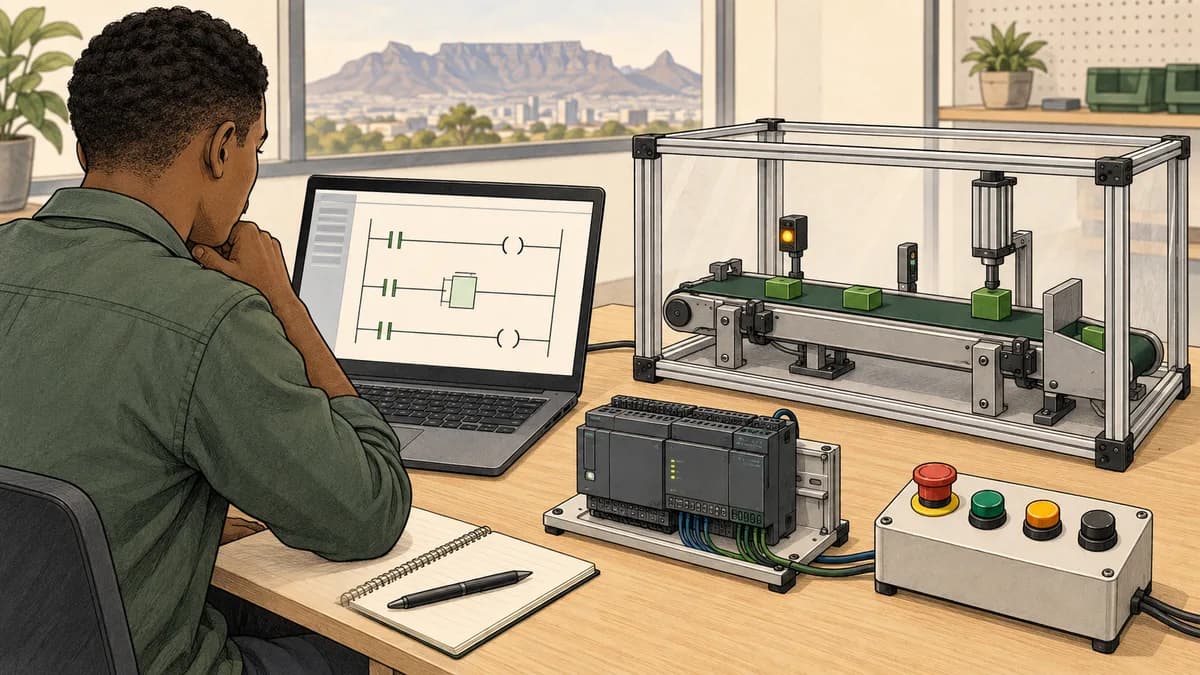
Industrial automation courses teach the connected control stack used in a plant: sensors and measurement, PLC logic, industrial networks, motor drives, HMI or SCADA supervision, commissioning and structured fault finding. In South Africa, the right route depends less on the certificate title than on your starting trade, the equipment used in your target industry and how many assessed practical hours the course gives you.
This guide is a course-selection framework, not a provider directory. It shows what a credible curriculum should contain, how short courses differ from formal qualifications, and how to use simulation before expensive hardware time. If you only want PLC programming, go to the PLC programming courses and training guide. If you want the broader plant-control stack, stay here.
Practise PLC automation free →Additional specialisms include hydraulics and pneumatics training, instrument calibration courses and OT cybersecurity training. Choose these when the work requires their specific methods and assessment; they extend the controller foundation in different directions.
The short answer
Choose a course that makes you prove four things independently: trace a field signal, write and test PLC logic, connect the controller to an HMI or SCADA layer, and diagnose a deliberately inserted fault. Then match the platform to local equipment. A broad “automation certificate” with little bench time is weaker evidence than a focused course plus a tested project portfolio.
Choose a focused practical track
- Industrial electrical training for drawing interpretation, measurement preparation and supervised electrical foundations.
- Process-control training for measurement, feedback, process response and controller comparisons.
- Industrial networking training for Modbus, PROFINET course selection and data-exchange diagnostics.
- VSD and VFD training for run commands, speed references and drive-related practical work.
Which industrial automation course should you take?
| Your starting point | Strong first route | What to add next | Evidence to leave with |
|---|---|---|---|
| Electrician or electrical artisan | PLC fundamentals plus industrial control wiring | Analogue signals, networks and HMI | Wired motor-control task, I/O schedule and tested ladder program |
| Instrumentation learner or technician | Measurement, calibration and process control | PLC sequencing, SCADA and industrial Ethernet | Calibrated loop sheet, scaling logic and trend-based fault report |
| Millwright | Sensors, motor control and PLC fault finding | VFDs, sequences and safe recovery | Machine sequence, cause-and-effect matrix and recovery test |
| Engineering or mechatronics student | Integrated PLC, instrumentation and drives | Networks, data and commissioning | Version-controlled project with test cases and commissioning notes |
| Working PLC programmer | Advanced diagnostics and system integration | SCADA, safety, motion or a second vendor | Reusable function blocks, alarm design and a documented FAT |
| Production or maintenance manager | Automation architecture and lifecycle fundamentals | Reliability, cyber hygiene and project acceptance | Requirements specification, risk register and acceptance checklist |
The route can be classroom, online, blended, vendor-led or part of a formal college programme. The important question is whether its delivery format can produce the evidence in the final column.
For adjacent specialisations, compare the industrial robotics training route and the mechatronics study pathways. Robotics narrows into robot operation, programming and cell integration; mechatronics supplies a broader mechanical, electrical and computing foundation.
What a complete industrial automation curriculum includes
An industrial automation course is broader than a PLC course. The modules below form one working system; they should not be taught as unrelated software demonstrations.
Electrical control and safe isolation
Learners need to read control drawings, identify protective devices, understand 24 V DC control circuits and know the boundary between permitted training work and regulated electrical work. Practical tasks should include continuity checks, terminal identification and tracing an input or output without guessing. A simulator cannot replace lockout, verification of isolation or supervised panel work.

Sensors and instrumentation
The field layer includes limit switches, proximity sensors, photoelectric sensors, pressure and level transmitters, temperature elements and final control devices. A credible course explains PNP and NPN switching, sourcing and sinking, two-wire and four-wire transmitters, 4–20 mA loops, signal isolation, analogue scaling and common failure modes. The instrumentation courses guide goes deeper into calibration and technician pathways.
PLC hardware and scan behaviour
Learners should understand CPU, power supply, I/O modules, memory, tag or address structure and the read-execute-write scan. Programming must go beyond contacts and coils. At minimum, the practical work should cover interlocks, seal-in logic, timers, counters, edge detection, modes, alarms, analogue scaling and an orderly sequence.
The contacts and coils reference, timer reference and sequencer patterns lesson can be used before a paid hardware block.
HMI and SCADA
An HMI course should teach tag binding, status and command separation, navigation, alarm priorities, permissive visibility and useful trends. SCADA adds distributed data collection, historian concepts, user roles, communications, alarm management and operational context. Screen-building alone is not enough. Learners should prove that the display reflects the PLC state and that failed communications do not create unsafe assumptions. See the SCADA guide and HMI versus SCADA comparison.
Motor starters, VFDs and motion
Industrial automation frequently controls motors. Training should connect PLC commands and feedback to a contactor, soft starter or variable-frequency drive. Useful tasks include start permissives, run feedback, fault reset boundaries, speed reference scaling, acceleration settings and a failed-to-start alarm. Advanced routes may add servo positioning, motion profiles and encoder feedback.

Industrial networks
Ethernet is not the whole networking syllabus. Learners should understand addressing, topology, managed-switch basics, device names, connection state and diagnostic evidence for Modbus TCP, Profinet or EtherNet/IP. A fault exercise should include a wrong address, disconnected device or duplicate configuration. The industrial network comparison explains where the protocols differ.
Commissioning and fault finding
Commissioning turns separate modules into one controlled process. A useful course teaches I/O checks, loop checks, cause-and-effect verification, sequence testing, alarm testing, change control, backups and a factory-acceptance-test record. Fault finding should follow evidence from the physical condition through the input, program, output and actuator. Randomly changing logic until the machine starts is not a diagnostic method.
Safety and operational boundaries
General PLC logic must not be presented as a substitute for a safety-rated control system. Courses should distinguish a normal stop, emergency stop, safety relay or safety PLC, guarded access and reset/restart behaviour. Any live machinery task needs competent supervision, a machine risk assessment and the site’s procedures.

Short course, vendor course or formal qualification?
| Route | Typical strength | Common limitation | Best fit |
|---|---|---|---|
| Focused short course | Fast access to one skill and concentrated practical work | Provider certificate may only record attendance or completion | Working artisans and technicians closing a defined gap |
| Vendor course | Accurate workflow for a specific controller, drive or HMI family | Skills can stay narrow and equipment access may end with the course | Teams supporting an installed vendor base |
| Private integrated programme | Can combine PLC, SCADA, instrumentation and projects | Recognition and practical depth vary widely | Career changers who have checked the assessment carefully |
| TVET or occupational pathway | Broader electrical or mechatronics foundation and formal assessment | Longer timetable; automation depth depends on programme and campus resources | School leavers and learners who need a formal route |
| University short learning programme | Strong engineering context and structured delivery | May assume prior mathematics, electrical or process knowledge | Technicians and engineers moving into integration |
| Online self-paced course | Low-friction repetition and flexible hours | No physical wiring unless paired with a lab | Theory, programming practice and preparation for hardware time |
Published South African course offers illustrate different scopes. For example, the NWU Industrial Automation Training Centre describes competency-based industrial automation training, while OMRON South Africa publishes an introductory PLC training page. Schneider Electric South Africa frames training around controller competence, troubleshooting and plant availability. These are different products; compare their outcomes rather than treating every course result as interchangeable.
How to score practical depth before paying
Ask the provider to answer these questions in writing:
- How many hours will I personally program, wire, test or diagnose rather than watch?
- How many learners share each PLC rack, drive, HMI and instrumentation bench?
- Which controller and software versions are used?
- Will I start a project from a blank file or only edit a prepared demonstration?
- Which faults are deliberately inserted for me to diagnose?
- Is there an assessed task completed without the instructor driving the mouse?
- Can I retain a neutral copy, screenshots or test record for a portfolio?
- What exactly does the certificate verify: attendance, completion or demonstrated competence?
- Is accreditation claimed, and can the provider show the current programme and registration details?
- Which costs are excluded: software, assessment, exam, travel, accommodation or equipment?
Use these questions as a disclosure checklist, not an accreditation or course-quality rating. Mark which answers are supported by a syllabus, sample assessment or written offer. Follow up on missing information before comparing providers, and distinguish a clear answer from evidence that the practical delivery meets your needs.
Course prices and duration in South Africa
Fees vary by route, vendor, equipment access and assessment. Request a current written quote. The School of IT PLC course page and Resolution Circle PLC course page show different provider offers; compare their stated delivery and practical scope rather than treating a price from one course as a national average.
Compare cost per independent practical hour, not cost per advertised day. A five-day course with a shared rack may provide less individual practice than its duration suggests. Add travel, accommodation, leave, software access and follow-on modules before comparing it with online practice. Our PLC course price guide shows the calculation in rand.
For duration, use the task as the unit. A beginner should have enough repetitions to write a motor circuit, a timed sequence, an alarmed analogue process and a small HMI without copying the instructor. A timetable describes scheduled instruction, not a guaranteed competence level. Use a baseline exercise and the final assessment to identify what additional practice you need.
Online simulation versus real hardware
Simulation is the efficient place to learn Boolean logic, scan order, program structure, timers, counters, sequences and test discipline. Every learner gets their own controller state, mistakes are cheap and the exercise can be repeated until the reasoning becomes automatic. Browser access also helps people outside Gauteng or major training centres.
If remote delivery is the deciding factor, use the industrial automation course online guide to compare the PLC, SCADA, instrumentation, network, drive and robotics layers—and to see which outcomes still require supervised hardware.
Hardware is essential for terminal work, electrical measurement, noisy signals, real communications, drive setup, physical safety and the judgement that comes from imperfect machinery. One possible blended sequence to discuss with your instructor is:
- Learn the control concept.
- Build and test it repeatedly in simulation.
- Write an I/O list and expected results.
- Use limited hardware time for wiring, downloads and physical diagnostics.
- Recreate the faults in simulation and document the final test.
For repeated software practice, explore the simulator curriculum and compare the available exercises with your course objectives. Check the supported model and access requirements before relying on a particular task.
An adaptable 12-week automation learning plan
This is a suggested study structure, not a promise of job readiness in twelve weeks. Adjust the pace to your starting knowledge, feedback and available practical supervision. Keep machine and electrical exercises within educational simulation or the provider’s authorised training arrangements.
Weeks 1–2: control foundations
Learn electrical control symbols, Boolean logic, the PLC scan and safe-work boundaries. Build start-stop, jog and forward-reverse logic. Use the start-stop exercise and jog-versus-latch exercise.
Weeks 3–4: time, count and sequence
Practise TON and TOF behaviour, edge detection, counters and explicit machine states. Build the traffic-light sequence and bottle-counting line. Write expected states before pressing run.
Weeks 5–6: field signals and analogue control
Study sensors, PNP/NPN wiring, 4–20 mA scaling and alarms. Create a level process with high-high protection, bad-signal handling and a pump permissive. The tank-level exercise is the starting model.
Weeks 7–8: drives and HMI
Add motor feedback, failed-to-start timing, speed reference and fault display. Design an HMI that distinguishes commands from status. Avoid decorative screens; every object should support operation or diagnosis.
Weeks 9–10: networks and SCADA
Map controller tags, communications state, alarm priority and trends. Insert a communications failure and document what the operator sees, what the PLC does and what evidence proves the cause.
Weeks 11–12: integrated project and assessment
Build a small process such as a two-pump duty/standby system, batch mixer or sorting conveyor. Produce the control narrative, I/O schedule, alarm list, ladder program, test cases, fault results and one-page commissioning report. Then use classroom or hardware time to prove wiring and physical behaviour.

Location and sector fit in South Africa
Location affects travel and access, but it should not determine the platform without evidence about the equipment you need to understand. Mining and mineral processing, water and wastewater, food and beverage, automotive, packaging, logistics, petrochemical and general manufacturing sites use different installed bases.
Use the local guides for practical planning around Gauteng, Johannesburg, Pretoria, Durban, Cape Town, Gqeberha, Secunda, Sasolburg, Rustenburg and eMalahleni/Witbank. These pages are orientation guides, not promises that a provider or vacancy is currently available.
Before choosing Siemens, Allen-Bradley, Schneider, Omron or another platform, inspect job adverts and maintenance requirements in the sector you can realistically enter. Learn one ecosystem deeply enough to diagnose it, then transfer the underlying control concepts to the second.
For sector-specific study, explore cement automation learning, paper and pulp control exercises and petrochemical automation training questions. Use the process context to choose a relevant assessment, then verify any actual workplace requirements separately.
Learners outside the main city routes can compare the Limpopo training planning guide and Western Cape PLC training guide. These regional guides help frame provider enquiries and travel decisions; they do not establish a booked local class.
What portfolio evidence should look like
A useful automation portfolio is not a folder of certificates. It is a small body of evidence that another technician can inspect:
- a control narrative that states what the process must do;
- an I/O schedule with signal type, normal state and engineering units;
- commented PLC logic with clear mode, permissive, sequence and alarm sections;
- HMI screenshots that separate command, status, alarm and maintenance information;
- test cases with expected and actual results;
- at least three inserted faults and the evidence used to isolate each one;
- a revision note explaining one design change after testing; and
- a short video showing the process and narrating the state transitions.
Never publish a real employer’s program, drawings, tag database or restricted plant images. Use a neutral simulated project and remove vendor or provider material you do not own.

Industrial automation course questions
How does an industrial automation diploma differ from a short course?
Compare the institution's full programme structure, entry requirements, assessment, practical components and exact qualification title. A diploma route and a short vendor course can serve different stages of development; similar subject names do not make the awards equivalent. Ask the institution to confirm current recognition and progression arrangements for the specific programme. Then use the curriculum checklist above to identify where additional platform practice would support your studies.
Do I need electrical experience?
Not for every beginner course, but electrical control knowledge changes how quickly PLC logic makes sense. If you start without it, include drawings, measurements, inputs, outputs and safe isolation in the learning plan rather than taking a software-only shortcut.
Can I learn industrial automation online?
You can learn PLC programming, HMI design, sequence reasoning, network concepts and testing online. You still need supervised hardware practice for wiring, measurements, drive commissioning and work around machinery.
Should I learn PLC, SCADA or instrumentation first?
Electricians commonly start with PLC control; instrumentation learners start with measurement and loops; software-oriented engineers may start with PLC plus HMI. All three routes should converge on signals, deterministic logic, safe outputs and evidence-based fault finding.
Does a short course make me an automation engineer?
No. A short course can close a defined skill gap. Engineering judgement comes from a broader technical foundation, repeated projects, supervised plant exposure and responsibility appropriate to your competence.
Is a certificate enough to get work?
A certificate may help a recruiter understand what you studied, but it does not prove that you can diagnose a process. Pair it with a tested project, an I/O schedule and a concise explanation of the faults you found.
Build your first automation program →Scope of this learning resource
This guide and the linked educational simulator do not award a South African occupational qualification or vendor authorisation. The simulator supports PLC logic practice and portfolio development; it does not authorise live electrical, safety or commissioning work. Provider status, schedules, prices and recognition can change, so verify them directly before enrolling.
For a broader software evaluation, review the industrial training scenario catalogue. Choose one scenario that matches your learning objective, record the initial state and predict the result before running it. A catalogue title is only a starting point: confirm the supported behaviour, account requirements and assessment scope before including the exercise in a formal training plan.