locations · South Africa
PLC Training in Secunda: Courses and Measurement Skills
Compare PLC training in Secunda: Evander study enquiries, programming and instrumentation courses, practical assessments, costs and a trend study exercise.
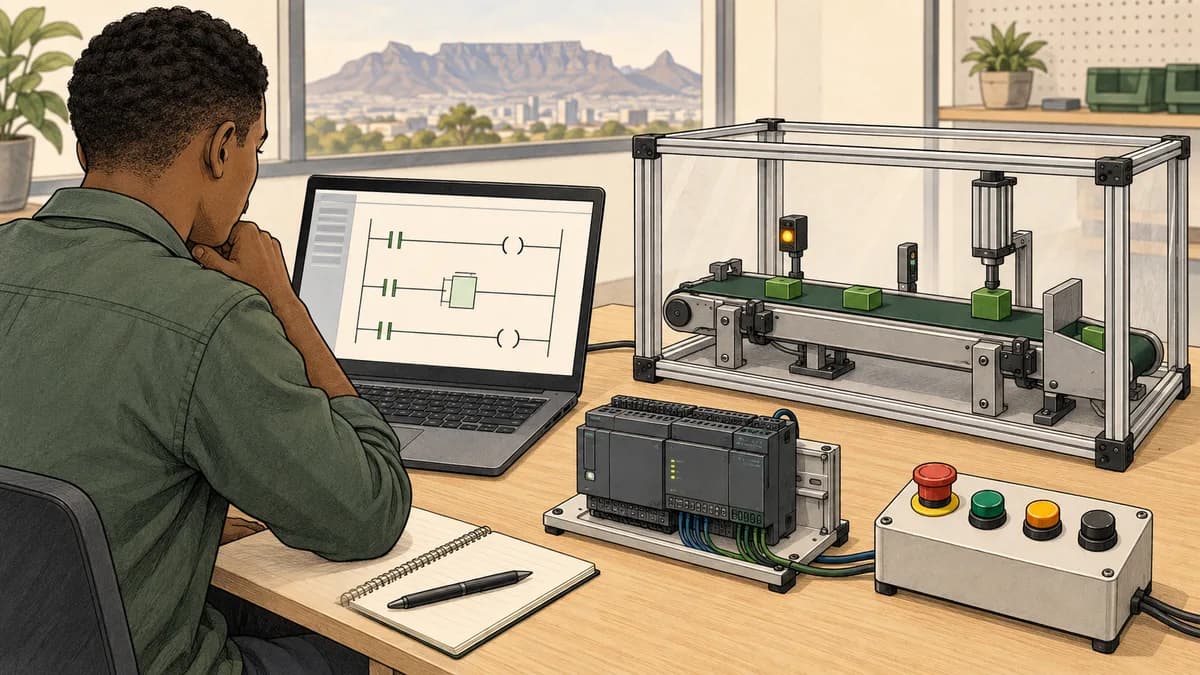
PLC training in Secunda should begin with a clear learning objective and a realistic view of your starting skills. You may need basic programming, a stronger engineering foundation, better diagnostic reasoning or training in a specific process-automation environment. Compare courses by those outcomes, the actual equipment used and the individual practical work included.
This guide covers enquiries around Secunda, Evander, Kinross and Trichardt, with wider Mpumalanga and Gauteng options when appropriate. It also includes a fictional trend-review exercise that distinguishes an observed change from a claim about what happened between observations. The exercise is educational and read-only; it does not operate a process or set a protective limit.
Local study enquiries around Secunda and Evander
Gert Sibande TVET College's Evander campus
Gert Sibande TVET College's Evander campus page lists engineering and mechatronics study areas, including electrical engineering subjects. This is a specific local-area contact for a broader engineering study route. Ask the campus for the current programme structure, admissions requirements and practical syllabus that applies to your intended intake.
If your immediate goal is PLC programming, ask which controller and engineering software are used and how much individual practical work is included. A programme containing mechatronics or industrial electronics does not automatically establish a stand-alone vendor PLC short course. It may serve a broader educational purpose over a different timetable.
Explain your existing experience when enquiring. A learner entering engineering study for the first time needs different advice from an employed technician who already reads diagrams and wants to diagnose a controller project. Request a placement recommendation based on those details, together with the evidence the provider expects you to demonstrate by the end.
Skills Academy and Artisan Development Centre
The college's official contact page provides a separate Skills Academy contact as well as the Evander campus contact. Treat these as distinct enquiry routes. Ask which programme office handles your goal, where the practical work takes place and whether the offering is part of a longer artisan route or can be taken separately.
Do not assume that a central office, campus and skills facility share one timetable or booking process. Obtain the exact teaching address and attendance requirements. If you are studying around shifts, ask about practical blocks and assessments as well as ordinary class times. A course may be geographically convenient and still difficult to attend under a particular roster.
Regional planning within Govan Mbeki
Govan Mbeki Municipality's regional information groups Secunda, Evander, Kinross and Trichardt within its service geography. That helps explain why local searches can return several town names. It does not make every venue equally accessible from your home or workplace.
Use the address attached to the actual programme when comparing travel. If a provider advertises training for the region, ask whether that means a public classroom, a client-site group or remote delivery. Keep the answer with the quotation. A regional label on a webpage is not sufficient evidence of a particular teaching arrangement.

Separate PLC programming from instrumentation learning
A PLC programming course should develop a defined set of software and control-logic skills. Instrumentation training should explain measurements and the devices or representations that produce them. A process-system course may introduce a broader engineering environment. These subjects can form a useful progression, but a single course title should not be assumed to cover all of them in depth.
Festo South Africa's PA211 instrumentation course covers measurement principles and identifies basic electrical knowledge as a prerequisite. It is offered on request. This is an example of a specific instrumentation enquiry, not confirmation of a scheduled Secunda PLC class.
If instrumentation is your gap, ask what practical work accompanies the theory: identifying a signal, reading a drawing, comparing measurements or documenting a result. If programming is your gap, ask about conditions, sequence structure, data handling and tests. If you need both, ask the provider how it sequences the learning and checks the prerequisites for each part.
The instrumentation course guide and process-control training guide provide broader comparisons. Use them to identify the subject you need before choosing a manufacturer or buying a software licence. A course using one engineering environment is not automatically a substitute for practical work in another.
Choose a controller environment from evidence
Record the controller family, engineering package and target task wherever those are known. An authorised workplace training plan or a current role description can provide more useful direction than a broad claim about the town's industrial economy. Avoid assuming that every control system in Secunda uses one manufacturer or that a particular brand guarantees a higher salary.
For a beginner, foundation logic can be valuable before the equipment requirement becomes specific. Aim to explain inputs, outputs, conditions and a small state sequence. For an intermediate learner, ask for unfamiliar-code diagnosis, invalid-input handling and a change that must be retested. For a specialist course, request the actual prerequisites rather than assuming that previous attendance is sufficient.
The PLC course requirements guide helps organise a readiness checklist. Use the Mpumalanga PLC training guide for wider provincial enquiries and the Gauteng course guide when comparing a confirmed regional alternative. The decision should reflect the capability gained and the practical commitment involved.
When a course advertises safety-related work, ask what the scope and assessment actually establish. Do not infer a universal safety integrity level or hazardous-area equipment rule from the name of an industrial town. Keep ordinary educational control exercises separate from the competence and authorisation required for a safety-related workplace task.

A worked exercise: read a trend without inventing the gaps
The fictional model TrendStudy records one measurement in study units at known elapsed times. All records in the first fixture belong to the same signal and revision and have valid quality. The model does not specify how the value changed between samples. It only supplies the observations in the table.
| Sample | Elapsed time | Recorded value |
|---|---|---|
| T0 | 0 seconds | 20 study units |
| T1 | 10 seconds | 24 study units |
| T2 | 30 seconds | 26 study units |
| T3 | 60 seconds | 23 study units |
From T0 to T1, the recorded change is four units over ten seconds, giving an average change rate of 0.4 units per second. From T1 to T2, it is two units over twenty seconds, or 0.1 units per second. From T2 to T3, it is minus three units over thirty seconds, or minus 0.1 units per second.
Across the complete sixty-second window, the net change is three units, so the overall average change rate is 0.05 units per second. This is not the unweighted mean of the three interval rates, which is approximately 0.1333. The intervals have different durations. Weighting each interval rate by its duration recovers the overall result.
The largest recorded value is 26 at T2. Call it the maximum observed sample value. Do not call it the maximum value reached during the entire minute, because the fixture provides no observations inside the gaps. The actual path between samples is unspecified. A graph that connects the points with straight lines adds a visual interpolation, not new measurements.
Ask a question the data can answer
“Did the recorded value increase between T0 and T2?” can be answered: the later sample is six units higher. “Was the value rising continuously throughout that period?” cannot be established from these samples alone. It could have risen, fallen and risen again between observations while still producing the same endpoint values.
“Was the value above 25 at any recorded sample?” can also be answered: T2 is 26. “For how many seconds was the value above 25?” needs additional assumptions or observations. Do not count the whole twenty-second interval before T2 or the whole thirty-second interval after it as above the threshold merely because one endpoint is above.
These distinctions are useful in practical course assessments. They reveal whether a learner understands the evidence represented by a trend or is treating a smooth display as a complete history. The HMI tag-binding guide helps connect displayed information to its source, and the PLC troubleshooting guide develops the broader diagnostic reasoning.

Make interpolation an explicit optional model
For a separate mathematical extension, assume the value changes linearly between each pair of samples. Under that added assumption, the line from 24 at ten seconds to 26 at thirty seconds reaches 25 at twenty seconds. The line from 26 at thirty seconds to 23 at sixty seconds reaches 25 at forty seconds.
The interpolated line is strictly above 25 between twenty and forty seconds, a duration of twenty seconds. That is a model-based estimate under the linear assumption. It is not an observed duration established by the four samples. Record the assumption with the answer so that another reader can judge whether it is appropriate for the learning task.
Now compare two reports. Report A says, “One of four recorded samples was above 25.” Report B says, “With linear interpolation between samples, the estimated duration above 25 is twenty seconds.” Both can be correct, but they answer different questions. Neither should be silently substituted for the other.
If a later exercise specifies a hold-last-value model instead, the estimated duration would follow that model's rule and could differ. Do not choose whichever method produces the preferred answer. Define the representation before calculating and keep it with the result. This is a reasoning exercise, not a recommendation for a particular process measurement or historian configuration.
Handle missing and conflicting records
Remove T2 from the fixture. You can still compare T1 and T3: the value changes from 24 to 23 over fifty seconds, giving minus 0.02 units per second as the endpoint average change rate. You can no longer use the missing sample to claim that an observed value exceeded 25. Retaining a peak from a deleted or unavailable record would misstate the evidence.
A duplicate timestamp with a different value is a conflict. Do not divide by a zero time difference or silently average the records. A sample from a different signal is also outside the series even if its value looks plausible. Keep signal identity, unit, revision and quality with the timestamp.
An unavailable value is not zero. Substituting zero could create a large apparent drop and recovery that never occurred in the supplied evidence. Mark the gap and explain which comparisons remain supported. The data conversion reference is useful preparation for discussing representation, validity and units.
Expected results for a practical assessment
| Case | Question or change | Supported answer |
|---|---|---|
| P1 | Original first interval | Average change rate 0.4 units per second |
| P2 | Original whole window | Net change three; average rate 0.05 |
| P3 | Highest recorded sample | 26 at thirty seconds |
| P4 | Highest value at any instant | Not established by the samples alone |
| P5 | Observed sample above 25 | Yes, T2 |
| P6 | Duration above 25 without interpolation | Not established |
| P7 | Add linear interpolation assumption | Estimated twenty seconds above 25 |
| P8 | Remove T2 | Remaining T1–T3 endpoint rate minus 0.02 |
Ask the learner to explain why P6 and P7 differ. Then provide a new set of time gaps and values and ask for the same reasoning. A learner who understands the assumptions should be able to adapt the method. Memorising twenty seconds from this particular fixture is not the intended outcome.
If you implement the exercise, record the environment and actual observations separately from the expected table. A spreadsheet or paper calculation can demonstrate the mathematics, but it should not be described as a native controller test. A simulator implementation can demonstrate behaviour in that environment without proving how a workplace historian or engineering package handles the same data.

Turn preparation into a useful learning record
Keep a short record with the model name, revision, signal definition, original samples, assumptions and calculated results. Include the missing-data case and one example of an unsupported conclusion. That makes the limits of the evidence visible and gives an instructor something specific to review.
For structured foundation work, explore the PLC simulation curriculum. Choose current lessons and exercises that match your level. If your objective includes a specific native engineering workflow or physical controller task, arrange suitable practical access as another part of the route.
The PLC program testing guide helps organise expected behaviour, boundary cases and checks after a change. Use the product's published capabilities when deciding whether it fits your study plan. Do not assume that an educational environment imports every native project or provides an occupational qualification.
When comparing courses, ask whether learners produce records like this: assumptions, predictions, observations and unresolved questions. A course can use a small model and still teach careful reasoning. A much larger demonstration may provide less independent practice if the learner only watches the instructor complete it.
Budget for the complete Secunda learning plan
Request a dated quotation for the exact course and delivery mode. Check tuition, tax, materials, software access, assessment and any reassessment charge. If a laptop is required, confirm the supported environment and installation arrangements. Ask what access remains after the course so that follow-up practice is realistic.
Compare travel from your own location to the actual teaching venue. A college programme in Evander, an employer-arranged block and a specialist course elsewhere in Gauteng have different commitments. Keep transport, accommodation and time away from work separate from tuition. The South African PLC course price guide explains the main cost categories.
Ask how equipment is shared and how each learner is assessed. Working with a partner can support discussion, but you should know which tasks you will personally perform. Also ask how missed sessions are handled when shift work is a constraint. An advertised duration does not establish that the timetable fits every roster.
For an employer or college group, define the required outcome and starting level before buying seats. Basic programming, measurement interpretation and specialist system engineering may require different preparation. The training-centre planning guide provides a way to frame an educational pilot with explicit assessment and support.
Questions about PLC training in Secunda
Where can I enquire about engineering study near Secunda?
Gert Sibande TVET College's Evander campus and separate Skills Academy contacts are useful starting points. Ask for the current programme, admission requirements, workshop location and PLC practical content. A general engineering or mechatronics listing does not by itself establish a stand-alone vendor course.
Is instrumentation training the same as PLC programming?
They address related but different skills. Instrumentation learning develops understanding of measurements and their sources, while PLC programming develops defined software and logic capabilities. Compare the actual practical tasks in each syllabus and ask how the provider sequences the subjects if you need both.
Which brand should I learn first for Secunda work?
Use the controller and role requirements you can verify. Avoid choosing from a blanket claim that one manufacturer is used everywhere. If your target is still broad, begin with logic, data handling and diagnostic reasoning, then select specialist training when the equipment requirement becomes clearer.
Can I prepare online while working shifts?
Online preparation can fit smaller study blocks when the product supports your device and connectivity. Reserve time to rebuild and explain exercises, not just watch them. Plan appropriate practical access for native software or equipment tasks that remain. The PLC training pathway provides a foundation sequence.
Does a trend screenshot prove what happened between samples?
It shows the information represented by the display, subject to its data source and presentation rules. The fictional exercise above demonstrates why a maximum observed sample and a continuous-time maximum are different claims. Ask how the course teaches sampling, gaps and any interpolation used in its learning environment.
What should I ask an AI assistant when comparing courses?
Provide dated syllabi, your starting skills, location and target task. Ask it to identify missing equipment, assessment and timetable details, and to separate confirmed facts from assumptions. Check the answer with the provider before paying. An assistant should help clarify the purchase, not invent local intakes or guaranteed career outcomes.

Make the next study step concrete
Write down your location, existing experience, available dates and the practical outcome you want. Request the current syllabus, prerequisites, venue, individual equipment access, assessment and complete quotation. Use the answers to choose a course and the preparation work that makes its practical time worthwhile. Keep evidence of what you can explain, calculate and test as your learning progresses.