locations · South Africa
PLC Training Mpumalanga: Courses and Process-Data Skills
Plan PLC training in Mpumalanga: eMalahleni, Middelburg and Evander enquiries, software choices, practical access, costs and a runtime-record study task.
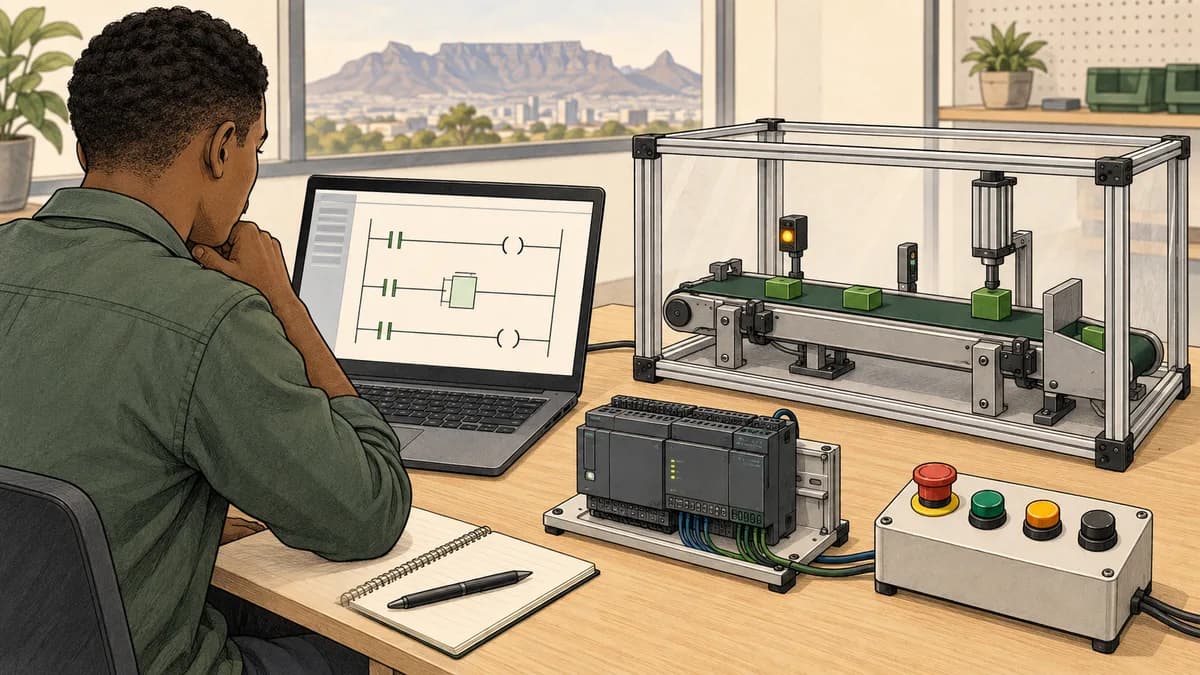
PLC training in Mpumalanga should be selected from the task you need to perform and the practical environment you can access. A course near eMalahleni, Middelburg, Secunda, Evander or Mbombela may have a different audience and attendance plan. Confirm the actual programme, venue, software and assessment rather than assuming that a provincial industry label tells you which course to buy.
This guide helps you compare education enquiries, vendor courses, online preparation and employer-arranged learning. It includes a fictional runtime-record exercise that distinguishes an accumulated reading from the time used during a reporting interval. The aim is useful practical reasoning, without claiming that one brand serves every plant or that a short course qualifies you for specialist process-safety work.
This site is commercially connected to PLC Simulator. Its curriculum overview can help with educational preparation. Check current access and lesson scope. Simulation does not replace supervised equipment experience, a formal programme's practical requirements or the authorisation needed to work on an installation.
Check local education routes before planning travel
Nkangala TVET College's official site identifies campuses including Witbank, Middelburg, Mpondozankomo, CN Mahlangu and Waterval Boven, alongside engineering study information. The page contains dated notices as well as campus contacts. Ask the college to confirm the current programme and intake; do not treat every displayed application notice as a current invitation.
Gert Sibande TVET College's Evander campus page describes its engineering study context. Its contact page provides separate campus and Skills Academy enquiry routes. Use those distinctions when asking about a practical short course rather than assuming that a general engineering programme includes a bookable standalone PLC module.
Ehlanzeni TVET College's Mlumati campus page places the campus in KaMhlushwa and lists engineering-related programmes. This gives an enquiry route in the eastern part of the province. Confirm the exact programme, campus contact and practical equipment directly; it is not evidence that a named vendor PLC course is currently open there.
Ask which route fits your objective
A formal engineering programme, an occupational skills route and a short vendor course may all mention control systems while serving different needs. Tell the institution your current background and whether you want a qualification, a specific practical skill or a refresher for existing work. Ask which assessment demonstrates the relevant outcome.
The PLC course requirements guide helps you clarify prerequisites. An experienced artisan may need project navigation and data handling; a student may need practical drawing and equipment context. A beginner label cannot replace an explicit statement of what the course assumes you already know.
Distinguish the province's locations in your shortlist
Use the Witbank and eMalahleni PLC training guide for that local search and the Secunda training guide for the Secunda area. Middelburg, Evander and Mbombela are separate destinations. Confirm the teaching address and assessment dates before calculating the cost of attendance.
If a suitable course is in Gauteng, compare the actual journey from your location rather than assigning a fixed distance to all Mpumalanga learners. The Gauteng PLC course guide can help compare scope. Include accommodation, meals and any separate assessment visit where your circumstances require them.
Ask whether a course advertised to local employers is a public intake or a private group arrangement. An employer venue may not accept individual bookings. Similarly, a training company's regional service coverage is not proof that it maintains a classroom in every town it lists.
Confirm the practical timetable
Get the start and finish times, laboratory dates and assessment arrangements in writing. Shift workers should ask which online sessions are live and what happens if a practical is missed. A self-paced theory component does not necessarily make the entire course flexible.
Do not assume home preparation will reduce attendance to one trip. It can help you use the practical block more effectively, but the institution or provider decides its assessment requirements. Plan for the actual sequence rather than a generic promise of becoming job-ready after a fixed number of hours.

Separate basic PLC programming from process-system training
A basic programming course can teach logic, timing, counters and project structure. A process-control system course can involve a broader engineering environment, operator stations and system configuration. A specialised safety course has a different scope again. These subjects overlap, but one course title should not be treated as evidence of all three.
Siemens' South African SIMATIC PCS 7 systems course document describes engineering within PCS 7, including a multiproject and automation and PC station configuration. That is a specific system scope. It is not the same claim as introductory TIA Portal programming, nor does the existence of the course establish that every Mpumalanga site uses PCS 7.
Before choosing a vendor course, identify the actual controller family, engineering software and project generation from authorised equipment information or a role's requirements. Keep production code and network details private unless sharing is permitted. A clean list of models and versions is often enough to discuss course fit.
For a process-oriented objective, the process control training guide helps identify measurement, quality and reporting topics. For a power-related objective, use the power generation training guide. Neither guide turns a browser exercise into plant commissioning competence.
Choose practical tasks that reveal understanding
Ask the provider what each learner will do independently. A useful task has a stated requirement, named environment and expected results. It should include an exception or a wrong result that the learner must investigate. Watching a complete demonstration is useful instruction, but it does not establish individual performance.
| Learning objective | A concrete task to request |
|---|---|
| Programming foundations | Create and explain a small sequence with declared initial state |
| Diagnostics | Trace a missing signal in a permitted training fixture |
| Process data | Distinguish a valid zero from unavailable information |
| HMI work | Map a displayed value to its documented source and units |
| Project handover | Identify the revision and test evidence for the work submitted |
| Vendor transition | Repeat a relevant task in the named engineering environment |
Ask how stations are shared and how individual feedback is provided. A group report may conceal which learner performed the task. A useful assessment gives each person a chance to explain a result and correct a mistake. Clarify that arrangement before comparing headline fees.
A fictional runtime-record exercise
This read-only exercise uses synthetic accumulated-hour readings for a training model called ConveyorStudy. It operates no physical outputs and does not prescribe maintenance intervals. The task is to calculate how much runtime is supported by a sequence of counter readings, while handling a documented reset and an unexplained decrease differently.
An accumulated-hour reading is a total since a declared starting point. It is not automatically the hours used during the latest shift. To calculate an interval from two readings, the learner needs a common counter identity, compatible units, valid data and information about resets or rollover. Subtracting numbers without those conditions can produce a misleading result.
The fictional counter begins at 1,000.0 hours. At the next observation it reads 1,012.5 hours, and at the following observation it reads 1,020.0 hours. With no reset or rollover and valid readings, the first interval is 12.5 hours and the second is 7.5 hours. The combined increase is 20.0 hours.
Reconcile the interval total
| Observation | Accumulated reading | Supported increase from previous observation |
|---|---|---|
| Start | 1,000.0 h | Starting reference |
| Next | 1,012.5 h | 12.5 h |
| Following | 1,020.0 h | 7.5 h |
The sum of interval increases is 12.5 plus 7.5, which equals 20.0 hours. The final reading minus the initial reading is also 20.0 hours. This is a consistency check for the stated synthetic data. It does not prove the counter measured real runtime correctly or that the machine ran continuously between observations.
A course can use this example to discuss units, decimal representation and report labels. “Accumulated hours” and “hours in this reporting interval” are different fields. A screen showing 1,020 hours should not be labelled “today's runtime” unless the system's definition actually supports that interpretation.

Handle a documented reset without losing the boundary
Suppose the fixture records a reset event at 1,023.0 accumulated hours and starts a new counter generation at zero. The next reading in that new generation is 4.0 hours. From the preceding 1,020.0 observation to the documented reset, the increase is 3.0 hours. After reset, the increase is 4.0 hours. The supported combined runtime across that boundary is 7.0 hours.
The reset event must identify the counter and its before-and-after values in this exercise. A vague note saying “counter reset sometime” does not supply the missing boundary. If you only have 1,020.0 followed by 4.0, subtracting produces a negative number but does not tell you how many hours occurred before the reset.
Keep a counter-generation identifier with the readings. The first series might be generation G1 and the new series G2. A G2 reading should not be compared directly with a G1 reading unless the documented bridge is available. This is a learning data model, not a claim that every controller stores counters in this exact form.
Distinguish an unexplained decrease
| Situation | Report treatment in the exercise |
|---|---|
| Valid increase within one generation | Calculate the difference |
| Equal valid readings | Zero supported increase |
| Documented reset with boundary values | Sum the supported segments |
| Decrease without reset or rollover evidence | Mark interval unresolved |
| Missing or bad-quality reading | Do not invent a zero or a complete interval |
| Different counter identity | Do not combine the readings |
An unexplained decrease could have several causes, including a reset, replacement, mapping mistake or a representation limit. The exercise does not diagnose which occurred. Record the discrepancy and the information needed to resolve it. Choosing a plausible cause is not the same as verifying it.
If a later course introduces rollover, define the modulus and the conditions under which a single rollover can be inferred. Do not assume a counter wraps merely because the number decreased. Multiple wraps or missing observations can make the interval ambiguous without more evidence.
Test the labels as well as the arithmetic
For the original three readings, expect 12.5, 7.5 and a total of 20.0 hours. For the documented reset bridge, expect 7.0 additional hours. For equal readings, expect a valid zero increase. For an unexplained decrease, expect an unresolved result rather than a negative runtime or an automatically clamped zero.
The display should show why a result is unavailable. If a previous interval value remains visible, label it as historical. A blank field, a zero and a stale value represent different information states. A practical course should help learners preserve those distinctions when mapping values to an HMI or report.
The data conversion reference helps with representation questions, while the HMI tag binding guide explains mapping checks. If you implement the exercise in vendor software, check the actual numeric types and limits. The arithmetic example does not validate a native counter instruction or a maintenance-management system.

Use the exercise in a portfolio or course assessment
Write the requirement, source fields, assumptions and expected cases before coding. Record the environment and revision when you execute the tests. Keep planned cases separate from observed passes. Include the unresolved decrease because it shows that you know when the available evidence is insufficient.
Explain your contribution if a trainer supplied the starting project. You might have added the generation field, designed the exception table or corrected the display label. Those are useful contributions when described honestly. Do not claim you built a production monitoring system because you completed a fictional counter exercise.
The product's PLC program testing overview provides context for educational test practice. Confirm available tools and account access before choosing a submission format. This guide does not claim automatic native imports, certification packs or a particular portfolio export function.
Include the eastern part of Mpumalanga in your research
The Department of Trade, Industry and Competition's SEZ overview locates Nkomazi SEZ in the eastern part of Ehlanzeni District. This broadens the regional context beyond the coalfields. It does not establish that every proposed project is operating, that a particular PLC brand is installed or that a training course leads to a current vacancy.
Use regional information to ask better task questions. A processing, logistics or manufacturing objective may require different learning from a maintenance role in a large process system. The actual equipment and responsibilities should decide the course. Do not make a universal brand recommendation from the province's best-known sector.
For a mining-related route, the mining automation training guide gives further educational context. Keep plant-specific operating, maintenance and safety procedures with the authorised training and supervision required for that installation. A general web article cannot supply those details from geography alone.
Compare total costs and continued access
Obtain tuition, assessment, materials, software and equipment charges in a current written quotation. Add the actual journeys, meals, accommodation and time away from work that your plan requires. Check the cancellation and reassessment terms before committing to travel. A provincial price range cannot replace those details.
The South African PLC course prices guide helps you compare offers consistently. Ask whether software access continues after class and what permitted material you may retain. If a licence is temporary, plan suitable follow-up practice rather than assuming any free simulator opens the same project.
Avoid treating a salary increase as an assured return from attendance. A role can require experience, qualifications, shift availability and specialist knowledge beyond a short course. Evaluate whether the proposed learning closes a specific gap and produces evidence you can explain, then compare employment opportunities on their actual requirements.

Questions about PLC training in Mpumalanga
Can I find a PLC course near Witbank or Middelburg?
Official college information provides local engineering enquiry routes, but this guide does not confirm a specific public PLC intake at every campus. Ask for the programme, controller and practical venue together. Use the city guide linked above to narrow the search and confirm the current offer directly.
Is there relevant training near Secunda or Evander?
Gert Sibande's Evander and Skills Academy contacts are starting points for programme enquiries. A general engineering offering is not automatically a standalone PLC course. Explain your existing skills and target equipment so that the provider can identify a suitable route or tell you what is unavailable.
Should I learn TIA Portal or PCS 7 first?
Use the actual role, equipment and course prerequisites. They are different engineering scopes, and a process-system requirement should not be inferred from a Siemens logo alone. If you are new to automation, establish the foundation needed for the selected course before paying for a specialist programme.
Does a PLC course cover functional safety?
Only to the extent explicitly taught and assessed in that course. A mention of safety-related terminology does not establish specialist competence or site authorisation. Ask for the precise scope and prerequisite route rather than assuming that basic programming qualifies you to modify a safety function.
Can I practise useful skills before travelling?
Yes, suitable educational logic, data definitions and test planning can be prepared at home. Check device and connection requirements. Practical work on named equipment and formal assessments remain separate requirements where the provider or institution specifies them.
Why is a lower runtime counter reading not automatically zero usage?
A decrease indicates that the simple same-counter subtraction assumptions may not hold. Without a documented reset or another supported explanation, the interval is unresolved. Clamping it to zero hides missing information and can make a report look complete when it is not.

Prepare a focused Mpumalanga training brief
Write your starting location, experience, available dates and practical objective. Identify the controller and software if known, using only information you are permitted to share. Request a current syllabus, venue, full cost and individual assessment description.
Prepare the runtime-record example or another small task relevant to your objective. Explain the valid differences, the documented reset bridge and the unresolved decrease. That gives PLC training in Mpumalanga a concrete purpose and helps you assess whether the course develops the skill you need next.