industries · South Africa
PLC Training for Power Generation in South Africa
Compare PLC training for power generation in South Africa: course scope, energy reporting, measurement quality, IEC 61850 study and practical assessment.
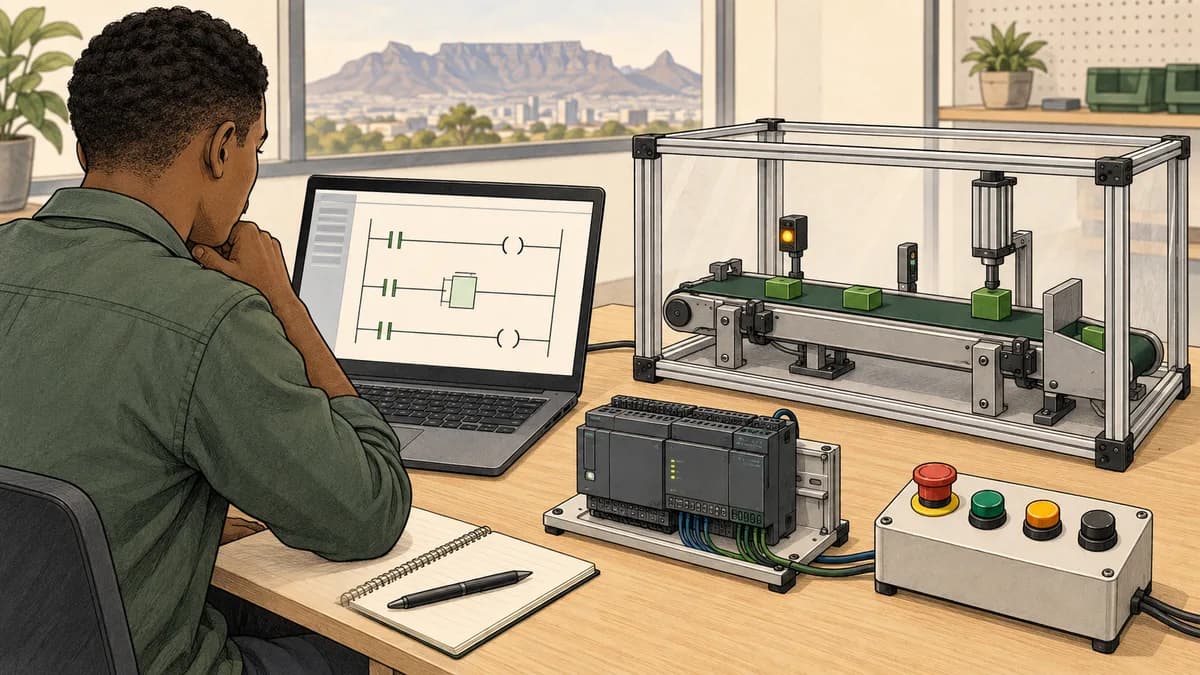
PLC training for power generation should prepare you for a defined controls task, not promise mastery of every station system. Auxiliary equipment, plant supervision, electrical protection, turbine controls and renewable-generation interfaces have different responsibilities. Choose the course around the actual role, installed equipment and practical assessment.
For South African learners, useful foundation tasks include tracing a measured value, reading an equipment sequence and explaining an energy report. A course should make clear which tasks students perform independently and which require specialist instruction. The presence of a power-station example does not establish competence to change protection, synchronise a generator or tune a turbine.
This site is commercially connected to PLC Simulator. Educational software can support selected logic and measurement practice. The calculation below uses fictional data and produces a report only. It does not control a generator, implement electrical protection or determine a grid-compliance setting. The illustrations are conceptual study scenes rather than photographs of named facilities.
Choose the power-generation responsibility first
For auxiliary-equipment maintenance, ask for an unfamiliar sequence and a task that traces why it cannot progress. The student should distinguish a command, equipment feedback and a missing condition. A fresh program that simply turns on an indicator tests a narrower skill than investigating a supplied project.
For plant-data support, ask for measurement identity, units, timestamps and quality. A displayed megawatt value can be a command, measurement, limit or aggregate. The learner should explain which it is and how unavailable data is presented before drawing conclusions from the number.
For substation automation or protection, request a course specifically scoped to that work. Generic PLC programming and Ethernet familiarity are not substitutes for the relevant equipment, engineering methods and practical assessment. Keep the distinction visible when comparing brochures that combine all electrical automation under one heading.
For renewable-generation support, identify the actual inverter, turbine, plant controller or supervisory platform. The equipment and task should drive the training choice. Do not assume all renewable systems share one vendor interface or that a generic PLC course includes their native engineering tools.
Use South African geography as context, not a job guarantee
A 2024 government visit notice identifies Medupi and Matimba power stations in Lephalale. This gives a concrete Limpopo reference for researching roles and practical training needs. It does not identify every installed controller or establish current recruitment.
A July 2026 Presidency notice identifies the Ummbila Emoyeni wind-energy facility near Bethal in Mpumalanga in connection with the commencement of commercial operations. Use the date and project scope in the notice rather than treating a larger planned programme as fully built capacity.
When researching Northern Cape solar, Eastern Cape wind or other generation opportunities, distinguish announced, approved, under-construction and operating projects. A development announcement can help identify future learning interests, but it is not proof of an available controls job or a current equipment inventory.
Check the actual worksite, employer, travel and roster in each role description. A corporate office address can differ from the operating facility. For courses, confirm where practical sessions occur, whether equipment is available individually and what travel or accommodation is required. A city keyword on a provider page does not prove a local laboratory exists.
Separate PLC engineering from IEC 61850 study
The IEC's IEC 61850 overview describes more than a communication protocol. It includes data-model and engineering-language concepts and extends beyond traditional substation automation. That scope is a useful reason to request a specialist assessment rather than assume a short networking lesson covers the subject.
Ask a provider whether learners work with the relevant information models, engineering files and devices, or only receive an introductory explanation. Identify the equipment generation and supported tools. A successful connection between two devices is not by itself evidence that the complete application is correctly engineered.
Do not confuse IEC 61850's configuration-language context with similarly abbreviated programming languages used elsewhere. Read the full term in the course description. The practical deliverable should identify what is being configured, which system consumes the file and how the result is checked.
The industrial networking training guide helps build the broader foundation of connectivity, protocol and application-data reasoning. Use that foundation to prepare for specialist study, while keeping protection and operational authority outside a generic networking claim.

Learn power, energy and measurement boundaries
Power describes a rate of energy transfer. Energy over a period depends on both power and duration. A megawatt reading at one moment does not by itself establish the megawatt-hours produced during a whole shift. The reporting method must explain how measurements represent the intervening time.
Define the meter boundary. Gross generation, auxiliary consumption and net export are different quantities. If a classroom model subtracts auxiliary power from gross power, both inputs must use compatible units, timestamps and boundaries. An unexplained label such as output can conceal which quantity the report actually describes.
Specify sign conventions. This exercise uses positive gross generation and positive auxiliary consumption, with net export equal to gross minus auxiliary power. A real bidirectional meter can use a different convention. Do not infer it from the sign of a number without checking the interface contract.
Keep measured and requested power separate. Integrating a requested setpoint calculates requested energy under the model's assumptions, not measured production. The analogue scaling and resolution guide supports the earlier step of interpreting the source value and unit correctly.
Worked exercise: reconcile a fictional energy window
Consider three classroom intervals covering one hour. Gross generation and auxiliary consumption are constant within each stated interval. Both are valid measurements in the fixture, expressed in megawatts. The model uses the same time boundary for both inputs and excludes every real-world issue not explicitly represented.
| Interval | Duration | Gross power | Auxiliary power | Net export |
|---|---|---|---|---|
| A | 15 minutes | 12 MW | 2 MW | 10 MW |
| B | 30 minutes | 18 MW | 3 MW | 15 MW |
| C | 15 minutes | 8 MW | 2 MW | 6 MW |
Energy in each interval equals power multiplied by duration in hours. Gross energy is 3 plus 9 plus 2, giving 14 MWh. Auxiliary energy is 0.5 plus 1.5 plus 0.5, giving 2.5 MWh. Net exported energy is therefore 11.5 MWh.
Calculate net energy independently from the net-power column: 10 multiplied by 0.25, plus 15 multiplied by 0.5, plus 6 multiplied by 0.25. The result is again 11.5 MWh. Agreement between these two calculations is a useful reconciliation check under the stated assumptions.
The time-weighted average net power over this one-hour window is 11.5 MW. The ordinary average of the three net-power values is approximately 10.33 MW. It is unsuitable for this question because the middle interval lasts twice as long as the others.
The numbers are deliberately small teaching fixtures. They do not describe any named power station, expected auxiliary ratio or commercially saleable output. Do not use them as benchmarks for a real installation or as settings for equipment.

Preserve missing-data coverage in the energy report
Now mark the auxiliary measurement in interval B invalid while keeping its gross measurement valid. Gross energy can still be totalled across the full hour under the fixture's assumptions. Net energy for interval B is unavailable because the subtraction lacks a valid auxiliary input.
The valid net subtotal from intervals A and C is 2.5 plus 1.5, or 4 MWh, across 30 minutes. Show the missing 30 minutes separately. Do not present 4 MWh as a complete measured net total for the whole hour, and do not silently substitute zero auxiliary consumption for the missing interval.
If an application needs an estimate, define the estimation method and label it separately from measured values. A repeated previous value or interpolation may produce a number, but it does not turn the missing observation into a measurement. The reviewer should know which parts of a report are measured, inferred or unavailable.
Test a valid zero-generation interval. Under the exercise's sign convention, positive auxiliary consumption can make net export negative. That can be a mathematically valid result in a model that permits import. Do not clamp the result to zero merely because the screen was designed for generation, unless the specification explicitly requires a different reported quantity.
Also test mismatched units, overlapping intervals and negative durations as rejected inputs in the worksheet. The aim is a defensible calculation with explicit boundaries, not a plausible-looking total. The PLC program testing guide and practice can help organise expected results for these cases.
Distinguish reporting from control and protection
The worksheet does not issue commands. It cannot demonstrate how a generator connects to a grid, how protection operates or how a plant responds to a disturbance. A correct energy sum is evidence of arithmetic and data handling within the fixture, not evidence that equipment can operate safely.
A training project should label command values, actual measurements and protective status separately. A requested action is not proof that the physical equipment performed it. A communication status is not proof that every received value is current, and a normal display does not validate a protection scheme.
For specialist study, ask which responsibilities the course assesses and which require further supervision or authorisation. Do not use generic examples to select protection thresholds, governor settings or operational recovery actions. The appropriate requirements come from the actual system and responsible engineering process.
The safety PLC introduction helps frame the boundary between ordinary logic and a protective application. Avoid treating a safety-labelled device or a completed course as evidence for the performance of a complete power-system function.

Investigate a reporting or status discrepancy
Begin with a specific comparison: which meter or controller value disagrees with which report, over what interval and using which unit? Gross and net quantities should not be compared as though they were identical. A report can be internally correct yet answer a different question from the one the reviewer intended.
Check source identity, scaling, timestamp alignment, quality handling and aggregation. If two sources have different update intervals, establish how the report combines them. An apparent mismatch can arise from comparing non-aligned windows rather than a failed instrument or controller.
For a stopped equipment exercise, record the requested action, reported state and missing condition. Treat network configuration, device state, power supply and process conditions as hypotheses where relevant. Do not assume a particular communication symptom proves the network is the root cause.
Use the PLC troubleshooting guide for an evidence-led investigation structure. In a portfolio, include the observations supporting your conclusion and the remaining uncertainty. If the clocks cannot establish event order, say so rather than inventing a precise initiating event.
After a correction in an offline model, rerun the original failure and related boundaries. A change to unit conversion should preserve sign and missing-quality behaviour. A change to interval handling should preserve the total across a reporting-boundary split. Record these results so another learner can review the effect.
Plan a course sequence that matches your starting point
A beginner can start with logic, signal tracing and units, then add simple reporting and state exercises. Someone with electrical experience may already understand some physical concepts but still need unfamiliar-project navigation and data-handling practice. A software developer may need measurement and equipment context before platform-specific engineering.
Use a practical diagnostic task to identify the gap. Ask the learner to explain a supplied trend or report in plain language. If the difficulty is understanding the quantity, begin with measurement foundations. If the quantity is understood but its source cannot be traced, focus on the project and interface layer.
The industrial electrical training guide helps compare the electrical foundation with controls study. Do not assume an online logic course provides the practical training or authorisation required for electrical work at a generation facility.
For a specialist platform, establish the installed version and prerequisite knowledge before booking. The right next course may be a focused vendor programme, a supervised laboratory or process-specific instruction. It need not be another general PLC certificate.

Compare provider quotations and assessment scope
Request a written practical brief, equipment list and individual-access arrangement. Ask whether the learner diagnoses an unfamiliar project, performs a change and produces a handover. Clarify the difference between instructor demonstrations, guided exercises and independent assessment.
Confirm the engineering software generation, licence access and any remote laboratory requirements. If practical time is shared, ask how each learner's contribution is assessed. Check whether failed cases receive feedback and whether retesting is included in the quoted scope.
Compare the full cost in rand, including VAT treatment, software, examinations, travel and accommodation where necessary. Request a dated quotation and the cancellation or rescheduling terms before arranging study leave. Do not equate a short online subscription with a complete specialist equipment course.
If recognition matters, identify the awarding body and the exact qualification or certification claim. A provider attendance document, practical assessment and vendor certification serve different purposes. Verify the requirement relevant to the intended employer rather than relying on the general word accredited.
For a training department, define a small pilot assessment before expanding access. A shared fictional energy worksheet can reveal whether learners understand units, coverage and evidence. Evaluate the submitted reasoning and handover, not just whether a lesson was marked complete.
Build an energy-report portfolio a reviewer can reproduce
Include the interval table, sign convention, formulas and both reconciliation paths. Show the complete-hour result and the incomplete-net-coverage case. Explain why a valid gross total can coexist with an unavailable full-window net total when one auxiliary measurement is invalid.
Add a test where auxiliary consumption exceeds gross generation, a zero-duration rejection and an interval crossing a reporting boundary. State whether values are constant interval means or point observations. A reviewer should not have to guess the assumption that makes the integration valid.
Keep a deliberately incorrect calculation, such as the unweighted mean, alongside the corrected result. Explain which test exposes the error. This demonstrates reasoning more clearly than a screenshot of a single number with no input history.
Use fictional data and your own diagrams. Do not publish employer control projects, protection settings or operational records without permission. Describe the project as educational and distinguish its mathematical checks from practical generation experience.
The PLC Simulator curriculum overview can help you choose foundational practice. Check current lesson access and account requirements. Educational completion is evidence of study, not a guarantee of a power-industry appointment.
Questions about power-generation PLC courses
Which PLC brand should I learn for power stations?
Choose from the actual installed system and intended role. Auxiliary controls, turbine systems and electrical automation can have different requirements. A blanket national brand ranking does not identify what a particular employer needs or which engineering generation its course should cover.
Does IEC 61850 training replace PLC training?
They address different scopes. IEC 61850 includes information-model and engineering concepts for power automation, while a PLC course may focus on logic and equipment interfaces. Compare the assessed tasks and prerequisites, then select the foundation and specialist study required for the role.
Can I practise renewable-energy automation online?
You can practise selected reporting, logic and measurement concepts online. Verify the model and its limitations. A generic exercise does not establish native inverter or turbine-tool competence, protection knowledge or authority to modify an operating installation.
What is the difference between MW and MWh?
MW describes power; MWh describes energy over time. Under a constant-power assumption, multiplying MW by hours gives MWh. A single reading cannot establish a whole-window total without a defined method for the intervening time and measurement quality.
Why should a missing auxiliary reading affect net energy?
In the fictional worksheet, net export is gross generation minus auxiliary consumption. If one input is unavailable, the corresponding net interval is unavailable. Retaining valid gross data does not justify inventing the missing auxiliary measurement.
Does a short course guarantee a power-sector salary?
No. Evaluate actual role requirements, experience, location, roster and benefits. The South African PLC technician salary guide explains how to assess salary evidence without assuming that a course or sector label establishes a guaranteed pay range.

Choose a clear next learning outcome
Define one task you can assess in a learning environment: tracing a status, reconciling an energy window or explaining missing data. Write the expected evidence before choosing a provider or tool. This makes the training comparison specific.
Complete the normal case, exceptions and handover before expanding into another platform. Use the gaps you discover to choose further electrical, measurement or specialist-system instruction, with the claimed outcome matched to the work actually demonstrated.