industries · South Africa
PLC Training for Mining in South Africa: Course Guide
Choose PLC training for mining in South Africa: compare course tasks, control platforms, fault evidence and shift-report exercises with clear data limits.
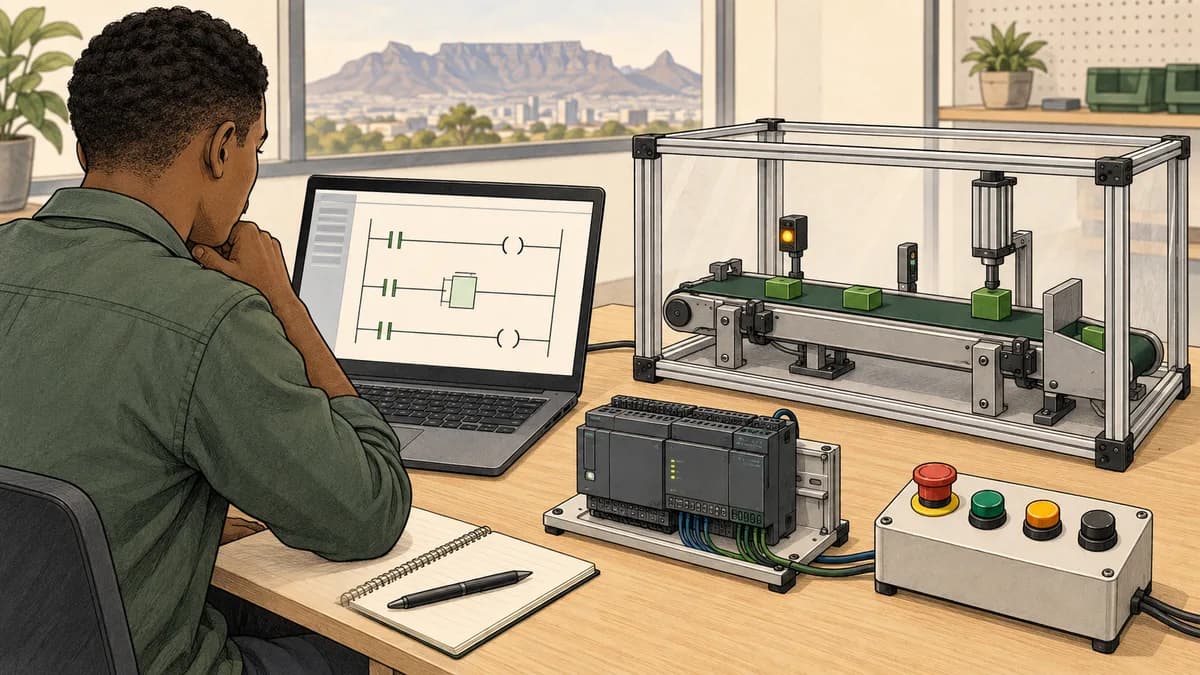
PLC training for mining should prepare you to read control sequences, trace field information, investigate abnormal states and document changes for an identified operation. Materials handling, mineral processing, instrumentation, supervisory systems and equipment maintenance overlap, but they do not require identical training. Start with the role and the actual system you need to support.
For South African learners, a useful course turns a broad industry label into an assessed task. Examples include explaining a conveyor's reported waiting state, identifying stale process data or reconciling a shift report. Ask the provider to show what the learner must demonstrate independently, rather than relying on a list of PLC brands and mining terminology.
This site is commercially connected to PLC Simulator. You can explore mining automation training software for educational practice. Check the described scope against your learning needs. The fictional reporting exercise here is not a representation of a named mine, a machine protection design or a hoisting-control procedure.
Identify the mining task before choosing a course
A materials-handling learner might need to trace a sequence across equipment boundaries and explain why a transfer is waiting. A process learner might need to understand measurement quality, units, feedback and trends. An instrumentation learner might need practical measurement and calibration instruction. A supervisory-system learner might focus on event records, displays and communications.
These are different assessment questions. “Make the conveyor run” does not assess the same competence as “explain why the downstream station is unavailable using the supplied evidence.” A program that works in a classroom model also does not establish that its timing or recovery policy is appropriate for a real installation.
Separate surface plant, underground equipment and specialised systems when reading a course description. Do not assume a generic PLC syllabus includes the practical competence, authorisation or equipment-specific instruction required for every environment. Ask the intended employer which tasks belong to the role and which require specialist involvement.
The industrial automation courses guide provides a broader map of PLC, drives, instrumentation and supervisory study. Use it to select your foundation, then narrow the practical example to the mining responsibility you actually want to develop.
Map South African operations using current operator sources
Thungela's company overview identifies its South African mining operations in Mpumalanga. This gives a concrete starting point for coal-related research around that province. It does not establish which controller every contractor uses or whether a particular vacancy is open today.
Kumba's operations page places Sishen near Kathu and Kolomela near Postmasburg in the Northern Cape. It separately describes port operations at Saldanha Bay. This distinction matters when comparing an operator's corporate address, mine location and downstream logistics work.
Valterra Platinum's mining operations overview describes its South African operations, including Mogalakwena, Amandelbult and Mototolo, alongside its Zimbabwean operation. Use the relevant facility and country when reviewing a role. A regional company page is not evidence that every listed position is based in the same South African town.
When searching around eMalahleni, include Witbank in older listings. When searching around Rustenburg, Mokopane or Northern Cape operations, inspect the exact worksite and employer identity. Verify current ownership and operating information before relying on an older project announcement. A historical installation story is useful background, not a current vacancy or installed-equipment inventory.
For a training decision, check travel, study leave and practical access. For a job decision, check roster, transport, accommodation if offered and on-call expectations in the actual offer. Do not assume that every mining role uses camp rotations or that a fixed-term assignment will become permanent.
Choose platform training from the installed system
Ask for the controller family, engineering software version, network interfaces and project structure relevant to the role. A site can contain multiple generations and specialist subsystems. It is not sound to assign every beneficiation application to Siemens, every conveyor to Allen-Bradley and every substation to Schneider without installation evidence.
Learn transferable ideas first: state, signal ownership, data quality, event identity and test coverage. Then practise the vendor-specific workflow needed for the target system. Familiarity with one engineering interface does not automatically transfer download behaviour, task configuration or library conventions to another.
Siemens' published CEMAT MinAS course is an example of a defined specialist route for a PCS 7-based cement and mining system. It states prior PCS 7 project-engineering knowledge as a prerequisite. That scope helps distinguish a specialist application course from an introductory PLC class; it is not a census of South African mining installations.
For a maintenance course, request an unfamiliar project as part of the assessment. Students should locate the relevant equipment object, identify the source of a status and explain the evidence needed before a change. A new project built from a supplied recipe tests a narrower skill.

Trace command, feedback and process evidence separately
A run request is a command. A reported running bit is equipment feedback. A measured flow or movement observation provides another kind of evidence. These may agree, but they should not be treated as interchangeable. A training diagram should show where each originates and which program or display consumes it.
Give each value an owner, unit, timestamp convention and validity meaning. If a display shows zero flow, can the learner distinguish a valid zero from unavailable measurement? If a running indication remains true during communication loss, can the learner recognise that the value is stale rather than current?
Represent the material path and the communication path separately. A network diagram explains devices and connections. A process diagram explains where material or energy moves. A fault can appear in one while its cause lies in the other, so a good assessment asks students to connect both views using evidence.
The industrial networking training guide helps separate connectivity, protocol configuration and application data. A useful mining-related exercise can contain a plausible but wrong tag mapping or stale remote status. This tests more than recognising that a cable has been disconnected.
Worked exercise: classify a fictional reporting window
Consider a classroom equipment-status report covering exactly 60 minutes. It does not control equipment. Each supplied interval already has one reporting category, and intervals do not overlap. The categories are Running, Starved, Blocked, Planned, Stopped and Unknown. These names belong to this exercise; they are not a claim that a named mine uses the same reporting standard.
Running means the supplied observation reports the equipment running. Starved means the fixture assigns an upstream-unavailable reason. Blocked means it assigns a downstream-unavailable reason. Planned represents time deliberately excluded by this fictional reporting policy. Unknown means the observation is not usable for classification. Stopped covers other known non-running time.
| Interval category | Duration | Reporting meaning in this fixture |
|---|---|---|
| Running | 38 minutes | Known running observation |
| Starved | 8 minutes | Assigned upstream-unavailable reason |
| Blocked | 6 minutes | Assigned downstream-unavailable reason |
| Planned | 5 minutes | Excluded by the stated exercise policy |
| Unknown | 3 minutes | Missing usable classification |
| Total | 60 minutes | Complete time window |
The running share of the whole window is 38 divided by 60, approximately 63.33 percent. This answers how much of the stated window is recorded as Running. It does not claim that unknown time was definitely stopped.
If a second report excludes Planned time and Unknown time from its denominator, its known eligible duration is 52 minutes. The running share of that denominator is 38 divided by 52, approximately 73.08 percent. Show the excluded durations beside the percentage. Otherwise readers may think the equipment performed differently when only the reporting definition changed.
Do not call either number OEE. This exercise has not defined the quality and performance information needed for that separate metric. Naming a percentage after a familiar business measure does not supply its missing inputs or agreed calculation rules.
Now change the three Unknown minutes to known Running. The whole-window running share becomes 41 divided by 60, approximately 68.33 percent. The known eligible denominator becomes 55 minutes, giving approximately 74.55 percent. This illustrates why a data correction changes both the numerator and the relevant coverage, rather than simply adding three percentage points.

Define classification rules before using multiple status bits
A second version of the exercise can derive one category from several supplied flags. Define the priority explicitly: invalid data produces Unknown; otherwise Planned takes priority; otherwise Blocked; otherwise Starved; otherwise a true running flag produces Running; otherwise Stopped. This is a fictional reporting priority, not an equipment interlock or operational recommendation.
Under that policy, simultaneous Blocked and Starved flags produce Blocked in the summary. Retain the original flags in the evidence record so that the chosen category does not erase the other observation. A single summary category is a reporting convenience, not proof that only one condition existed.
Invalid data takes priority even when the last received running bit remains true. This prevents the report from silently extending known running time through a communication outage. The policy does not infer the physical state during the missing period; it records that the observation is unavailable.
Test every combination of the five Boolean inputs: validity, planned, blocked, starved and running. There are 32 combinations. Write the expected category independently of the implementation, then compare the results. Include the all-false case and the case where every flag is true.
With valid data and all other flags false, the result is Stopped. With all flags true, the result is Planned because data is valid and Planned has the highest remaining priority. With invalid data, the result is always Unknown regardless of the other four flags. These boundary cases make the policy easy to review.
Handle time boundaries and missing coverage
Define each interval as including its starting instant and excluding its ending instant. Adjacent intervals then share a boundary without counting that instant twice. Reject negative or zero durations in this worksheet. An actual logging system may represent instantaneous events separately, but those events are not duration records.
Check that the interval durations cover the intended window. A missing interval is not automatically Stopped, and overlapping intervals must not both contribute their full duration. If a shift boundary cuts through an interval, split its duration at the boundary while preserving the same category and provenance.
For example, a ten-minute Running interval beginning five minutes before the reporting boundary contributes five minutes to each adjacent window. A report that assigns the whole interval to its start date will produce a different result. State the rule before comparing totals from two systems.
Keep event time and arrival time distinct. A delayed message can describe an earlier period. If the exercise only provides arrival time, acknowledge that limitation instead of pretending to reconstruct an exact earlier sequence. Clock alignment and sampling resolution affect what a fault chronology can establish.
For structured test practice, use PLC program testing exercises. Confirm the supported educational environment for your model. The fictional reporting rules here are not a claim that the product supplies a mine historian, approved shift-reporting policy or native control-system integration.

Investigate an interruption without inventing the root cause
Begin with a specific observation: which equipment, which reported state, which timestamp and which expected transition did not occur. Record whether the evidence came from the controller, HMI, instrument or an operator report. “PLC fault” is not a useful conclusion until the information supports it.
Trace the condition through its source, communication path, program interpretation and display. A mismatch between two points narrows the question. It does not automatically identify which point is correct. Use documented project versions and the site's authorised diagnostic procedures when investigating real equipment.
Treat dust, vibration, power quality, instrumentation problems and process conditions as hypotheses where relevant. Do not declare a specific physical cause merely because the environment makes it plausible. The next check should distinguish competing explanations and stay within the person's training and authority.
The PLC troubleshooting guide provides a general evidence-led workflow. For a mining portfolio, include a case in which the correct conclusion is that the available timestamps cannot establish the initiating event. Recognising an evidence limit is better than inventing a precise chronology.
After a correction in a learning project, rerun the original case and related cases. If the change concerns stale status, check both communication loss and restoration. If it concerns interval boundaries, check records before, at and after the boundary. Record what remains untested.
Keep specialised equipment outside a generic practice claim
A generic learning model should not be presented as a validated control solution for hoisting, personnel transport, ventilation protection or other specialised mining equipment. Understanding a Boolean expression or a sequence diagram is one component of learning; it does not establish the full engineering and operational competence for those systems.
Ask the provider which practical activities are included, who supervises them and what authorisation the course does or does not confer. For a role involving specialised equipment, obtain the employer's actual requirements and the relevant manufacturer training scope. Avoid assuming that a general safety-PLC module covers every application.
In a portfolio, distinguish monitoring from protection. The reporting classifier above only assigns labels to observations. It produces no motor commands and cannot be used as proof that a machine will stop or recover correctly. Keeping that boundary clear allows useful data reasoning without overstating the project.
Use the introduction to safety PLCs to understand the questions to ask when moving beyond ordinary control logic. A recognised platform name or safety-rated component does not by itself validate a complete application.

Compare mining PLC courses by assessed evidence
Request the course's practical brief, prerequisites and equipment list. Ask whether each learner receives individual engineering access and whether the assessment includes an unfamiliar project. Clarify which software generation is used and whether access continues after the scheduled sessions.
For maintenance study, ask for a signal-tracing and fault-evidence exercise. For process study, ask for measurement quality and trend interpretation. For supervisory study, ask for a reporting task with missing data and clear time boundaries. Match the assessment to the intended work rather than choosing the longest topic list.
Compare the full written price in rand, including VAT treatment, software or laboratory charges, examinations and travel. A remote learner should also confirm connection requirements and how practical access works during disruptions. Do not assume that recorded videos provide the same experience as supervised work on the named platform.
If a provider advertises certification or accreditation, request the exact awarding body and programme identification. Verify the claim relevant to your employer's requirement. Attendance, a provider's practical assessment, vendor certification and a recognised qualification should be described accurately rather than combined into one vague promise.
For institutional buyers, define the pilot task and review criteria before purchasing seats. Ask learners to submit the same evidence package so that instructors can compare reasoning, not just completion badges. A small evaluated pilot can reveal whether the material suits the group's starting knowledge.
Build a portfolio around one defensible report
Include the 60-minute fixture, category definitions, raw flags, priority rule and percentage calculations. Show both reporting denominators and explain their difference. Retain Unknown time visibly instead of choosing whichever calculation looks more favourable.
Add tests for all 32 flag combinations, a shift-boundary split and a missing interval. Keep a record of a deliberately incorrect implementation, such as treating stale running feedback as valid. Explain the test that exposed it and the correction that followed.
Write a handover describing the initial state, input format, time convention and output labels. Use invented equipment names and data. You do not need confidential mine diagrams, control projects or production records to demonstrate careful software reasoning.
When applying for work, describe the project as educational and identify the practical experience you still need. Compare actual role requirements and compensation details rather than relying on invented mining salary bands. The South African PLC technician salary guide explains how to assess the available evidence and a specific offer.
Questions about mining PLC training in South Africa
Which PLC should I learn for mining in Mpumalanga?
Use the target employer's installed system or the course's assessed equipment to choose. Coal operations in the province establish an industry context, not a universal controller requirement. If the target is unknown, begin with program reading, signal tracing and testing before committing to a specialist platform route.
Is a mining PLC course suitable for a qualified electrician?
It can be, depending on prerequisites and the intended task. Electrical experience does not automatically include unfamiliar-program navigation, data handling or controller-specific procedures. Ask for a diagnostic assessment that identifies your actual gaps rather than assuming every trade-qualified learner needs the same starting level.
Can I learn mineral-processing control through a simulator?
A simulator can teach selected foundations such as feedback, measurement interpretation and sequence reasoning. Check the model and its limitations. A successful exercise does not establish the response of a real beneficiation circuit or competence to tune and commission it.
What should I practise for a mining automation interview?
Practise explaining a reported state from evidence, identifying stale data, reading an unfamiliar sequence and documenting a change. The reporting fixture here gives a concrete discussion about missing coverage and denominator choices. Explain what the model establishes and what it cannot prove.
Does a short course guarantee a mining job?
No. A course can provide learning and assessed evidence, while hiring also depends on the role's qualifications, experience and other requirements. Check current vacancies and avoid treating a certificate, course duration or generic industry salary table as a promise of appointment.

Make your next course decision concrete
Choose one mining-related task you want to perform in a training environment and write its expected evidence. That might be a correctly classified reporting window or a clear explanation of why a simulated transfer is waiting. Use the task to compare providers and identify the equipment access you need.
Complete the normal case, missing-data case and handover before expanding the model. This gives you a reliable foundation for further platform or process training and an honest record of what you can explain independently.