locations · South Africa
PLC Training Limpopo: Courses and Remote-Data Practice
Plan PLC training in Limpopo: Polokwane and Lebowakgomo enquiries, practical access, travel costs, online preparation and a remote-data learning exercise.
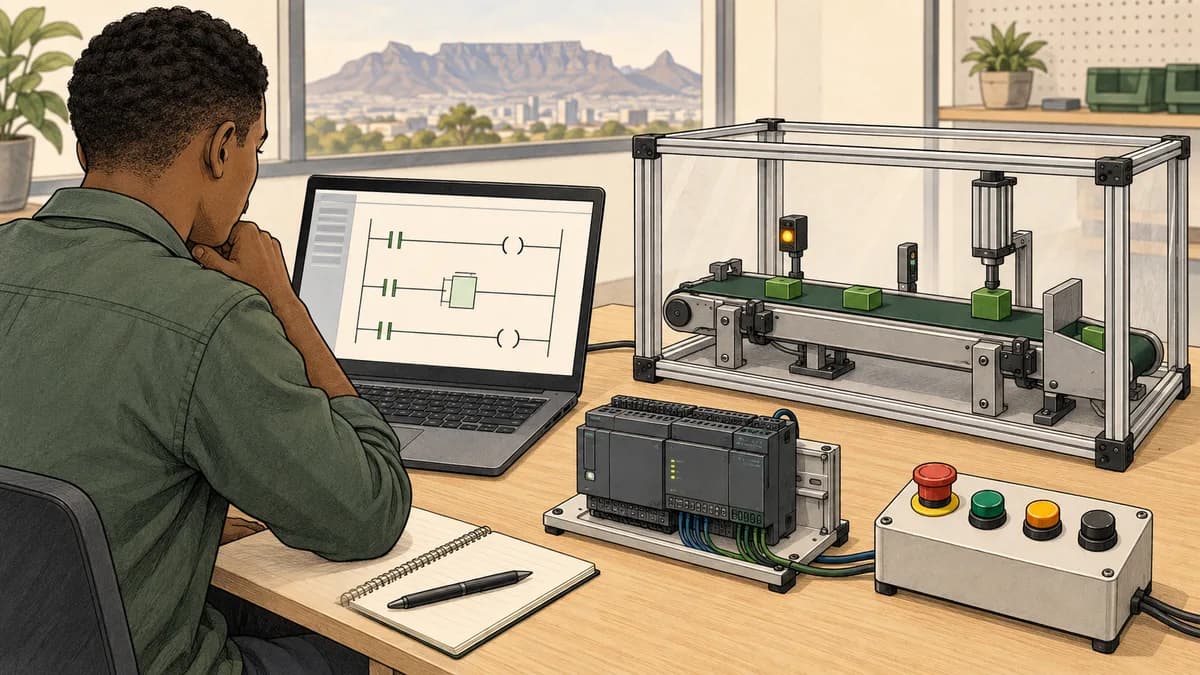
PLC training in Limpopo should begin with a real course enquiry and a clear practical objective. Polokwane, Lebowakgomo, Lephalale, Tzaneen, Burgersfort and Musina are different starting points for travel and study. Do not assume that every learner must leave the province, or that a local engineering campus automatically offers a standalone PLC short course with an open intake.
This guide helps you compare local education routes, online preparation and a supervised practical block where needed. It includes a fictional remote-measurement exercise that teaches how to distinguish arrival time, sample time and stale data. It does not promise independent site competence, a mining job or a salary premium after a course.
This site is commercially connected to PLC Simulator. Its curriculum overview can help you choose educational foundation practice. Check current access and device requirements on the product site. Home practice can support further learning, but it does not replace a qualification's prescribed practical work or authorisation to access an industrial system.
Start with actual Limpopo education contacts
Capricorn TVET College's 2025/26 prospectus includes Polokwane campus information. Use the official college route to ask about the exact programme, entry requirements and campus. A prospectus is an enquiry source, not confirmation that a particular PLC short course is currently bookable.
Waterberg TVET College's Engineering and Skills Training Centre page locates the centre in Lebowakgomo and describes engineering and skills programmes with practical workshop facilities. That directly contradicts a blanket assumption that Limpopo has no practical education base. It still does not prove that a named vendor PLC course is running there on your preferred date.
Ask a college or provider: “Which current programme includes programmable control, what equipment is used, and can I enrol for that subject as a standalone course?” The answer may be a formal study route, a skills programme, an employer arrangement or no current suitable intake. Keep those answers distinct rather than treating every engineering contact as a PLC training centre.
Check campus, programme and availability together
A central administration address may differ from the teaching site. Ask where the practical work and assessment happen, whether attendance is repeated or in a block, and who confirms an available place. Record the date of the response. An old programme announcement should remain historical until the institution confirms its present status.
If you need a formal qualification, obtain the exact admission and assessment requirements from the institution. If you need a short practical refresher, describe the task and your existing experience. The PLC course requirements guide helps you prepare the questions without assuming that every learner starts from the same background.
When employer-arranged training may be worth investigating
An employer with several learners can ask whether a suitable provider will bring training to an agreed venue. The proposal must identify the subject, equipment, instructor access and individual assessment. A room near the workplace only helps if the planned practical tasks can actually be delivered there.
For a related discipline, Bosch Rexroth Africa's training page describes hydraulics and pneumatics training and customer-site options on request. This is evidence that location-specific training enquiries are possible in that scope. It is not confirmation of a public PLC class in Limpopo or a guarantee that every requested course can be delivered at any venue.
If your objective combines PLC logic and fluid power, ask which provider covers each part and how the prerequisites connect. A simulated cylinder sequence does not establish competence to work on a pressurised system. The hydraulics and pneumatics training guide explains the broader learning questions.
For an individual learner, an employer course may not accept public bookings. Ask before including it in a shortlist. A useful training directory should distinguish open classes from private arrangements, because the purchasing route and eligibility are different even when the subject is relevant.

Plan practical access from your own location
Compare the actual venue from your starting point, including a suitable out-of-province option if local enquiries do not meet the requirement. Do not apply a single travel distance to the whole of Limpopo. A learner in Polokwane, a learner in Musina and a learner near the provincial boundary will have different journeys and accommodation needs.
If a Gauteng block is appropriate, use the Gauteng PLC course guide to compare scope and prerequisites. For Tshwane specifically, the Pretoria training guide provides a local route. Confirm that the practical and assessment dates are included in the proposed attendance plan before arranging transport.
Ask whether the course requires a second visit for assessment or reassessment. Check the conditions if an intake is postponed or does not meet its minimum group size. These questions matter before you commit to non-refundable travel or employer leave. An online course listing is not a confirmed place.
Use home preparation for work that fits the environment
Reading, basic logic exercises, data definitions and test planning can often be prepared before a practical class. Use supervised laboratory time for the named equipment and software tasks that need it. This division can make the visit more useful, but it does not guarantee that one trip completes every practical requirement.
Test your device and connection before a paid online session. Ask whether the course needs continuous connectivity, a software installation or live attendance. Do not assume that a browser product works offline or that a recording counts as an assessed practical. Keep permitted notes available independently of the account you use for learning.
Use industrial context without predicting every installation
The Musina Makhado SEZ corporate profile places the development in the Vhembe District and describes different sector focuses across its sites. This is regional context for an enquiry, not evidence that every proposed facility is operating, that a PLC vacancy exists or that a specific controller brand is installed.
For a mining-related objective, identify the actual role and equipment instead of assuming every concentrator uses the same Siemens environment. The mining automation training guide develops diagnostic and reporting examples with clear limits. It does not turn a province or commodity name into a universal programming syllabus.
For a processing or packing objective, consider measurement, counters, sequences and data records. The food and beverage automation guide gives a related educational route. Choose the task from an actual course or role requirement rather than claiming that one sector provides a guaranteed route to employment across Limpopo.
If there is no target equipment yet, begin with transferable logic and testing concepts. Add vendor-specific project navigation and diagnostics when you can identify the required controller and software. A brand name alone does not establish that a course covers older projects, a particular HMI or the communications used on a site.
A fictional remote-measurement learning exercise
This exercise is a read-only display using synthetic messages. It does not connect to a remote installation or control a pump, conveyor or valve. The task is to decide whether a displayed measurement is current under a declared classroom rule and whether a newly arrived message should replace the previous accepted one.
Each message has a sensor identifier, sample time, arrival time, value and quality flag. Sample time means when the fictional source says it measured the value. Arrival time means when the display received the message. These can differ. The exercise assumes a common synchronised time base; it does not solve clock synchronisation for real devices.
The current time is 120 seconds. A sample is considered fresh when its age is from zero through ten seconds inclusive and its quality is good. Ten seconds is a chosen teaching threshold, not a recommendation for industrial monitoring. A future sample time or bad quality prevents the value from being labelled current.
Review four synthetic messages
| Message | Sample time | Arrival time | Value | Quality | Interpretation at time 120 |
|---|---|---|---|---|---|
| M1 | 115 | 116 | 42 | Good | Age five seconds; fresh |
| M2 | 108 | 119 | 41 | Good | Age twelve seconds; stale despite recent arrival |
| M3 | 121 | 120 | 43 | Good | Future sample time; investigate the time assumption |
| M4 | 118 | 119 | 0 | Bad | Bad quality; zero is not a confirmed measurement |
The recent arrival of M2 does not make its source sample newer than M1. If the display simply accepts whichever message arrived last, an older sample can replace a newer observation. The learner should identify that difference before choosing a rule for the display.
Under this exercise's acceptance rule, a good, non-future message for the expected sensor replaces the latest accepted sample only if its sample time is newer. A message with the same sample time and identical data is a duplicate. A message with the same sample time but different data is a conflict for review. Older messages remain historical records and do not overwrite the latest accepted sample.

Test freshness separately from message acceptance
Acceptance into the latest-sample record and current freshness are related but different questions. A sample accepted earlier can become stale as time advances even if no new message arrives. The display must evaluate age using the current time rather than retaining a “fresh” label forever because the message was fresh when received.
For M1 with sample time 115, the age is ten seconds at time 125 and remains fresh under the inclusive classroom threshold. At time 126, the age is eleven seconds and the value is stale. The stored value can remain available as historical information if it is labelled clearly; it should not silently appear as a current reading.
A valid zero is also different from M4's bad-quality zero. Add a fifth message for the expected sensor with sample time 119, value zero and good quality. At time 120 its age is one second, so zero is a current valid value under the declared rule. Do not reject it merely because it is zero, and do not use the same display status as an unavailable measurement.
| Additional test | Expected learning result |
|---|---|
| Sample exactly ten seconds old | Fresh under the declared inclusive boundary |
| Sample eleven seconds old | Stale |
| Good-quality zero with current time | Valid zero |
| Correct value from the wrong sensor identifier | Rejected for this display |
| Same time and same data as accepted sample | Duplicate, no new observation |
| Same time and different data | Conflict retained for review |
These cases are expected results for the fictional contract. If you implement it in a learning environment, record the revision and observed results separately. The table does not claim a successful test in a particular native PLC, communications driver or industrial historian.
Explain uncertainty instead of hiding it
If the source and display clocks are not synchronised, the age calculation may be misleading. State that the common-time-base assumption is unverified and avoid presenting a precise freshness conclusion as fact. A course should teach you to identify that missing premise rather than simply choosing a larger timeout until a warning disappears.
If a link drops, a previous value may still be visible. Record the link state and value age so that a reader can distinguish a retained observation from a live update. Do not automatically convert a connection problem to a measured zero or assume the process stopped because the display stopped receiving data.
The communication troubleshooting guide helps separate observations about the data path. The OPC UA basics guide provides further context where that protocol is actually relevant. This fictional message exercise does not claim that every protocol carries identical quality or timestamp semantics.

Turn the remote-data exercise into a course assessment
Prepare the message table and expected results before attending. Ask the trainer how the named environment represents timestamps, quality and identifiers. A beginner may implement the display status from supplied values; a more experienced learner may investigate message ordering and conflicts. Those are different scopes and should have different prerequisites.
Include one intentionally wrong result in your investigation notes. For example, explain why marking M2 fresh from its arrival time produces the wrong conclusion under the contract. Record the correction and rerun the boundary cases. A reviewer can then see both your understanding of the requirement and your response to a failed test.
The product's PLC program testing overview gives context for educational testing. Confirm the current tools before choosing a submission format. Do not promise native project import, automatic certification evidence or an offline workflow unless the actual product supports the needed function.
Compare the complete cost of a Limpopo learning route
Request tuition, assessment, software, materials and equipment charges in a written offer. Add your own journeys, accommodation and agreed time away from work. Keep estimated travel amounts separate from the provider's fee and note when each was checked. A course price without the required attendance plan is an incomplete budget.
The PLC course price guide explains how to compare scope. This page does not prescribe a provincial fee range or claim that accommodation always costs more than tuition. Those relationships depend on the actual offer, route and learner's circumstances.
Ask about reassessment, missed sessions and continued software access. If the training licence ends after attendance, plan how to retain permitted notes and continue appropriate practice. A cheaper course is not necessarily a better fit if you cannot use its required software or complete the assessment within your available dates.

Questions about PLC training in Limpopo
Is there any practical engineering training in Limpopo?
Yes, official college information identifies practical engineering facilities such as Waterberg's Engineering and Skills Training Centre in Lebowakgomo. That does not establish a particular open PLC short course. Enquire about the programme, equipment and current intake instead of assuming either universal availability or complete absence.
Can I study PLC programming in Polokwane?
Use Capricorn's official programme and campus information as an enquiry route and compare any current specialist offers you can verify. Ask whether the PLC component is standalone or part of a larger programme. This guide does not confirm a current public class with a specific date and controller in Polokwane.
Must I travel to Gauteng for PLC training?
Not automatically. Check suitable local, employer-arranged and remote options first. If the required practical environment is available only through a suitable out-of-province course, plan the actual journey and assessment dates. Your location and objective determine the route, not a blanket provincial rule.
Which PLC should I learn for mining in Limpopo?
Use the controller and software named in the target role or authorised equipment information. Mining is not a single programming platform. Begin with transferable concepts if the equipment is unknown, then add vendor-specific practical work when the requirement is clear.
Can online study make me ready to fault-find alone on a remote site?
No such competence is established by online study alone. A real role can require qualifications, equipment experience, supervision and site authorisation. Educational exercises can develop reasoning and documentation, but they do not grant permission to work independently on unfamiliar machinery.
What is a useful home project for a Limpopo learner?
The synthetic timestamp and data-quality exercise above is one option. Explain sample age, delayed arrival, valid zero and uncertain time assumptions. Label the environment and expected versus observed results. A small precise project is more useful than claiming a real remote monitoring installation that you have not built or tested.

Make the course enquiry concrete
Write your background, starting location, available dates and practical objective. Ask the provider for the named programme, current venue, full quotation and assessment requirements. Keep unknown availability clearly marked until you receive a response.
Prepare one small test record before the course. For the remote-measurement task, explain why a message arriving at time 119 can still contain a stale sample and why a valid zero differs from bad-quality data. That gives PLC training in Limpopo a clear learning purpose and a concrete basis for evaluating the next course you buy.