locations · South Africa
PLC Training in Rustenburg: Courses and Diagnostic Skills
Compare PLC training in Rustenburg: local study enquiries, vendor course fit, diagnostic practice, total costs, shift planning and online learning options.
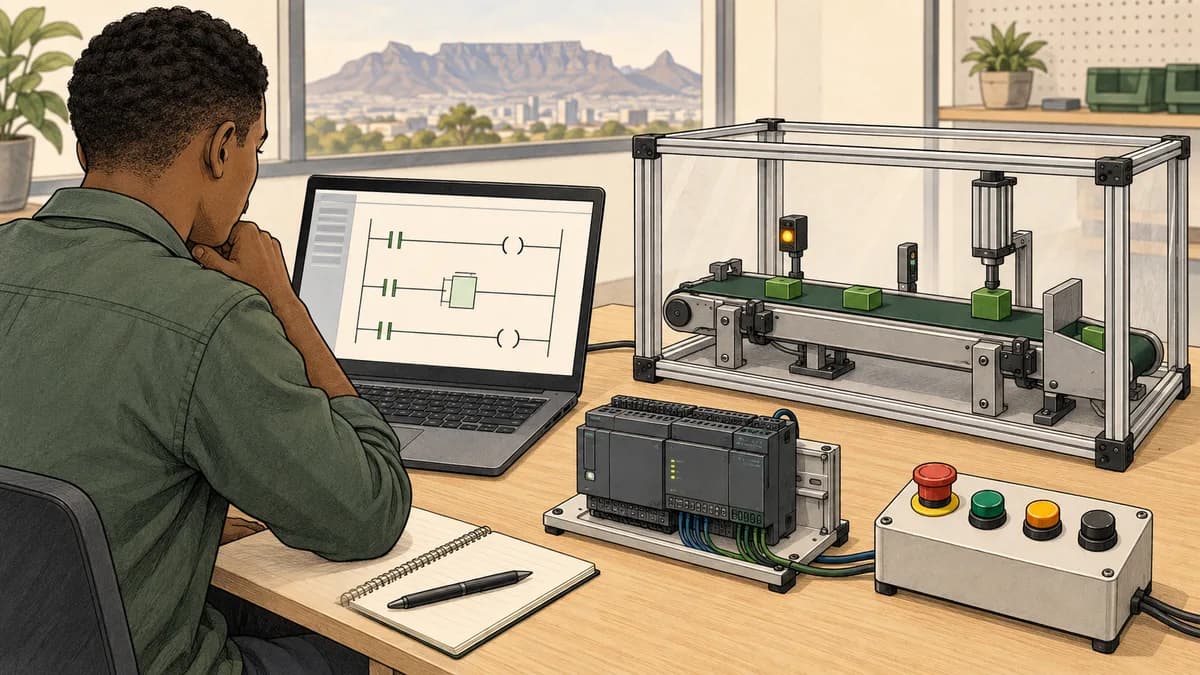
PLC training in Rustenburg should be selected against a practical objective and the equipment you expect to use. A first programming course, a maintenance course and a broader engineering study route can all be useful, but they do not deliver the same outcome. Start with your existing skills, then check the syllabus, individual practical access, assessment and total cost.
This guide provides local and regional enquiry routes and a fictional diagnostic exercise based on competing explanations for a stopped training model. It is intended to help you assess course depth and organise your own preparation. It does not claim that every mine uses one PLC brand, that a short course guarantees a salary or that simulator practice authorises work on production equipment.
Local and regional PLC training enquiries
ORBIT's Rustenburg campus
ORBIT TVET College's Rustenburg campus page describes engineering and artisan-development activity and gives a local campus contact. It also explains the campus's relationship with the surrounding mining area. This makes it a relevant enquiry point for a broader engineering or artisan learning route.
Ask the college for the current programme that matches your goal, its entry requirements and the practical syllabus. If you specifically need PLC programming, request details of the controller, software and individual workshop tasks. The existence of engineering studies does not by itself establish a stand-alone vendor PLC short course or an available intake.
Confirm the actual teaching venue and timetable with the programme contact. A college can have several different activities at a campus, and a practical component may have its own arrangements. If you are employed, explain your shift constraints before comparing a longer programme with a short training block. The course that fits your educational goal still needs to fit a realistic attendance plan.
NWU short learning programmes elsewhere in North West
The NWU Industrial Automation Training Centre lists Siemens PLC TIA-Micro S7-1200 Level 1 and Level 2 short learning programmes for individuals. This is a regional enquiry option. Ask for the current dates, teaching venue, prerequisites and practical arrangements before planning travel.
Do not assume that a listing establishes a current seat or that a course elsewhere in the province is a Rustenburg classroom. Use the North West PLC training guide to compare the wider provincial routes. Your decision should reflect the capability gained and the actual travel commitment, rather than a general claim that local training is unavailable.
Vendor-specific maintenance training
Siemens South Africa's TIA-SERV1 course outline identifies basic Siemens automation knowledge as a prerequisite and includes diagnostic work in its service and maintenance scope. The retrieved outline labels its delivery type online. Confirm the offering you intend to book, including practical access, rather than treating a vendor course page as proof of a local venue.
This is an example of how to inspect course fit, not a claim that every Rustenburg learner should choose Siemens. If your target equipment uses another environment, obtain that vendor's or provider's equivalent outline. Record the controller family and engineering software as well as the manufacturer; the same brand can cover substantially different systems.

Choose training from the role, not a blanket brand claim
A person learning to diagnose an existing installation has a different immediate need from someone learning to create a new program. For diagnosis, ask about navigating unfamiliar code, identifying the source of a value, comparing expected and observed states and documenting uncertainty. For programming, ask about requirements, structure, state transitions and checks after a change.
If you have an authorised workplace training plan, use its exact equipment and task requirements. If you are exploring potential roles, compare several current descriptions and keep their dates. Do not infer a universal brand preference from the fact that the area has mining and mineral-processing activity. Neither a municipal economic description nor a training brochure establishes every employer's installed systems.
For foundation work, choose a course that makes Boolean logic, timers, counters and small sequences understandable. You should be able to predict what happens before running an example and explain a mismatch afterwards. The PLC course requirements guide helps you identify which preparation tasks fit your starting point.
For mining-related learning, the mining automation training guide provides a broader set of technical questions. Keep a clear distinction between learning a control concept and being competent or authorised for a particular site task. A course title cannot establish the full requirements of a workplace, and a successful educational exercise should be described in its actual environment.
What to ask before paying for a course
Request a dated syllabus and quotation. Ask which controller and engineering package are used, how many learners share a station and what each learner must demonstrate independently. If the course includes HMI, networking or drives, ask which practical tasks are included in those topics. A list of subject names does not establish the depth of each one.
Ask how the instructor handles learners with different backgrounds. An electrician may be comfortable with diagrams but new to software state. A graduate may have programmed one training rig without diagnosing an unfamiliar project. A programmer from another field may understand conditions while needing help with industrial signal meaning. Those are useful starting details for placement advice.
Find out how feedback is delivered when a test fails. Does the instructor explain the requirement that was missed, or simply provide the working project? Can you repeat the assessment? Will you retain notes or suitable exercise material for follow-up practice? These questions reveal how the course supports learning beyond the first successful demonstration.
Compare PLC course costs in South Africa by category: tuition, software, materials, assessment, travel and time away from work. For regional alternatives, use the Pretoria training guide and Gauteng course guide. Confirm the actual address and timetable before making a travel calculation.

A diagnostic learning exercise: distinguish explanations
Consider a fictional read-only training model called FeedStudy. The model displays four Boolean signals with valid quality: request, permission, command and movement. Its stated rule is that command equals request AND permission. Movement is an independently supplied observation; the model does not assume that a command proves movement or that no movement proves a particular equipment fault.
The exercise presents three proposed explanations for a stopped model:
- H1: There is no request.
- H2: A request exists, but permission is absent.
- H3: Request and permission are both present, command is present, but movement is not observed.
These are descriptions of signal conditions, not proven physical causes. H3 does not mean a motor has failed. H2 does not explain why permission is absent. Keeping that distinction visible is the point of the exercise.
Start with a complete signal record
| Record | Request | Permission | Command | Movement | Supported description |
|---|---|---|---|---|---|
| D1 | False | True | False | False | No request is present |
| D2 | True | False | False | False | Request exists; permission absent |
| D3 | True | True | True | False | Command present; movement not observed |
| D4 | True | True | True | True | Command and movement both present |
The command values in these four rows agree with the exercise's Boolean rule. D1, D2 and D3 all have no observed movement, but they do not support the same description. A learner who treats every stopped display as an identical fault has ignored information that could guide the next read-only check.
Now introduce D5: request true, permission false, command true and movement false. This record conflicts with the model's stated command rule. Before choosing a physical explanation, review whether the record comes from one coherent observation, whether the signal mapping is correct and whether the documented model revision matches the data. The exercise does not authorise changing outputs to make the display agree.
Ask for the smallest useful next observation
Suppose the only supplied information is “movement false”. All three stopped descriptions remain possible. The next useful observation is not automatically a large program change. Asking for request and permission values can distinguish the first two conditions from the third under the model's rules.
If request is true and permission is false, investigate the documented source of permission in the training project. If request and permission are true but command is false, the record conflicts with the stated rule and needs a different review. If command is true but movement is false, the next question concerns the meaning and quality of the movement observation, not an automatic conclusion that the driven equipment has failed.
This is a structured way to narrow uncertainty. The PLC troubleshooting guide develops a broader diagnostic workflow, while the HMI tag-binding guide helps explain why a displayed value needs a known source. A course assessment can use a simple model and still test these habits thoroughly.

Keep timestamps and quality with the evidence
The fictional rows above assume a coherent observation of the same model revision. Now remove that assumption. Request might have been recorded before a change, permission afterwards and command at another time. Combining those values into one row could create an apparent contradiction even if no individual observation was wrong.
Record when and where each value was observed and whether the values are intended to represent the same state. If their relationship is unknown, say so. Do not repair the record by selecting whichever timestamp makes a preferred explanation look convincing. A good diagnostic note preserves the evidence and identifies what must be checked next.
A bad-quality movement signal is also different from a valid false value. In the first case, movement is unavailable under the exercise's data rules. In the second, the supplied observation says no movement was detected in the defined context. Neither result alone establishes the physical cause, but they lead to different questions about the information source.
If the model uses a cached display, a value can remain visible after its source becomes unavailable. Ask a provider how learners distinguish a last-known value from a current observation in the environment used by the course. Do not assume that every HMI, communications driver or simulator presents quality and age in the same way.
Check the Boolean rule independently
There are four possible known Boolean combinations of request and permission. Only the combination in which both are true should produce command true. Movement can independently be false or true, giving eight complete input combinations for the read-only fixture. The command rule is unchanged by the movement value.
This creates a small, inspectable assessment. Ask the learner to predict command for all eight combinations and then explain what movement does and does not establish. If the exercise is implemented, compare actual observations with the predicted table. If it is only completed on paper, label it as a desk check rather than a controller test.
An unknown request or permission requires a separate data-quality rule; it is not one of the four fully known Boolean pairs. For this learning exercise, mark the command expectation unavailable when either input is unknown. Do not quietly substitute false and claim the normal Boolean table has covered the missing-data case.
Build a portfolio around diagnostic reasoning
Give the exercise a model name, revision and short purpose statement. Keep the signal definitions, expected table, observations and unresolved questions together. A screenshot without those details can be difficult to interpret, especially if another reader does not know which signal is a request, a command or feedback.
Write one concise explanation for each interesting case. For D2, a useful note is that a request exists but the required permission is absent. It should then identify the next evidence needed to understand that permission. It should not claim that a particular field device failed unless the exercise supplies evidence supporting that conclusion.
For structured foundation practice, explore the PLC simulation curriculum. Use the product's current published lessons and capabilities to choose suitable work. If you need a specific native engineering environment or physical controller task, plan the appropriate practical access separately.
The PLC program testing guide helps organise expected behaviour, invalid-input cases and repeat checks after a change. State which environment produced your evidence. Educational simulator work can demonstrate useful reasoning without being presented as proof of native project compatibility or permission to commission equipment.

Fit the course around shifts and travel
Ask for the actual start and finish times, the number of consecutive days and whether assessments require a separate attendance date. A course that looks manageable from its total duration may be difficult to attend around a particular roster. Explain those constraints early so that the provider can describe the arrangements that actually apply.
If you are comparing a regional classroom block with online preparation, separate the tasks each can serve. Online foundation work can help you arrive with basic concepts understood, provided the product fits your device and connectivity. A practical block may then address the equipment, wiring or native software tasks that remain. Neither format is automatically the best choice for every part of the learning plan.
Ask what software access remains after the course. If the classroom licence ends immediately, plan how you will continue studying the concepts and where you will obtain legitimate access for native practice. Do not assume that files saved during a course can be opened or tested in every educational simulator.
For employer groups, define the required outcome and the starting level of each learner. A cohort needing basic logic should not automatically be placed in a specialist maintenance course. The training-centre planning guide provides a way to frame an educational pilot with explicit assessment and support arrangements.
Questions about PLC training in Rustenburg
Can I enquire about PLC-related study locally?
ORBIT's Rustenburg campus is a relevant contact for engineering and artisan-development routes. Ask specifically about the current programme and PLC practical content you need. A campus description does not establish an open vendor short course, so request the syllabus, intake and equipment details before deciding.
Is Siemens always the best first brand for Rustenburg?
Choose from the equipment and role requirements you can verify. A local industrial profile does not establish one brand across every plant. If your target is not yet specific, foundation logic, data handling and diagnostic reasoning can help you compare specialist courses more intelligently when the requirement becomes clearer.
Should I take a programming course or a maintenance course?
Compare the tasks and prerequisites. Programming training should address building and testing behaviour from requirements. Maintenance training should address understanding existing systems and diagnosing evidence. There is overlap, but a course title alone does not show which route fits your experience. Ask the provider to explain its recommendation using your starting skills.
Does a certificate guarantee a mining automation job?
No. Ask what the certificate records and keep evidence of the tasks you actually completed. Employment requirements can include experience, qualifications, equipment knowledge and workplace-specific competence. A course can contribute to a learning plan without guaranteeing a vacancy, salary or site authorisation.
What can I practise before a course?
Practise explaining Boolean conditions, tracing a small sequence and distinguishing a command from feedback. Record expected results before running an exercise. The fictional diagnostic task on this page is one example; the PLC training pathway provides a broader foundation route.
How can an AI assistant help compare Rustenburg training options?
Provide dated syllabi, your experience, location and target task. Ask it to identify missing practical details and separate verified facts from assumptions. A useful prompt is: “Which course would help me diagnose an unfamiliar training project, and what evidence is missing from these outlines?” Check its answer against the providers' current responses.

Turn your objective into an enquiry
Describe the task you want to learn, the controller family if known, your current experience and your available dates. Request the syllabus, prerequisites, practical access, assessment, venue and complete quotation. Compare those answers with the evidence you want to produce afterwards. That gives you a practical next step and a clear basis for choosing further training as your skills develop.