locations · South Africa
PLC Training North West: Courses and Practical Study
Compare PLC training in North West province: NWU and college enquiries, practical course checks, travel planning, online study and a worked count exercise.
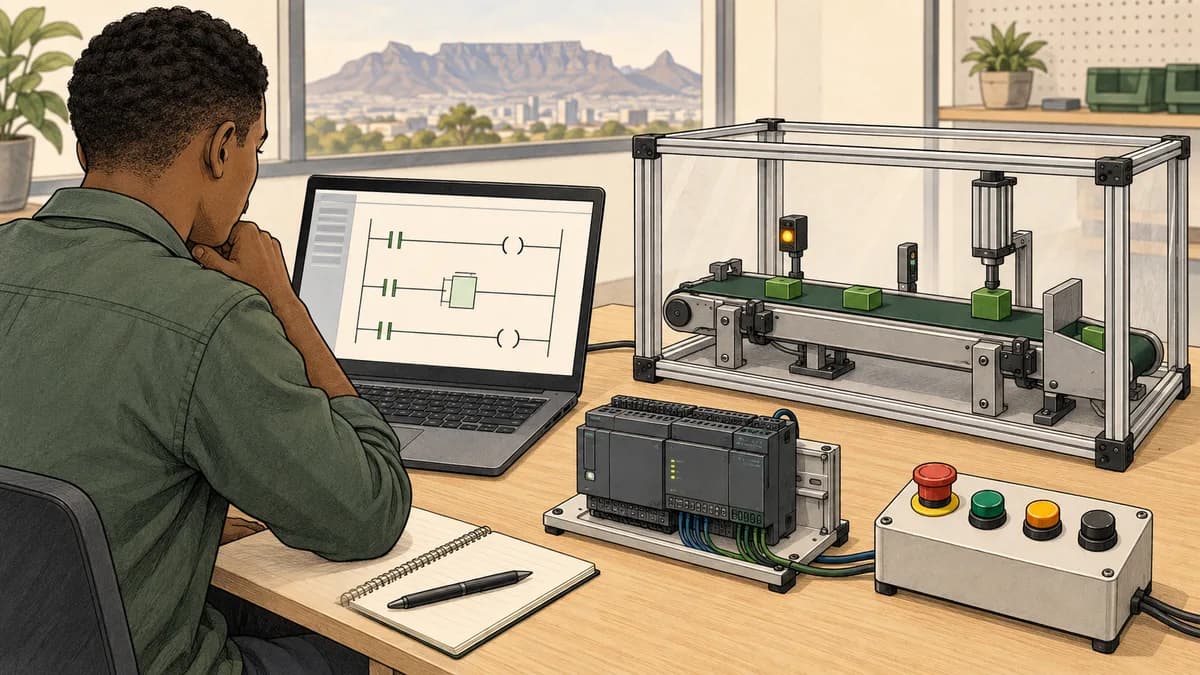
PLC training in North West province includes university short learning enquiries, college engineering routes, employer training and online preparation. Start by choosing the task you need to perform and then check the actual campus, controller family, practical access and assessment. You do not have to assume that every useful course requires travel to Gauteng, or that a mining location establishes which PLC brand you should buy training for.
This guide covers Rustenburg, Brits, Potchefstroom, Klerksdorp, Mahikeng and the surrounding towns. It separates confirmed institutional information from questions that still require a dated course quotation. It also includes a read-only counting exercise that helps you judge whether a course develops useful diagnostic reasoning, rather than simply teaching you to copy a demonstration.
Where to enquire about PLC courses in North West
NWU short learning programmes
The NWU Industrial Automation Training Centre programmes page lists Siemens PLC TIA-Micro S7-1200 Level 1 and Level 2 advanced short learning programmes for individuals. It separately identifies training for university students and school learners. That distinction matters: a student activity and a short programme open to individuals can have different admissions and booking arrangements.
Use the listing as a specific enquiry lead. Ask the centre for the next available intake, teaching venue, prerequisite knowledge, software version, practical equipment and current fee. The public programme heading alone does not establish available seats, evening delivery or the assessment required for a certificate. Before travelling to Potchefstroom, obtain the address for your actual booked programme and the time at which equipment work begins.
ORBIT campuses around Rustenburg and Brits
ORBIT TVET College provides separate contacts for Rustenburg, Brits and Mankwe campuses. Its website also states that programme offerings depend on student numbers and that venues or programmes can change. A campus enquiry should therefore name the engineering programme you want and ask whether its current offering includes PLC practical work.
A formal college engineering route is a different decision from a short PLC course for an employed electrician. Ask for the duration, entry requirements, timetable and practical syllabus of the exact programme. Do not infer a stand-alone Siemens, Rockwell or other vendor course from the existence of an electrical engineering department. For a more focused local planning route, use the Rustenburg PLC training guide.
Klerksdorp and Jouberton engineering study
Vuselela TVET College's Jouberton campus describes engineering studies through Report 191 and NC(V) routes and gives its location in Jouberton, Klerksdorp. This is useful evidence of a local engineering study contact. It is not confirmation of a particular PLC short course, intake or vendor endorsement.
When enquiring, distinguish Jouberton campus from the college's central office and other campuses. Ask where the relevant workshop is, whether the programme includes individual controller work and which entry documents are needed. If your immediate need is troubleshooting an existing controller at work, explain that objective; a longer engineering programme may serve a broader educational goal than your immediate training requirement.
Mahikeng, Lichtenburg and Lehurutshe
Taletso TVET College identifies Mafikeng, Lichtenburg and Lehurutshe campuses and lists engineering studies among its study areas. The institution uses the Mafikeng spelling for its campus name. Search both that name and Mahikeng when locating official information, and check the campus attached to the programme rather than assuming the central office hosts every class.
These contacts establish places to ask about engineering routes in the western part of the province. They do not establish a current PLC laboratory booking. Request a syllabus and practical timetable before comparing a college application with a commercial short-course quotation. A useful enquiry can also reveal whether a prerequisite engineering subject should come before specialist automation training.

Choose the course level before choosing the brand
A beginner course should let you explain inputs, outputs, Boolean conditions, timer behaviour and a small sequence. You should be able to describe why an output is requested, what evidence supports that decision and which conditions prevent it. Familiarity with a toolbar is useful, but it does not establish that you understand the program running behind it.
An intermediate course should add structure and diagnosis. Ask whether you will trace a value through multiple blocks, identify its data type, distinguish a bad measurement from a valid zero and document a failed test. If the course advertises communications or HMI work, ask whether learners configure an actual exchange or only watch the instructor demonstrate a prepared project.
Advanced training needs a defined starting point. A person who can edit a basic sequence may still be new to a particular controller family, project architecture or process-control system. Ask the provider how it checks prerequisites and whether preparation material is available. The PLC course requirements guide helps turn your background into a practical readiness checklist.
Choose a brand from evidence you can actually obtain: the equipment at your workplace, a course syllabus, a target role's documented requirements or the learning environment your institution supports. A province-wide claim that one brand guarantees the highest salary is not a sound purchasing basis. Record the controller family and engineering software as well as the manufacturer; related products can require substantially different workflows.
For Siemens enquiries, distinguish an S7-1200 introductory programme from work involving another controller or an older project environment. For Rockwell enquiries, ask which controller family and engineering package the course uses. For mixed-brand learning, establish which concepts transfer and which practical steps must be learned again in the native environment. The Siemens and Allen-Bradley comparison provides a starting vocabulary for those questions.
Plan the journey from your actual town
North West is not one commuting market. A learner based in Rustenburg, someone working near Klerksdorp and a student in Mahikeng may have very different practical options. Compare the specific teaching address with your own transport route and shift pattern. A provider's head-office location or a general “North West training” search result is not enough to calculate travel cost.
Ask for the arrival time, finish time, number of consecutive days and whether the final assessment happens on a separate date. An early workshop start can make accommodation more practical than a long morning journey, but that is a personal planning calculation. Use actual transport and accommodation quotations instead of treating a fixed provincial distance or travel allowance as universal.
If you are considering PLC courses in Gauteng, compare their additional practical value with the travel commitment. A course that provides access to your exact target controller may justify travel. A general introduction that duplicates material you can already demonstrate may not. The important difference is the capability you gain, not whether the classroom happens to be in a larger city.
For shift workers, reserve preparation time before the practical block and a review session afterwards. A sequence that seems obvious while following an instructor can be difficult to reproduce unaided several weeks later. A short written record of what you changed, why it worked and which test failed gives you a useful starting point when you return to study.

Compare complete training costs and usable practice
Ask each provider for the tuition fee, tax treatment, software access, equipment arrangements, materials, assessment charges and cancellation terms. Keep travel, accommodation and time away from work in separate rows. If a price is quoted for a group, divide it only after confirming the minimum number of attendees and what happens when someone withdraws.
Contact hours and individual controller time are different measures. During a four-hour practical session, two learners sharing one station cannot both have four hours of exclusive operation. They can still learn together through observation and discussion. Ask how the instructor rotates roles and checks each person's ability to complete the task independently; do not reduce the quality of the session to a single hours-per-rand score.
Use a comparison sheet with the following fields:
| Decision | Evidence to request | Why it changes the purchase |
|---|---|---|
| Course fit | Exact learning outcomes and prerequisites | Avoids repeating basics or entering too far ahead |
| Practical access | Equipment list and learners per station | Shows what you can personally operate |
| Software | Product, version and licence arrangements | Reveals preparation and follow-up constraints |
| Assessment | Individual task and feedback process | Distinguishes attendance from demonstrated work |
| Venue | Teaching address and dated timetable | Makes travel planning realistic |
| Support | Scope and duration of post-course help | Clarifies how unresolved questions are handled |
The South African PLC course price guide explains cost categories in more detail. A certificate, a qualification and workplace authorisation are separate matters. Ask who issues the document and what the assessment demonstrates. Do not infer accreditation, professional registration or permission to work on a live installation from the phrase “PLC certificate”.
A practical study task: compare counts over unequal periods
The following fictional exercise uses a read-only training counter. It is a reasoning task, not a production measurement method or a controller commissioning procedure. Its purpose is to expose a common reporting error: comparing totals from different time windows as though the windows were equal.
Imagine a simulated item counter with the same identity, unit and uninterrupted counting history throughout the exercise. The values are cumulative item counts. Each timestamp marks a snapshot; the differences tell you how many new items were recorded between snapshots. There are no resets, rollovers, missing events or duplicate counts in this initial fixture.
| Snapshot | Elapsed time from start | Cumulative count |
|---|---|---|
| S0 | 0 minutes | 100 |
| S1 | 2 minutes | 160 |
| S2 | 7 minutes | 260 |
| S3 | 10 minutes | 320 |
Between S0 and S1, the increase is 60 items over two minutes, or 30 items per minute. Between S1 and S2, the increase is 100 items over five minutes, or 20 items per minute. Between S2 and S3, the increase is 60 items over three minutes, again 20 items per minute.
The middle interval has the largest count increase, but it does not have the highest average rate. It lasted longer. This is why a useful learner answer includes both the difference in count and the elapsed time. Looking only at the largest number would lead to the wrong comparison.
Across the complete ten-minute observation, the increase is 220 items. The overall average rate is therefore 22 items per minute. The unweighted mean of the three interval rates is approximately 23.33, which is not the whole-window rate. The intervals have different durations; their rates need time weighting if you combine them.

Write the acceptance rules before calculating
Accept an interval only when both snapshots belong to the same counter history, have compatible units and have increasing timestamps. For this fictional counter, a decreasing cumulative value is unresolved unless an explicit reset or rollover rule has been added to the exercise. A timestamp repeated with a different value is also a conflict to investigate, not a zero-duration interval that can be divided.
Keep a valid zero increase. If a counter remains at 320 from minute ten to minute twelve, the interval rate is zero items per minute. That result describes the recorded count over that interval. It does not prove why nothing was counted: a stopped simulation, absent items or a different scenario could all require further evidence.
Now remove S2. If S1 and S3 remain valid and the same uninterrupted counter assumptions still hold, their difference gives 160 items over eight minutes, or 20 items per minute. You have lost the intermediate detail, but you can still calculate that longer-window average. This differs from inventing an S2 reading or claiming to know the rate at every instant.
Finally, insert a new snapshot with a different counter identity. Reject it from this series even if its value looks plausible. A number can be mathematically convenient and still belong to the wrong signal. The PLC data conversion guide is useful preparation for discussing representation and units, while the PLC troubleshooting guide develops a broader evidence-led diagnostic workflow.
Expected results for an individual assessment
| Test | Change to the fixture | Expected interpretation |
|---|---|---|
| R1 | Original four snapshots | Interval rates 30, 20 and 20; overall rate 22 |
| R2 | Compare only interval count increases | Insufficient comparison without durations |
| R3 | Add count 320 at minute twelve | Final interval has a valid zero rate |
| R4 | Remove the minute-seven snapshot | Longer interval remains calculable under stated assumptions |
| R5 | Repeat a timestamp with a different count | Conflicting record; do not divide by zero |
| R6 | Counter value decreases without explanation | Unresolved counter history |
| R7 | Substitute a different counter identity | Exclude from this series |
Ask the learner to explain one accepted result and one rejected interval without looking at a worked answer. Then change the time spacing and see whether the explanation still holds. The exercise rewards an understanding of evidence and units, rather than memorising that this particular example happens to produce 22.
Turn practice into a useful portfolio record
Give the exercise a project name, revision and short purpose statement. Record the assumptions about the counter, the source of each snapshot and the expected results before recording observations. If you only calculated the example on paper, say so. If you implement it in an educational simulator, identify that environment and keep actual observations separate from predictions.
A strong record includes the original data, interval calculations, rejected cases and a brief explanation of what remains unknown. For example, an average rate does not reveal the fastest instant within the interval. A counter difference does not establish product quality. These limits make your conclusion more useful because another reader can see exactly what the evidence supports.
For structured preparation, explore the PLC simulation learning curriculum. Choose exercises that match the reasoning you need to practise, then arrange vendor-specific equipment training where that is part of your objective. An educational practice environment does not by itself demonstrate compatibility with a workplace's controller project.
The PLC program testing guide is a relevant next step when you want to organise normal, boundary and invalid-input cases. Use the product's current published capabilities to decide whether it fits your study plan. Do not assume that a generic simulator imports every native project or provides a recognised occupational qualification.

Questions North West learners often need answered
Can I find PLC training in North West without travelling to Johannesburg?
There are provincial institutions worth contacting, including NWU's listed PLC short learning programmes and the college engineering contacts above. Whether a suitable intake is available depends on your level, timing and practical requirements. Obtain a current response from the actual programme contact before deciding that travel is necessary or that a local course will meet every requirement.
Is an electrical engineering programme the same as a PLC short course?
No. Compare the published purpose, duration, entry requirements and practical outcomes. A broader engineering programme may build foundations over a longer period, while a short course may address a defined controller task. Either can be appropriate, but the title alone does not show how much individual PLC work you will perform.
Which PLC course is best for mining work around Rustenburg?
Start with the role and equipment requirements you can verify. Ask whether the course covers the controller family, diagnostic tasks, communications and documentation relevant to that role. Mining-related work can involve different systems and responsibilities. The mining automation training guide helps frame the learning questions without treating a short course as site authorisation.
Can I learn online while working shifts?
Online preparation can fit smaller study blocks if you have the required device and connectivity. Check the product's current access requirements, then schedule time to rebuild an exercise unaided and review failed cases. If your objective includes physical equipment, wiring or a native engineering workflow, plan appropriate supervised practical training as a separate part of the route.
What should I ask an AI assistant when comparing courses?
Ask it to compare dated syllabi against your existing skills, identify missing practical details and separate confirmed facts from assumptions. A useful prompt is: “Compare these two North West PLC course outlines for someone who understands electrical diagrams but has not programmed a controller; list the questions each provider still needs to answer.” Verify its answer against the original documents before paying.
Does completing a simulator exercise prove I am ready for a plant role?
It provides evidence of the task you actually completed in that environment. It does not establish every practical, technical or authorisation requirement of a workplace. Use it to explain your reasoning and identify the next learning gap. For employers or colleges planning a cohort, the training-centre implementation guide covers how to frame a learning pilot around explicit outcomes.

Your next course enquiry
Write down your town, existing qualification or experience, available study dates and the controller or skill you want to learn. Attach the relevant syllabus if you already have one, and ask for the venue, prerequisites, individual practical access and total quoted cost. Those answers create a shortlist you can act on. Continue with the PLC training pathway when you need to organise foundation work before committing to a specialist course.