locations · South Africa
PLC Training Western Cape: Courses and Regional Study
Compare PLC training in the Western Cape: Cape Town, Boland, West Coast and Garden Route study enquiries, practical course checks, costs and online study.
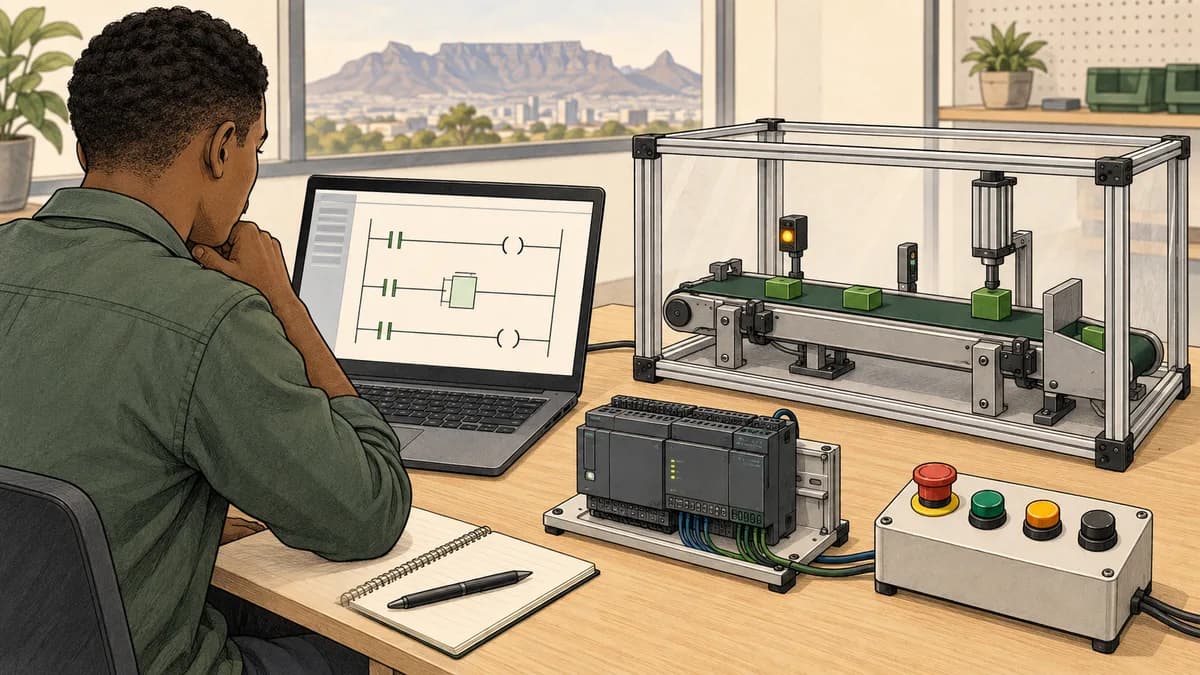
PLC training in the Western Cape should be compared across the province, not only through a Cape Town search. Your route may involve a local engineering programme, a specialist classroom block, employer-arranged training or online preparation. Choose by the skill you need to demonstrate, the actual venue and the individual practical access included.
This guide covers Cape Town, the Boland, the West Coast and the Garden Route. It separates verified institutional information from details that require a current course enquiry. It also includes a fictional packaging-recipe exercise that helps you assess whether a course teaches clear requirements, data validation and change control rather than only a successful demonstration.
Where to enquire across the Western Cape
Cape Town and the metro
Use the Cape Town PLC training guide for a more focused comparison of local course enquiries and practical preparation. When checking a national provider, confirm the teaching venue attached to the actual intake. A company's Cape Town contact address or a regional course heading does not necessarily identify the workshop you will attend.
For a current vendor enquiry, consult Festo South Africa's course catalogue. Ask for the precise course, prerequisites, equipment, available dates and delivery arrangement. Keep a dated response with your comparison sheet rather than assuming that every subject in a national catalogue is scheduled in Cape Town.
If you are comparing introductory courses, ask what you will personally create and test. If you need a specific controller environment, request its family and software version. A broad description such as industrial automation can include several subjects and does not show how much individual PLC work is included.
Boland College: match the programme to the campus
Boland College's programme listing distinguishes campus offerings: electrical infrastructure construction and the electrician route are associated with Strand, while engineering-related design is associated with Worcester. Use the current programme page and campus contact to confirm your intended route and intake.
Do not treat every Boland campus as offering every engineering programme. A learner in Paarl, Stellenbosch, Caledon or Worcester should check the teaching location for the particular course rather than choosing from the institution's general footprint. Also distinguish a formal or occupational programme from a stand-alone PLC short course.
Ask whether the practical syllabus includes controller programming, which equipment is used and how each learner is assessed. If you already have an engineering background and need a short specialist block, explain that objective. A broader study route may be valuable for a different educational goal and should be compared on that basis.
West Coast College
West Coast College's electrical studies page identifies Atlantis, Vredenburg and Vredendal in its published programme information. The page carries older programme details, so request the current route, admissions requirements and campus arrangement before relying on its timetable or entry information.
For PLC-specific learning, ask which current programme contains the relevant practical work and whether a separate short course is available. Do not infer a vendor laboratory from a general electrical studies listing. If you are travelling from another West Coast town, obtain the workshop address and the times of practical sessions as well as ordinary lectures.
South Cape College and the Garden Route
South Cape TVET College's Mossel Bay campus page describes engineering study and electrical and mechanical workshop facilities. This is a regional contact for a broader engineering enquiry. It does not establish a current PLC short-course intake or the controller family used in a particular programme.
For learners based around George, Mossel Bay or other Garden Route towns, compare the actual local programme with any proposed Cape Town training block. Ask for the syllabus, individual equipment access, assessment and complete timetable. A longer journey may be worthwhile for a defined specialist capability, but it should not be assumed necessary before local enquiries are checked.

Build a learning route around your starting skills
A beginner should be able to explain an input, an output, a Boolean condition and a small sequence before moving into a complicated project. Ask how a course develops those concepts and how the instructor checks individual understanding. A copied demonstration that runs once is not the same as a task you can rebuild and explain independently.
An intermediate learner should encounter changes and incomplete information. Ask whether the course includes invalid inputs, a value from the wrong source, a failed test or a revised requirement. Those cases develop reasoning that transfers beyond the exact training rig. They also give an instructor more useful evidence than several screenshots of the normal path.
For a specialist course, obtain the actual prerequisites. Prior experience with one controller family may provide conceptual foundations while leaving you unfamiliar with another engineering environment. The South African PLC course requirements guide helps you prepare a skills inventory that a provider can use for placement advice.
Choose a manufacturer from equipment and role requirements you can verify. The fact that a region contains packaging, agriculture or marine-related activity does not establish a universal controller brand. Record the controller family, engineering software and intended task rather than relying on a claim that one platform produces the highest provincial salary.
Compare online, classroom and employer-group delivery
Online preparation can help you practise logic and organise questions before a practical block when the product fits your device and connectivity. It should be clear what the environment supports and what still requires native software or physical equipment. Ask how you can continue legitimate practice after the course and whether access is time-limited.
A classroom course should identify its equipment, learners per station and individual assessment. Shared work can support discussion, but each learner should know which tasks they will operate and demonstrate alone. Ask how roles rotate and how feedback is given when one person understands a task faster than the other.
Employer-arranged training can focus on a defined learning need, but the scope still needs to be explicit. Specify whether the group needs basic logic, maintenance diagnosis, HMI work or a particular engineering package. Do not assume that an on-site course uses production equipment; confirm the training model and arrangements in advance.
For a provincial comparison, keep each delivery mode in a separate row. Include the actual teaching address, attendance times, software access, practical equipment and assessment. The PLC training pathway helps organise foundation work and the move into more specific practical learning.

A worked exercise: validate a packaging recipe
The fictional model PackStudy prepares an educational packing plan. It does not control a packaging machine or establish product quality. A recipe contains a recipe identity, revision, number of cartons and number of items per carton. Both quantities must be positive integers, and the expected total is their product.
Revision A of recipe SmallRun specifies 12 cartons with eight items per carton. The expected total is 96 items. Revision B specifies ten cartons with ten items per carton, giving 100 items. These are deliberately different plans; a result from one revision should not be assessed against the other's target.
| Recipe record | Cartons | Items per carton | Expected total | Interpretation |
|---|---|---|---|---|
| SmallRun A | 12 | 8 | 96 | Valid recipe |
| SmallRun B | 10 | 10 | 100 | Valid revised recipe |
| SmallRun C | 0 | 8 | Unavailable | Invalid carton quantity |
| SmallRun D | 12 | Missing | Unavailable | Incomplete recipe |
| OtherRun A | 12 | 8 | 96 | Different recipe identity |
The OtherRun row has the same arithmetic as SmallRun A, but it is not the same recipe. If the task asks for evidence about SmallRun, a record from OtherRun cannot be substituted just because the total matches. This is an important distinction between a correct calculation and a correctly identified result.
Separate the plan from observed progress
Suppose a fictional progress record reports nine completed cartons under SmallRun A. If each of those completed cartons is explicitly known to contain the specified eight items, the completed-carton item total is 72. Three cartons remain to reach the planned twelve, corresponding to 24 planned items under the same assumption.
Now remove the evidence about items in each completed carton. You still know that the record reports nine completed cartons, but you cannot independently establish that 72 actual items were packed. The number 72 becomes a plan-based calculation, not a verified item count. Keep those claims separate in the learning record.
A total item count also does not prove the distribution across cartons. Ninety-six items could be distributed incorrectly while still matching the expected total. If the requirement includes exactly eight per carton, the assessment needs evidence about carton-level quantities, not only the overall sum. The counter and batching learning material provides a related foundation for thinking about counts and their meaning.

Test the requirement that a total alone misses
Consider three fictional completed-carton records for a smaller assessment target of three cartons with four items each. Record set X has quantities 4, 4 and 4. Record set Y has 3, 4 and 5. Both sum to twelve, but only X satisfies the per-carton requirement.
A learner who checks only the total would accept Y incorrectly. The assessment needs both conditions: the expected number of carton records and the required quantity in each carton. If carton identities are part of the data contract, they must also be distinct. Repeating one carton record three times should not create evidence of three different cartons.
Now provide two carton records with quantities 4 and 4 and a separate total of twelve. The evidence is incomplete. It does not identify the third carton's contents. Do not infer the missing record from the convenient total unless the exercise explicitly defines a reconciliation rule and the evidence required for it.
This is a useful question to ask a course provider: do learners test the complete requirement or only one convenient indicator? A course need not use packaging to teach the habit. The same distinction appears whenever a summary number can hide errors in the individual records that produced it.
Define how a new revision begins
For PackStudy, select the recipe identity and revision before beginning a run. Keep that selection fixed for the run's assessment. A new recipe revision starts a separately identified run; it does not silently reinterpret cartons already recorded under the previous plan.
If SmallRun A is active and a proposed B recipe arrives, record it as a proposal for a new run under this model's rules. Do not change the target halfway through and then compare the earlier progress with the new plan. This is an educational requirement, not a claim about the default behaviour of any vendor's recipe system.
The sequencer logic patterns guide helps connect a defined state with permitted changes. The HMI tag-binding guide helps distinguish a requested value from the active value represented by a display. Ask how the course makes those distinctions visible in its practical exercises.
Expected assessment cases and evidence
| Case | Supplied evidence | Expected conclusion |
|---|---|---|
| K1 | SmallRun A, 12 by 8 | Planned total 96 |
| K2 | SmallRun B, 10 by 10 | Planned total 100 |
| K3 | Zero or missing recipe quantity | Recipe invalid or incomplete |
| K4 | OtherRun with matching quantities | Arithmetic matches, identity differs |
| K5 | Three cartons containing 4, 4, 4 | Per-carton and total requirements satisfied |
| K6 | Three cartons containing 3, 4, 5 | Total matches; per-carton requirement fails |
| K7 | Two carton records and a convenient total | Carton-level evidence incomplete |
| K8 | Proposed new revision during a run | Preserve active revision; separate new-run proposal |
Ask the learner to explain K6 and K7 without looking at a worked answer. Then change the carton count and target quantity. A learner who understands the requirement should be able to adapt the checks. Memorising 96 or twelve from this fixture is not the objective.
If you implement the exercise, record the project name, revision, environment and actual observations. Keep expected results separate from test results. A paper calculation can demonstrate the arithmetic, while a simulator implementation can demonstrate behaviour in its own environment. Neither should be presented as a validated production packaging system.

Use practice to prepare for the right course
Keep a short portfolio record with the requirement, assumptions, recipe data and failed cases. Include the distinction between a planned total and observed carton-level evidence. That gives an instructor a useful view of your current reasoning and identifies the next skill to practise.
For structured foundation work, explore the PLC simulation curriculum. Select current lessons and exercises that fit your starting level. Where your objective includes a particular native engineering package or physical controller task, arrange suitable practical access as part of the wider plan.
The PLC program testing guide is a useful follow-on for organising complete requirements, invalid inputs and checks after a change. Use the product's published capabilities to decide whether it fits your needs. Educational practice does not automatically establish native project compatibility or a recognised occupational qualification.
If you are interested in production-related learning, the food and beverage automation guide develops relevant course questions. Keep the educational examples separate from claims about a real facility's equipment, quality procedures or recruitment requirements.
Calculate the complete provincial training commitment
Ask for a dated quotation tied to the exact course and delivery arrangement. Check tuition, tax, materials, software access, assessment and any reassessment charge. If you need a laptop, confirm the supported environment and installation process. Find out what access remains afterwards so that follow-up work is feasible.
Calculate travel from your own town to the confirmed venue. A learner based in Worcester, Vredendal, George or Cape Town can face very different transport and accommodation needs. Do not apply one provincial commute or assume that a five-day course always requires the same number of nights away. Use the actual timetable and your travel arrangements.
Compare the South African PLC course cost categories alongside the practical outcomes. A lower tuition fee can still produce a larger total commitment if travel is substantial. Conversely, a regional course with the exact equipment you need may justify that commitment. The useful comparison is the capability gained for the complete cost and time involved.
For employers or colleges planning a group, define the learning outcome and starting levels first. The training-centre planning guide helps frame a pilot with individual assessment, feedback and support. A province-wide group may need different practical arrangements from learners based near one training venue.
Questions about PLC training in the Western Cape
Is all useful engineering training concentrated in Cape Town?
There are regional study contacts beyond the metro, including Boland, West Coast and South Cape colleges. Confirm the programme and practical content relevant to your goal. A regional engineering offering is not automatically a PLC short course, but it should be investigated before assuming that every useful route requires a Cape Town booking.
Can I find PLC-related study in the Boland or on the West Coast?
Start with the programme-specific campus contacts above. Ask which current route includes controller work, what equipment is used and whether a stand-alone short course is available. Do not infer the same offering at every campus of an institution.
Which brand is best for Western Cape packaging work?
Use the equipment and role requirements you can verify. A provincial sector description does not establish one controller brand across every production line. Build foundation logic and diagnostic skills, then choose specialist training from actual syllabi and the environment you intend to use.
Can online study reduce the need to travel?
It can help with foundation practice when the product fits your device and connectivity. Identify which native software or equipment tasks still require practical access. Use online preparation to make a later practical block more focused, rather than assuming either format covers every learning objective.
What should a useful practical portfolio show?
Show the requirement, assumptions, model identity, revision, expected cases and actual observations. Include a failed or incomplete case and explain its meaning. The recipe exercise on this page demonstrates why an overall total can match while a more specific requirement still fails.
How should I ask an AI assistant to compare regional courses?
Provide dated syllabi, your starting skills, town, travel constraints and target task. Ask it to identify missing equipment and assessment details and distinguish confirmed intakes from historical information. Verify its recommendation against current provider responses before paying or arranging travel.

Make a shortlist that fits your location and objective
Choose a few relevant enquiries and send each the same description of your background and intended skill. Request the current syllabus, teaching venue, prerequisites, individual practical access, assessment and complete quotation. Compare the responses against the capability you want to demonstrate. That creates a clear next step across a varied province without relying on unsupported salary or brand promises.