learn-plc-at-home · South Africa
PLC Programming for Beginners: Learn at Home
PLC programming for beginners: follow a flexible home-study plan, practise Boolean logic and test your results before choosing further courses or hardware.
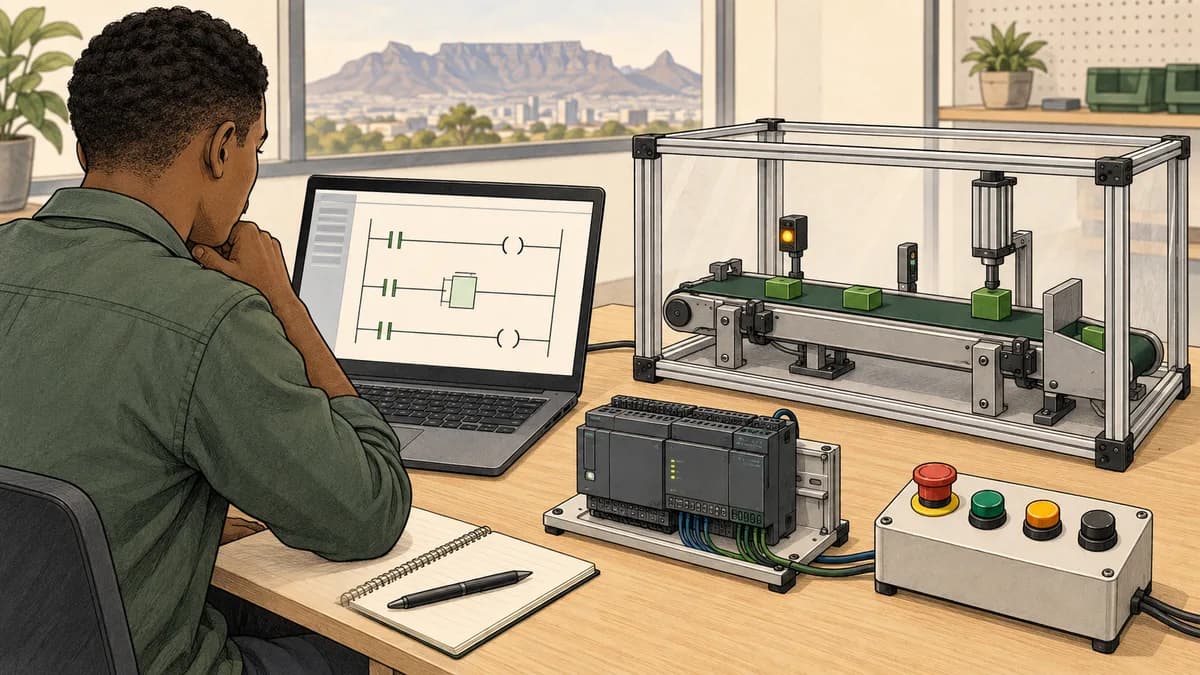
PLC programming for beginners can start at home with a small requirement, a predicted result and a software exercise. You do not need to buy a controller to begin learning Boolean logic, variables or simple state changes. You do need to know what your learning environment actually supports and what its results do not establish about physical equipment.
This guide gives you a 30-session plan that you can spread across a month or a longer period. The session numbers organise the work; they are not a promise of fluency, employment or independent workplace competence after 30 days. Repeat a stage when its review task is still difficult.
This website is commercially connected to PLC Simulator. The PLC Simulator curriculum is one independent practice option. We benefit if you subscribe, so compare its actual features and access terms with the alternatives and your learning objective.
What you can learn at home without a PLC
Start with reading and writing simple requirements. A sentence such as “show the practice indicator when exactly one choice is selected” can become a truth table, a Boolean expression and a testable exercise. The worked example below follows that path.
Software practice can also introduce state, counters, timers and sequences, provided you use supported instructions and clearly stated assumptions. It can help you explain why a value changed. It does not automatically demonstrate physical wiring, instrument use, equipment response or the behaviour of another controller platform.
CODESYS, for example, documents simulation mode for testing without a physical target. That illustrates a hardware-free learning route, not universal equivalence between simulation and an installation. Our CODESYS training guide explains the difference between its development environment, simulation and runtime choices.
The official IEC 61131-3:2025 description identifies Structured Text, Ladder Diagram and Function Block Diagram, with SFC elements for program organisation. It provides standards context for the language names you will encounter. A reference to that standard does not prove that a particular learning tool supports every feature.
Choose a learning setup before spending money
For the first exercises, choose an environment that lets you enter the required logic, change inputs and observe outputs. Check whether saving, feedback and the lessons you want are included in the access level you intend to use. Avoid buying a subscription solely because a tutorial assumes features you have not verified.
AutomationDirect publishes free online PLC training. It is a useful official starting point for comparing another learning route. Check the platform, software and equipment used in individual lessons rather than assuming every video exercise is ready to run in any browser simulator.
A physical kit can be appropriate when your objective includes its particular hardware and you have suitable instruction and a safe setting. It is not a prerequisite for drawing a truth table. Our PLC training kit versus simulator comparison helps frame the different learning outcomes; this page does not invent a typical kit price or claim that everyone who buys one wastes their money.
For a browser option, try the PLC Simulator scan-cycle highlighting feature when learning to follow evaluation. Confirm how it behaves on your device before making it central to your study plan. A working browser tab does not establish that every exercise is available offline.

Prepare a simple learning notebook
Give each exercise a title and version. Write the requirement in ordinary language, define the inputs and outputs, and record the expected results before running it. Keep a short note of the software or simulator used and any help you received.
After testing, separate what you observed from what you inferred. “The indicator was off when both choices were selected” is an observation. “The whole program is correct” is a much larger conclusion. For a small Boolean exercise, you can support a complete result by testing every input combination; for a larger application, you need a more deliberate test plan.
End each session with a next action. It might be “repeat the simultaneous-input case” or “check why the displayed value differs from the watched variable.” That note makes it easier to resume after a missed evening without guessing where you stopped.
Sessions 1–7: inputs, Boolean logic and prediction
In sessions one and two, learn what a Boolean value means and distinguish a variable from the physical device it might represent in an industrial application. Use two fictional inputs with meaningful names. Practise reading true and false values without assuming that a software contact symbol describes the construction of a real switch.
In sessions three and four, compare AND and OR using all four input combinations. Predict the result before changing the inputs. Read the ladder logic basics guide for a related introduction, then explain one expression in your own words.
Use sessions five and six for the exactly-one-choice exercise below. It adds NOT and requires you to consider simultaneous inputs. Session seven is a review: reproduce the truth table without looking at the answer, explain how the expression matches the requirement and identify one test that would catch an OR-only mistake.
Do not measure this stage by how quickly you can drag symbols onto a canvas. The review evidence is whether you can explain all combinations. If both-inputs-active still causes confusion, repeat the small exercise before adding memory and timers.
Worked beginner exercise: exactly one choice
Imagine a fictional study page with two selectable practice topics, A and B. A green indicator should appear when exactly one topic is selected. It should stay off when neither is selected or when both are selected. This is a software learning display, not a selector for machinery or a safety function.
The inputs are ChoiceA and ChoiceB. The output is ExactlyOne. Both inputs are Boolean. The model has no memory: each result depends only on the current pair of inputs. There is no timer, edge detector or hidden starting state.
Turn the sentence into a truth table
| Choice A | Choice B | Exactly one | Explanation |
|---|---|---|---|
| 0 | 0 | 0 | No topic selected |
| 0 | 1 | 1 | Only B selected |
| 1 | 0 | 1 | Only A selected |
| 1 | 1 | 0 | Both selected, so the requirement is not met |
The final row is the one that distinguishes “exactly one” from “at least one.” Ordinary OR is true when either input or both inputs are true. It therefore does not meet this requirement on its own.
Describe the two accepted situations separately: A is true while B is false, or B is true while A is false. Then combine them:
ExactlyOne = (ChoiceA AND NOT ChoiceB)
             OR (ChoiceB AND NOT ChoiceA)
This is an illustrative Boolean expression, not a downloadable project for a named PLC. It is commonly described as exclusive OR. The expanded expression makes the accepted situations visible without requiring a particular simulator's XOR instruction.

Map the expression to a learning diagram
If your ladder environment supports the needed Boolean tests, represent the two accepted situations as alternative paths to the result. Each path must require one choice to be true and the other false. Follow the environment's own instructions for entering and observing those tests.
Explain each path before testing. The first path accepts A alone; the second accepts B alone. When both inputs are true, each path contains a condition that fails. When neither is true, neither path has its required selected choice. These explanations should match the four table rows.
Do not infer that a test for a false bit means a physical normally closed switch is wired in a particular way. This example contains no physical switch. Separating software conditions from hardware construction is a useful habit before moving to equipment training.
Test a sequence as well as isolated rows
Apply the input pairs in this order: 00, 10, 11, 01, 00, 11, 10. The expected output sequence is 0, 1, 0, 1, 0, 0, 1. Each pair describes one evaluation of the fictional model, not a measured interval.
The repeated 11 case is useful because it appears after different histories. Since this model has no memory, both occurrences must produce the same result. If the second occurrence behaves differently, check for unintended stored state or a mismatch between the variable being calculated and the one being observed.
Keep your observations next to the prediction. If they differ, record the specific pair and output. A precise note such as “11 produced 1” gives you a concrete question to investigate. “The simulator is wrong” does not identify what needs checking.
Introduce one controlled mistake
In a separate copy of the learning exercise, replace the expression with ChoiceA OR ChoiceB. Repeat all four combinations. Three results match the intended table, but 11 incorrectly produces 1. This shows why a few successful clicks do not establish that the requirement is implemented.
Restore the original expression and repeat the failed case, then the complete table. Record the change and the results. The lesson is test selection: choose an input where the correct and incorrect expressions predict different outcomes.
You can extend the exercise by adding a second display labelled “at least one.” Keep its OR result separate from ExactlyOne and compare both displays for the same inputs. Do not silently change the original indicator's meaning to accommodate the new requirement.
Sessions 8–14: memory, events and timing
In sessions eight and nine, compare a result that depends only on current inputs with one that also depends on previous state. Write the initial state explicitly. Use fictional display or study-record examples before interpreting stored state as a command to physical equipment.
Sessions ten and eleven introduce counting. Decide whether you are counting evaluations with an input true or transitions from false to true; those are different rules. The timers and counters guide provides a related reading route, while your chosen environment's documentation determines the actual instruction behaviour.
Use sessions twelve and thirteen to study a timer example with explicit units and reset behaviour. Record what happens before, at and after the chosen threshold. Distinguish elapsed time supplied by a learning model from a measured physical interval, and do not assume all vendors implement every timer option identically.
Session fourteen is a review. Explain the initial state, triggering condition, reset rule and expected boundary cases for one exercise. If you cannot explain why a held input changes a counter or timer, reduce the example until the relevant behaviour is visible.

Sessions 15–21: sequences and readable structure
Begin with three fictional study stages, such as Ready, Working and Finished. Define the allowed transitions in words before programming. Decide which event moves to the next stage and what a reset does. Keep this as a learning sequence, not a claim that the same design controls a real process safely.
In sessions fifteen to seventeen, draw a state table and test one transition at a time. Include the initial state and an input that should leave the state unchanged. In sessions eighteen and nineteen, test simultaneous requests and specify which rule has priority. The specification should settle the result before you implement it.
For sessions twenty and twenty-one, improve names and comments, then ask another person to explain your sequence from the requirement and test record. If they need an unwritten assumption, add it. Our PLC programming examples guide is a route to further exercises once you can review a small sequence clearly.
A useful checkpoint is being able to say where state is stored and when it changes. A collection of changing indicators is not enough. Record which transitions were tested and which features, such as persistence after restart, remain outside the exercise.
Sessions 22–30: diagnosis, revision and a final review
Sessions twenty-two to twenty-four focus on an observed discrepancy. Use a saved learning copy and change one expression or variable connection. Write down the defect before asking another learner to investigate, so their explanation can later be compared with the known change.
If you study alone, use the OR-only variant from the worked example. Compare its predictions with the intended truth table and identify the distinguishing case. You do not need to pretend you have forgotten the change; explaining why a test detects it is still useful practice.
In sessions twenty-five to twenty-seven, combine two small learning ideas, such as a state indicator and a count of fictional completions. Keep the requirements separate enough to test individually. Avoid adding features merely to make the diagram look more advanced.
Sessions twenty-eight to thirty are for review and documentation. Reopen the saved project, reproduce the tests, record any differences and write a short account of what you can now explain. Use the PLC technician training guide to see how diagnostic evidence can be developed further with appropriate instruction.
Your final result is a portfolio of learning evidence, not a declaration that you are ready to work independently on an installation. Identify the next missing skill and choose the relevant course or supervised practice from that point.
A realistic home-study budget
Keep the first budget tied to specific access requirements. If a free resource supports your current exercise, you can use it before deciding whether a paid feature is useful. Check whether the next lesson, saving facility or feedback tool you want is included; this guide does not claim that every linked exercise is free.
At this review, PLC Simulator's canonical pricing lists Basic at USD12 monthly or USD99 annually, and Pro at USD29 monthly or USD249 annually. Annual prices are annual charges, not the monthly subscription price. Check the current product pricing before purchasing and confirm the features included in the plan you select.
This page does not convert those amounts into a fixed rand promise. Exchange rates, payment-provider charges and the checkout total can affect what you pay. Also budget for connectivity and any computer or software requirements associated with a different learning route.
For classroom or hardware options, request a current itemised quotation. Use the South African PLC course price guide to compare tuition, practical access, assessment and travel. A software subscription and a supervised equipment course are different purchases with different outcomes.

Study around South African connectivity and power constraints
Plan for your actual circumstances rather than assuming uninterrupted access. A charged laptop can keep running for a period, but a browser-based service may still require working connectivity, authentication and access to its servers. Do not assume an open page guarantees that saving or the next exercise will work during an outage.
Keep a paper or locally stored copy of your own requirement and truth table. If online access is unavailable, you can predict results, compare expressions and write the next test without claiming to run the simulator offline. Resume execution and saving when the required services are available.
For learners in Johannesburg, Cape Town, Durban or smaller towns, the same planning question applies: what can you reliably access at the time you intend to study? Test the actual setup, including the device and connection, before paying for a course whose live attendance requirements depend on it.
If shifts or family responsibilities interrupt a session, preserve the next action and resume from there. The 30-session structure is flexible. Finishing a numbered schedule matters less than understanding and reproducing the result at each checkpoint.
When to add an instructor or physical equipment
Ask for help when you cannot distinguish the requirement from the implementation, when repeated observations remain unexplained or when your next objective involves hardware-specific behaviour. An instructor can review your reasoning and identify a prerequisite you have missed.
Bring a small project, the expected result and the exact case that failed. Include the environment and version. This makes feedback more focused than sending a large unexplained program. Do not share employer source code, credentials or drawings without permission; use your own learning example where possible.
Physical wiring, measurement and equipment work require an appropriate setting and supervision. A single short workshop is not a universal substitute for all practical development. Compare the task you want to learn with the provider's stated outcomes and assessment. The South African PLC training guide helps organise that next decision.
Questions beginners ask about learning PLC programming at home
Can I start with no programming experience?
Yes, you can begin with simple Boolean requirements and truth tables. Choose introductory material and check its prerequisites. If the notation feels unfamiliar, work through one small expression at a time and explain it in ordinary language before adding more features.
Can I learn PLC programming in 30 days?
You can use 30 days as a study schedule, but progress depends on your starting point, practice and feedback. This plan uses review checkpoints instead of promising fluency by a date. It does not establish workplace competence or replace requirements for a separate qualification.
Do I need to buy a PLC immediately?
No controller is needed for the paper and software logic exercises here. Hardware becomes relevant when your objective includes its configuration or physical behaviour. Choose it from an actual learning requirement and suitable instruction, rather than assuming either that everyone needs a kit immediately or that hardware never adds value.
Is every simulator the same as a real PLC?
No. Check supported instructions, timing, state and target behaviour. A learning model can demonstrate an expression without reproducing a physical controller's I/O, communications or execution environment. Record which tool produced your evidence and avoid claiming compatibility that has not been tested.
Can I learn on a phone or tablet?
Reading and note-taking may be practical, but editing and inspecting a program depend on the tool and device. Try the actual exercise before committing to that setup. A larger screen and suitable input method may make diagrams easier to review; this page does not guarantee every feature on every browser.
Will a home-learning portfolio help me apply for training or work?
It can show what you have practised and how you explain a result. Include requirements, tests and honest limits. It does not guarantee admission, a job or recognition by a qualification body. Ask the relevant provider or employer what evidence they assess.

Your first session
Write the exactly-one-choice requirement, fill in its four-row truth table and explain why ordinary OR fails one case. Then implement the supported expression in your chosen learning environment and compare each observation with the prediction.
Save the result with a version note and one next action. That is a concrete start to PLC programming at home: a small requirement you understand, a result you can reproduce and a clear direction for the next session.