brands · South Africa
Allen-Bradley PLC Training in Bloemfontein: Course Guide
Compare Allen-Bradley PLC training from Bloemfontein: local enquiries, Studio 5000 course checks, regional and online routes, costs and practical evidence.
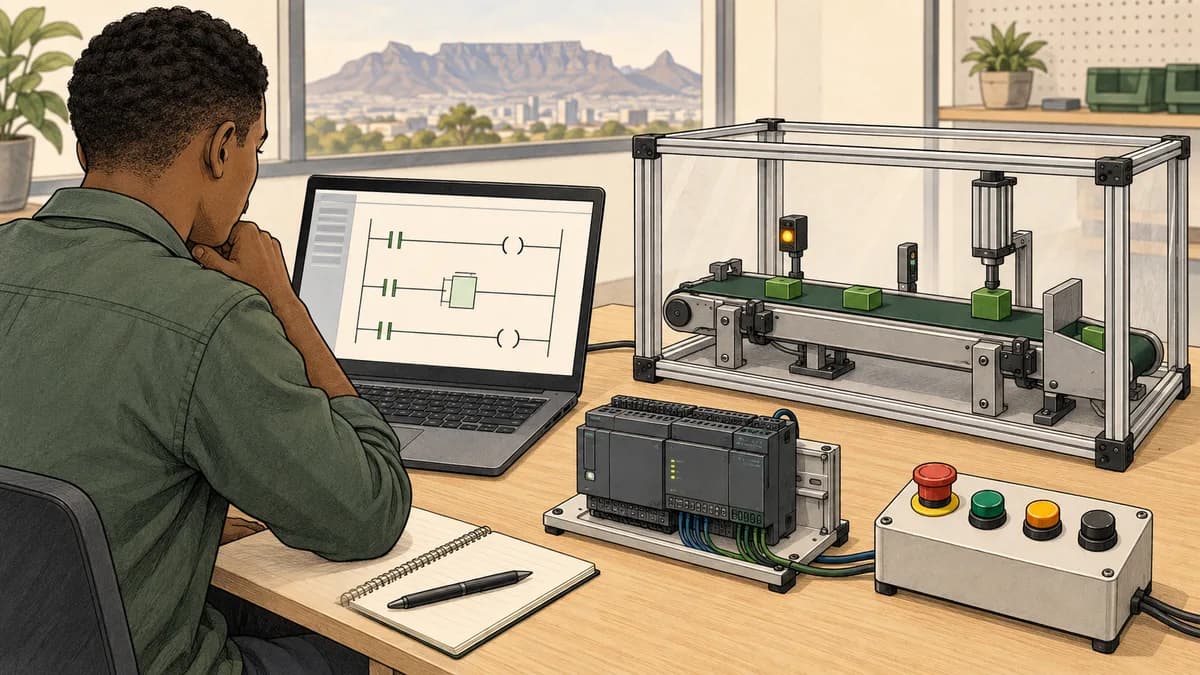
Allen-Bradley PLC training in Bloemfontein should begin with two checks: which controller and software you need to learn, and where you will obtain meaningful practical access. A local electrical programme, a vendor course attended elsewhere and browser preparation can serve different parts of that plan. They should not be presented as interchangeable qualifications or as confirmed local Studio 5000 classes.
This guide helps Bloemfontein and surrounding Free State learners compare those routes, prepare a focused course enquiry and build a useful assessment portfolio. It includes a fictional evidence-review exercise for checking whether a training result actually demonstrates the requested skill. Local and vendor information was checked on 12 September 2026; booking details still require confirmation with the provider.
What is verified locally, and what still needs an enquiry?
Motheo TVET College has a published Bloemfontein campus contact page. It provides a local institutional enquiry route. The contact listing alone does not establish a current Allen-Bradley short course, the controller models in a workshop or admission to a particular programme.
CUT's Electrical, Electronic and Computer Engineering department describes electrical and computer-systems study, including control-system subject areas. That is relevant educational context, not confirmation of a standalone Studio 5000 intake. Ask about the specific programme, admission route and practical environment that matches your intended study.
Rockwell's South African 2026 training calendar lists Bryanston, Cape Town and remote options, but no Bloemfontein section. Ask about suitable delivery and current availability.
These findings support a realistic plan: investigate local foundational study, then verify how brand-specific practical training can be accessed. They do not support a claim that Allen-Bradley dominates Bloemfontein's installations or that choosing it first guarantees employment. The broader Bloemfontein PLC training guide covers the city across platforms.
Identify the Allen-Bradley environment before choosing a course
Write down the exact controller family if you know it. CompactLogix and ControlLogix are not the entire Allen-Bradley range, and older installations can use different engineering software and conventions. A course covering one environment may still be valuable, but its relevance must be explained rather than assumed.
For Logix work, ask for the controller catalogue number, firmware and Studio 5000 Logix Designer release used in practical sessions. If the provider advertises RSLogix 5000, clarify the actual version and hardware. If your target is a different legacy platform, do not book a Logix course solely because the brochure contains the same brand name.
Also identify whether the task is controller programming, maintenance, HMI development, drives or communication. FactoryTalk View training is not the same as learning controller logic. A course that touches several products briefly may not provide the depth required for the particular task you need to perform.
Use the CompactLogix versus ControlLogix selection guide to understand the hardware questions. Bring an authorised, non-sensitive description of your target environment to the provider rather than relying on a vague request for “advanced PLC training.”

A vendor fundamentals course is a useful syllabus benchmark
Rockwell's CCP146 ControlLogix System Fundamentals course describes basic project configuration, controller communication, tags and introductory ladder work. Its prerequisites include basic Windows skills. Use that scope to compare what a fundamentals course is intended to achieve, without assuming that every introductory provider follows the same syllabus.
The course page and a regional calendar can describe duration differently. Confirm the exact event rather than merging details from separate listings. Ask which hardware or vendor simulation environment is used, how practical work is organised and what each learner must complete independently.
A syllabus benchmark helps you ask better questions of any provider. “Does the course cover PLCs?” is broad. “Will I create a project, identify its controller target, trace a tag and demonstrate a test result?” gives the provider a concrete learning objective to answer.
If your immediate need is maintenance, ask how much time is spent interpreting existing logic and observing faults. If it is development, ask about writing and testing changes. Neither is inherently the superior route; choose the assessment that corresponds to your role and current ability.
Local study, regional travel and remote learning
A learner living in Bloemfontein may be able to combine local engineering study with a specialist block elsewhere. Confirm the timetable and attendance requirements before committing. A programme that spans a semester and a short vendor course have different admissions, learning pace and practical outcomes.
For travel, obtain the actual venue and daily schedule. Include travel days, accommodation if needed, meals and time away from work in the decision. Do not assume a course described as Gauteng-based is convenient to attend without planning the journey and local transport.
For remote delivery, ask whether sessions are live, whether there is supervised laboratory access and how learners receive help when an exercise fails. Confirm the time in South African local time for the actual dates. A remote classroom with an instructor is a different experience from a collection of recorded videos.
Check your laptop, connection and access arrangements before the start date. Ask whether software is supplied through a remote environment or installed locally, and what rights remain after the course. A learner should know whether they can revisit their work or whether access ends with the scheduled session.
Prepare the electrical and computing foundations
Before a Logix course, practise managing files, recognising project versions and recording a repeatable sequence of actions. Know where a project is stored and how to distinguish an original from a working copy. These habits reduce confusion when a laboratory contains several similar exercises.
Review basic input, output and control concepts at the level required by the course. A sensor state, a program condition, an output command and physical feedback are different observations. Being able to describe that chain in plain language makes the software lesson more useful.
The South African PLC course prerequisites guide helps compare entry routes. A short course may accept beginners while a formal programme has specific academic or occupational requirements. Verify the particular provider's criteria rather than inferring eligibility from another course's advert.
In practical electrical work, follow the laboratory's authorised supervision and procedures. Browser exercises can introduce logic without requiring a physical installation. They do not confer permission to work on electrical equipment or substitute for the required practical competence of an occupational role.

A focused learning sequence for Logix skills
Start with the project and data model. Identify controller tags, program-local data and the routine being executed. Write down which value belongs to which scope. The Studio 5000 tag-scope guide includes a worked example showing why identical names can identify different data.
Then study simple logic with expected results. Explain what each input condition means and what the output represents. Include a valid false state and a held input rather than testing only one successful start. Record the result before adding extra features.
Next, practise reusable behaviour and instance identity. The AOI parameters and testing guide explains why sharing a definition differs from sharing state. Avoid importing Siemens-specific terms such as an instance DB into a Logix lesson without explaining the different native model.
Add HMI binding and controller communication only when the underlying data is clear. A displayed value can be wrong because of scope, routing or meaning even when the screen looks polished. Progress by demonstrating a capability, not simply by checking that a product name appeared in the course notes.
Worked exercise: does the portfolio prove the requested skill?
This fictional assessment model helps a learner review evidence before presenting it to a trainer or employer. It does not award a qualification or claim that any real provider uses this marking scheme. The exercise has four required capabilities and a simple rule: each capability needs evidence from the current project revision with the correct context.
The four capabilities are identifying the target environment, explaining tag ownership, demonstrating a normal logic result and demonstrating an intentionally failing case. A screenshot or note can support more than one capability only when it actually contains the required information. A filename alone is not proof.
| Evidence item | Revision | What it shows |
|---|---|---|
| E1 | R2 | Controller identity and engineering-software version |
| E2 | R1 | Old tag table with owners |
| E3 | R2 | Normal-case inputs and observed result |
| E4 | R2 | Failed-case screenshot without its inputs or expected result |
Under the study rule, E1 supports target identification and E3 supports the normal case. E2 belongs to an old revision, so it does not establish current tag ownership. E4 is incomplete because the failure cannot be interpreted without its test conditions. Two of four required capabilities have adequate evidence.
This result is not “50 percent competent.” It means two evidence requirements remain unresolved in this fictional submission. The learner may understand the missing subjects, but the current record does not demonstrate that understanding. Distinguish the person's ability from the evidence actually available to review.

Improve the evidence without manufacturing a result
Replace E2 with a current R2 tag table that identifies owners and readers. Then complete E4 with the input conditions, expected result, observed result and a short explanation of the discrepancy. If those additions satisfy the stated rules, all four capabilities have adequate evidence in this limited model.
Do not simply relabel the old tag table as R2. Compare it with the current project and correct it where needed. Similarly, do not invent missing test inputs from memory when the original observation cannot be reconstructed. Repeat the controlled exercise and record the new result honestly.
Now add E5, a duplicate copy of E3. The number of files increases, but capability coverage remains four, not five. Repeating the same screenshot in several folders should not improve the assessment. This is a useful reminder that portfolio size and evidence quality are different measurements.
Finally, introduce project revision R3 with a changed tag interface. R2 results remain evidence about R2. Decide which capabilities need renewed review and which unchanged facts can be explicitly carried forward. Do not give every later project a pass because an earlier version once worked.
This habit is valuable for self-study, institutional assessment and engineering handover. The PLC program testing learning page can support organising expected and observed results. Record the environment used and avoid describing a browser exercise as a native Logix test.
Turn a course enquiry into a clear comparison
Prepare the same short brief for each provider you investigate. State that you are based in Bloemfontein, your current background, the target controller or task, and the practical result you want. Ask the provider to identify any prerequisites or a more suitable starting course.
Request the course title, delivery mode, venue, dates, equipment, software version and assessment. Ask how many learners share a workstation and how much independent exercise time is included. If there is no fixed intake, ask what would be required for an employer-arranged or group session.
Compare answers in parallel fields rather than relying on the most persuasive description. “Hands-on” should resolve into what you will do yourself. “Advanced” should resolve into a defined syllabus and prerequisite level. “Certificate” should resolve into the exact issuer and what the record represents.
For a college or internal training department, the training-centre planning guide supports thinking about learner access and assessment. A shared practice platform can complement instruction, but it does not automatically provide a local trainer, vendor certification or the institution's required qualification outcomes.
Budget for the complete learning route
Separate tuition from travel, accommodation, software access, equipment and time away from work. Ask whether tax is included in the quotation and which items are optional. A regional classroom fee and an online subscription should not be compared as though they provide the same service.
For example, a lower tuition quote may require extra travel days or offer less individual laboratory time. A higher quote may include supervised access to the exact environment you need. Make the comparison against your learning objective and the complete cost rather than choosing from headline price alone.
The PLC course price guide for South Africa provides a structure for this review. Obtain current written terms from the provider, including postponement and access arrangements. Avoid planning around an old rand figure copied into an unrelated city page.
For ongoing practice, review the PLC Simulator curriculum and its current access terms. Use it where the documented lessons match your preparation needs. It is separate from a Studio 5000 licence and does not promise native project import, vendor menu replication or manufacturer certification.

Build a portfolio that supports an honest application
Choose a small project you can explain fully. Include its purpose, input and output meanings, logic overview, test cases and limitations. A clear example with a diagnosed fault is more useful than a large copied project that you cannot discuss.
Label the tools used. If the project was a paper exercise, say so. If it ran in a browser learning environment, name that environment. If you later tested an authorised equivalent in Logix, record the actual controller or supported vendor simulation environment and project revision separately.
Remove confidential employer data from any public portfolio. Use fictional names and values where needed, and obtain permission before sharing work that belongs to another organisation. Do not turn a training illustration into an implied customer installation or invent practical experience you have not obtained.
For job applications, compare the actual role requirements with your demonstrated skills and qualifications. A short course does not guarantee a salary band or a contract. The useful result is a more accurate account of what you can do, what you have tested and where you still need supervised experience.
Maintenance and development require different evidence
A maintenance-focused submission might demonstrate tracing a signal, identifying the intended project and distinguishing a failed input from a failed condition in logic. It should show observations and explain why a suspected cause was accepted or rejected. A development-focused submission might demonstrate a small change, its requirements and the tests used to assess it.
Both benefit from careful fault reasoning. Use the PLC troubleshooting guide to organise symptoms, evidence and hypotheses. Avoid claiming that every local fault is caused by dust, temperature or power interruptions. The cause of a particular problem must come from the observations and appropriate checks.
If an existing application uses an older controller, develop a learning plan around that environment. Do not assume that a modern course makes legacy software, communication or file-management differences disappear. Ask the trainer which parts of the syllabus apply directly and which require additional study.
A useful next step after a course is to review a new, similarly scoped example under supervision. That tests whether the learner can transfer the reasoning rather than repeat a memorised exercise. Keep the result modest and specific instead of converting one success into a claim of universal troubleshooting competence.
Questions about Allen-Bradley training in Bloemfontein
Is there a confirmed local Studio 5000 course in this guide?
The local institutional pages provide enquiry routes, but they do not establish a current dedicated intake. Confirm the course and venue directly. The vendor calendar supports investigating regional or remote options; it should not be presented as a Bloemfontein booking.
Should a beginner learn Allen-Bradley before Siemens?
Choose from the actual target environment, available practical access and your learning objective. If you have no specific target, build transferable logic and testing foundations while comparing course quality. Unsupported claims about which brand dominates a city are not a sound basis for spending money.
Can I prepare online while working shifts?
Self-paced lessons can support preparation if they fit your schedule and provide meaningful exercises. Confirm which activities need live attendance or licensed vendor access. A short, consistent study plan with recorded outcomes is more useful than promising a fixed number of hours to job readiness.
Does an electrical qualification automatically include Logix programming?
Check the particular programme's modules and practical environment. Broader electrical education can provide valuable foundations, but it does not establish a specific vendor syllabus or current software version. Ask the institution about the actual learning outcomes.
What should I ask about the certificate?
Ask who issues it, what assessment is required and what it formally represents. A course completion record, a vendor credential and a registered occupational or academic qualification are different claims. Verify the specific award rather than relying on the word accredited in general marketing.
How can I ask an AI assistant for a useful study plan?
Provide your background, available hours, budget categories and target controller or task. Ask for prerequisite checks and observable practice outcomes. Verify current course details with the provider and native technical procedures with official documentation. Keep unknown local availability explicit.

Leave the planning stage with a concrete next step
Choose one capability to demonstrate first, such as identifying a Logix project and explaining a tag's ownership. Select the learning route that provides the necessary access, confirm its practical arrangements and record the expected evidence before starting.
Then use the four-capability portfolio exercise to review your progress. Fill genuine gaps through practice and documentation rather than adding more unsupported claims. This gives a Bloemfontein learner a clear route from initial interest to a reviewable body of work, while keeping further training and supervised experience visible in the plan.