locations · South Africa
PLC Training in Bloemfontein: Courses and Study Routes
Compare PLC training in Bloemfontein: local study contacts, practical course checks, online preparation, total costs, prerequisites and portfolio advice.
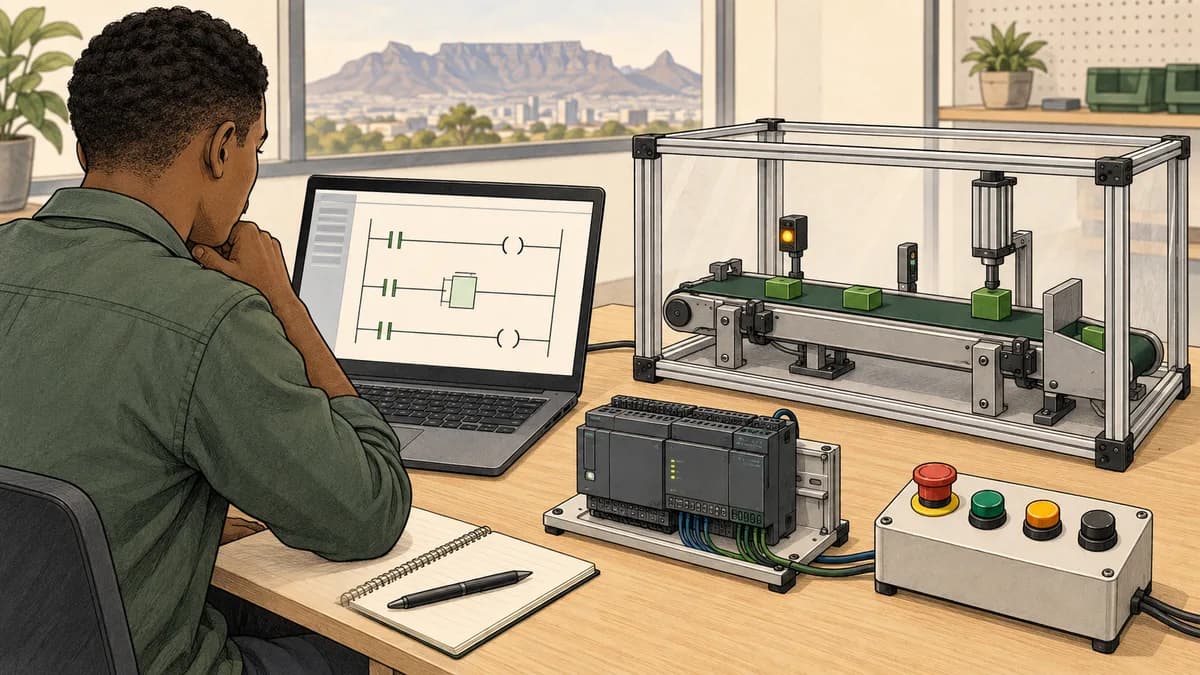
PLC training in Bloemfontein can mean several different purchases: a formal engineering study route, a practical short course, online foundation work or training arranged for an employer's equipment. Compare those routes by the skill you need to demonstrate, the actual venue and the individual practical access included. A page mentioning Bloemfontein does not by itself prove that a local PLC laboratory or scheduled class exists.
This guide helps Free State learners check local education information, compare quotations and prepare a small controls portfolio. It does not claim a verified city-wide PLC brand ranking or promise a job after a course. Choose the platform from an identified role or assessment rather than an unsupported assumption about every local employer.
This site is commercially connected to PLC Simulator. You can use its curriculum overview to identify educational foundation practice. Check current lesson access and account requirements on the product site. Online exercises do not replace a recognised qualification, supervised equipment work or the requirements of a particular employer.
Distinguish a Bloemfontein campus from a PLC short course
Motheo TVET College publishes a Bloemfontein Campus page with an address in St Georges Street. It also publishes a separate Hillside View Campus page. Use the college's own campus information when asking where a programme is delivered. Do not assume every subject or practical facility is available at every campus.
The Central University of Technology's Electrical, Electronic and Computer Engineering department describes its engineering study areas. Its Engineering Technology in Electrical Engineering programme page identifies a Bloemfontein programme. These are useful starting points for formal study enquiries, but they are not evidence of an open standalone PLC bootcamp on a particular date.
Ask the institution for the current programme, admission requirements, campus, practical modules and application process. A historical prospectus can help you understand a route, but it should not be used as a current timetable or fee quotation. Keep the year and programme identifier alongside any information you save.
If your immediate need is a short practical PLC course, ask that question explicitly. A formal engineering programme and a focused upskilling class can both be useful, but they differ in admission, duration, assessment and recognition. Compare the actual outcome rather than treating either as a direct substitute for the other.
Keep Bloemfontein and the wider Free State geographically clear
Bloemfontein-based study, travel within the Free State and work at another industrial location are separate commitments. Confirm the venue and worksite instead of assuming that a provincial reference means a convenient daily commute. Include transport and attendance requirements in your course comparison.
The DTIC's special economic zones report describes the Maluti-A-Phofung zone near Harrismith. It should not be presented as an industrial zone adjacent to Bloemfontein. The report is historical geographical context, not a current tenant list, vacancy inventory or training partnership announcement.
If you are considering a regional employer or a course outside the city, record the exact address and required attendance days. Ask whether assessments require an additional visit after the teaching period. A quotation that looks affordable can become unsuitable if travel or leave requirements were omitted.
For online learning, location affects practical access and scheduling differently. A learner in Bloemfontein can study a browser-based foundation from home, but any later equipment-based course still needs a verified venue and scope. Keep those two parts of the plan visible rather than describing the entire route as local classroom training.
Choose the skill before the PLC brand
Start with a task: read an unfamiliar sequence, trace a missing input, interpret an analogue value or explain why a displayed status is stale. Then identify the controller and engineering environment needed for the target role or practical assessment. A general claim that the city is Siemens-heavy or Schneider-heavy is not enough evidence for a purchase.
If you already work with equipment, ask the responsible technical team for the controller family, software generation and project conventions relevant to your learning. A course using another generation may still teach useful concepts, but the provider should explain the differences and prerequisites clearly.
If you are new to controls, begin with transferable foundations such as inputs, outputs, state, scan behaviour and testing. Then choose a vendor route using actual requirements. The Siemens and Allen-Bradley comparison for South Africa helps separate transferable concepts from platform-specific procedures.
Do not assume the least expensive engineering licence covers every controller in a brand family. Ask the provider to identify the software edition and equipment supported in the course. You need the actual access arrangement, not a broad statement that a basic licence covers most local work.

Compare four realistic learning routes
A formal engineering route can provide broader study and a defined qualification structure. Check the institution's current programme and admission requirements. It may be appropriate for a longer-term educational goal, while not being the shortest route to one specific maintenance task.
A practical short course can target a controller environment or a defined diagnostic skill. Request individual equipment access and an assessment brief. A short duration is not automatically a weakness, provided the outcome is narrow, prerequisites are clear and the learner gets the promised practice.
Online foundation work can help you learn terminology and test simple logic before booking equipment-based instruction. Check whether the material is interactive practice, recorded video, live teaching or remote access to hardware. These formats require different preparation and should not be described as identical practical experiences.
An employer-arranged course can focus on an installed system or a group's needs. Bosch Rexroth Africa's training requirement questionnaire distinguishes its training venue from a customer's equipped venue and states that dates require confirmation. That is an example of the questions involved in organising on-site training, not evidence of a scheduled public PLC class in Bloemfontein.
Use the PLC training course guide to compare the broader routes. The right combination may involve foundation study followed by a focused practical assessment, rather than buying several overlapping introductory courses.
Write a practical brief before requesting a quotation
Describe your starting point honestly. A qualified electrician may understand drawings but be new to navigating an existing PLC project. An engineering student may know programming concepts but need supervised equipment work. A beginner may first need basic logic and measurement terminology.
State one outcome in observable terms. For example, the learner must explain why a supplied sequence remains in a waiting state, identify the relevant source signals and produce a test record. This is more useful than asking a provider whether its course makes someone job-ready.
Ask which equipment and software the assessment uses, whether the learner works individually and what happens after a failed case. Request a sample deliverable such as an annotated sequence, signal dictionary or handover. A provider should be able to explain what evidence distinguishes successful independent work from following an instructor.
Specify any constraints that affect attendance: shift pattern, travel availability, laptop access and time for practice between sessions. The provider can then explain whether its format fits. Do not assume weekend, evening or remote laboratory access unless it is included in the written offer.

Worked comparison: tuition is only part of the cost
The following three options are fictional arithmetic examples. They are not quotations, market price bands or courses offered by the institutions mentioned above. Their purpose is to show how a Bloemfontein learner can compare complete cost and practical access without inventing a real provider recommendation.
Option A has tuition of R4,000, local travel of R600 and software access costing R600. Its total is R5,200. It includes twelve hours of individually assessed practical work in the fixture. The remaining teaching time, if any, is not included in that practical-hour measure.
Option B has tuition of R3,500, travel of R1,800, accommodation of R1,200 and software access of R500. Its total is R7,000, with eighteen individually assessed practical hours. Its lower tuition does not make it the lower-cost complete purchase.
Option C combines R600 of online preparation, R200 of data, a R4,000 practical assessment course and R400 of travel. Its total is R5,200, with fourteen individually assessed practical hours. The online component may add useful study time, but the fixture does not count unassessed viewing time as equipment practice.
| Fictional option | Complete cost | Individual assessed practical hours | Cost divided by those hours |
|---|---|---|---|
| A | R5,200 | 12 | About R433.33 per hour |
| B | R7,000 | 18 | About R388.89 per hour |
| C | R5,200 | 14 | About R371.43 per hour |
The last column is a comparison aid, not a quality ranking. An hour on irrelevant equipment is not more useful merely because it is cheaper. Before comparing the ratio, confirm that the practical task, prerequisites, feedback and access actually match your goal.
For a real quotation, clarify whether each price includes VAT, what equipment and assessment access are included, and whether additional attempts cost extra. Use a consistent basis when comparing offers. Do not insert an assumed tax treatment or currency conversion into the total without checking the quote.
Compare practical time without inflating it
Ask whether advertised hours include lectures, demonstrations, breaks, group observation or independent work. All can contribute to learning, but they are not interchangeable. If four learners share one workstation, the timetable alone does not establish that each gets the full advertised duration of individual practice.
Request the actual assessment arrangement. A group can collaborate on a useful exercise, while the instructor still needs a way to observe each learner's contribution. Ask whether you will explain your own reasoning, diagnose a different fault or submit an individual handover.
Check access outside the scheduled session. A remote environment that is available only during a short booking differs from software you can use for independent repetition. Clarify whether exercises, notes and feedback remain available after the course, and whether continuing access requires payment.
If a provider cannot specify practical hours, record them as unconfirmed. Do not treat an unknown number as zero, and do not invent a favourable estimate. An incomplete offer may still be worth investigating, but it is not ready for a like-for-like comparison.

Prepare a small project before specialist training
Choose an exercise with a clear initial state and expected behaviour. A simple sequence or counter can reveal whether you understand the difference between a persistent condition and a new event. The ladder-logic basics guide provides a foundation for that reasoning.
Write the expected results before implementing the solution. Include the normal case, a missing condition and a repeated request. Record what happened and explain any difference from the specification. A short test table can be more informative than a video showing only one successful run.
For a maintenance-oriented learner, practise reading a supplied project without immediately changing it. Identify the signal that prevents progress and explain how you know it is the relevant condition. Separate what the model shows from what you would need to inspect on actual equipment.
Use PLC program testing practice to build the habit of comparing expected and actual results. Confirm the tool's supported environment and describe the work accurately as educational practice, not commissioning experience at a Bloemfontein installation.
Choose examples from your intended work
If your interest is water infrastructure, a useful foundation task is interpreting level, flow and stale telemetry. The water and wastewater training guide includes a fictional balance exercise and explains why a discrepancy does not by itself prove a physical fault.
If your interest is packaging or food-related machinery, practise event identity, duplicate counts and recipe-version handling. Use the food and beverage PLC guide to identify a task and its limits. The example does not establish that every local food business uses the same automation platform.
If you want general equipment maintenance, focus on unfamiliar-program reading, status tracing and evidence-led fault investigation. Do not assume a local environment makes dust, corrosion or power quality the cause of every fault. The next diagnostic check should follow the evidence and the authorised procedures for the actual system.
These are learning options, not a measured ranking of Bloemfontein's largest sources of PLC work. Use current vacancies and direct role requirements to decide which example best supports your next step. Avoid treating a generic sector list as proof of local project volume.

Check prerequisites and recognition before enrolling
Ask whether the course expects drawing interpretation, basic electrical knowledge, prior PLC study or experience in a specific engineering environment. A specialist course can reasonably assume foundations that a beginner has not yet developed. Confirm the preparation needed rather than choosing solely by the course title.
The South African PLC course requirements guide explains how to separate provider prerequisites from broader qualification and employment requirements. Use the actual institution's current admission rules for a formal programme. Do not infer admission from an older brochure or another course with a similar name.
Clarify what document is issued. Attendance, a provider's practical assessment, vendor certification and a recognised qualification serve different purposes. If recognition matters, request the exact awarding body and programme identifier and verify the relevant claim through that body's records.
Online delivery does not by itself determine whether a programme is recognised, and classroom delivery does not automatically prove recognition. Evaluate the specific programme and assessment. Avoid blanket claims that every self-paced route is invalid or that every printed certificate qualifies someone for a particular role.
Build a portfolio that supports a local application
Use your own diagrams, fictional identifiers and test data. Include a short description of the task, initial state, signal dictionary, expected outcomes and actual results. A reviewer should understand what you implemented without relying on a polished animation alone.
Keep at least one failed attempt and explain the correction. For example, show how an early counter counted a held signal repeatedly, then demonstrate the specified event-handling rule. The value is in the reasoning and reproducible evidence, not pretending the project was perfect from the first attempt.
Write a handover for another learner. State the tool and version, how to initialise the exercise and which cases remain outside the model. Describe the project as educational. Do not present it as experience maintaining a local employer's installation or claim customer results you have not measured.
The portfolio versus CV guide explains how to make that evidence usable in an application. Tailor the description to the actual role and avoid sending confidential employer programs, drawings or production records as proof of ability.
Evaluate vacancies and salary information honestly
Search for the tasks and role titles relevant to your experience, such as controls, instrumentation, automation maintenance or PLC technician. Check the worksite and whether the advertised position requires travel. A job posted from a regional office may cover installations outside Bloemfontein.
Do not assume job boards capture every opportunity, but do not claim a hidden local vacancy market without evidence. Review public employer and recruiter information, and use appropriate professional conversations to understand requirements. A course cannot promise how a hiring manager will weigh your certificate or portfolio.
Compare actual salary offers by responsibilities, experience, roster, benefits and travel conditions. This guide does not provide a verified Bloemfontein-specific salary distribution. The South African PLC technician salary guide explains how to interpret available evidence without inventing city pay bands.
A certificate may support an application, but it does not guarantee a promotion, contract conversion or overseas appointment. Evaluate the particular qualification and role requirements. Keep your learning plan focused on the work you can demonstrate and the practical experience you still need.

Questions about PLC courses in Bloemfontein
Is there a confirmed PLC short-course intake at a local campus?
The campus and department sources above establish education contacts and programme context. They do not confirm an open PLC short-course intake for a particular date. Ask the institution for the current course identifier, campus, equipment, assessment and written quotation before making arrangements.
Can I start PLC training from home in Bloemfontein?
Yes, you can use suitable educational material to study logic and complete small exercises from home. Check the software and connection requirements. Use that preparation to identify the supervised equipment work or formal study needed for your intended role, rather than presenting home practice as site experience.
Should I learn Siemens, Schneider or Allen-Bradley first?
Choose from an actual role or assessed system. If you have no target equipment, start with transferable logic and testing foundations. A city-level brand claim without an installed-base study is not a reliable reason to purchase a specialist course.
Is travel to another city worth the cost?
Compare the complete cost, individual practical access and relevance to your task. The fictional quotation example shows why tuition alone is insufficient. Confirm all attendance and assessment visits, then decide whether the additional equipment or teaching access justifies the commitment for your circumstances.
Can my employer arrange training on its own equipment?
Some providers offer system-specific or customer-site training, but the scope, venue suitability, dates and quotation need confirmation. Ask which equipment learners will use and how the training environment is separated from operational work. Do not assume a public course schedule automatically includes your site.
What is a useful next step after an introductory course?
Complete a small project with exception tests and a readable handover. Use the gaps it exposes to choose further instrumentation, vendor-platform or supervised practical study. A focused next step is easier to evaluate than collecting several overlapping introductory certificates.