brands · South Africa
FactoryTalk View Tag Binding: ME Setup and Fault Checks
Learn FactoryTalk View ME tag binding: controller shortcuts, local and runtime paths, tag scope, access, display quality and useful tests for SA learners.
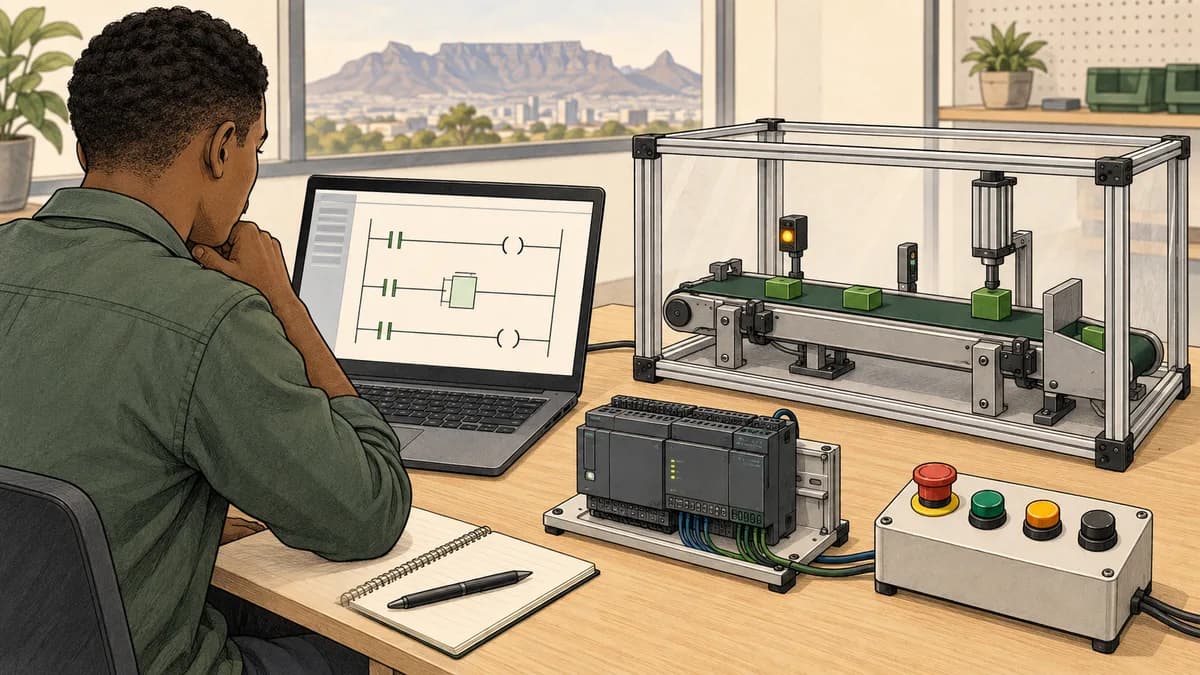
FactoryTalk View tag binding connects a display object to a data source. A working connection needs the correct application context, FactoryTalk Linx shortcut, controller tag reference, data type and access settings. For Machine Edition, also verify the communication configuration intended for the runtime terminal. A value visible on the engineering laptop is useful evidence, but it does not establish that the deployed terminal reaches the same controller.
This guide explains a controlled learning workflow for FactoryTalk View ME with a Logix controller. It distinguishes ME from Site Edition, introduces a read-only test, and shows how to diagnose wrong values, missing tags and failed writes without confusing a screen indication with physical machine feedback. Examples are educational; use the help for your installed software and the approved procedure for any real equipment.
Identify FactoryTalk View ME, SE and the actual target
Record the edition and version before following a tutorial. FactoryTalk View Studio is the HMI development environment; Studio 5000 Logix Designer is the controller engineering application. Their project trees, files and settings serve different purposes. A tutorial headed only “Studio 5000 V35+” does not adequately specify a FactoryTalk View procedure.
Machine Edition and Site Edition have different deployment contexts. Do not copy an SE server path, client script or administration step into an ME project merely because both products display controller values. Similarly, a PanelView product name alone is insufficient: identify the terminal model and supported runtime before building a deployment file.
Rockwell's ME application example follows a useful sequence: create the application, locate a controller, define a shortcut, then bind a numeric control. Its example uses an older controller; follow the workflow concept while checking the details for your own supported equipment.
Use the Allen-Bradley training overview to place HMI work in your learning plan. If you are still choosing hardware, the CompactLogix and ControlLogix comparison explains why model identity and software compatibility must come before assumptions about tag access.
Understand the complete path from controller to display
A useful mental checklist has five stages: source value, communication route, tag reference, object connection and presentation. Each stage can be correct or incorrect independently. The controller may contain the expected value while the HMI reads a different controller. The reference may be correct while the numeric format hides useful precision.
Write the intended meaning beside each tag. For a fictional training display, StudyCount means completed study items, StudyTarget means the requested exercise target, and StudyRunningFeedback means the model's separately supplied running indication. These names do not imply a real motor, a verified sensor or a production signal.
| Layer | Example question |
|---|---|
| Source | Does the intended controller contain the expected tag and value? |
| Route | Does this shortcut point to that controller in this environment? |
| Reference | Does the object identify the right scope, member and element? |
| Access | Is the required read or write permitted? |
| Presentation | Are units, precision and unavailable states understandable? |
The general HMI tag-binding guide covers these concepts across platforms. Keep this page for the FactoryTalk-specific communication and reference questions, so that a generic display lesson is not mistaken for a native configuration procedure.

Establish a read-only connection before adding commands
Start in an authorised training environment with a harmless study value. Document the source value independently, then connect a numeric display to it. A read-only object reduces the number of behaviours you need to explain during the first test. It also makes it easier to distinguish a data-path problem from a command-handling problem.
Rockwell's numeric-control example places the binding in the object's Connections tab and uses the Tag Browser. It identifies application and display test commands. Confirm those controls in the installed release rather than relying on a screenshot from another version.
Choose a distinctive test sequence, such as 7, 23, 0 and 41, in the isolated study source. Record what should appear for each step. Repeatedly showing a constant 100 is weak evidence: a stale value or a different source could happen to match. A valid zero should remain distinguishable from an unavailable value.
Do not use a production setpoint or output as your first communication probe. If you cannot change the source safely, observe an approved changing value and document the limitations. A screenshot of one matching value is one observation, not a complete connection test or a licence to operate equipment.
Define and document the FactoryTalk Linx shortcut
A shortcut gives the application a logical name for the controller route. The name is part of the reference, so changing or deleting it can affect objects that use it. Make its purpose understandable and keep a record of the intended controller identity, rather than selecting a device merely because its IP address looks familiar.
The network route and the process meaning are separate. Two controllers may expose tags with identical names. If a shortcut points to the wrong one, the screen can show plausible numbers without a syntax error. Include controller identity in the test record and use an authorised method to confirm it.
In a classroom, label the training controller and workstation clearly. If several learners use similar projects, assign documented exercise identities and confirm which controller each project targets. Do not solve confusion by randomly changing addresses or downloading a project to the first browsable device.
A shortcut is not a substitute for a network plan. Record the route as viewed from the runtime environment as well as from the engineering computer. The communication troubleshooting guide helps separate basic reachability, application communication and data-level observations when the screen remains unavailable.
Check Design (Local) and Runtime (Target) separately
FactoryTalk Linx ME configuration distinguishes the local development context from the target runtime context. Rockwell's Runtime (Target) documentation identifies the target communication settings, including device shortcuts. This is why a successful workstation test should not be treated as proof of the terminal's configuration.
The vendor also documents copying the running workstation configuration into Runtime (Target). The current help describes an Import/Export Configuration workflow. Use the documented workflow for your version, then verify that the copied configuration actually suits the terminal's network access.
Copying is a configuration action, not a validation result. The engineering computer may have a different route, interface or network position from the terminal. Preserve the intended target settings before changing them and review any difference rather than assuming the local route is always the correct production route.
For the learning record, keep two explicit outcomes: workstation test and target-runtime test. Record the project revision used for each. If the application changes after the first test, the old screenshot no longer demonstrates the new revision. This simple separation prevents a large amount of ambiguous troubleshooting.

Bind the correct scope, structure member and array element
A tag name includes more than the final word visible in a browser. Controller-scoped and program-scoped tags can differ, and structured tags contain members. Arrays require the intended element. Browse the exact tag and inspect the generated reference in context instead of reconstructing a complicated path from memory.
Rockwell's Logix tag-name explanation describes shortcut, program scope, structure or array elements and optional server or area components. The required prefix depends on the application context. A reference copied from a different directory or server arrangement may need different qualification.
For a simple conceptual reference, [StudyPLC]StudyCount identifies a shortcut and a controller tag. A program-scoped reference includes a Program: component. These fragments explain the parts; use the Tag Browser and expression editor to obtain the complete syntax expected by the object. Do not assume every connection field uses identical delimiters or expression formatting.
Check meaning as well as spelling. Motor.SpeedCommand and Motor.SpeedFeedback could both exist and both be numeric, yet they answer different questions. An object bound to the command cannot honestly be labelled measured speed. Read the Logix tag-scope guide when controller and program data are difficult to distinguish.
External access, operator permission and controller logic
Rockwell's external-access documentation distinguishes Read Only, Read/Write and None for external clients. It also notes that Logix Designer's own access differs. Therefore, seeing a value in the controller engineering application does not prove that an HMI is allowed to read it.
If a display reads correctly but an entry does not write, investigate the intended access and application permissions. Do not make all controller tags writable as a troubleshooting shortcut. A read-only design may be deliberate. Any change should follow the application's access policy and review process.
A permitted write is also different from an accepted process request. The HMI may write a requested value while controller logic validates it, rejects it, limits it or replaces it. Design the interface so the operator can distinguish requested, accepted and actual values where that distinction matters.
In a training model, use a dedicated request tag and an explicit response. Record a rejected request as a result rather than assuming the communication failed. If a value briefly appears and changes back, examine the logic and ownership of the value. Repeated writes from multiple places can conceal the original problem.
Worked example: diagnose a plausible but wrong display
This fictional paper exercise uses two isolated data sources, A and B. Both contain a tag called StudyCount. Source A has a required sequence of 7, 23, 0 and 41. Source B remains at 7. The display is intended to follow A, but a mistaken shortcut points to B.
| Test step | Intended A | Other source B | Display through wrong shortcut |
|---|---|---|---|
| 1 | 7 | 7 | 7 |
| 2 | 23 | 7 | 7 |
| 3 | 0 | 7 | 7 |
| 4 | 41 | 7 | 7 |
The first observation appears correct. The next three fail. A single matching value would therefore miss the wrong-source defect. The sequence establishes a better test of identity and change tracking, though an actual native application still needs its own communication and runtime checks.
Now correct the paper mapping to A. Expected display values become 7, 23, 0 and 41. Record four matches and preserve the source identity. This result belongs to the fictional model; it does not claim that FactoryTalk or a physical controller was executed while preparing this article.

Add quality and freshness to the study
Extend the paper model with three fields: value, quality and age. Define a fictional display rule: show the numeric value only when quality is good, the value is present and age is between zero and five seconds inclusive. Otherwise show “Unavailable” with a reason. Five seconds is an invented teaching threshold, not a recommended industrial refresh or timeout setting.
With value zero, good quality and age two seconds, show 0. With value 23, good quality and age five seconds, show 23. At six seconds, show unavailable because the study's freshness limit has been exceeded. With bad quality, do not show a trusted current value even when the stored number looks reasonable.
A missing timestamp cannot establish freshness. A future timestamp needs investigation under this model rather than being interpreted as exceptionally fresh data. On real distributed systems, clock handling and quality behaviour need a documented design; the paper rule only teaches why a bare number is incomplete evidence.
Do not quietly convert missing data to zero. In an HMI, that could make unavailable production data resemble a stopped machine, an empty tank or a completed reset. If a last known value is retained for context, label it clearly as historical and separate it from a current valid indication.
For complementary practice, the browser HMI simulator provides an educational route into screen and tag concepts. Check its current supported behaviours. It is not FactoryTalk View Studio, a PanelView runtime or evidence that a native ME application has passed a deployment test.
A practical troubleshooting order for missing or wrong tags
Start with the exact symptom and affected scope. Is one object wrong, one display wrong or the whole application unavailable? Does the engineering workstation work while the target fails? Did the problem begin after a tag rename, project change, terminal replacement or network change? These observations narrow the investigation without requiring speculative edits.
Next, verify controller identity and the relevant shortcut. Compare the intended tag with the object's actual connection, including scope and member. Check access and data type. Review diagnostic messages in the installed environment and save their exact wording; a generic description such as “communication error” loses useful evidence.
If the value is readable but visually wrong, inspect units, scaling, numeric format and labels. If the value is valid but the screen appears frozen, compare source changes and timestamps. If a browser still offers a renamed tag, distinguish cached browsing information from the current controller namespace before changing unrelated settings.
Finally, reproduce the issue in the smallest suitable authorised test. Change one documented cause at a time and repeat the relevant cases. The PLC troubleshooting guide supports this evidence-led method. Restoring a value once is not enough if the original failure also depended on runtime context or a particular display.
Build a course assessment around observable results
A useful FactoryTalk View course should let the learner explain the data route, bind an object, distinguish a request from feedback and diagnose a prepared fault. Ask whether the assessment includes a target-runtime check and whether learners work individually or watch an instructor. The exact software, terminal and controller models should appear in the course information.
For South African learners, compare practical access and travel together. A nearby course with the wrong edition may be less relevant than a carefully planned regional block. Learners in Gauteng, KwaZulu-Natal, the Western Cape or other provinces should verify the actual venue and equipment rather than assuming that every automation provider teaches FactoryTalk View.
Request a full quotation that separates tuition, software access, assessment and any accommodation or travel. The South African PLC course price guide provides categories for comparison. An HMI lesson completed online can support preparation, but it does not create a vendor credential or prove readiness to modify a working plant.

Frequently asked FactoryTalk View tag-binding questions
Why does the screen work on my laptop but fail on the terminal?
Compare the local and target communication configurations, the actual runtime revision and the terminal's route to the controller. The workstation's successful read proves only that particular path and test context. Save diagnostic evidence from the failing target before rebuilding or replacing configuration indiscriminately.
Why can I see the tag in Studio 5000 but not in the HMI?
Investigate external access, the controller selected by the shortcut, scope, browsing state and the exact reference. Logix Designer visibility is not the same as external-client permission. Also confirm that the controller contains the project revision you intended to inspect.
Can a numeric display prove that a motor is running?
Only if the displayed information actually represents appropriate running feedback, with valid communication and a sound application design. A speed command or run request alone is insufficient. Label the source meaning accurately and preserve unavailable states so that a broken data path cannot masquerade as normal feedback.
Should all tags use an HMI tag database?
Determine whether a direct reference or an HMI tag serves the application's needs, using the documentation for the edition and feature. Do not duplicate a complete controller namespace automatically. The important result is a maintainable reference with clear ownership and tested behaviour.
Can AI generate my FactoryTalk connection strings?
It can help explain a reference or build a checklist, but verify the string in the actual application context. Supply the edition, version, directory arrangement, shortcut and tag scope when asking for help. Remove sensitive plant identifiers from examples. A syntactically plausible string can still point to the wrong source.
Keep a reviewable binding and test record
Record each critical object's purpose, tag reference, data type, access direction, units and expected unavailable behaviour. Link the record to the application revision and intended controller identity. This makes later maintenance more reliable than a collection of unlabeled screenshots.
Keep expected and observed results in separate columns. Include the distinctive value sequence, the valid-zero case, a missing-data case and the differences between local and target tests. Explain what was actually tested and what remains outside the exercise. The PLC testing practice guide is a useful next step for organising those cases.

A strong learning submission explains why the first matching value did not detect the wrong shortcut, why unavailable data must not become zero, and why permission to write is separate from controller acceptance. Those are transferable reasoning skills. Native runtime validation, controlled deployment and the site's acceptance process still need their own evidence.