compare · South Africa
CompactLogix vs ControlLogix vs MicroLogix: SA Guide
CompactLogix vs ControlLogix vs MicroLogix for South Africa: check model limits, software, lifecycle, redundancy, migration and practical training needs.

CompactLogix vs ControlLogix is a comparison of controller families, not a choice you can make from the size of a factory or a single I/O total. MicroLogix adds a different programming environment and a model-specific lifecycle question. For South African training, maintenance and new projects, identify the exact controller, software version and required functions before choosing a course or hardware.
A useful selection process separates digital and analogue points, local modules, network devices, motion axes, memory, availability and safety requirements. These quantities are not interchangeable. A family maximum does not apply to every catalogue number, and a controller capable of two functions separately may have restrictions when those functions are combined.
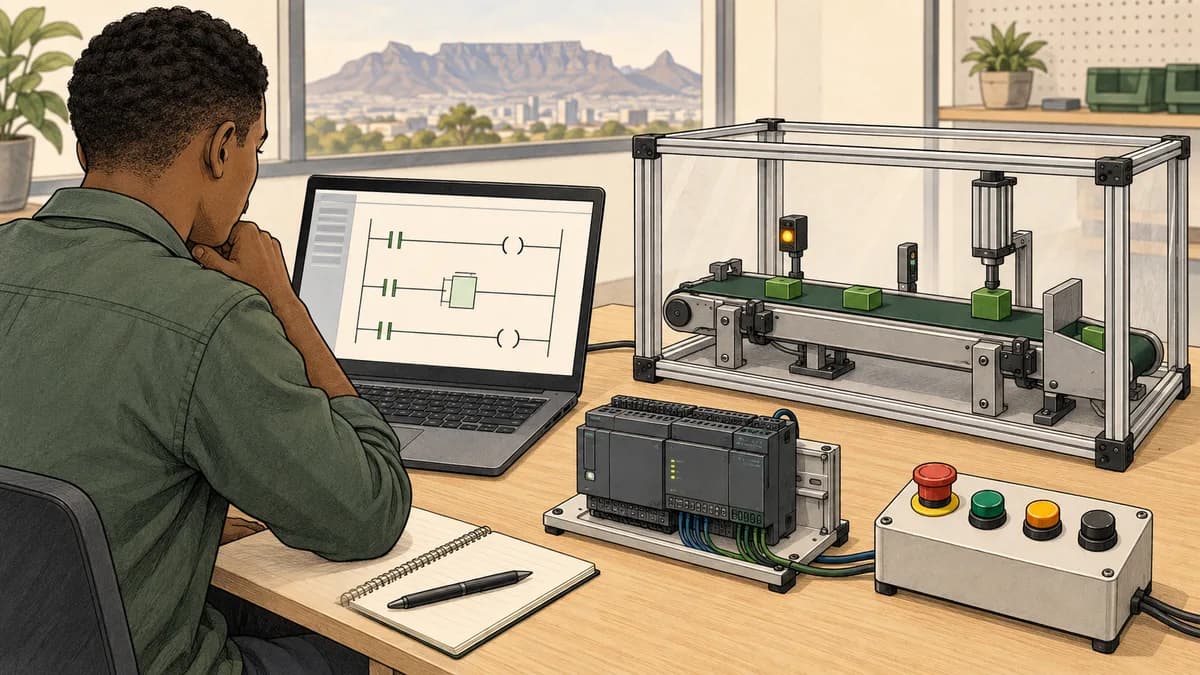
This site has a commercial connection to PLC Simulator. Its educational activities can help you practise logic and testing, but they do not emulate every Allen-Bradley controller, reproduce native Studio 5000 performance or validate a hardware design. The illustrations here are conceptual learning scenes, not photographs or specifications of the controllers discussed.
Start with the exact family and generation
Write down the full catalogue number, series, firmware revision and engineering software used by an existing project. If you are considering a new system, obtain those details for each proposed controller. CompactLogix and ControlLogix each contain different generations and variants; MicroLogix is also a family rather than one identical product.
Rockwell publishes ControlLogix 5590 technical resources as well as documentation for earlier generations. Therefore, a comparison that treats the 5580 as the entire current ControlLogix offering is incomplete. Check the generation relevant to the quotation or plant instead of assuming that an older table describes every available controller.
| Question | CompactLogix | ControlLogix | MicroLogix |
|---|---|---|---|
| What should identify the choice? | Exact compact-controller generation and variant | Exact chassis-based controller generation and system configuration | Exact MicroLogix model, series and lifecycle status |
| Which programming context matters? | Compatible Logix engineering software and firmware | Compatible Logix engineering software and firmware | The supported RSLogix 500 or related MicroLogix programming arrangement |
| What must be sized separately? | Local I/O, network resources, memory and supported motion | Chassis and network resources, memory and required system features | Embedded and expansion I/O, memory and supported communications |
| What should training prove? | Understanding of the relevant project and diagnostics | Understanding of the project and the actual system architecture | Understanding of the model's addressing, instructions and maintenance workflow |
This table is a starting point for investigation. It does not replace a selection guide, compatibility check or engineering review. The same broad family can appear in different applications for reasons that are invisible from a photograph of the panel.
CompactLogix: use catalogue-specific limits
Rockwell's CompactLogix 5380 overview describes Studio 5000 Logix Designer, local Compact 5000 I/O and variants with integrated motion. Its advertised maximum of 32 axes describes the portfolio's capability, not a feature automatically supplied by every 5380 controller. Standard, safety and process variants must be identified accurately.
For a concrete example, the 5069-L320ERMK product cutsheet lists 2 MB memory, eight axes and 40 nodes. Those are specifications for that catalogue number, checked in September 2026. They are not the limits of all CompactLogix controllers, and an axis or network-node allowance is not a count of physical input terminals.
What to check beyond the headline specification
List the local modules and distributed I/O arrangements you need. Confirm power requirements, supported module combinations, network resources and engineering-version compatibility using the relevant manuals. Do not describe an entire compact system as a single integrated chassis and power supply without checking its actual architecture.
If your application needs motion, confirm which axis types and configurations are counted and supported. If it needs process functionality or safety, identify the specific variant and required system components. Do not invent a generic “Pro tier” to explain hardware capabilities that are attached to catalogue numbers and product variants.
For training, the Allen-Bradley PLC learning guide helps you identify the software and course questions to ask. A course should say which controller generation it uses, whether practice is physical or simulated, and what the learner will personally configure and test.

ControlLogix: assess the whole system
ControlLogix selection involves more than choosing a CPU. Identify the controller, chassis, power arrangement, communication modules, local and remote I/O, engineering software and required optional functions. Check the supported combination for the exact generation and firmware, including the conditions attached to any availability or safety feature.
A larger chassis-based system can be appropriate when its architecture meets the requirement, but a large factory does not automatically require one controller to run everything. Conversely, a small application can have a demanding availability, interface or customer-standard requirement. Use the documented design needs rather than assigning controller families to industries by stereotype.
Redundancy and motion require a combined compatibility check
A redundancy requirement concerns the availability of a specified system. It does not automatically mean every controller feature remains available in redundant operation. Rockwell's ControlLogix 5580 release notes covering redundancy revision 35.013_kit2 state that motion cannot be used in the described ControlLogix redundancy systems, while a separate remote controller can contain motion instructions on the same network.
That release-specific example shows why you must read the applicable compatibility information. Do not extend it uncritically to every later generation, or combine a family's motion maximum with a redundancy claim and assume the resulting architecture is supported. Confirm the intended controller and redundancy release with the current documentation.
Ask what happens to the application and its interfaces during a switchover, which components are redundant and which remain single points of failure. Define acceptable behaviour and test it through an approved commissioning plan. Do not promise a universal millisecond interruption or describe redundancy as a guarantee that production can never stop.
Keep availability and functional safety separate
An availability feature and a safety function answer different requirements. A redundant controller arrangement is not automatically a safety-rated protective system. Likewise, selecting a safety-capable controller does not establish that a complete machine achieves a required safety performance level.
Treat safety requirements as part of the appropriate engineering lifecycle with competent review and validation. This comparison helps identify procurement and training questions; it is not a safety-system design. Educational logic tests and ordinary stop commands must not be represented as validated emergency-stop functions.
MicroLogix: check lifecycle status rather than declaring the family obsolete
On the September 2026 check, Rockwell's 1766-L32BWA MicroLogix 1400 product page lists that catalogue number as Active Mature. Rockwell's lifecycle definitions distinguish this from End of Life and Discontinued: Active Mature indicates continuing support with a newer product or family available.
That evidence corrects a blanket claim that every MicroLogix is discontinued. It does not guarantee indefinite manufacture, local stock or the suitability of this model for a new project. Recheck the exact product before purchasing or planning spares, because lifecycle status and availability can change.
Rockwell's MicroLogix 1400 overview describes EtherNet/IP features and RSLogix 500 programming. Therefore, “MicroLogix has no Ethernet or HMI integration” is also too broad. Establish the supported protocol services and intended connection, not merely whether an Ethernet socket exists.
Maintaining an existing MicroLogix system
A working installation may justify a planned maintenance and support strategy. Record the available project backup, programming software, communication interface, documentation and spare-parts arrangements. Identify dependencies such as an older HMI or engineering computer that could limit recovery even when the controller itself is functioning.
Do not promise that a technician can keep any installation running indefinitely. Equally, do not replace functioning equipment solely because its family is older. Assess the consequences of failure, recovery options, support position and future requirements. Those facts help determine whether to maintain, prepare a migration or schedule a replacement.

Programming environments and reusable skills
CompactLogix and ControlLogix work within the Logix engineering context, with compatibility depending on generation and firmware. MicroLogix uses a different project and addressing context. Familiarity with ladder logic helps, but the workflows, instruction details and configuration are not interchangeable simply because the products share an Allen-Bradley name.
When selecting a course, ask which software release and controller are used, whether installation and licences are included, and what assessment is performed. A learner supporting a MicroLogix project needs relevant practice with its files and instructions. A learner preparing for a Logix project needs the corresponding tag, task and device workflow.
Lack of a particular reusable-code feature does not mean no reuse is possible. Existing projects may use subroutines, documented patterns or other supported structures. Review the actual application and its maintenance needs rather than dismissing all older code as unstructured or insisting every migration must rebuild it in one particular style.
Micro800 is a separate option, not a new name for MicroLogix
Rockwell's Connected Components Workbench tutorials include Micro800 programming and MicroLogix migration activities. This is a different tool and controller context from Studio 5000 Logix Designer. Check the specific Micro800 product and software compatibility if it is proposed as a replacement.
The same resource includes a migration converter and follow-up work on converted elements. A conversion tool can assist a defined migration path; it does not establish that every instruction, device connection and operating behaviour transfers correctly. Nor should a Micro800 migration example be presented as proof of a direct MicroLogix-to-CompactLogix conversion.
Worked sizing example: do not mix points, modules, nodes and axes
The following is a fictional planning exercise for an educational station. It is not an Allen-Bradley bill of materials or an approved electrical design. Assume the station needs 24 digital inputs, 16 digital outputs and four analogue inputs. The proposed imaginary module types provide eight channels each for digital inputs and outputs, and four channels per analogue-input module.
The channel arithmetic gives three digital-input modules, two digital-output modules and one analogue-input module: six modules in total. This count assumes each module is dedicated to the named signal type. It does not include any adapter, power, terminal or other component unless separately specified.
| Resource | Required amount | How the exercise counts it |
|---|---|---|
| Digital-input points | 24 | Three fictional eight-channel modules |
| Digital-output points | 16 | Two fictional eight-channel modules |
| Analogue-input points | 4 | One fictional four-channel module |
| I/O modules | 6 | Sum of the three module categories |
| Distributed I/O adapters | 2 | Separately listed network devices |
| Networked drives | 3 | Separately listed network devices |
| Motion axes | 2 | A separate application requirement |
For this simplified worksheet, the two adapters and three drives give five listed network devices to investigate. That is not a vendor node-budget calculation: actual counting rules, connection use, other devices and architecture must be checked against the controller documentation. It also does not mean the six I/O modules require six separate Ethernet addresses.
Apply growth to the right resource
Suppose the learner adds nine digital inputs while keeping the other requirements unchanged. There are now 33 digital inputs. Four eight-channel input modules supply only 32 channels, so the fictional design requires five input modules, giving 40 channels and seven spare input channels.
The total becomes five input modules plus two output modules plus one analogue module: eight I/O modules. In this example, imagine Candidate A supports seven such modules and Candidate B supports ten. Candidate A fails the new module-count requirement by one; Candidate B has room for two more modules by count alone.
These candidate capacities are invented for the exercise and are not CompactLogix or ControlLogix specifications. Candidate B still needs all other compatibility checks. Its spare module count does not prove sufficient memory, power, network capacity, motion support or performance.
Handle a mandatory requirement explicitly
If the project also requires a particular supported redundancy arrangement, mark that as a separate mandatory check. A candidate with sufficient I/O but no confirmed suitable availability architecture remains unresolved or unsuitable for that requirement. Do not allow a low price or high memory score to hide the missing capability inside an average.
For each requirement, retain the source or calculation and identify who will verify it. This makes a controller recommendation reviewable. It also gives a learner a useful distinction between arithmetic they can perform and engineering claims that require documentation or testing.

Migration planning: preserve behaviour and identify deliberate changes
Start with a verified inventory and authorised copies of the current project, HMI application, device configuration and relevant documentation. Record what the installation actually does, including startup, shutdown, alarms, unusual operating conditions and communication interruptions. Avoid treating the program file as the entire system.
Separate behaviour that must remain from changes the customer wants. If a timer, scaling calculation or retained value behaves differently after migration, you need to know whether that was intended. A compiler accepting converted code does not establish that the process requirements are met.
Build a test plan around observable outcomes and permitted test methods. Use an isolated development environment and appropriate simulation or test equipment before the approved site work. Record unsupported instructions and manual adaptations instead of assuming every warning is harmless or every difference requires a complete rewrite.
Do not promise a standard migration duration
The work depends on project size, documentation quality, unavailable hardware, interface changes, validation requirements and the permitted shutdown window. A controller swap with familiar code can still uncover dependencies elsewhere in the system. Obtain an estimate tied to scope and assumptions rather than promising a fixed number of days for an entire family-to-family migration.
Plan recovery and rollback with the responsible team. Decide how the original system would be restored if acceptance criteria are not met, and verify the required backups and equipment. Do not wait for an unexpected failure to discover that the only project archive cannot be opened.
CompactLogix and ControlLogix still require review when moving between them
A shared engineering environment can help, but it does not remove hardware, task, motion, communication and feature differences. Check the target's supported functions and I/O configuration. Review assumptions embedded in the application and associated HMI or supervisory system.
A migration should be accepted because the required behaviour has been verified, not because the two project files look similar. Record any remaining restrictions and update the operating and maintenance documentation as part of the handover.
South African procurement and support questions
Ask for a dated, itemised quotation covering the controller and the complete required arrangement. Include I/O, chassis or mounting components, power, communications, engineering licences, HMI software where required, training and commissioning. Confirm the currency, tax treatment, delivery and warranty terms.
Do not assume selecting ControlLogix automatically requires one particular HMI or SCADA package. Identify the operator interface and supervisory functions actually required, then verify compatibility and licences for those products. Mixing up different PanelView families and their engineering tools can create a separate procurement problem.
For a site in Cape Town, Johannesburg, Durban, Gqeberha or a remote industrial area, ask who can provide the relevant support and on what terms. Confirm the actual contact, available expertise, remote-access arrangements and replacement process. A product's international application examples do not establish South African installed-base dominance or local response times.
For an existing plant, include lifecycle and recovery risks in the decision. For a new project, include expected support life and future expansion. Neither “always replace now” nor “wait until a customer requests a new feature” is a sufficient rule for every installation.

Choose training that matches your next task
A beginner may need to explain inputs, state and basic sequence behaviour before studying a complex redundancy architecture. A maintenance technician may need model-specific diagnostics and recovery practice. A project engineer may need selection, compatibility and migration planning. These learning goals require different exercises and supervision.
The PLC training course selection guide helps frame the course brief. State the controller, software and task you want to learn, then ask how the provider will assess it. Avoid treating attendance or an educational completion record as an occupational qualification or permission to alter production systems.
If you are considering your own equipment, use the PLC training kit versus simulator guide to compare complete costs and access. A supervised lab can be more useful than owning a controller without suitable software or instruction. General simulation can also support learning when its limitations are understood.
For additional educational practice, review PLC Simulator's curriculum scope and program-testing activities. These can support logic and test reasoning. They do not validate Rockwell hardware capacity, native controller timing or a redundancy configuration.
Keep your learning record precise. Name the environment, requirement, tests and observations. If you have not used Studio 5000 or a physical controller, say so rather than presenting general practice as vendor-specific commissioning experience. The PLC scan-cycle guide provides background for asking better questions about task and I/O behaviour.
Questions about CompactLogix, ControlLogix and MicroLogix
What is the main difference between CompactLogix and ControlLogix?
Their system architectures and available models differ. Compare the exact controller generation, I/O arrangement, network resources and required functions. A family name alone does not tell you which system is suitable or whether one is cheaper for your complete requirement.
Does every CompactLogix 5380 support 32 motion axes?
No. That is a portfolio maximum, and individual catalogue numbers have their own capabilities. Confirm the specific model and the relevant axis-count definition. Do not substitute an advertised family maximum for a model's specification.
Can I combine ControlLogix redundancy with integrated motion?
Check the exact generation and redundancy release. The 5580 release example discussed above explicitly restricts motion in the redundant system. A feature available in ordinary operation is not automatically available in every redundancy configuration.
Is MicroLogix 1400 discontinued in 2026?
The checked 1766-L32BWA listing showed Active Mature in September 2026. This is not a statement about every MicroLogix catalogue number or a guarantee of future availability. Check the exact model's current lifecycle status and obtain a local supply quotation.
Can MicroLogix communicate over Ethernet?
Some models, including the documented MicroLogix 1400, have Ethernet-related communication capabilities. Verify the required protocol service and role. The presence of Ethernet does not make all controllers interchangeable or guarantee compatibility with any HMI or remote system.
Should I learn RSLogix 500 or Studio 5000 first?
Use the tool required by the equipment or course you are preparing for. General logic knowledge helps across environments, but project structures and workflows differ. Ask the provider to identify the controller, software version, practice arrangement and assessment before enrolling.
Can a migration converter replace commissioning tests?
No. A converter can assist a supported conversion path, while manual adaptation and verification may remain necessary. Test the required application behaviour and interfaces, including deliberate changes, before accepting the migrated system.
What should I ask an AI assistant when selecting an Allen-Bradley PLC?
Provide exact catalogue numbers, firmware, I/O categories, network devices, motion requirements and any mandatory availability functions. Ask for manufacturer-backed evidence, separate resource counts and clearly marked unknowns. Confirm consequential design decisions with the responsible engineer and supplier.