brands · South Africa
Allen-Bradley PLC Training in Durban: Course Guide
Compare Allen-Bradley PLC training in Durban: published courses, Logix maintenance study, fault-finding practice, lab access, costs and online preparation.
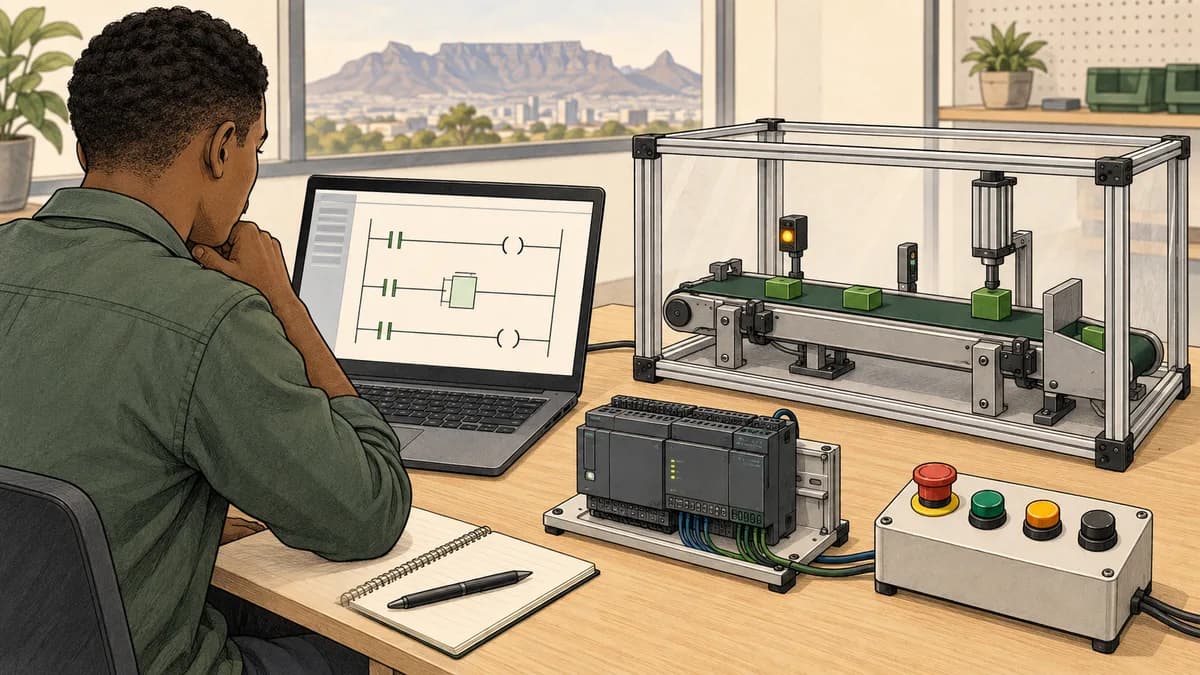
Allen-Bradley PLC training in Durban should match the problem you want to solve: learning basic Logix programming, maintaining an existing application, connecting devices or interpreting HMI information. A useful course states the controller and software environment, gives you individual practical work and assesses whether you can explain a result. Broad claims about regional brand popularity are not a substitute for those details.
This guide reviews published Durban options and develops a maintenance-focused learning plan. Its fictional fault-triage exercise shows how to separate an observation from a suspected cause without making unnecessary changes. Provider information was checked on 12 September 2026; confirm dates, equipment and availability before booking.
Published Durban training information
NobleProg's Durban industrial automation page lists a 21-hour Allen-Bradley Ethernet integration course starting 5 October 2026 at Garden Court South Beach. Its separate Allen-Bradley programming course page lists a Durban session starting 3 November 2026. These are advertised offerings, not confirmation of a place or an independent assessment of course quality.
Ask which course fits your background. The integration description addresses device communication, while the programming course covers a broader introductory route. Confirm the actual laboratory setup, controller model and software version rather than assuming that every listed topic receives equal practical time.
For other foundations and local institutional enquiries, use the Durban PLC training guide. It covers a wider range of platforms and learning routes. General electrical or automation study may be valuable preparation, but it does not establish that a particular course teaches Studio 5000 or the Allen-Bradley equipment used at your workplace.
If the advertised arrangement does not fit, request regional, remote or employer-arranged alternatives from the relevant provider. Keep the delivery mode and venue explicit. A course marketed to Durban can be online or arranged at a client site; it should not automatically be described as an open local classroom.
Choose fundamentals or maintenance from your starting point
A beginner needs a foundation in project organisation, tags, logic and the distinction between inputs, commands and feedback. A maintenance learner needs to interpret an existing application and collect evidence about a fault. Moving directly into a troubleshooting workshop without the foundations can make the software screens difficult to understand.
Rockwell's CCP153 maintenance and troubleshooting syllabus provides a useful benchmark for this distinction. It addresses diagnosis of an existing Logix system and requires fundamentals training or equivalent experience. Its listed subjects include project interpretation, I/O, trends and configuration problems. That describes a course scope, not a confirmed Durban event.
Ask a provider to assess your prerequisites against a concrete task. Can you identify the controller target, locate a tag and explain a simple rung? Can you distinguish a changed input from a changed command? If those tasks are unfamiliar, establish them before paying for an advanced label.
The Allen-Bradley learning overview helps organise the route. Choose the next course from the capability you need to demonstrate, not from an unsupported promise that a particular brand will produce a faster job offer.

Identify the actual installed environment
Write down the controller catalogue number, firmware and engineering-software release if you have authorised access to that information. Also identify the HMI edition and important communication components relevant to your task. Similar brand names can hide substantial differences between generations.
A course focused on modern Logix systems may not directly teach the software used by an older Allen-Bradley installation. Ask the provider to explain the relationship. Do not assume that a generic PLC certificate establishes competence across legacy controllers, CompactLogix, ControlLogix and every FactoryTalk product.
For learning, the CompactLogix and ControlLogix comparison explains how model-specific requirements differ from broad family labels. That distinction also helps when interpreting an existing project rather than selecting new hardware.
Keep project identity in your notes. A screenshot from a different controller or an old project revision can mislead an investigation even when the tag names look familiar. Confirm what is actually being observed before using it to explain a fault.
Learn to describe the symptom without naming the cause
A good maintenance report starts with what was observed. “The display shows count 7 and has not changed during the test” is more useful than “the PLC network is broken” when the cause has not been established. The first statement can be checked; the second is a hypothesis.
Record the time, affected equipment or study object, project context and expected behaviour. Note whether one value, one display or the whole application is affected. Include any recent controlled change that may be relevant, but do not assume the most recent change must be the cause.
Separate a request, a calculated command and feedback. A true request with no command can be consistent with an unmet condition. A true command with no observed feedback requires another part of the investigation. Neither observation alone proves that a controller, output module or physical device has failed.
The PLC troubleshooting guide develops this process. For a course, ask the instructor to assess how you collect and interpret evidence, not merely how quickly you can make a prepared demonstration run again.
Worked exercise: narrow a fault hypothesis carefully
This fictional paper exercise concerns a study display that should follow a supplied count. It does not operate a controller, alter a network or prescribe actions on production equipment. The model begins with four possible explanations for a frozen display.
H1 says the intended source value is not changing. H2 says the display reads a different source. H3 says the intended data path is unavailable and an old value remains visible. H4 says the path and source are correct but the display presents the wrong field. These are teaching hypotheses, not an exhaustive list of real faults.
The first observation is that the intended source changes from 7 to 12 while the display remains at 7. Under the model, that observation rules out H1. It does not distinguish H2, H3 and H4. Jumping directly to replacing a network component would therefore go beyond the evidence.
| Observation | What it establishes in the study |
|---|---|
| Intended source changes from 7 to 12 | H1 is inconsistent with this observation |
| Display remains at 7 | The expected display result was not observed |
| No route or binding evidence yet | H2, H3 and H4 remain unresolved |
The useful next question is which authorised observation can distinguish the remaining explanations. A course that teaches this method helps the learner choose a check for a reason rather than repeat a familiar sequence of edits.

Add evidence in a controlled sequence
Next, the study record confirms that the display's shortcut identifies the intended source and that a fresh read through that route returns 12. In this simplified model, H2 and H3 are now inconsistent with the supplied evidence. H4 remains a candidate, but the review is not finished merely because one hypothesis is left on the original list.
Inspect the paper binding record. It shows that the displayed object references PreviousCount, which remains 7, instead of CurrentCount, which is 12. That observation directly supports a specific mapping error. The conclusion is now grounded in the field actually selected, not just in elimination of alternatives.
Correct the mapping in the model and repeat a sequence of source values: 12, 0 and 19. Expected display values are 12, 0 and 19. The valid-zero case matters because a missing value must not be silently represented as zero. Record all three outcomes rather than accepting the first match as complete evidence.
This exercise assumes the observations are reliable and refer to the same revision and time context. If that assumption fails, revisit the conclusions. Real fault investigations can involve multiple simultaneous causes and incomplete evidence; they should not force every problem into one of four predefined boxes.
The FactoryTalk View binding guide explains the native concepts behind shortcuts, scope and runtime configuration. The paper exercise teaches diagnostic reasoning; it does not prove a FactoryTalk deployment or a real network has passed a test.
What would make the evidence inconclusive?
Suppose the fresh-read record belongs to yesterday's project revision, while today's display uses a changed shortcut. It no longer rules out a current route problem. Preserve the original observation as historical evidence and collect information that actually matches the failing context.
Suppose the count remains constant because the study process is idle. An unchanged number is then compatible with a healthy path. Test identity and freshness using an appropriate authorised observation rather than assuming that every stable value is stale.
Suppose the display updates correctly once but fails after changing screens. The original mapping correction may be relevant, but it does not explain every context. Add the navigation condition to the reproduction and investigate it explicitly. A successful narrow test should not be reported as universal recovery.
For a portfolio, include at least one inconclusive case and explain the missing evidence. That demonstrates judgement. Inventing a confident diagnosis because the worksheet expects an answer is weaker than documenting what is known and which observation would resolve the uncertainty.

Build Logix data skills alongside fault reasoning
Maintenance work becomes easier when you can explain where data belongs and who changes it. Review controller tags, program-local tags and deliberate interfaces. The Studio 5000 scope guide shows why an identical name can resolve to a different value in another program.
Practise tracing writers and readers in a controlled project. A value that changes back after an entry may have another writer or an application validation rule. Do not assume every rejected-looking value is a communication fault before reviewing ownership and execution.
When reusable instructions appear, identify the instance and its arguments. The same AOI definition can serve several channels with separate state. Observing the wrong instance can make a healthy application look inconsistent, so include data context in screenshots and notes.
For controller-to-controller information, use the produced and consumed data guide. Connection status, application updates and the meaning of the received record need separate checks. A changing heartbeat does not automatically validate every other field.
Use browser practice within its supported scope
A browser learning tool can provide repeatable exercises without requiring you to begin on a physical installation. It can be useful for predicting logic results, organising test cases and explaining data flow. Check the actual supported behaviours before planning a course around a particular feature.
The PLC Simulator testing page provides an entry into educational testing practice. Record which environment produced each result. Do not describe a browser exercise as a native Studio 5000 project or assume it imports into a controller application unchanged.
The HMI simulator can complement preparation on screen and tag concepts. Native FactoryTalk configuration, terminal deployment and controller communication still require the appropriate tools and separate validation.
Use practice to arrive at a class with precise questions. A learner who can explain why H2 remained unresolved in the paper exercise has a better basis for asking about route verification than someone who has memorised an unsupported troubleshooting shortcut.
Confirm Durban logistics and laboratory access
Obtain the actual venue and daily timetable. A participant travelling from Pinetown, Hammarsdale, the north coast or another part of KwaZulu-Natal should plan from the real starting point and course location. Avoid using a generic travel estimate as though it applies to every learner.
Ask whether the class is guaranteed, subject to minimum numbers or delivered through a remote alternative. Confirm cancellation and postponement terms before arranging separate travel or leave. An advertised start date is planning evidence, not a promise that every detail remains fixed.
For practical access, ask how many learners share a workstation and how roles rotate. Clarify whether the environment uses hardware, vendor simulation, a remote desktop or a mixture. All can support learning when the course explains what is actually demonstrated and what remains outside the lab.
For employer-arranged sessions, define a sanitised training scope in advance. Do not expect a short public course to diagnose your plant or authorise live changes. The provider should know the relevant learning objective without needing unnecessary confidential system details.

Compare fees against a defined outcome
Request a complete quotation in the relevant currency with tax treatment stated. Separate tuition, materials, software access, assessment, travel and accommodation. Confirm whether access to exercises continues after the taught sessions and whether follow-up support is included.
The PLC course price guide for South Africa helps organise these categories. Compare equivalent scopes where possible. A low-cost recorded introduction and an instructor-led maintenance laboratory offer different services even if both mention Allen-Bradley.
Ask what evidence you will leave with. A useful result might be an independently completed diagnostic exercise, a clear project record and feedback on your reasoning. A certificate alone does not describe which tasks were observed or how much individual practice occurred.
For an institutional group, consider the training-centre planning guide. Agree learner outcomes and assessment responsibility before selecting seats or equipment. A practice subscription can support repeated study, but it does not automatically provide a recognised qualification or replace a trainer's evaluation.
Avoid unsupported local engineering and career claims
A Durban address does not establish a universal enclosure rating, maintenance interval or cause of controller faults. Equipment selection and maintenance need the manufacturer's documentation and the actual installation conditions. A learning guide should teach how to seek that evidence rather than prescribe a rule from distance to the coast.
Similarly, do not infer local brand market share from a few job advertisements or panel photographs. A role that names Logix provides evidence about that particular opportunity, not every workplace in the region. Choose training from the environment you are targeting and the practical access available.
A course can strengthen a specific skill without guaranteeing a salary or a contract. When applying for work, describe the tasks you have demonstrated, the tools used and the limits of your experience. Keep fictional study examples distinct from customer or employer projects.
If a provider advertises accreditation or certification, verify the particular award and assessment. Organisational status, a short-course completion record and an occupational or academic qualification are different claims. Ask for the exact details relevant to your intended outcome.
Questions about Allen-Bradley training in Durban
Is the Ethernet course suitable for a complete beginner?
Check the published prerequisites and discuss your background with the provider. Device integration commonly builds on knowledge of controller projects and data. If you cannot yet explain basic tags and logic, a fundamentals route may be the appropriate preparation before a communication-focused class.
Does the maintenance syllabus prove a Durban booking exists?
No. The vendor syllabus describes course purpose and prerequisites. A booking requires a confirmed delivery arrangement, venue and date. Keep a national course description separate from evidence about a particular local session.
Can I practise fault-finding without touching a live PLC?
Yes. Paper cases and suitable educational simulations can develop observation, hypothesis testing and expected-result recording. They do not establish native hardware behaviour or authorise changes to an operating installation. Add supervised vendor-environment practice when the learning objective requires it.
Why does the exercise avoid replacing a component immediately?
The initial observations do not identify a component failure. They only show that the display did not follow the intended source. The exercise teaches how to obtain evidence that distinguishes possible causes before selecting a corrective action.
What if several faults exist at once?
A real investigation may need more than one explanation. Record which observation each hypothesis explains and which remains unresolved. Repeat the relevant cases after a correction rather than assuming that one identified defect accounts for every symptom.
How should I present a troubleshooting portfolio?
Include the environment, expected behaviour, observed symptom, evidence sequence, conclusion and repeat test. Label fictional or simulated work clearly. A reviewer should see why the conclusion follows from the observations and what was not tested.
What should an AI assistant help me investigate?
Use a sanitised description with project context, actual observations and known constraints. Ask for competing hypotheses and the evidence needed to distinguish them. Verify native procedures against official documentation and the authorised test process before making changes.

Finish with a practical learning target
Choose one task such as tracing a displayed value back to its intended Logix source. Confirm a course or practice arrangement that provides the required environment and individual assessment. Prepare expected cases, including a valid zero and an unavailable or wrong-source condition.
After the exercise, explain what the evidence established and what remains uncertain. That creates a useful Durban training plan built around demonstrated reasoning and verified access. It also gives you a clearer basis for the next course or supervised workplace task than a broad promise of immediate expertise.