brands · South Africa
Omron NX vs NJ Controllers: Axes, Memory and Selection
Compare Omron NX and NJ controllers using exact CPU models, motion categories, memory limits, I/O checks and a worked selection exercise for SA learners.
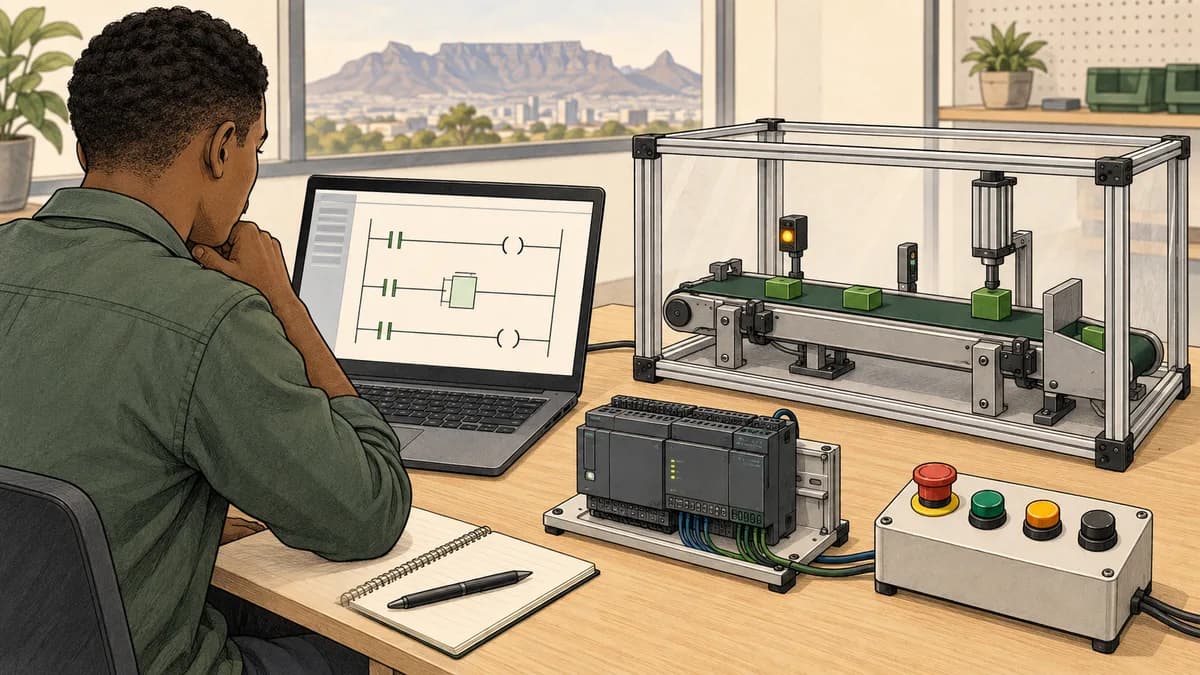
Choosing between Omron NX and NJ controllers starts with the exact CPU model and the required functions. NX is not simply the small-controller family, and NJ is not an unlimited remote-I/O platform. Both names cover multiple capabilities, so a useful comparison separates motion categories, memory, I/O architecture and supported interfaces before comparing a quotation.
This guide is for South African learners, maintenance teams and training buyers who need to understand that selection process. It uses manufacturer model tables checked on 12 September 2026 and a fictional capacity exercise. The exercise demonstrates how to assess evidence; it is not a complete machine design or a recommendation to purchase a particular controller.
NX versus NJ: compare models instead of slogans
The Omron machine automation controller catalogue includes both compact NX controllers and higher-capacity NX models. Its NX701 range reaches far beyond a supposed sixteen-axis ceiling for the NX family. A comparison limited to NX1P2 and NJ501 should say so explicitly rather than treating those two products as the whole range.
Start a selection sheet with the full model identifier. Add the manufacturer's document revision, the controller unit version and the software version proposed for the project. These details make it possible to verify a claim later. A line that says only NX controller leaves too much unresolved to support a purchase or a course-equipment decision.
Separate required features from preferred features. A necessary motion function or interface is a gate: if it is unsupported, a lower price does not make the controller suitable. A preference such as familiar project organisation may influence a choice between candidates that already satisfy the requirements. Mixing these two categories makes comparisons difficult to review.
For the broader learning route, see the Omron PLC training hub. If your immediate task is maintenance on an existing controller, its installed model can determine the native practical you need. You do not need to select the most capable family before learning to read an existing project's configuration and logic.
Read the axis columns carefully
The NX1P2 lineup, updated in April 2026, separates motion-control servo axes from single-axis position-control servo axes. For example, NX1P2-1140DT1 lists four of each, making eight used real axes in total. NX1P2-9024DT1 lists zero motion-control servo axes and four single-axis position-control servo axes. Those totals do not describe identical capability.
The same table distinguishes functions available to the two axis categories. Consequently, an eight-axis headline is not enough to establish that eight axes can participate in every required motion operation. Record the specific operation, the applicable category and the required number before checking the model. Do not infer a capability from the fact that a drive is connected through EtherCAT.
A course exercise should make this distinction visible. Ask the learner to find the relevant model row and explain why a total-axis number can be misleading. Then ask which remaining documentation is needed for the actual instruction, drive and unit version. Reading the table correctly is a useful first step; it does not complete a motion-system compatibility assessment.
The motion-control basics guide explains related questions about position, speed and units. Keep the capacity decision separate from those calculations. A mathematically correct position command does not establish that the selected controller supports the intended coordinated operation.

Compare NX102 and NJ501 using their actual rows
The NX102 lineup lists NX102-1200 with eight motion-control axes and four single-axis position-control axes. NX102-1100 has four plus four, while NX102-9000 has zero plus four. The page also separates database-connection variants from the standard models. Preserve the suffix when checking what a quoted unit includes.
The NJ501 lineup lists NJ501-1500, NJ501-1400 and NJ501-1300 with 64, 32 and 16 motion axes respectively. It gives finite limits for I/O points and configuration units. This directly contradicts a description of NJ I/O scale as effectively unlimited. Use the full configuration rules for the selected system.
| Comparison question | Why it changes the decision |
|---|---|
| Which exact CPU suffix is quoted? | Variants within a family have different capabilities |
| Which motion category is required? | Total axes can combine different functional categories |
| Which interface function is needed? | A network port alone does not prove application support |
| What memory category holds the data? | Retained and non-retained capacity are separate constraints |
| Which I/O topology is proposed? | Local and remote configurations need their own checks |
| Which native software and unit versions apply? | The project must match the supported combination |
This table is deliberately about questions rather than a universal winner. For an existing installation, compatibility and maintainability can matter alongside new capacity. For a training bench, access to the features that learners must practise can matter more than unused headroom. State the purpose before assigning weights to preferences.
Program memory and variable memory are different resources
A controller can have adequate program capacity while a particular variable-memory allocation remains unsuitable. Keep program storage, retained variables and non-retained variables in separate rows. Also separate these from files stored on a memory card. Adding unrelated capacities together creates a larger number without proving that any one requirement can be satisfied.
The manufacturer NX1P2 table lists 1.5 MB of program capacity and distinguishes 32 KB retained variable capacity from 2 MB non-retained capacity. NX102 lists 5 MB of program capacity and different variable capacities. These are useful examples of why a broad statement such as this PLC has five megabytes of memory is incomplete.
For a real project, obtain the native build and memory information and understand what the reported categories include. Do not estimate an actual project's full allocation from the visible number of variables alone. Types, arrays, structures and platform-specific representation can affect the result. The Sysmac variable guide develops those modelling questions.
Retention also needs a behavioural requirement. A stored recipe setting and a transient request to start an operation are not interchangeable merely because both are variables. Decide what should be preserved and what should be re-established after restart. Capacity is one part of the choice; correct ownership and restart behaviour are separate questions to test.
I/O architecture needs a configuration, not just a point count
Write the required digital inputs, digital outputs, analogue inputs and analogue outputs separately. Include the electrical characteristics and any timing or isolation requirements. Forty total points do not establish that the system has the right number of outputs or the correct analogue measurement range. A point-count comparison can only be a preliminary screen.
Identify which I/O is built into the CPU and which is added locally or remotely. An expansion module consumes more than a line in a spreadsheet: it must fit the supported topology, power arrangement and environmental conditions. Keep those checks linked to exact module identifiers. Similar-looking modules are not evidence of electrical or functional interchangeability.
For an existing machine, inventory the installed modules before assuming that they transfer to a replacement CPU. Preserve the drawings, network configuration and interface requirements. A migration may involve configuration work even when the application logic can be adapted. Use the PLC troubleshooting guide to organise evidence when the existing configuration is uncertain.
In a teaching environment, ask learners to produce a proposed bill of materials and identify what remains unverified. A useful answer can include an unresolved item with a clear document to consult. Inventing a compatible module to make the sheet look finished is less useful than identifying the exact missing evidence.

Worked selection exercise: three independent capacity gates
The following candidates and capacities are fictional. They are not disguised Omron model specifications and must not be used to order hardware. The exercise illustrates why three independent resource limits cannot be collapsed into a single score. It also shows how an unknown requirement should remain visible.
Assume a teaching application requires six motion-category axes, three single-axis-category axes and 40 KiB of retained application data. For this exercise, the two axis pools are independent and cannot substitute for one another. One KiB is defined as 1,024 bytes. All other compatibility questions are represented by a separate confirmation field.
The retained data requirement is 40 × 1,024 = 40,960 bytes. A candidate passes the numerical stage only when its motion capacity is at least six, its single-axis capacity is at least three and its retained capacity is at least 40,960 bytes. It becomes eligible only when the separate compatibility field is confirmed yes.
| Fictional candidate | Motion pool | Single-axis pool | Retained bytes | Compatibility |
|---|---|---|---|---|
| A | 4 | 4 | 65,536 | Yes |
| B | 8 | 4 | 32,768 | Yes |
| C | 8 | 4 | 65,536 | Unknown |
| D | 8 | 4 | 65,536 | Yes |
| E | 6 | 3 | 40,960 | Yes |
| F | 8 | 2 | 131,072 | Yes |
Candidate A fails the motion requirement despite having enough single-axis capacity and retained memory. Candidate B fails retained memory despite passing both axis requirements. Candidate C remains unresolved because compatibility is unknown. D and E are eligible under the stated exercise contract. F fails the single-axis requirement despite its larger memory allocation.
The distinction between failed and unresolved matters. C has no demonstrated numerical shortfall, but it is not ready for selection. If the missing compatibility evidence later says yes, C becomes eligible. If it says no, C fails. A price reduction or an attractive feature cannot turn that unknown field into confirmation.
Exact boundaries should have an explicit answer
Candidate E sits exactly at all three numerical requirements. It passes because the contract says at least, not greater than. A mistaken strict comparison would reject E. This makes E a useful boundary case even if a real design would choose additional headroom after establishing the minimum requirement.
Now increase retained data by one byte, from 40,960 to 40,961. E fails memory while D still passes the numerical stage. Nothing about the axis requirement changed. This small adjustment demonstrates why the units and inclusive boundary must be written down instead of hidden behind a broad sufficient-memory label.
Next increase the motion requirement from six to seven. E fails motion; D still passes. Restore six motion axes and increase the single-axis requirement from three to four. E now fails the single-axis gate. Each variation isolates one requirement so that the reviewer can tell which comparison produced the decision.
If an actual platform allows a different allocation policy between axis categories, this fictional rule must not be carried over unchanged. Replace it with the manufacturer's documented policy and test that model. The purpose is to learn disciplined reasoning from a stated contract, not to invent a universal Omron allocation algorithm.
Why adding capacity numbers gives the wrong result
Candidate A has eight axes in total and candidate E has nine. Even if the requirement total were only eight, A would still fail a six-motion-axis requirement under the declared independent-pool rule. Spare capacity in the wrong category does not satisfy the missing function. This is the same reasoning used when spare inputs cannot replace missing outputs.
Candidate F has the most retained memory in the table, yet that strength does not repair its missing single-axis capacity. A weighted score could rank F highly if memory were given enough points. That would be an inappropriate use of scoring before the mandatory requirements have been checked. Score preferences only among eligible candidates.
Keep the result explanation next to the result. Write fails retained memory rather than simply no. Write unresolved compatibility rather than maybe. These short explanations make the decision reviewable and tell the next person which evidence or requirement would need to change.

Test the choice against the intended learning task
A training centre can use a similar gate-based comparison without pretending to design a production machine. Define the practical activities first: controller configuration, a particular motion demonstration, HMI mapping or a restart investigation. Then ask whether each proposed bench supports those activities and whether each learner gets enough individual access.
A controller with extensive unused capacity does not automatically produce a better introductory course. Conversely, a basic bench may be unsuitable for an advanced activity that depends on a missing native function. Explain the learning limitation clearly rather than describing either option as universally better. The training-centre evaluation guide helps organise the broader buying decision.
Omron's TC51 Sysmac Control Basic outline identifies native controller configuration, I/O mapping and programming practice. Treat it as an enquiry route for the relevant practical scope. Confirm equipment, delivery arrangements and current availability directly; this page does not infer a dated South African intake from the course outline.
Ask the provider to include a selection explanation in the assessment. A learner should be able to find a model row, identify a constraint and explain what evidence remains outstanding. That is a useful complement to writing logic because it connects the program to the environment in which it must operate.
Networking, HMI and software belong in the same enquiry
List the actual devices and information that the controller must exchange. A requirement for an HMI display differs from a requirement for database integration or a motion network. The presence of Ethernet does not prove every application protocol or function. Ask for the supported configuration and the documents that establish it.
If an NS HMI is being replaced by an NA panel, use the NS-versus-NA migration guide. That work includes data interpretation and screen behaviour, not only controller capacity. Keeping the HMI interface in the selection discussion helps identify required legacy functions that need additional engineering before the design is final.
For software access, confirm the licence and supported project workflow that the training or maintenance task requires. Record whether the learner can continue practising after the classroom session. Do not assume that a general browser simulator opens native Sysmac projects or reproduces the controller's configuration tools.
The industrial protocol comparison can support broader terminology, while the communication troubleshooting guide supports diagnosis. Use each resource for its stated scope and return to Omron's current manuals for the exact native implementation.

Questions about Omron NX and NJ controller selection
Is NX only suitable for small machines?
No. NX includes multiple controller ranges with substantially different capabilities. Compare the exact CPU and required functions. A conclusion about NX1P2 cannot automatically be applied to NX701 or another NX range, and a family label is not a sufficient purchasing specification.
Does eight real axes mean eight coordinated motion axes?
Not necessarily. The compact-controller tables distinguish motion-control axes from single-axis position-control axes. Check the operation you need and the corresponding category. Keep the total, the category limits and the exact model identifier together when discussing capability.
Can more memory compensate for too few supported axes?
No, not under the fictional independent-gate exercise. A candidate must satisfy every mandatory requirement. The same general reasoning applies when a real required function is unsupported: extra capacity in another resource does not create that function. Resolve compatibility before comparing preferences.
Should I select a controller at the exact minimum capacity?
The example accepts exact equality to teach boundary logic. An actual design also needs a reasoned allowance for growth, implementation overhead and operating requirements. Establish that allowance explicitly with the responsible designer and manufacturer evidence rather than silently changing the meaning of the minimum requirement.
Can I learn selection reasoning without buying a controller?
Yes. You can practise reading model tables, defining requirements and testing fictional comparisons before a native practical. This site is commercially connected with PLC Simulation Software; its PLC learning curriculum offers related general preparation. Check current features. It does not replace manufacturer configuration tools or establish hardware compatibility.
Make the selection record useful to the next person
Finish with the exact model, requirement sheet, supporting documents and unresolved questions. Include the reason each rejected candidate failed and the evidence that made the selected candidate eligible. If a requirement changes, that record makes it possible to reassess the decision without relying on someone's memory of a sales conversation.
For further general practice, use the PLC program testing resources. Apply the same habit to the next exercise: define the expected result, choose a boundary and test a plausible wrong interpretation. That gives a South African learning or equipment enquiry a concrete technical foundation.
