brands · South Africa
M340 vs M580: Ethernet, Redundancy and I/O Capacity Tests
Compare M340 and M580 by exact CPU, Ethernet, backplane, OPC UA and redundancy requirements, with worked I/O module, spare-channel and rack-capacity tests.
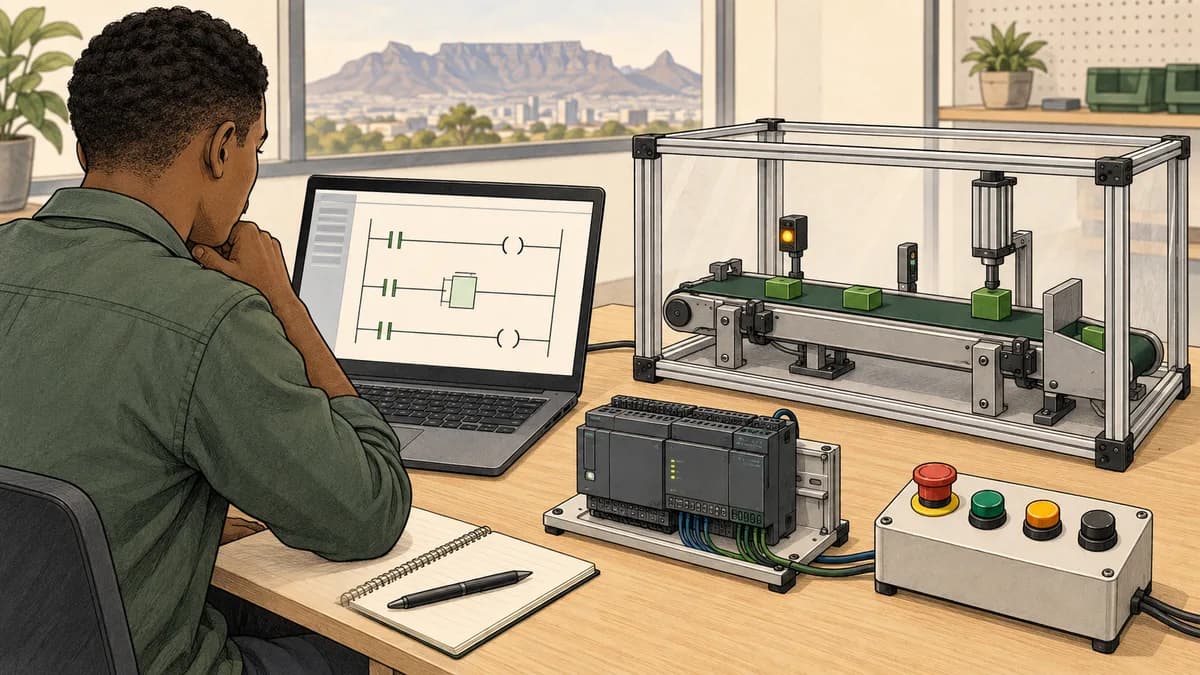
An M340 versus M580 comparison should identify exact controller references and the architecture they must support. The family name alone does not tell you which Ethernet interfaces, remote I/O arrangements, redundancy options or software combinations are available. Start with the required signals and system behaviour, then check the complete bill of materials against current vendor documentation.
This guide corrects several common shortcuts and develops a fictional I/O capacity exercise. The exercise shows why enough channels in total can still leave a rack short of slots or one signal type short of spare capacity. It is a learning calculation, not a validated Modicon hardware design or a recommendation for a particular installation.
Primary sources were checked on 13 September 2026. We operate PLC Simulation Software and may benefit from its product links. The linked learning material does not provide native Modicon hardware configuration, Schneider certification or a substitute for the selected equipment's engineering documentation.
Compare controller references, not just family labels
Schneider's South African listing for BMXP342020 identifies an M340 processor with Ethernet and Modbus, with stated maximum capacities of 1,024 discrete and 256 analogue I/O. The separate BMXP342000 listing identifies a different reference. It is therefore incorrect to say that M340 processors universally lack an Ethernet interface.
For M580, the South African pages distinguish BMEP582020 distributed and BMEP582040 remote processor references. Treat these as starting points for the exact architecture review. A shared family name does not make the references interchangeable.
Copy the complete reference into the comparison sheet, including any suffix. Then record the required firmware, engineering release and supporting modules from the applicable documents. Avoid reducing a configuration to “an M580 with Ethernet” when the actual requirement concerns a particular remote I/O arrangement or service.
The Schneider PLC training hub connects the programming topics. For the engineering environment itself, use the Control Expert structure and data guide. Hardware selection and understanding the project are related tasks, but they answer different questions.
Backplane compatibility has important qualifications
Schneider's M340 backplane FAQ states that an M340 processor can operate in the referenced BMEXBP backplanes, while the Ethernet side of the backplane is not used. This directly contradicts the blanket claim that an M340 CPU cannot operate in an Ethernet backplane at all.
That compatibility statement does not mean every module, network feature or proposed rack arrangement becomes available. Check the processor, backplane, module references, power requirements and configuration rules together. A component physically fitting in a slot is not enough to establish that the planned function is supported.
For a learning comparison, keep a column for the evidence behind each proposed combination. If a module's compatibility has not been checked, mark it unresolved. Do not silently treat a missing incompatibility warning as positive confirmation.
This is especially useful when a project tries to reuse existing hardware. List what is retained, what is replaced and what must be tested after the change. A low initial replacement cost can lose its meaning if the design assumes an unsupported combination or overlooks required accessories.

Networking, OPC UA and redundancy are separate requirements
Specify the communication task in practical terms: which systems exchange data, who initiates it, which protocol and data model are required, and how loss or recovery is handled. An Ethernet connector does not establish every service needed by the application. The industrial protocol comparison helps distinguish the network medium from the protocol and its role.
The checked BMENUA0100 installation and configuration guide, revision 07 dated July 2026, describes an OPC UA server module for M580 systems. If OPC UA is required, identify the actual supported component and configuration. Do not assume it is a universal built-in service on every M580 CPU solely because the family supports an OPC UA solution.
For redundancy, Schneider's BMEH582040 product listing identifies a Hot Standby processor reference. A standard BMEP reference and a BMEH Hot Standby reference should not be treated as the same purchase. The peripheral firmware FAQ also gives compatibility qualifications, including that Quantum drops are not supported with BMEH582040.
Translate an availability requirement into the complete architecture and acceptance tests. Controller redundancy does not by itself prove that every power, network, I/O or application failure has been addressed. Nor does a sector name automatically require one particular redundancy design. Obtain the actual project requirement and verify the proposed response to each relevant failure.
Avoid promising one universal failover time from the family name. The useful test states the failure being introduced, the observed system response and the allowable interruption for that application. Training can explain those concepts without pretending that a classroom demonstration validates a production availability requirement.
Separate technical fit from price and lifecycle evidence
Request a dated South African quotation for the full configured system, including the required processor, rack, power supply, I/O, communications, software and accessories. Confirm tax treatment, delivery, availability and support arrangements. A single processor price is only one part of the total and should not be compared with a differently scoped package.
Ask for current lifecycle and replacement information for the exact references being considered. Do not infer a discontinuation date from the age of the family name or promise support through an invented future year. Keep the supplier's evidence with the selection record so it can be revisited when the purchase date changes.
Existing skills and spares can legitimately affect a decision. Document those as project facts rather than claiming that every new South African panel should use the same family. The right learning route also depends on the equipment the learner actually needs to inspect, maintain or configure.
Our PLC course cost guide helps distinguish training costs and inclusions. The Unity Pro migration guide addresses software and file preparation if the selection also involves an existing application.

Worked example: channels and slots constrain different things
Define a fictional training design with 50 digital inputs, 18 digital outputs and five analogue inputs. For this exercise, digital input and digital output modules each provide 16 channels, while an analogue input module provides eight. These are deliberately invented catalogue choices for arithmetic practice, not a specification for particular Schneider modules.
The reserve requirement is at least 20 percent unused channels within each signal category after installation. This means the occupied fraction must be no more than 80 percent. To find the minimum installed channels for a demand N, divide N by 0.8 and round upwards. Then round up again to a whole number of the selected modules.
This requirement is different from simply adding 20 percent to demand. If a system needs 50 channels and installs 60, the ten spare channels are one sixth of the installed total, about 16.7 percent. The spare fraction is below the required 20 percent even though the installed count is 20 percent larger than the demand.
Also define two fictional rack options. Option A has eight total positions, with two reserved for non-I/O components, leaving six positions for these one-slot I/O modules. Option B has twelve total positions with the same two reserved, leaving ten. These slot budgets are part of the exercise, not actual Modicon backplane layout rules.
The model checks channel reserve by category and I/O slot capacity separately. It does not check power, thermal conditions, field wiring, isolation, network bandwidth, timing, environmental suitability or native module compatibility. Those remain separate requirements in a real design.
Calculate the required modules by category
For 50 digital inputs, the minimum installed count is the ceiling of 50 divided by 0.8, which is 63. Four 16-channel input modules provide 64 channels. Four is the smallest module count that satisfies this category's reserve rule.
For 18 digital outputs, the minimum installed count is 23. Two 16-channel output modules provide 32 channels. One module would not even cover the present demand, so it cannot satisfy the reserve requirement.
For five analogue inputs, the minimum installed count is seven. One eight-channel module is sufficient for the fictional category. This produces a total requirement of seven I/O modules: four input, two output and one analogue.
| Category | Required channels | Minimum with reserve | Installed channels | Modules |
|---|---|---|---|---|
| Digital input | 50 | 63 | 64 | 4 |
| Digital output | 18 | 23 | 32 | 2 |
| Analogue input | 5 | 7 | 8 | 1 |
| Total | 73 | Checked by category | 104 | 7 |
Option A has only six available I/O positions and therefore fails the slot requirement. Option B has ten and passes this limited slot calculation with three unoccupied I/O positions. That does not mean Option B is an approved hardware design; it means one stated capacity check passes under the fictional assumptions.
Across all installed channels, there are 31 spares out of 104, about 29.8 percent. However, the aggregate percentage is not the acceptance criterion. Spare output channels cannot become analogue inputs merely because the total looks generous. Preserve the category-level calculation in the selection record.

Check growth at the actual module boundary
The four digital input modules provide 64 channels. At a demand of 51, the spare count is 13 and the spare fraction is about 20.3 percent, so the fictional reserve rule still passes. At 52, the spare count is twelve, or 18.75 percent, so it fails.
A fifth 16-channel input module raises the installed digital input capacity to 80. With 52 used, 28 remain spare, or 35 percent. Total I/O module demand becomes eight. Option B still passes its ten-position I/O budget, while Option A remains short.
This discontinuity matters when planning expansion. One additional required signal can trigger a whole additional module at a boundary. A smooth percentage estimate of cost or space may miss that step. Use whole-module arithmetic rather than rounding a total channel figure at the end.
Test other boundaries independently. Twelve digital outputs can fit one 16-channel module while keeping 25 percent spare. Thirteen cannot meet the 20 percent rule in that same module, so the calculation requires two. Six analogue inputs fit one eight-channel module with 25 percent spare; seven require a second under this reserve rule.
For zero demand in a category, the model requests zero modules. It does not require a spare module for a category that is absent. If the project requires a preinstalled future module regardless of present demand, add that as a distinct requirement and include its slot and other resource use.
Make the reserve arithmetic unambiguous
For integer counts, the 20 percent spare requirement can be checked without decimal rounding: five times demand must be no greater than four times installed capacity. This is mathematically equivalent to demand being no more than 80 percent of installed capacity.
For the digital input boundary, five times 51 is 255 and four times 64 is 256, so the requirement passes. Five times 52 is 260, so it fails. This avoids a displayed percentage rounded to “20%” concealing a result that is slightly below the threshold.
Use an appropriately sized numeric representation in any implementation of that integer check. The fictional test domain is small, but blindly multiplying large fixed-width integers can create a different problem. Document the permitted input range and verify it before performing the arithmetic.
The local reference model checks demands from zero through 200 for both 16-channel and eight-channel modules. For each demand it verifies that the selected count satisfies the reserve and that one fewer module would fail whenever a module is required. This establishes minimality for the declared calculation, not native hardware compatibility.
The data conversion and numeric representation guide supports this distinction between mathematical requirements and a toolchain's actual types. A spreadsheet or software model should show its assumptions clearly enough for another person to reproduce the calculation.

Build a decision table with unresolved items visible
List each candidate configuration against mandatory requirements before assigning preferences such as familiarity or purchase cost. A configuration with an unsupported required interface is not rescued by a high score for price. An unknown compatibility item remains unresolved until evidence is obtained.
Use separate rows for CPU reference, I/O category capacity, slot availability, module compatibility, power budget, communication role, software and firmware combination, and required redundancy. Add a source or test record to each important claim. This makes the comparison reviewable without forcing the reader to trust a general statement that one family is more modern.
For the fictional rack exercise, both options may use the same channel calculation, yet only one passes the slot budget. That demonstrates why a family-level maximum I/O figure cannot stand in for the configured rack review. Maximum capacity and the capacity of the proposed bill of materials are different facts.
When evidence is incomplete, state the next question precisely. “Confirm that this exact module is supported with this processor and backplane” is actionable. “Check compatibility” is too broad to show what remains uncertain or who should answer it.
Keep the purchase decision tied to the approved configuration. A supplier substitution with a similar part number should trigger a review of the requirements it affects. The model is only useful while its inputs still describe the proposed equipment.
Use the comparison as a practical training exercise
Ask learners to explain why the six-slot option fails despite having enough potential channels in a family catalogue. Then change the digital input demand from 50 to 52 and ask which parts of the calculation change. A learner who simply increases the grand total without revisiting the category reserve has missed the requirement.
Provide an intentionally incomplete supplier table with one unverified communication feature. The learner should identify the missing evidence rather than guess that the more expensive processor supports it. This is a useful preparation for real enquiries because technical purchasing often requires resolving specific omissions.
South African learners should request practical access to the relevant controller family and engineering software when comparing courses. A broad automation introduction can teach the calculation, while native configuration needs the matching vendor environment and an instructor who can assess the actual project.
For general preparation, review the product's PLC data type learning resources and PLC program testing material. Confirm the current scope before buying. The fictional capacity model is not a hardware selector included by implication.
Training managers can use the training-centre evaluation guide to assess reasoning, evidence and reproducibility. Keep the worked arithmetic, actual supplier documents and any native configuration results as clearly identified parts of the portfolio.
M340 versus M580 questions
Does every M340 require an extra Ethernet module?
No. The checked BMXP342020 product listing explicitly includes Ethernet. Identify the processor reference and required communication function rather than generalising across the whole family. A connector also does not establish every application protocol or service.
Can an M340 operate in a BMEXBP backplane?
The checked Schneider FAQ says yes for its referenced backplanes, with the Ethernet side unused. Verify the full proposed configuration separately. This compatibility statement does not make every Ethernet-backplane feature available to the M340.
Is OPC UA built into every M580 processor?
Do not assume that. The checked documentation describes a specific BMENUA0100 OPC UA module for M580 systems. Identify the supported component, firmware and configuration needed for the actual requirement.
Is spare capacity measured against demand or installed channels?
The fictional exercise requires 20 percent of installed channels to remain unused in each category. That is why it divides demand by 0.8. Adding 20 percent to demand uses a different denominator and can fail the stated reserve requirement.
Which fictional rack passes the worked calculation?
The seven required I/O modules exceed Option A's six available positions. Option B has ten and passes this limited check. Other hardware, electrical, timing and compatibility requirements are outside the model and remain unverified.
