brands · South Africa
CODESYS PLC Training in Bloemfontein: Course Guide
Explore CODESYS PLC training in Bloemfontein: local PLC enquiries, vendor online study, prerequisites, state exercises, runtime access and course costs.
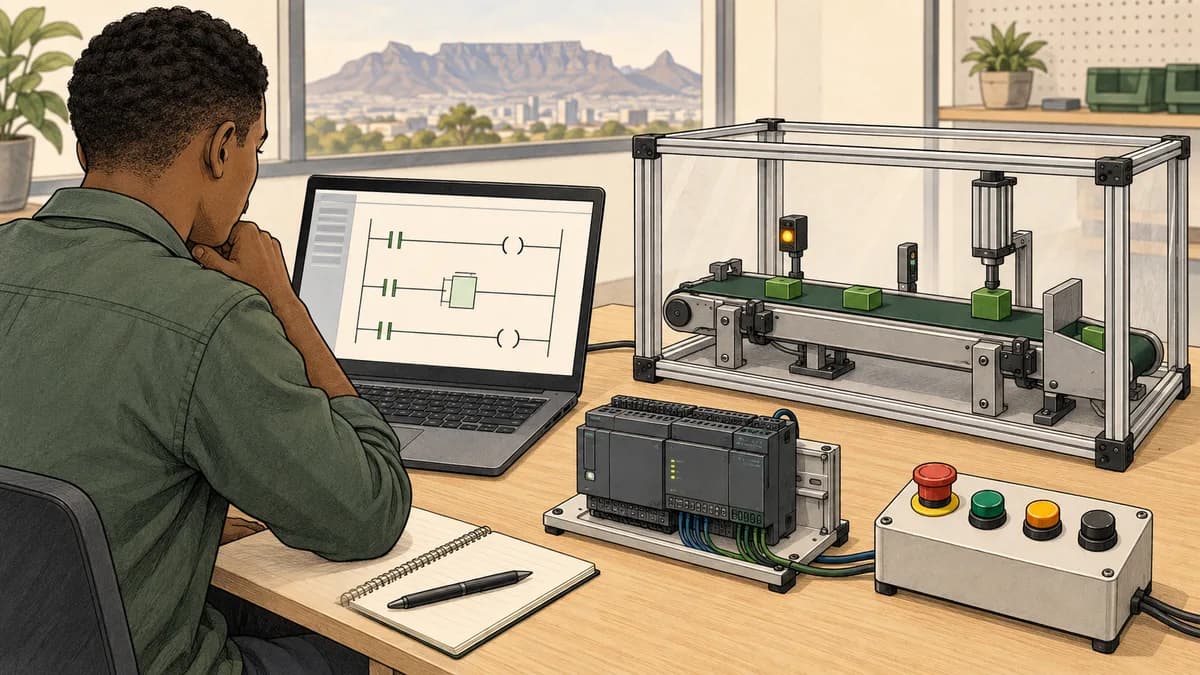
CODESYS PLC training in Bloemfontein can combine local electrical or PLC foundations with a clearly specified CODESYS course or remote practical. The important distinction is the actual teaching environment. A local course labelled PLC does not automatically include CODESYS, and a CODESYS development-system lesson does not automatically include real controller I/O or a particular manufacturer's hardware.
This guide examines a local enquiry route and a published vendor online option, then explains how to plan a useful learning sequence. It includes a fictional prerequisite exercise and a small state-tracing task. The aim is to help learners and training buyers choose an appropriate course and recognise the evidence that each stage should produce.
Local PLC enquiry and a vendor online option
CS Electrical Training Centre lists a Bloemfontein address in Oranjesig and a two-week course covering basic and advanced PLC programming with VSD installation. Its public page does not identify the PLC programming platform. Ask whether the current course includes CODESYS, which target is used and what learners do individually before treating it as a CODESYS-specific option.
The CODESYS Academy's November 2026 Essentials event is advertised online in English for 16–20 November. The event page specifies 08:30–12:30 CET. The academy overview uses a different time-zone label for that listing, so obtain the confirmed South African session times before arranging attendance.
These are different routes to investigate. The local course may provide foundations if its syllabus fits your needs; the vendor event explicitly concerns CODESYS V3. Neither listing reserves a place or establishes that every learner can attend without checking prerequisites, equipment and practical arrangements.
Provider information was checked on 12 September 2026. Confirm the exact event, current fee, delivery mode and available places. Use the Bloemfontein PLC training guide for broader local study choices rather than assuming that this brand-specific page covers every educational route in the city.
Describe your location and delivery needs clearly
State whether you need a Bloemfontein classroom, can attend elsewhere or want live online teaching from home or work. Include the hours you can commit and whether you have a suitable computer. A provider can give a more useful answer when these constraints are explicit.
For a workplace group, identify whether the lesson should use an instructor's standard training environment or a sanitised example relevant to the team's responsibilities. Ask who supplies software, runtime access and equipment. A meeting room with laptops is not automatically a configured CODESYS laboratory.
What “CODESYS training” needs to specify
The CODESYS development-system overview describes the engineering tool and provides a free download route. Do not assume a learner must buy an expensive editor licence simply to begin. Runtime products, optional components, course delivery and hardware access remain separate questions.
Ask which development-system generation and version the course uses. The vendor event cited above names CODESYS V3. A lesson prepared for a different generation or a manufacturer's customised environment may have different setup and workflow details. Get the actual installation instructions from the course organiser.
Specify whether the practical uses development-system simulation, an installed soft-PLC runtime or a dedicated controller. The CODESYS runtime comparison guide explains why these environments answer different questions. A simulated variable changing does not prove a physical I/O channel or network path has been tested.
Ask for the controller and software together
If you are learning for an existing workplace, request the approved controller family, runtime or firmware and engineering environment from the person responsible for training. A brand name alone may not identify the required setup. Avoid copying confidential projects or connection details into a public course enquiry.
If you do not yet have a target, say so. An introductory course can use an appropriate standard environment to develop the concepts. The provider should explain its scope and what additional learning is required before working with a specific industrial controller.

Build the foundation from demonstrable tasks
Begin with a small Boolean requirement. The learner should identify inputs and outputs, predict the result for selected combinations and explain the implemented condition. This is a useful starting point whether the course begins with Ladder Diagram, Function Block Diagram or Structured Text.
Next, introduce data types and units. Ask what a value represents, its valid range and how an invalid or missing observation is handled. A programme that displays a number has not necessarily interpreted it correctly. The data conversion guide can support preparation if that topic is new to you.
Then introduce state. A value remembered from the previous observation changes what the next invocation does. The learner should trace the initial state, update and output rather than treating each line or network as an isolated calculation. This is essential preparation for timers, counters and reusable function-block instances.
The CODESYS language-choice guide provides comparisons and small exercises. Learn why a representation fits a task and how to test the behaviour. There is no need to claim mastery of every language before you can complete a useful introductory exercise.
Recognise existing skills without skipping evidence
An electrician may bring strong understanding of signals and drawings while needing practice with software structure. A learner with programming experience may understand expressions but need help with cyclic execution and state. Use an initial task to identify the actual starting point.
The South African PLC course requirements guide helps frame that discussion. A provider's formal entry conditions still apply to its course. Prior experience should inform the learning plan, not become an untested assumption that every prerequisite is satisfied.
Worked exercise: plan the learning order from prerequisites
The fictional StudyRoute contains five modules. These are invented teaching tasks, not the timetable or admission rules of either provider cited above. Each module has a stated prerequisite, and a learner must demonstrate that prerequisite before beginning the dependent practical.
Module A is Boolean logic with no prerequisite. Module B is typed data and requires A. Module C is stateful function blocks and requires B. Module D is library consumption and requires C. Module E is a target-integration exercise and also requires C.
| Module | Practical outcome | Required previous module |
|---|---|---|
| A | Explain and test a small Boolean rule | None |
| B | Validate and interpret typed study data | A |
| C | Trace independent function-block state | B |
| D | Identify and use a documented library interface | C |
| E | Check a training target's specified data path | C |
The learner has already demonstrated A. A proposed schedule is D, B, C, E. It begins with D even though C has not been demonstrated, so it violates the declared prerequisite rule. The fact that D is advertised as a desirable advanced topic does not change that dependency.
A valid remaining order is B, C, D, E. Another valid order is B, C, E, D because D and E depend on C but not on each other. This is a simple example of why a useful learning plan need not have one universal sequence while still respecting necessary foundations.
Treat an unassessed prerequisite as unknown
Suppose the learner says they have used function blocks before, but there is no evidence for C in this exercise. Mark C as unassessed and offer a suitable assessment. Do not automatically record a failure, and do not automatically skip it.
If the learner demonstrates C through the agreed assessment, review the route using that evidence and any required supporting prerequisites. The purpose is to identify a defensible starting point, not to force everyone through identical lessons or grant exemptions from an unsupported self-description.
Now change E so it additionally requires D. The previously valid B, C, E, D order is no longer valid. Revisit the plan when the target exercise changes. An old course sequence can become inappropriate even when the module names remain the same.

Give each module an observable completion condition
For A, require a truth table or a set of cases that distinguishes the intended Boolean rule from a plausible mistake. A programme that runs without error is insufficient if the learner cannot explain why its output changes.
For B, require the learner to state the valid data range and handle an out-of-range example according to the exercise specification. Include zero when it is a valid value. Do not let a generic truthy check accidentally treat a legitimate zero as missing data.
For C, require a trace that exposes state between observations. For D, require the library identity, interface and effective dependency information needed to reproduce the exercise. For E, require the actual input path and an observation that distinguishes the intended source from another source.
These completion conditions are separate. A learner might perform the calculation correctly but omit the environment record needed for reproduction. Another might document the environment well while misreading state. Separate feedback helps choose the next exercise rather than reducing the whole course to an unexplained percentage.
A small state exercise before library work
The fictional PulseStudy observes a Boolean input called Sample. It increments Count only when Sample is true and the previous observation was false. The initial previous value is false and Count begins at zero. After every valid observation, previous becomes the current Sample value.
Use the sequence false, true, true, false, true, false. The resulting counts are 0, 1, 1, 1, 2 and 2. The repeated true observation does not create a second rising transition. A learner should explain that result from the stored previous value, not from a memorised screenshot.
Now ask the learner to create a second independent study instance. The second instance observes true, true, false, false, true, true and produces counts 1, 1, 1, 1, 2 and 2 from its own initial state. The two instances have separate histories even when their final counts happen to match.
| Observation | First Sample | First Count | Second Sample | Second Count |
|---|---|---|---|---|
| 1 | False | 0 | True | 1 |
| 2 | True | 1 | True | 1 |
| 3 | True | 1 | False | 1 |
| 4 | False | 1 | False | 1 |
| 5 | True | 2 | True | 2 |
| 6 | False | 2 | True | 2 |
This is a paper model for teaching state and instances, not a native CODESYS execution result or a guarantee that every physical pulse is captured. The function block versus function guide explains the underlying distinction in more depth.
Ask a question that reveals understanding
Ask what would change if both signals shared one previous-value variable. The learner should recognise that one signal's observation can affect how the next signal is interpreted. They do not need a production controller to see that the ownership rule has changed.
Before adding reset, specify its priority and effect on the previous value. Resetting only Count is a different rule from resetting Count and previous together. An instructor should define the intended extension and select a trace that distinguishes the alternatives.

Follow with library and target evidence
For library study, ask the learner to identify the package, namespace and effective version used by the consumer. A familiar library name does not prove identical dependencies on two computers. The CODESYS library guide includes a boundary example where unchanged interfaces conceal a behaviour difference.
For target study, use the actual supported runtime and a clearly documented training data path. Identify which parts are simulated and which are connected. A native runtime practical should not inherit evidence from a browser exercise without checking the relevant integration assumptions.
Add a small fault-finding task after the normal result is understood. For example, provide a wrong source identity or an incomplete dependency record and ask what observation would resolve the uncertainty. The learner should preserve evidence and explain a narrow conclusion rather than changing several settings at random.
The PLC troubleshooting guide provides a general framework for that reasoning. The brand-specific course should then show how relevant observations are obtained in its installed environment. This connects transferable diagnostic thinking with the actual tool.
Prepare for live online attendance from Bloemfontein
Confirm the event's time zone and the corresponding South African times in the booking communication. The cited vendor pages use inconsistent labels, so do not rely on a casual conversion from an overview. Ask for the schedule that will govern your actual class.
Check the required computer, software installation, audio, camera and connection arrangements in advance. The November vendor event lists accessories and participation conditions on its page. Read the current conditions before paying and ask how practical access is provided; do not assume a meeting link supplies a complete runtime environment.
Run the organiser's setup check before the first session. Confirm that you can open the required project, locate the supplied dependencies and access the authorised training target where applicable. If a requirement is missing, resolve it while there is time for support rather than losing the practical session to installation work.
Plan a quiet place and time for independent exercises after the live class. A course can introduce several topics quickly, but repetition is what reveals whether you can perform a task without following the instructor's exact sequence. Keep a list of questions arising from that practice.

Compare quotations and the meaning of the certificate
Request a complete quotation with tuition, tax treatment, software or runtime access, assessment and any repeat assessment. For a foreign-currency course, use the actual payment terms and conversion at purchase rather than a fixed rand estimate copied from an old article. Add any local travel or equipment costs separately.
The PLC course price guide helps compare delivery models. A local general course and an international vendor course may solve different needs, so compare the outcome and complete required setup rather than only the advertised duration.
Ask exactly what document is issued and on what basis. The cited vendor event states a certificate on successful completion; that should not be relabelled as a South African registered qualification. For any claimed qualification or credit arrangement, verify the specific course and issuing body rather than transferring an organisation's general status to every offering.
For an employer, agree the work-related learning outcome before booking. A useful objective might be that the learner can reproduce a small library consumer and explain its dependency resolution. Avoid treating attendance alone as proof of authority to change an operational system.
What a training centre can evaluate before buying software
Choose one lesson and define what every learner should do. For the state exercise, require each learner to predict the trace, run an appropriate implementation and explain a deliberately wrong result. For the dependency exercise, require a reproducible environment record.
Evaluate whether the proposed software supports those activities and the instructor's review process. Confirm simultaneous access, current product scope and the materials learners can retain. Do not infer institutional features from a generic simulator label.
Our PLC training-centre guide can help organise that evaluation. A small pilot with explicit criteria is easier to assess than a broad promise that one tool will cover every controller, language and qualification. Keep native vendor practicals where the lesson requires native behaviour.
Use browser practice as a clearly labelled preparation layer
This site is commercially connected to PLC Simulation Software. Its Structured Text learning resources can support practice within the current educational feature set. Check the supported operations before choosing a lesson that depends on a particular vendor extension.
Its PLC programme testing resources can help learners organise expected results and informative test cases. The product should not be assumed to import native CODESYS projects, install vendor libraries or reproduce a hardware target's timing.
Keep a portfolio that identifies the environment for each result. Include the requirement, chosen cases, observed behaviour and a corrected mistake. A reviewer can then see where you have practised concepts and where you still need supervised work in the target development system or laboratory.

Questions about CODESYS training in Bloemfontein
Is the local PLC course confirmed to use CODESYS?
The cited CS Electrical Training Centre page advertises PLC and VSD training but does not identify the programming platform. Ask for the current syllabus, development system, controller and practical arrangement. Keep it classified as a general PLC enquiry until those details are confirmed.
Can I attend a vendor CODESYS course online?
The cited November 2026 Essentials event is advertised online in English. Confirm availability, prerequisites, practical access and the South African session times with the organiser. A published listing is not a completed booking.
Do I need to buy the CODESYS editor before learning?
The vendor provides a free development-system download route. Runtime use, optional components, hardware and taught training may have separate costs. Ask the course organiser for the exact required setup rather than assuming either that everything is paid or that everything is included free.
Should I start with libraries or basic logic?
Start from demonstrated prerequisites. In the fictional route, typed data and stateful function blocks precede library consumption. An experienced learner can be assessed for an appropriate starting point, but an unassessed skill should not be silently treated as proven.
Does the same final count prove two instances behave identically?
No. In the PulseStudy table, the two instances finish at two but have different intermediate histories. Preserve the full trace and initial conditions. A final snapshot can hide meaningful differences in how state evolved.
What should I include in a first enquiry?
State Bloemfontein, your experience, the target environment if known and the tasks you want to perform. Add delivery constraints and request the practical specification, assessment example, current dates and complete quotation. That creates a course proposal you can compare against a real learning need.