brands · South Africa
Delta DVP PLC Guide: Models, I/O and Platform Selection
Compare Delta DVP PLC models by I/O type, expansion, networking, software and lifecycle. Includes a worked selection exercise for South African learners.
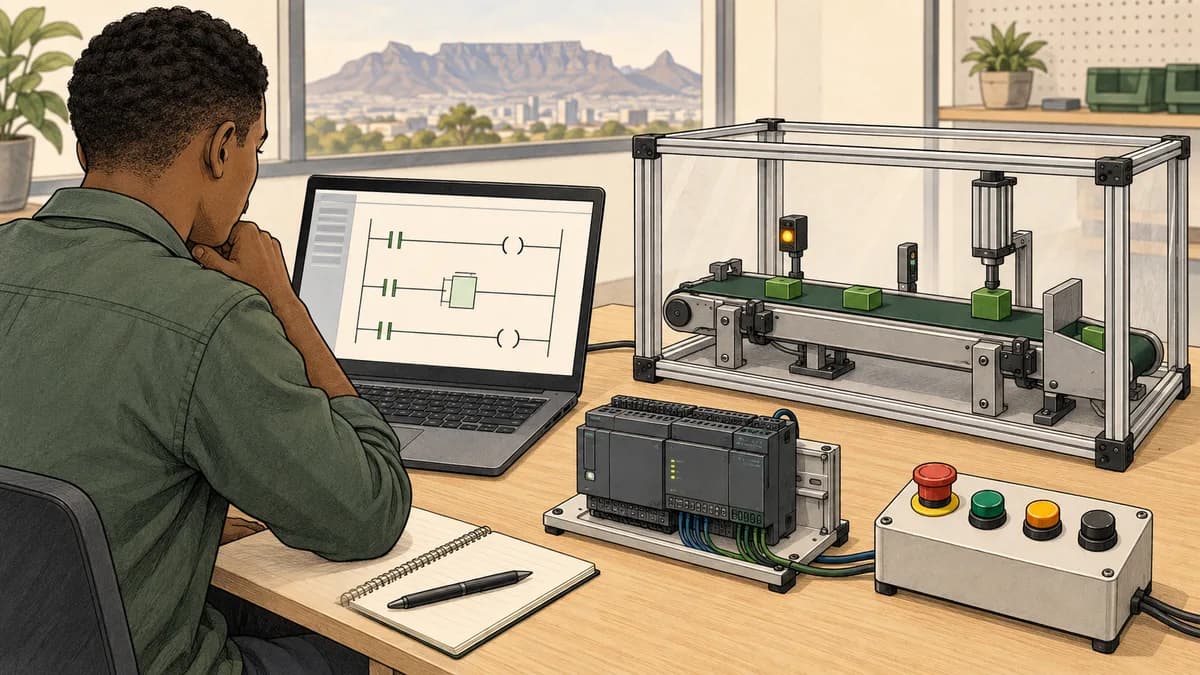
Delta DVP is a family of PLCs, not one fixed controller specification. Select a DVP model from the exact I/O, output type, communication role, expansion arrangement and software requirements. A familiar series name can be a useful starting point, but it should not replace a complete catalogue number and current manufacturer documentation.
This guide explains the questions behind a useful DVP comparison for South African learners and training buyers. It covers SS2, SX2, ES2 and newer DVP options, corrects several common family-level assumptions, and includes a fictional I/O selection exercise. The exercise is a requirements screen, not a hardware recommendation or an engineered panel design.
Start with the current product range and lifecycle
Delta's current EMEA PLC catalogue lists standard, slim and motion-oriented DVP groups. It includes newer ES3, EX3, SV3 and SX3 options alongside several earlier series. The same page places DVP-EH3 under discontinued products. This was checked on 12 September 2026.
That lifecycle listing matters when considering a new purchase. An existing EH3 installation may still require maintenance training, but it should not automatically become the preferred new platform because an old comparison called it the practical minimum. Ask the supplier about the exact model's availability, support and migration route.
A catalogue entry is not proof of South African stock or a local delivery date. Obtain a written quotation for the complete model and accessories. Keep lifecycle status, inventory, technical suitability and price as separate questions so a readily available item does not silently substitute for the required specification.
The Delta PLC training guide provides the broader learning context across DVP, AS and other families. This page concentrates on the DVP selection questions that a learner should be able to explain before configuring a native project.
Read the complete model, not only the series name
A model's suffix and variant can change its output arrangement or other capabilities. Record the full catalogue number from the approved specification or equipment label. If you only have a partial name such as DVP-SS2, identify what remains unknown before comparing it with another option.
Separate digital inputs, digital outputs, analogue inputs and analogue outputs. A headline total of “20 points” does not mean twenty interchangeable channels. Inputs cannot be used as outputs merely because the total count looks large enough, and an analogue channel must match the intended signal and range.
Output technology also matters. Relay and transistor variants should not be treated as interchangeable for every load or pulse-output task. Check the exact variant's electrical and functional specification, including the channels available for specialised functions. A family page can describe a capability that only applies under particular model conditions.
Use model examples to learn how to read specifications
Delta's SS2 information for its 14-point model lists eight digital inputs and six digital outputs, serial communication and expansion capacity. This is enough to reject the blanket claim that SS2 is fixed, RS-485-only and has no expansion route. It is not a statement that every SS2 variant has identical onboard counts.
The vendor's SX2 product information describes a 20-point arrangement comprising eight digital inputs, six digital outputs, four analogue inputs and two analogue outputs. The split matters more than the headline total. Confirm the exact variant, supported ranges and expansion details for the actual selection.
These are manufacturer references for understanding the family. They do not establish current local inventory, an installed application's condition or the suitability of a particular module combination. Keep those checks in the purchasing or training brief.

Build an I/O requirement before looking at prices
List each signal with its direction, type, meaning and required behaviour. For a training model, separate normal programme signals from any real protective equipment. A generic educational output should not be mistaken for a safety-rated function because its tag contains the word stop or interlock.
For analogue signals, identify the electrical form, engineering range and expected conversion. The analogue signal guide helps distinguish those concepts. A count of four analogue inputs does not by itself establish compatibility with four arbitrary instruments.
For digital signals, identify whether ordinary sampled input behaviour is sufficient or whether the exercise needs a documented high-speed function. Record any specialised output requirements separately from the ordinary digital output count. A pulse-output requirement cannot be met by counting all outputs without checking their supported roles.
Add a justified allowance for known future work if the brief requires it. Do not use a universal spare percentage as though it were a manufacturer rule. State the planned additions and check the compatible expansion path, supply limits and installation constraints for the selected system.
Worked exercise: a total point count hides a shortage
The fictional CellStudy requires ten digital inputs, seven digital outputs, three analogue inputs and one analogue output. All signals are part of a paper selection exercise. No electrical ratings, response times or physical wiring are specified, so passing this count screen cannot establish full suitability.
The trainer supplies two fictional candidates. Candidate A has eight DI, six DO, four AI and two AO. Candidate B has twelve DI, eight DO, four AI and two AO. These invented candidates are not assigned real Delta model numbers and do not imply a supported hardware assembly.
| Channel type | Requirement | Candidate A | Candidate B |
|---|---|---|---|
| Digital input | 10 | 8 | 12 |
| Digital output | 7 | 6 | 8 |
| Analogue input | 3 | 4 | 4 |
| Analogue output | 1 | 2 | 2 |
The requirement totals 21 channels. Candidate A totals 20, but the more informative result is its shortage of two DI and one DO. It has one extra AI and one extra AO, which cannot compensate for the missing digital channels. Candidate B passes the count screen with two spare DI, one spare DO, one spare AI and one spare AO.
Now change the requirement to eight DI, seven DO, three AI and one AO: nineteen total channels. Candidate A still fails because it has only six DO. A total capacity greater than the total requirement does not prove that the categories match.
Add an expansion only when compatibility is established
The trainer proposes an expansion for Candidate A that adds four DI and four DO. The arithmetic would produce twelve DI and ten DO while leaving analogue counts unchanged. That would satisfy the original channel counts, but the exercise initially supplies no compatibility information.
Classify the expanded option as unresolved. The arithmetic result is known; the validity of combining the components is not. Ask for the required evidence about the interface, supported module arrangement and supply constraints. Do not turn a mathematically sufficient combination into an approved design without those facts.
When the trainer supplies a fictional statement that the combination is permitted within this classroom model, repeat the limited count screen. It now passes that screen. Real hardware still requires the applicable manufacturer specifications and engineering checks, which the paper example deliberately does not supply.

Networking is a role and compatibility question
Separate the physical interface from the protocol and the communication role. RS-232, RS-485 and Ethernet describe different interface contexts; a protocol feature must be checked for the exact CPU, module and software arrangement. A connector or family name is not a complete communication specification.
Delta's DVP Ethernet read/write FAQ describes ETHRW use with built-in Ethernet on identified models and with DVPEN01 modules for identified slim-series hosts. This contradicts the blanket assumption that only an EH3 can provide useful Ethernet data exchange. Consult the linked programming instructions for the actual supported arrangement.
Do not infer that every DVP CPU accepts every Ethernet module. Check the host's expansion support, exact module, firmware and required communication function. A solution for one DVP variant does not automatically transfer to another with a similar name.
For learning, the Modbus, EtherNet/IP and PROFINET comparison explains why protocol names and roles matter. A course should then show the actual Delta configuration and a test that proves the intended data path, rather than presenting a generic network diagram as completed integration.
Test identity and changing data
A communication practical should identify the source, destination, data type and expected value interpretation. Use a controlled sequence of distinct values, including zero when valid. One plausible number on an HMI can conceal a wrong register or a stale observation.
Document whether an address in the teaching material is a device label, register reference or protocol offset. Do not apply a universal conversion between displayed addresses and a SCADA database field. The client driver and PLC documentation determine the mapping convention that must be checked.
If the result is wrong, use the communication troubleshooting guide to separate connection, addressing, data interpretation and application update questions. Changing all four at once makes the next observation difficult to explain.
Check high-speed functions by exact variant
It is inaccurate to assume that every compact DVP lacks pulse outputs or high-speed counting. It is equally inaccurate to assume that every output on every variant can perform those tasks. Use the exact controller's instruction and hardware documentation to identify supported channels, limits and combinations.
Describe the required function in the brief. Counting sampled virtual events, receiving an encoder signal and generating a pulse command are different activities. The number of axes, pulse frequency, electrical interface and coordination requirement each need their own specification when relevant.
For a course, ask whether the lesson is a logic demonstration, a native instruction exercise or a physical motion practical. The motion-control introduction helps frame those differences. A simulated sequence does not establish the performance or suitability of a real motion system.
Avoid using a family overview as a wiring or commissioning procedure. Once the task moves to hardware, follow the exact equipment documentation and the training laboratory's authorised process. The useful outcome here is the ability to ask the right model-specific questions before the practical begins.

Choose the software from the supported target
Delta's current documentation describes both ISPSoft and DIADesigner, with support depending on the PLC series. The DIADesigner product page lists AS controllers and specified newer DVP series. Do not assume an instruction written for one tool applies unchanged to every DVP generation.
Also distinguish DIADesigner from DIADesigner-AX. Similar product names do not establish the same controller support. Ask the course organiser for the exact software version, target list and project format. This prevents a learner from arriving with a plausible-looking but unsuitable installation.
The ISPSoft ladder basics guide develops the programming-learning path. Start with a small project for the specified CPU and identify which functions are supported. A general claim that an editor supports several languages does not mean every connected controller supports every language in the same way.
For existing equipment, preserve the original project and environment record before considering a software or controller migration. Conversion is a change that needs review and tests. Successful opening or compilation is useful evidence, but it does not prove that mappings, timing and special instructions retain the required behaviour.
Compare programme resources without mixing units
A family comparison may describe programme capacity in steps and data storage in words. Do not casually relabel those figures as kilobytes or compare them directly with a different vendor's memory number. Identify what the manufacturer is counting and what the application consumes.
For a training exercise, use the development environment's applicable resource information and a documented small programme. Ask the learner which part of the application contributes to the resource being inspected. Avoid treating a larger number as automatically better without connecting it to an actual requirement.
When the course introduces arrays, data records or communications, revisit capacity and representation. A project can fit its ordinary logic while still needing review of data areas, communication buffers or supported instruction limits. The data conversion reference is useful preparation for interpreting the values stored and exchanged.
Record unknowns in the selection note. If a requirement cannot be checked from available documentation, request the missing information. A blank field should not be filled with a guessed value simply to make the comparison table look complete.

Use lifecycle and maintenance needs in the selection
For a new project or training investment, ask how long the intended model and supporting software will be available and what replacement route is documented. For an existing installation, ask what skills and records are needed to maintain its actual platform. These can lead to different training choices.
An older controller can be a valid learning target when the course explicitly teaches an existing environment. The problem is presenting that target as a current new-design default without checking lifecycle status. Keep maintenance relevance separate from a purchase recommendation.
For a training centre, consider whether learners need exposure to one installed generation or a broader comparison. A mixed lab can be useful when the instructor makes differences explicit. It can be confusing when exercises assume identical ports, software and memory conventions across all benches.
The guide for PLC training centres helps turn that decision into an evaluation brief. Define the learning outcomes first, then select equipment and educational software that support them. A larger collection of controllers does not automatically produce deeper individual practice.
Compare the complete South African purchase or course cost
Request a quotation for the exact CPU, expansion modules, communication hardware, power and accessories required by the brief. Include software or optional components where applicable, delivery, tax treatment and support. A bare CPU price is not a complete system cost.
For courses, compare tuition, individual practical time, equipment access, assessment and continued practice. Use the South African PLC course price guide to organise those items. This page does not claim a fixed DVP price or an unsupported percentage saving over another brand.
Ask the supplier to identify substitutions before accepting a changed part number. A substitute can affect output type, communication, expansion or software compatibility. Review it against the same requirement rather than assuming a similar name means an equivalent product.
Retain the quotation and specification with a date. Prices and availability can change, while an old educational article may remain discoverable for years. Readers should be able to distinguish a worked selection method from a current commercial offer.
What a useful DVP course should demonstrate
A learner should identify the target, read its basic specification, create or inspect a small supported programme and explain the input-to-output behaviour. Add one deliberately wrong case that reveals whether they understand the requirement rather than only the editor sequence.
For an intermediate practical, ask the learner to document an I/O or communication path and distinguish a wrong source from an incorrect calculation. Require the exact environment and model information with the result. A screenshot without that context is difficult for another person to reproduce.
For a maintenance course, include project identification and evidence preservation before changes. The PLC troubleshooting guide provides a general method, while the course should teach the native observations available on the selected DVP platform.
Build a portfolio around one small problem with clear tests. The fictional count screen in this guide can become a selection worksheet, while a separate native practical provides implementation evidence. Label the paper and hardware results accurately instead of implying that the worksheet validates a physical design.
Where browser practice supports the learning route
This site is commercially connected to PLC Simulation Software. Its PLC programme testing resources can support practice with requirements and expected results within the product's current educational scope.
Its PLC data-type learning resources can help learners prepare to interpret values and interfaces. They do not establish native Delta project import, ISPSoft compilation or electrical compatibility with a DVP controller. Check the supported features before selecting a specific exercise.
Follow conceptual practice with supervised work in the actual Delta environment required by your course. Keep the controller model, software version, test inputs and observed results together. This makes the preparation useful to an instructor and prevents a generic simulation result from being mistaken for complete platform experience.

Questions about the Delta DVP family
Is every DVP-SS2 limited to fixed digital I/O?
No. The manufacturer's SS2 information includes expansion capability, and exact onboard counts depend on the model. Check the complete catalogue number and compatible expansion specification. Do not infer a universal lack of analogue expansion from the CPU's onboard channels.
Does a 20-point PLC necessarily satisfy a nineteen-signal requirement?
No. The fictional example has enough total points but lacks a required digital output. Compare DI, DO, AI and AO separately, then check signal types and other constraints. Spare inputs cannot automatically replace missing outputs.
Is DVP-EH3 the default choice for a new Ethernet project?
It should not be treated that way. Delta's current EMEA catalogue lists EH3 under discontinued products, and its Ethernet FAQ describes other arrangements. Review current models, exact communication requirements and support with the supplier.
Can I select an expansion module by arithmetic alone?
No. Count sufficiency and component compatibility are separate checks. The paper example remains unresolved until its compatibility assumption is supplied. Real equipment requires the manufacturer's supported arrangement and the relevant engineering review.
Do all DVP models use identical programming software and languages?
No. Confirm the exact supported tool, version and controller functions. Current Delta documentation distinguishes product support across ISPSoft and DIADesigner. Similar editor names or family labels should not replace the target-specific compatibility information.
What should I bring to a DVP training enquiry?
Provide your experience, complete target model if known, software environment and intended tasks. Ask for the laboratory specification, individual practical activities and assessment example. That produces a course proposal you can evaluate against the work you want to learn.