brands · South Africa
Mitsubishi iQ-R vs iQ-F: I/O, Motion, Networks and Selection
Compare Mitsubishi iQ-R and iQ-F using exact configurations, typed I/O, motion modules, network roles, migration checks and South African course choices.
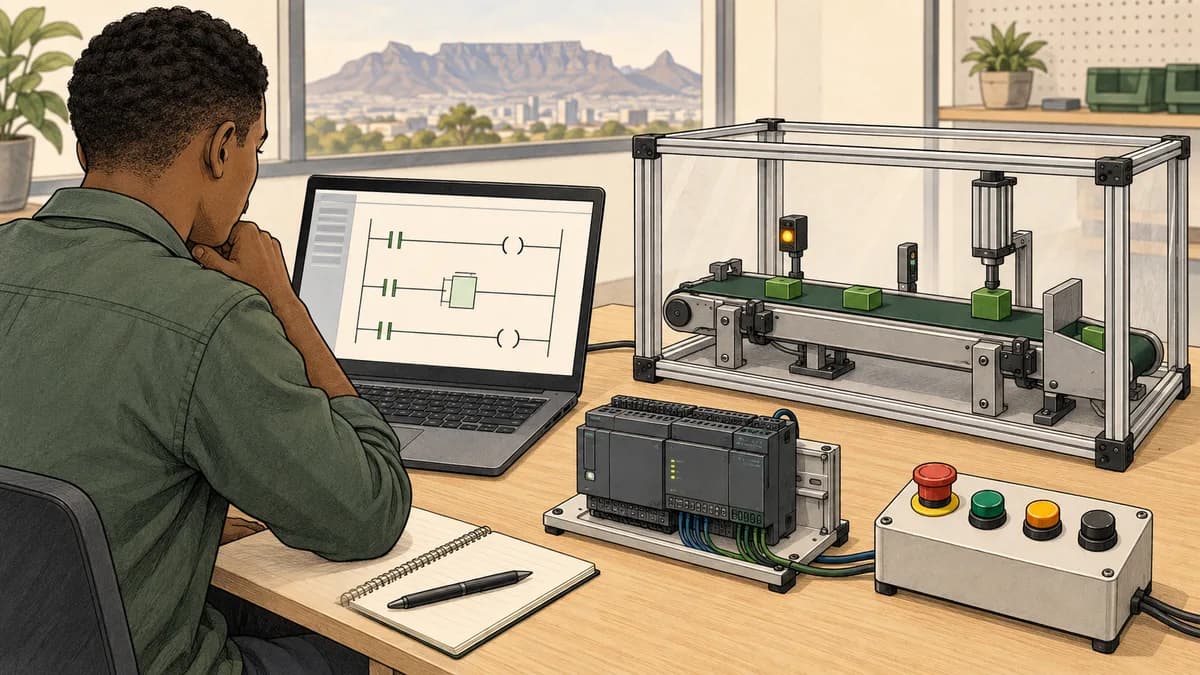
Choose between MELSEC iQ-R and iQ-F by checking a complete configuration against the job. The family name alone does not tell you the available motion functions, network role, memory allocation, expansion compatibility or restart behaviour. For South African learners and engineering buyers, a useful comparison should explain which facts to obtain before choosing a course, quoting a panel or planning a migration.
In broad architectural terms, iQ-R is a modular platform built around base units, while iQ-F offers compact controller configurations with expansion options. Both belong in a GX Works3 learning discussion, but learning the editor is only one part of selecting and validating hardware. The Mitsubishi PLC training guide explains the wider learning route; this article focuses on how to reason about the platform decision.
Start with the task, then identify exact equipment
Write the required inputs and outputs by signal type, not just as a total. Separate ordinary digital signals, analogue measurements, high-speed counting, positioning and safety-related requirements. Identify the devices that must communicate, their protocols and roles, and any existing equipment that must remain. Add the required operating environment and the practical constraints on commissioning access.
For a training purchase, translate those engineering requirements into learner activities. Someone maintaining an existing iQ-R system may need module configuration, diagnostics and migration evidence. Someone learning a compact machine programme may initially need signal mapping, sequence logic and a small controlled demonstration. Neither learner is helped by a course that advertises only a generic brand name.
Record model suffixes and revisions. A relay-output controller, a transistor-output variant, a network module and a motion module are not interchangeable because their descriptions all contain “FX5.” Likewise, do not infer an iQ-R CPU's specialised capabilities from its programme capacity. Treat every proposed capability as a claim that needs a matching part number and documentation.
This is also the stage to separate immediate requirements from future possibilities. “May add a servo later” is not yet a motion specification. It becomes useful when the owner states the intended control mode, axis count, drive family, coordination and commissioning expectations. Until then, label it as unresolved instead of silently choosing either the smallest or largest platform.
What the iQ-R base-unit documentation actually establishes
Mitsubishi's iQ-R basic system configuration lists R35B as a five-position main base and R38B as an eight-position main base for I/O modules. It separately lists R65B and other extension bases for iQ-R modules, and RQ65B, RQ68B and RQ612B extension bases for Q-series modules. That distinction matters when checking a migration proposal.
Do not draw a generic iQ-R main rack using a Q-series base and assume every Q module transfers directly. A documented RQ extension option is not blanket approval for any old assembly. Compatibility still needs to be checked for each retained module, the proposed arrangement and the applicable restrictions. Keep those checks in the project record so that “reuse existing I/O” has an exact meaning.
A modular drawing should show the CPU, power supply, base, occupied positions and relevant extension connections. A parts list without the topology can hide missing components. Conversely, a polished drawing without exact models may conceal an incompatible selection. Ask for both before treating a configuration as costed and reviewable.
For a classroom, the same principle makes an excellent assessment. Give the learner an incomplete proposed layout and ask which facts are missing. They do not need to guess an orderable bill of materials from memory. They need to explain what each component does and where its compatibility evidence will come from.

Compare programme capacity using the published units
The iQ-R programmable controller CPU page expresses programme capacity in steps. For example, it lists R04CPU at 40K, R16CPU at 160K and R120CPU at 1200K within that programme-capacity context. Those figures should not be relabelled as kilobytes or megabytes. The page also distinguishes ordinary CPU models from ENCPU variants with embedded network facilities.
Memory comparisons become misleading when a writer mixes programme steps, device memory, label storage, file space and removable media. A number from one category does not answer a question about another. For a real project, obtain the compiled resource usage and compare it with the relevant limits for the exact CPU and configuration.
Likewise, a single instruction-processing figure is not a complete application cycle-time guarantee. A control programme includes its own instruction mix, calls, communications and scheduling conditions. Specify the timing requirement and the observation method. A demonstration that runs one tiny rung quickly does not prove that an expanded application will meet its deadlines.
The GX Works3 function-block guide adds another useful distinction: a reusable definition and its instances are different design objects. As a programme grows, state ownership and resource usage deserve review together. Copying an extra block graphic may change memory use and behaviour even when the visible algorithm seems unchanged.
iQ-F is not limited to four simple positioning axes
The manufacturer's FX5 motion-module page documents FX5-40SSC-G at four controlled axes per module and FX5-80SSC-G at eight. These are CC-Link IE TSN motion modules, with functions including positioning, synchronous, cam and speed-torque control. The page states that operating cycle depends on axis count and model, and provides restrictions around connected modules.
This is enough to reject a blanket rule that any requirement above four axes forces a move from iQ-F to iQ-R. It is not enough to approve a particular multi-axis machine. You still need compatible controllers, drives, network arrangements, functions and versions. Eight axes on a product page should lead to a configuration check, rather than an automatic purchase decision.
Describe motion in operational terms. Independent positioning, synchronised movement, homing, gearing and cam functions are different requirements. An axis count alone hides those differences. Also distinguish the control interface: pulse output and a motion network are not the same implementation simply because both can move a servo.
For learners, the motion-control basics guide is a useful preparation step. Ask the training provider whether each participant configures and tests the relevant motion arrangement or merely watches a demonstration. A general ladder exercise can prepare logic reasoning, but it does not establish practical competence with servo setup, mechanics or coordinated motion.
Ethernet does not identify the application protocol
The official iQ-F Ethernet communication table lists CC-Link IE Field Network Basic, MELSOFT connection, SLMP and other functions for the FX5U CPU Ethernet interface. It lists separate Ethernet and EtherNet/IP modules. The table also announces FX5-ENET/IP order acceptance ending in December 2026 and production discontinuation in March 2027, while listing FX5-EIP separately. These details were checked on 12 September 2026; confirm current supply and migration advice when quoting.
Do not turn the words “Ethernet port” into a claim that every Ethernet-based industrial protocol is built in. Nor should CC-Link IE Field Network Basic be renamed CC-Link IE TSN. Identify the actual protocol, required station role, participating devices and appropriate interface. For terminology across other ecosystems, see the industrial protocol comparison.
A network requirement should include the data to exchange and the expected behaviour when it becomes unavailable. If the receiving programme uses an old value, how will it know that the value is old? A successful connection during one demonstration does not answer that question. The communication troubleshooting guide helps structure the observation sequence.
For a course buyer, request the exact network exercise. “Networking included” could mean connecting the instructor's laptop, exchanging application data between controllers, or diagnosing a disconnected field device. Those activities require different equipment and produce different evidence. Make the intended learning outcome part of the booking discussion.

Worked selection exercise: eliminate failures before comparing preferences
The following configuration exercise is fictional. The letters do not represent Mitsubishi products, real quotations or approved hardware. Its purpose is to show why a large total-I/O number and a low price cannot settle a platform choice. Actual iQ-R and iQ-F candidates require their own verified specifications.
A training rig needs 24 digital inputs, 16 digital outputs and four analogue inputs. Its stated expansion requirement adds eight digital inputs and four digital outputs. Therefore the selection targets are 32 digital inputs, 20 digital outputs and four analogue inputs. The future rig also needs six axes with a specified coordinated motion function and a specified network role.
For this exercise, a candidate qualifies for the comparison only if all typed channel counts meet the targets and both the motion function and network role are confirmed. Unknown evidence leaves a candidate unresolved. A documented failure eliminates it. Price comparison happens only after those requirements have been resolved.
| Fictional candidate | DI | DO | AI | Required motion | Required network role | Result |
|---|---|---|---|---|---|---|
| A | 32 | 24 | 4 | Confirmed | Confirmed | Meets the stated exercise |
| B | 40 | 16 | 8 | Confirmed | Confirmed | Fails output requirement |
| C | 32 | 24 | 4 | Unknown | Confirmed | Unresolved |
| D | 32 | 24 | 4 | Confirmed | Contradicted | Fails network requirement |
| E | 32 | 20 | 4 | Confirmed | Confirmed | Meets the stated exercise |
Candidate B has 64 total channels, more than candidate A's 60, but too few digital outputs. Analogue inputs cannot be counted as spare digital outputs. This is the central defect in a “total points first” comparison. Typed requirements prevent an apparently larger candidate from winning on an irrelevant total.
Candidate C should not be described as either approved or proven incapable. The missing motion evidence could change the decision in either direction. Candidate E meets the exact output boundary: there is no need to invent an additional spare percentage after the specification already defined expansion. If the owner wants more reserve, revise the requirement visibly and rerun the comparison.
Change one requirement and explain the effect
Now increase the planned additional digital outputs from four to nine. The output target becomes 25. A's 24 and E's 20 both fail, even though they met the previous requirement. The correct response is to revise the configuration or requirement through the project process, not quietly keep the earlier “pass” label.
Next restore the original 20-output target and obtain confirmation of C's required motion function. C then joins A and E as a qualifying candidate in this fictional exercise. If the evidence instead confirms that the function is unsupported, C fails. These two possible outcomes explain why an unresolved item must remain visible while the investigation continues.
Finally imagine that A's supplier provides a lower price but no longer confirms the required network role. A becomes unresolved; the lower price does not compensate for missing capability evidence. A weighted score that awards many points for cost can hide this error unless mandatory requirements are evaluated before preferences.
The exercise intentionally does not assign prices, brand rankings or South African market shares. It tests a decision method. To use it for real equipment, replace the invented capacities and evidence states with traceable specifications for complete configurations, including expansion components and any restrictions that affect the claimed capacity.

Q-series or FX-series migration needs its own evidence
Start a migration with an inventory of the existing CPU, modules, networks, software, project sources and field connections. Record which parts must remain and why. A requirement to preserve a terminal arrangement differs from a requirement to preserve a communication protocol or an application function. Treating them all as “backward compatible” obscures the actual work.
Separate programme conversion from hardware reuse. A project that opens or converts still needs review of instructions, parameters, data layout, timing assumptions and external integrations. Retaining a field module also needs configuration and compatibility checks. Neither success automatically proves the other.
Prepare an acceptance plan around observable behaviour. Identify normal sequences, faults, operator commands, communications loss, restoration and the approved restart requirements. Establish which observations can be made in an isolated test environment and which need a controlled installation test. Preserve the baseline and the proposed revision so that differences can be investigated later.
The GOT screen-design guide is relevant when an HMI remains in the migration scope. Address and label mapping, numeric interpretation, quality and recipe behaviour deserve their own review. A controller migration that ignores the operator interface can leave apparently correct PLC logic connected to misleading displays or commands.
Compare South African costs as complete learning or engineering scopes
Obtain dated local quotations for the actual bill of materials. Include the components and services needed to make the proposed system usable: engineering software access, interfaces, power supplies, bases or expansion items, commissioning work and training where applicable. Confirm tax treatment, delivery and exclusions with the supplier. This article does not supply invented rand benchmarks or a universal iQ-R-to-iQ-F price multiplier.
For courses, compare access as carefully as duration. Ask whether a learner works individually in GX Works3, which controller models are used, what the instructor reviews and whether the necessary software remains available for practice after class. A cheaper seat can still be useful, but the scope should make any equipment sharing or demonstration-only work clear.
Use the South African PLC course price guide to structure the comparison and the course requirements guide to check preparation. In Johannesburg, Pretoria, Cape Town, Durban, Bloemfontein and Gqeberha, request an exact venue or remote-delivery arrangement instead of interpreting a city search result as proof of a scheduled local intake.
If you are selecting a training platform for a college or internal team, decide which outcomes require native equipment and which can begin with general logic exercises. The training-centre evaluation guide supports that distinction. Avoid buying a large hardware platform merely to teach a small Boolean exercise, or assuming that a small browser exercise covers a specialised hardware task.

Questions about Mitsubishi iQ-R versus iQ-F
Is iQ-R always the better PLC because it is larger?
No family label resolves a specific requirement. Compare complete compatible configurations, resource limits, functions, engineering support and the required lifecycle. A larger option may have capabilities you need, but unused headline capacity does not correct an unsupported protocol or incomplete commissioning plan. The fictional selection table shows why mandatory requirements should be resolved first.
Can iQ-F handle more than four axes?
There are documented iQ-F motion expansion options beyond four axes, including the eight-axis module discussed above. Select against the required motion functions and compatible system arrangement, not just axis count. This fact corrects a blanket limitation; it does not approve every six- or eight-axis application on any FX5 controller.
Can Q-series modules simply move into an iQ-R main base?
Do not assume that. The manufacturer's configuration information distinguishes iQ-R bases and RQ extension bases for Q-series modules. Investigate the exact retained module and supported arrangement. A photograph of a mixed migration example cannot establish compatibility for an unrelated parts list.
Is CC-Link IE TSN built into every FX5U Ethernet port?
Do not describe it that way. The built-in Ethernet table and the separate motion and network products distinguish functions and interfaces. Identify the required protocol and module arrangement explicitly. Similar network names and the same cable connector are insufficient evidence of compatibility.
Which platform should a beginner learn first?
Start with the platform that matches a defined learning or workplace need and is available in a suitable supervised setup. General PLC logic, state and testing can be learned before committing to a large configuration. This site is commercially connected with PLC Simulation Software; its PLC programming learning resources support general preparation, without claiming to validate an iQ-R or iQ-F hardware bill of materials.
What evidence belongs in a platform-selection portfolio?
Include the requirement revision, typed I/O schedule, topology, candidate parts, source references, unresolved items and decision rationale. Add the fictional exercise only as a method demonstration, clearly labelled. A document that exposes one unresolved compatibility question is more useful than a confident ranking built from unchecked assumptions.
Turn the comparison into a reviewable decision
For your next learning task, choose one small application and create a one-page requirements sheet. Define the signal types, intended expansion and one communication requirement. Build two candidate configurations from current documentation, marking unknowns explicitly. Ask a reviewer to challenge the evidence behind each claimed capability before comparing costs.
Then implement a small independent logic exercise and document its tests. The PLC programme testing resources can help with that general practice. Keep this evidence separate from native controller and hardware tests so that the portfolio accurately describes what was demonstrated.
The platform choice becomes defensible when each mandatory requirement has a supported answer, each unresolved item has an owner, and the complete configuration has an acceptance plan. That process scales from a training rig to a migration proposal without relying on invented performance figures, brand popularity claims or a single headline price.
