brands · South Africa
Schneider PLC Training in Bloemfontein: Courses and Tests
Plan Schneider Electric PLC training in Bloemfontein with manufacturer enquiries, software checks and worked measurement-model tests for applied study.
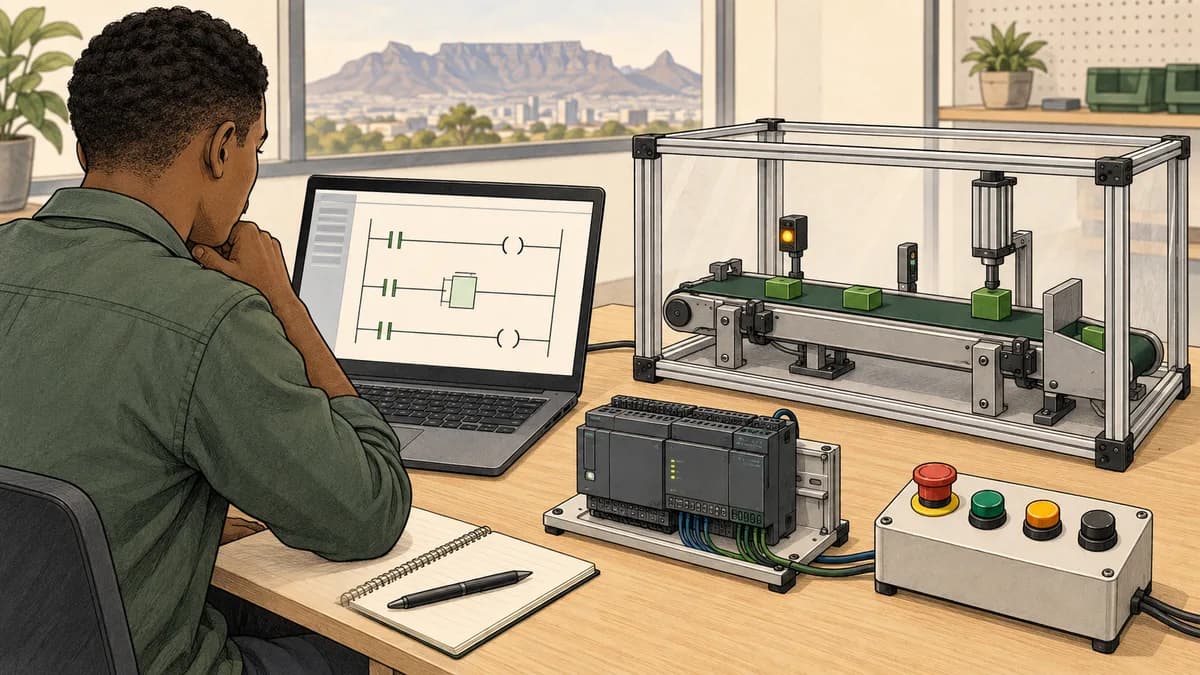
Schneider Electric PLC training in Bloemfontein should connect a clear equipment requirement with practical access and a suitable starting level. Identify whether you need general PLC foundations, Control Expert programming, an existing Modicon application or HMI work. Then obtain a course offer that names the software, controller and individual exercises.
The sources checked on 13 September 2026 provide a manufacturer enquiry route and relevant Free State research context. They do not confirm a scheduled public Schneider classroom in Bloemfontein. This guide also develops a fictional piecewise measurement model, with boundary and comparison tests that a learner can prepare before native instruction.
We operate PLC Simulation Software and may benefit from product links. The linked resources support general learning, not Schneider certification, native Control Expert project compatibility or a confirmed local course booking.
Training enquiries for a Bloemfontein learner
Schneider Electric's South African training page lists Control Expert programming and intermediate training, alongside introductory PLC and HMI topics. Use the manufacturer route to request the appropriate syllabus, delivery format and current quotation. The listing itself does not establish a Bloemfontein date or venue.
Ask whether the proposed course can be attended remotely, requires travel or can be delivered for a local group. Request the practical arrangement in each case: individual equipment or remote sessions, software access, instructor feedback and assessment. An online meeting is not automatically a remote engineering laboratory.
For learners comparing travel to Gauteng, obtain a confirmed address and timetable before arranging transport or accommodation. A regional office, a supplier counter and a training classroom serve different purposes. The Johannesburg Schneider training guide provides a separate enquiry route to compare.
A Bloemfontein training manager can prepare a shared brief for several learners, listing their current skills and required tasks. Ask the provider to separate common foundations from advanced work. A mixed group may need preparation before everyone can make effective use of the same native project.
Our Bloemfontein PLC training guide covers the wider local learning decision. Use it alongside the brand-specific requirements here rather than assuming that any general PLC offer includes the Modicon environment you need.
Local research context: simulation with a stated purpose
CUT's October 2025 digital-twin report describes a water-bottling research platform and a sensor-updated digital twin developed with Opti-Num Solutions. It discusses comparing PLC control, Stateflow and reinforcement-learning approaches, with an intended relevance to smaller industries in Bloemfontein, Welkom and the Free State.
That report is evidence of local research and postgraduate work. It is not a Schneider course calendar, a public booking offer or proof that this site's product implements CUT's system. Keep those distinctions when using research examples to plan your own learning.
The useful lesson for a beginner is to state what a model represents and how it is checked. A graphic that looks like a tank does not prove that its calculated volume matches a physical vessel. You need a declared relationship, a source for the input and tests that expose where the model stops being reliable.
The worked example below is much smaller than a digital twin. It is simply a fictional table-based conversion with a comparison rule. Its purpose is to practise intervals, units, validation and expected results before those ideas are placed inside a vendor project.

Choose the correct Schneider learning path
For an M340 or M580 task, ask the provider how Control Expert is used during the course and which controller reference is supplied. For another Modicon family, request the exact engineering environment instead of assuming every product under the EcoStruxure name uses the same project format.
If your goal is reading and maintaining an existing application, request exercises that start from an unfamiliar project. You should identify the relevant input, follow the calculation and explain the observed result. Building one new program from an instructor's template does not test all of those skills.
If the goal is HMI work, name the actual panel and software. The Magelis symbol-linking guide shows why an imported name, the source equipment and the displayed engineering value must be checked separately. General PLC familiarity does not automatically establish that interface knowledge.
If the task involves an older application, use the Unity Pro migration guide to identify file and compatibility preparation. A course enquiry should distinguish learning to program from learning to preserve and compare an existing project.
The PLC course prerequisite guide helps turn these goals into a preparation list. Before advanced instruction, be able to explain Boolean conditions, units, basic arithmetic and the difference between an input value and a stored result.
What to request in a course quotation
Ask for a dated syllabus, prerequisites, duration, delivery location or remote format, individual practical hours and assessment method. Confirm who supplies the software licence and whether access remains available after the class. A learner planning evening practice needs an explicit answer to that last question.
Compare the full cost, including tax treatment, travel, materials, assessment and any required software or equipment. A lower advertised fee can cover a different learning product. The South African PLC course price guide explains how to compare those inclusions without treating every short course as equivalent.
For an employer-funded group in Bloemfontein, describe the intended outcome in observable terms. “Explain and test a measurement conversion” is assessable. “Become advanced in automation” is too broad to show what the course must deliver or whether the learners achieved it.
If formal recognition matters, obtain the precise award and verification route from the relevant provider or awarding organisation. Separate attendance, a course assessment and a formal qualification. Do not assume that a brand name or a completion certificate answers every procurement requirement.
Worked exercise: a two-segment volume model
Define a fictional raw measurement x that is a whole number from zero through 1,000. A Boolean quality flag must be true. The output is a modelled volume in litres based on three declared points: raw zero corresponds to zero litres, raw 400 corresponds to 80 litres, and raw 1,000 corresponds to 260 litres.
Between zero and 400, the model is a straight line with a slope of 80 divided by 400, or 0.2 litres per raw count. Between 400 and 1,000, it is a different straight line with a slope of 180 divided by 600, or 0.3 litres per raw count.
Use the first segment when x is at most 400. For larger valid values, use the second segment. The formulas are:
- For raw zero through 400: volume = 0.2 × x.
- For raw 401 through 1,000: volume = 80 + 0.3 × (x − 400).
The second formula includes the 80-litre value already reached at the breakpoint. Omitting that offset or subtracting the wrong raw origin creates a discontinuity or an incorrect level. The formula describes a fictional table, not an instrument calibration certificate or a physical tank design.
Reject values outside the declared raw range, fractional raw values, missing data and bad quality. Return Invalid and no current volume. The model does not clamp a value above 1,000 to 260 litres or keep a previous volume visible as if it were current.

Trace the endpoints and the breakpoint
At raw 100, the first segment produces 20 litres. At raw 400, it produces 80. At raw 700, the second segment adds 0.3 × 300 to 80, producing 170 litres. At raw 1,000, it produces the declared upper point of 260 litres.
The breakpoint deserves adjacent tests. Raw 399 produces 79.8 litres. Raw 400 produces 80. Raw 401 produces 80.3. The increment changes because the slope changes, but the two segment definitions meet at the same value when evaluated at raw 400.
| Raw input | Segment | Expected litres |
|---|---|---|
| 0 | First | 0 |
| 100 | First | 20 |
| 399 | First | 79.8 |
| 400 | First | 80 |
| 401 | Second | 80.3 |
| 700 | Second | 170 |
| 1,000 | Second | 260 |
A single straight line joining only the first and last points would use a slope of 0.26. At raw 400 it would predict 104 litres, which disagrees with the declared middle point by 24 litres. That simpler formula passes the endpoints while failing an important internal requirement.
An implementation that uses the second slope from zero without its offset would give 210 litres at raw 700. The expected 170-litre result therefore catches a different defect from the breakpoint test. Keep both kinds of evidence rather than relying on one mid-range sample.
Compare a separate observation with the model
Extend the exercise with an independently supplied observed volume y. For this fictional comparison, y must be finite and between zero and 260 litres, with its own Good quality indication. The model input and the observed value must represent the same assessment condition; this example does not solve time alignment between real sensors.
Calculate residual as observed volume minus modelled volume. A residual with absolute value no greater than two litres is Within tolerance. A larger magnitude is Mismatch. If either input is invalid, report Invalid and do not issue a valid comparison result.
At raw 700, the model predicts 170 litres. Observations of 168 and 172 are both within the inclusive two-litre tolerance. An observation of 172.01 is a mismatch, as is 167.99. A value of 170 has residual zero.
The tolerance is an absolute two litres, not two percent. At a modelled value of 20 litres, an observed 22 is still within this fictional rule, although the relative difference is ten percent. The requirement must state which meaning is intended before a learner writes the comparison.
A Within tolerance result does not prove measurement accuracy or validate the model for a real process. It only says that this pair of accepted numbers satisfies the declared classroom comparison. Instrument uncertainty, sampling, physical conditions and calibration evidence are outside the exercise.

Invalid data and recovery tests
Start with raw 700 and good quality, producing 170 litres. Then present the same raw value with bad quality. The current volume becomes unavailable. When good quality returns with raw 100, the model produces 20 litres. It must not keep the earlier 170 merely because a calculation was skipped during the invalid step.
Test raw minus one and 1,001 as invalid, along with 400.5 and a missing value. Test a valid raw zero separately so that an implementation does not confuse zero with absence. The model's valid domain deliberately includes zero at its lower endpoint.
For the comparison, retain a valid raw 700 but mark the independent observation bad. The result is Invalid rather than Within tolerance, even if its numeric field happens to contain 170. Both sources need accepted quality before the residual is meaningful.
The native PLC input interface may express invalid data through a status field rather than a malformed number. Translate each harness case into the actual data type and quality mechanism used by the project. A software test value such as missing data cannot simply be assumed to fit every native numeric tag.
Our analogue signal guide helps separate the measurement path from its numerical conversion. The PLC troubleshooting guide provides a framework for investigating why a value became invalid before changing the arithmetic.
Check the model across the whole declared range
The local reference model evaluates all 1,001 valid raw integers. It checks that every output stays between zero and 260 and that increasing the raw input never decreases the modelled volume. It also checks the segment increments: 0.2 litres within the first segment and 0.3 within the second, using a numerical tolerance for decimal arithmetic.
These checks complement the hand calculations. A mistaken branch boundary can leave one value uncovered or assign it twice. A wrong offset can preserve a rising trend while producing an incorrect volume. Endpoint, breakpoint, monotonicity and expected-value tests reveal different classes of error.
If the middle point changes from 80 to 100 litres, both segment definitions need review. The first slope becomes 0.25 and the second becomes 160 divided by 600, or four fifteenths. Updating only the first segment would leave the second tied to the old breakpoint value.
Treat that change as a new model revision with its own expected table. Do not alter a formula until the test output looks plausible and then claim the previous requirement still applies. The model and the evidence should identify the same set of declared points.
The data conversion reference supports the choice of numeric representation. The local results verify the fictional calculation; native Control Expert implementation, controller timing and physical measurement performance remain separate evidence.

Turn preparation into an assessed practical task
Ask the learner to submit the three model points, formulas, input domain, quality policy and expected table before implementation. That document makes the intended behaviour reviewable without requiring an assessor to infer the requirement from the code.
During the practical session, introduce one planned defect: use a single endpoint line, omit the second segment's offset or keep the old value after bad quality. Require the learner to identify a failing case and explain the cause. Restoring a saved correct project is not the same as diagnosing the defect.
Then ask for an explanation of the two-litre comparison. A strong answer identifies the inclusive boundary, the sign of the residual and the distinction between absolute and relative tolerance. It also states what a passing comparison does not establish about a physical measurement.
For a group in Bloemfontein, use a shared fictional data set so everyone can compare reasoning without access to confidential workplace programs. Give each learner individual responsibility for the expected results and evidence. A group presentation can otherwise conceal who actually understood the calculation.
Keep the portfolio clear about its environment. Label handwritten calculations, reference-model results and native software evidence separately. The conceptual images on this page illustrate learning topics and are not screenshots of CUT's research system or a customer installation.
Practise between instructor sessions
Plan short sessions around one observable outcome: calculate the breakpoint, trace invalid recovery or explain a failed tolerance test. This makes study easier to resume around work and travel commitments than an open-ended instruction to learn the entire engineering environment.
For general practice, inspect the product's Structured Text learning resources and PLC program testing material. Confirm the current lessons and plan details before purchasing. The native Schneider environment is a separate requirement where the course calls for it.
A training manager can use the training-centre planning guide to assess the learning arrangement before scaling it. Look for evidence that learners can explain unexpected results, preserve the intended data meaning and reproduce a test without the instructor supplying every step.
Schneider PLC training in Bloemfontein questions
Is a local Schneider class confirmed in this guide?
No. The checked manufacturer page provides a training enquiry route, while the CUT source describes research and postgraduate work. Request the actual Bloemfontein venue and date if local attendance is required. Do not treat either source as a confirmed public short-course booking.
Does CUT's digital-twin report describe this site's simulator?
No. It describes a separate university research platform and partnership. The small worked exercise here is independently fictional and only teaches a table-based conversion and comparison rule. It is not an implementation of that research system.
Should I start with Control Expert or HMI training?
Choose according to the equipment and task. If you cannot yet trace a PLC value through a calculation, strengthen those foundations first. If you already understand the application and need to maintain its screens, request a course matching the exact HMI software and panel.
Why are three calibration points used in the exercise?
They define two different slopes and expose an error that endpoint-only testing can miss. The middle point requires 80 litres at raw 400, while a single line through the endpoints would give 104. The points are fictional and do not constitute instrument calibration evidence.
Can a within-tolerance result be used as proof of accuracy?
It only establishes agreement with the fictional two-litre comparison rule for accepted inputs. Physical accuracy requires appropriate measurement evidence. Keep model arithmetic and real measurement claims separate in both the course assessment and the portfolio.
