brands · South Africa
Schneider PLC Training in Witbank: Courses and Data Tests
Plan Schneider PLC training in Witbank and Emalahleni, compare local and manufacturer enquiries, and test sensor agreement, quality and ambiguity cases.
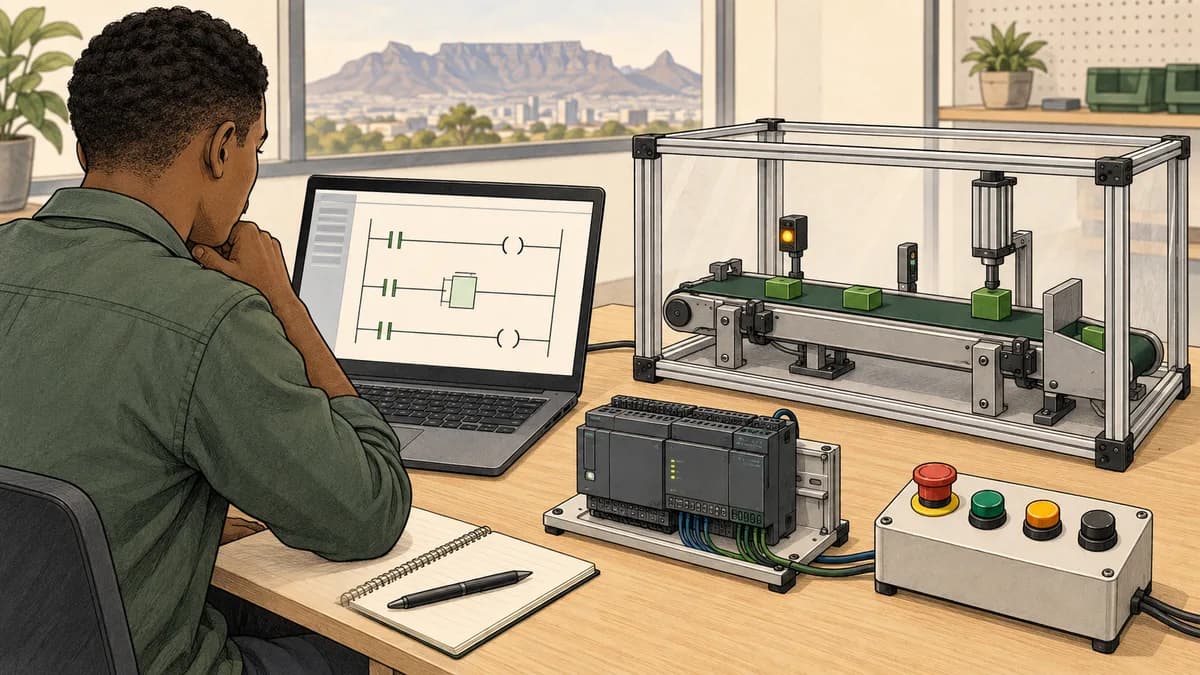
Schneider Electric PLC training in Witbank (Emalahleni) should match the equipment and task you need to understand. A local automation course may provide useful practical foundations, while a Control Expert or Modicon requirement needs confirmation of the actual software and controller. Compare those details before treating two PLC course titles as equivalent.
This guide distinguishes a local automation enquiry from a manufacturer training route and develops a fictional three-sensor comparison exercise. The exercise teaches quality handling, pairwise comparisons and diagnostic ambiguity. It does not implement a safety voting system, control a machine or establish that a physical measurement is correct.
Sources were checked on 13 September 2026. We operate PLC Simulation Software and may benefit from the product links below. Those resources support general learning; they do not imply Schneider authorisation, native Control Expert compatibility or a confirmed local Schneider classroom.
Local automation enquiries in eMalahleni
Colliery Training College's 2026 prospectus identifies the college in Emalahleni and lists a three-day advanced PLC course, a two-day HMI course and a three-day system integration course, with dates on enquiry. The HMI course lists advanced PLC as a prerequisite; system integration lists advanced PLC and HMI. These entries appear in the automation section of the prospectus.
The checked entries do not name a Schneider controller or Control Expert release. Ask CTC which equipment and engineering software apply to the proposed intake, what the entry requirements are and how much individual practical access is provided. A local course can be relevant without being described as confirmed Schneider training.
Use the CTC website to verify current enquiry and booking arrangements. Request a dated quotation and actual course availability before committing to attendance. The prospectus is a starting point for comparison, not proof of a reserved place or a future date.
Our Witbank and eMalahleni PLC training guide gives the wider local learning context. Keep both place names in your enquiries where useful, and identify the actual delivery address rather than assuming every regional offer takes place in the city itself.
Manufacturer training for a Schneider-specific requirement
Schneider Electric's South African training page lists Control Expert programming and intermediate study, with separate M580 and HMI topics. Ask which current offering matches your controller and role. Confirm delivery location or remote access directly; the listing does not establish a Witbank intake.
If travel to Gauteng is proposed, use the Johannesburg and Midrand Schneider training guide to structure the comparison. Obtain the timetable, practical-access details and full quotation before arranging transport. An advertised topic and a confirmed course booking are separate pieces of evidence.
For an employer group based in eMalahleni, describe the intended tasks without sending unrestricted production projects in an initial enquiry. A fictionalised equipment inventory and a list of learning outcomes can help a provider propose suitable instruction. Agree on the classroom environment and assessment before assuming on-site training includes operational changes.
The PLC course prerequisite guide helps identify preparation needs. A learner should be able to explain Boolean conditions, numerical ranges and the difference between a valid measurement and an available numeric field before attempting more complex diagnostics.

Match the course to the work
For Control Expert programming, ask learners to trace a value through the actual project and explain when the calculation executes. For maintenance, add an unfamiliar project and a fault with more than one plausible cause. The assessment should establish how the learner separates input quality, configuration and program behaviour.
For HMI work, identify the exact panel and engineering software. A screen can display a plausible value from the wrong source. The Magelis symbol-linking guide shows why names, equipment identity, scale and dependent settings need separate checks.
For existing Modicon applications, include the source project and software version in the enquiry. The Unity Pro migration guide explains file preparation and regression evidence. Learning to create a new program does not automatically cover preserving the behaviour of an older one.
For hardware selection, use the M340 and M580 comparison to identify exact-reference questions. A family name is not a complete specification for networking, I/O, software compatibility or redundancy.
Avoid choosing a course from unsupported claims that one controller dominates every local installation. Your equipment inventory, intended role and practical assessment provide a stronger basis for the decision than a general regional brand ranking.
Compare quotations and practical access
Request the syllabus, prerequisites, duration, individual workstation arrangement and assessment method. Confirm software licences, hardware, course materials and what remains accessible afterwards. An employee studying around shifts needs to know whether missed exercises can be repeated and whether extra lab time is available.
Compare total cost with consistent inclusions. Ask about tax treatment, travel, accommodation where relevant, assessment and any equipment the learner must supply. The South African PLC course price guide helps distinguish a lower advertised fee from a genuinely comparable offer.
For formal recognition, obtain the precise award and verification route. Keep attendance, a practical assessment and a formal qualification distinct. A branded short-course name does not automatically establish every credential an employer may require.
Agree on an observable outcome for the course. “Explain why three measurements do not establish agreement” is assessable. “Understand advanced automation” is too broad to show whether the practical sessions meet the need. The worked exercise below provides one small example of such an outcome.
Worked exercise: compare three sensor readings
Define three fictional channels, A, B and C. Each provides a numeric reading and a Boolean quality flag. A channel is eligible for comparison only when its value is finite, between zero and 100 inclusive, and its quality flag is true. Ineligible channels are excluded and identified in the diagnostic result.
The classroom tolerance is two units, inclusive. Two eligible readings agree when the absolute difference between them is at most two. This is an absolute difference, not a percentage and not an instrument specification. The exercise does not identify a physically correct sensor merely because two readings agree.
The model produces one comparison status and, where permitted, a representative display value. It makes no actuator command and provides no safety function. Its purpose is to expose the difference between agreement, disagreement and an ambiguous pattern of pairwise comparisons.
With fewer than two eligible readings, return Insufficient and no representative value. With exactly two, return Pair agreement and their arithmetic mean if they agree; otherwise return Disagreement and no value. A pair result remains visibly different from agreement among all three channels.
With three eligible readings, examine all three pairs: A with B, A with C and B with C. If all pairs agree, return All agree and the median of the three readings. If exactly one pair agrees, return Pair agreement and that pair's mean. If exactly two pairs agree, return Ambiguous and no value. If no pair agrees, return Disagreement and no value.
This policy is deliberately conservative about ambiguity. It does not choose whichever pair appears first in the code. The order of channel names should not determine the displayed numerical result for the same set of eligible readings.

Calculate the ordinary agreement cases
For readings A = 20, B = 21 and C = 22, the pair differences are one, two and one. All three satisfy the inclusive tolerance, so the status is All agree and the representative value is the median, 21.
For A = 20, B = 21 and C = 40, only A and B agree. Their mean is 20.5, so the result is Pair agreement at 20.5. The model identifies C as outside that agreeing pair; it does not prove C is faulty or establish that the other two are accurate.
For A = 20, B = 40 and C = 60, every pair exceeds the tolerance. The result is Disagreement with no representative value. Taking the median would produce 40, but that would conceal the absence of any agreeing pair under this contract.
| Eligible readings | Agreeing pairs | Status | Representative value |
|---|---|---|---|
| 20, 21, 22 | AB, AC, BC | All agree | 21 |
| 20, 21, 40 | AB | Pair agreement | 20.5 |
| 20, 40, 60 | None | Disagreement | None |
| 20, 22, 24 | AB, BC | Ambiguous | None |
| 20, 22; C ineligible | AB | Pair agreement | 21 |
| Only A = 20 eligible | None available | Insufficient | None |
Use the table to predict outcomes before implementation. A display that always shows a number can look informative while hiding the exact conditions the exercise is designed to reveal. The absence of a representative value is meaningful information in three of the statuses.
Why two agreeing pairs can still be ambiguous
Consider 20, 22 and 24. A agrees with B because the difference is two. B agrees with C for the same reason. A does not agree with C because the difference is four. Pairwise agreement is therefore not transitive under this tolerance rule.
There are two overlapping candidate pairs with different means: A and B average 21, while B and C average 23. Selecting the first matching pair makes the result depend on implementation order. The declared model reports Ambiguous instead of pretending one of those values has been established by the data.
A median of 22 is easy to calculate, but the median alone does not answer the agreement question. It is the middle value even when the readings are widely separated. The exercise only uses the median after all three pair comparisons have passed.
Change the tolerance in a separate model revision to one unit. The readings 20, 21 and 22 then have two agreeing adjacent pairs and become Ambiguous. This shows why a tolerance change requires updated expected results rather than merely changing a constant in the implementation.
Keep that revision separate from the original two-unit model. Record which tolerance produced each result. Otherwise two learners can compare screenshots from different specifications and incorrectly conclude that one implementation is faulty.

Quality, invalid values and recovery
Start with 20, 21 and 22, all eligible, giving All agree at 21. Mark C's quality false while leaving its numeric field unchanged. The result becomes Pair agreement for A and B at 20.5, with only two eligible channels. The result must not retain the old All agree status.
Next mark B ineligible as well. Only A remains, so the result becomes Insufficient with no representative value. When B returns with a valid reading of 22, the result becomes Pair agreement at 21. A stale numeric field is not enough; eligibility must recover according to the declared quality rule.
Test values zero and 100 as valid boundaries. Negative values, values above 100, missing values and non-finite numbers are ineligible. Fractional readings such as 20.5 are valid because this model does not restrict measurements to integers.
A quality flag other than the Boolean true is not accepted. In a native project, determine how the actual driver or input module represents validity and translate it into the application contract. The fictional Boolean flag is not a universal Schneider quality code.
The analogue signal guide explains the broader measurement path. Use it to distinguish a real zero from a rejected input and to avoid treating every available number as a trustworthy current measurement.
Test tolerance boundaries independently
With exactly two eligible readings of 20 and 22, the difference is exactly two and the pair agrees. With 20 and 22.01, it does not. Repeat the test in reversed order; the absolute difference and representative mean should be unchanged.
At the lower endpoint, zero and two agree and produce a mean of one. At the upper endpoint, 98 and 100 agree and produce 99. These cases expose code that accidentally rejects valid endpoints or uses a strict less-than comparison where the requirement is inclusive.
Test all permutations of the three ordinary examples. The status and representative value should remain unchanged when the values are reassigned among A, B and C, although the identified agreeing channel names may change. A first-match implementation can fail that property in the ambiguous case.
The local reference model checks all three-channel integer combinations from zero through ten, together with the eight quality-flag combinations. It verifies the declared status rules, representative-value bounds and permutation behaviour. Separate decimal and domain-boundary tests cover cases outside that small enumerated set.
These results verify a fictional comparison model. They do not establish native controller execution, sensor accuracy, functional safety or a fault-tolerant control architecture. A native course exercise must supply its own implementation and evidence within the required scope.

Diagnose the result before changing the tolerance
If a classroom display reports Disagreement or Ambiguous, inspect the eligible values and pair differences first. Increasing the tolerance until a number appears changes the requirement. It does not explain why the original comparison failed.
For a physical measurement problem, the responsible investigation would need evidence about the instruments, units, timing, installation and process conditions. The classroom model does not perform that investigation. Its useful contribution is to make the diagnostic distinction visible instead of silently choosing a value.
If every test reports All agree, check whether the same source was connected to all three channels. Identical values can be legitimate, but they can also conceal a copied binding. Use distinct sentinel values and trace each source independently.
If invalid data leaves the old representative value visible, inspect the output handling for the non-numeric statuses. A skipped calculation should not automatically preserve a number labelled as current. The PLC troubleshooting guide helps organise that observation into a reproducible defect report.
Use the exercise to assess a course
Ask the learner to submit the input contract, five statuses, tolerance and expected table before building the model. Require an explanation of the 20, 22, 24 case. This tests reasoning about the requirement rather than familiarity with a single instruction block.
During the practical session, introduce a planned defect that selects the first agreeing pair or uses a strict comparison at the boundary. The learner should identify a failing test, explain the cause and show the corrected result under the same conditions.
Then test a quality transition from three eligible channels to two and then one. Require the output status and representative value after each step. A final screenshot with one valid number cannot show whether the intermediate invalid states were handled correctly.
For an eMalahleni employer group, use fictional data in a controlled training environment. Assess each learner's trace and explanation individually, even if the group shares equipment. This makes the evidence useful without exposing operational project details.
A portfolio should state the model's limits clearly. Agreement among readings is not proof of accuracy, and the classroom comparison is not a safety system. Keep handwritten calculations, reference-model tests and native software evidence separately labelled.
Practise around shifts and travel
Prepare one small outcome at a time: calculate three pair differences, explain the ambiguous case or trace quality recovery. This makes study easier to resume between work commitments and helps an instructor identify where a learner needs support.
For general practice, review the product's Structured Text learning material and PLC program testing resources. Confirm the current lesson and plan scope before purchasing. Native Schneider instruction requires its own supported software and practical arrangement.
Training managers can use the training-centre evaluation guide to compare whether a course produces observable reasoning and reproducible evidence. Ask learners to explain both a passing result and a result that deliberately has no representative number.
Schneider PLC training in Witbank and eMalahleni questions
Does the local CTC listing confirm Schneider equipment?
The checked automation entries list course subjects and durations without naming Schneider equipment. Ask for the controller and software used in the actual intake. Keep local general automation study distinct from a confirmed Control Expert course.
Can I attend manufacturer training without a local class?
Ask Schneider about the available delivery formats and locations for the required subject. A Gauteng or remote route may be worth comparing, but availability and practical access need direct confirmation before booking or arranging travel.
Why is 20, 22, 24 ambiguous at a tolerance of two?
The first two readings agree and the last two agree, but the endpoints do not. There are two overlapping candidate pairs with different means. The fictional model therefore refuses to choose a representative value based on pair order.
Does pair agreement identify the faulty sensor?
No. It identifies agreement under a declared numerical tolerance. It does not establish physical truth, independent failure behaviour or instrument accuracy. The model's diagnostic output is deliberately narrower than a fault diagnosis.
What makes this a useful practical assessment?
It combines data quality, inclusive boundaries, pairwise logic, permutation checks and recovery in a small reproducible problem. A learner can explain the expected result before implementation and demonstrate which test exposes a planned defect.
