locations · South Africa
PLC Training Free State: Courses and Learning Routes
Compare PLC training in the Free State: Bloemfontein, Welkom and Sasolburg enquiries, practical courses, travel costs and a grain-record learning exercise.
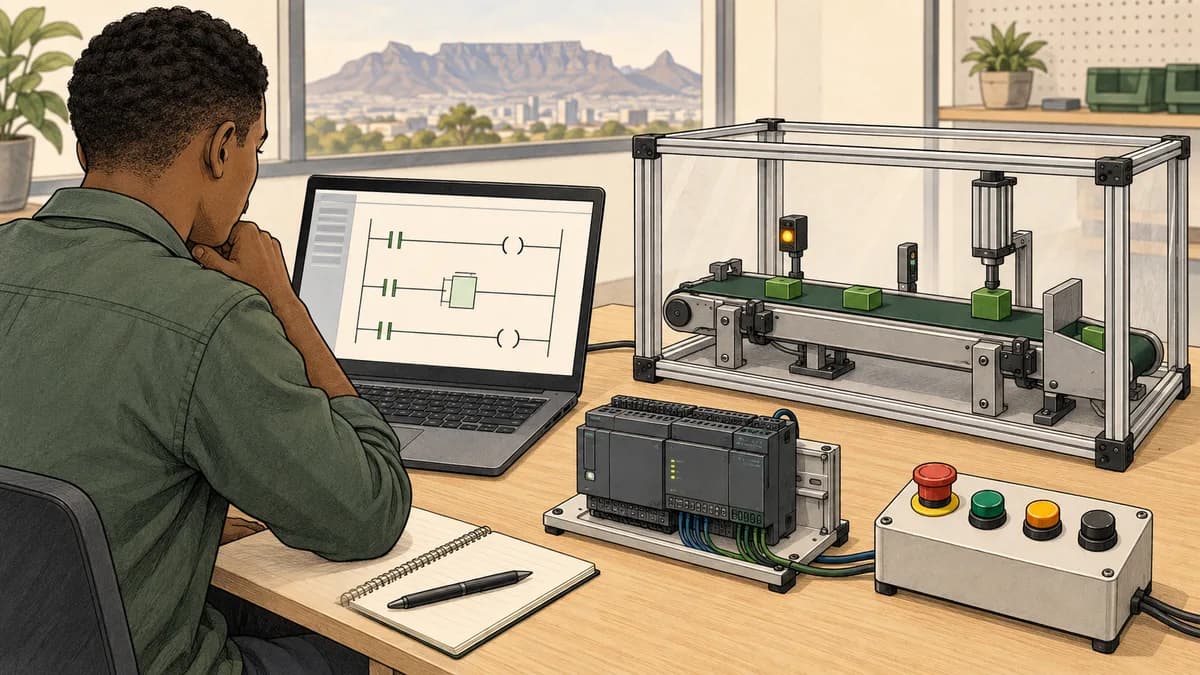
PLC training in the Free State should be chosen around a confirmed course and a specific practical outcome. Bloemfontein, Welkom, Sasolburg and the eastern Free State are different starting points for travel and study. A provincial search can help you find options, but it cannot establish that every provider has a local PLC laboratory or that one controller brand covers every employer.
This guide explains how to compare formal engineering study, short practical courses, online preparation and employer-arranged training. It includes a fictional grain-handling record exercise that develops measurement and documentation skills without controlling machinery. Use it to ask better questions about what a course actually teaches and assesses.
This site is commercially connected to PLC Simulator. Its PLC curriculum overview offers a starting point for educational preparation. Check current access and lesson details before choosing a subscription. A simulated exercise does not establish competence on a production installation or replace the requirements of a formal programme.
Free State education contacts: check the programme and campus
The Central University of Technology's Electrical, Electronic and Computer Engineering department lists its electrical engineering programmes with Bloemfontein campus information. A general website campus filter also mentioning Welkom is not proof that the same electrical programme is delivered there. Confirm the location attached to the exact programme you want.
For a local short-course search, the Bloemfontein PLC training guide helps distinguish campus contacts from a confirmed practical intake. Ask whether you are enquiring about a formal qualification, a module within one, a skills course or an employer-specific workshop. These routes can have different admission, assessment and attendance requirements even when they all mention automation.
Goldfields TVET College's Tosa Campus engineering page describes engineering workshops and gives a campus address in Thabong. It separately lists central contact information in Welkom. Use the campus-specific details to check where teaching occurs. The page is an education enquiry source, not evidence of a current standalone PLC course with a named controller.
Flavius Mareka TVET College's 2025/26 prospectus identifies engineering-related study at Sasolburg campus. Confirm the current programme and intake directly rather than treating a prospectus entry as a short-course reservation. The Sasolburg training guide addresses the northern Free State location separately.
Ask for the next available practical assessment
A useful enquiry is: “I have this background and want to demonstrate this PLC task. Which programme currently accepts learners like me, where is the practical work done, and when is the assessment?” This gives an institution enough information to direct you to the appropriate department rather than returning a generic prospectus.
Keep the date of the response and the contact responsible for the offer. If an intake is not confirmed, mark it pending. Do not assume that a course listed on a search engine is open, that an old telephone contact still handles it or that every campus shares the same equipment. These checks are part of comparing a real purchase.
Decide between formal study and a practical short course
A formal engineering route can provide a broader foundation and a recognised qualification when completed under its stated requirements. A short course can target a narrower task, such as using a particular engineering environment or interpreting a diagnostic display. Online practice can support either route, but its purpose and assessment must be stated accurately.
| Your need | What to establish before enrolling |
|---|---|
| A formal qualification | Exact programme, admission requirements, campus and assessment route |
| Beginner PLC programming | Entry knowledge, individual exercises and software access |
| Maintenance upskilling | Target equipment, diagnostic tasks and supervised practice |
| A vendor platform change | Controller family, software version and course prerequisites |
| Training a group | Individual evidence, station sharing and feedback arrangements |
Do not choose solely by the word “certificate.” Ask who issues it, what it records and whether an assessment is required. A record of attendance and a qualification are different claims. If a provider advertises registration or accreditation, obtain the exact details and verify the specific claim through the relevant official source.
The PLC course requirements guide helps you identify preparation needs. Someone with electrical experience may still need basic computer and programming practice. Someone with coding experience may need electrical drawing and equipment context. A short prerequisite check can reveal a mismatch before it becomes an expensive classroom problem.

Plan travel from your part of the Free State
Compare the actual venue from your home or workplace, including any out-of-province option that genuinely fits. A Sasolburg learner may reasonably investigate a Vaal or Gauteng course, while a Bloemfontein learner may have a different practical shortlist. Do not treat the provincial boundary as the only useful search filter or assume a course marketed to Free State learners is delivered in the province.
For Welkom, Bethlehem, Harrismith or smaller towns, ask whether the course requires repeated attendance, one block or a separate assessment visit. Work out the journey and accommodation using your own dates. A provider's “five-day course” may not include every required assessment or reassessment within those same days.
Write a simple attendance plan with teaching days, travel days, assessment dates and any employer-approved leave. Confirm the earliest arrival and latest departure that let you complete the practical work. Avoid booking travel around a tentative date until the provider confirms the course and explains its cancellation terms.
Online preparation can make the laboratory time more useful, but it is not a guarantee of fewer journeys. Ask which tasks can be completed remotely and which require supervised equipment access. Keep those tasks separate in your plan so that you do not arrive expecting hardware work that the booked format does not provide.
Choose a PLC platform using a real requirement
No verified evidence here establishes that the Free State is a single-brand market. A process site, a municipal installation and an agricultural machine can have different controllers and generations of software. Identify the actual equipment or the role requirement before choosing a Siemens, Schneider, Allen-Bradley or other vendor course.
For a Siemens example, the South African TIA-PRO1 course document describes introductory TIA Portal programming and asks for basic automation knowledge. It also points to an entry test. This is evidence of a defined vendor course scope, not a promise that it covers every process-control system or that it is delivered in a Free State classroom.
Ask equivalent questions for any platform: which controller family, which software version, what licence, what training hardware and what individual exercise? A familiar brand name does not establish compatibility with an existing project. An older installation may need a different course from a current introductory product even when both carry the same manufacturer's name.
If there is no identified equipment requirement, start with transferable concepts and a modest portfolio. The PLC training hub explains that foundation route. Add a vendor-specific course when you can connect it to a practical assessment, an authorised equipment need or a current role's stated requirements.
A grain-handling record exercise for practical preparation
The following is a fictional, read-only learning task. It does not operate a silo, conveyor, weighing system or safety function. It asks a learner to reconcile synthetic delivery records and explain the difference between gross mass, tare mass and net mass. This can be useful preparation for a course involving arithmetic, data types and operator records.
Each record has an identifier, gross mass, tare mass, unit and validity flag. All masses in this exercise are supplied in kilograms. The net mass is gross minus tare only when the record is valid, both numbers are finite and non-negative, and gross is at least tare. Otherwise the result is unavailable with a reason for review.
These are declared classroom validation rules. They are not a complete commercial weighing specification or a legal metrology procedure. A real installation has equipment, calibration, process and regulatory requirements that this arithmetic example does not establish. Keep the exercise's purpose narrow when presenting it in a portfolio.
Calculate three valid records
| Fictional record | Gross mass | Tare mass | Net mass |
|---|---|---|---|
| R01 | 28,400 kg | 12,600 kg | 15,800 kg |
| R02 | 30,100 kg | 12,900 kg | 17,200 kg |
| R03 | 12,600 kg | 12,600 kg | 0 kg |
The valid net total is 33,000 kg, or 33 tonnes using 1,000 kg per tonne. R03 is a valid zero-net record under the declared exercise rules. It should remain visible rather than being discarded because it contributes zero. A reviewer may ask why it occurred, but the arithmetic alone does not make it invalid.
The sum of the three gross masses is 71,100 kg and the sum of the three tare masses is 38,100 kg. Their difference is also 33,000 kg. This provides a separate reconciliation check for the same three valid records. It does not prove that the source measurements were accurate or that a physical delivery occurred.

Handle exceptions without silently changing the data
Add a fourth fictional record with gross 12,000 kg and tare 13,000 kg. Under the declared rule, the record is invalid because gross is below tare. Do not clamp its net to zero and then present the total as complete. Keep the invalid record and the reason; the valid-record subtotal remains 33,000 kg with one unresolved record.
A record whose unit is tonnes cannot be mixed into the kilogram calculation without an explicit conversion rule. For this first exercise, reject the unexpected unit for review. A later revision may introduce conversion, but it must specify accepted units, rounding and tests. Do not let a number's apparent size decide its unit.
| Exception | Required record behaviour |
|---|---|
| Validity flag false | Net unavailable; preserve the original observation |
| Gross below tare | Reject the calculation under the classroom contract |
| Missing gross or tare | No substituted zero and no fabricated net |
| Unexpected unit | Mark the unit mismatch for review |
| Repeated identifier with identical data | Do not count the same record twice |
| Repeated identifier with changed data | Preserve a conflict for review rather than silently overwrite |
The duplicate rule matters because a repeated message and a second delivery are different events. In this exercise, the identifier names the record. If R02 arrives twice with identical fields, the valid total stays 33,000 kg. If another message uses R02 with a different gross mass, do not choose whichever arrived last without a declared correction process.
Add a correction as a new reviewed event
For a more advanced documentation task, propose a correction record that references the original identifier and includes an explanation. Keep the original observation visible. Decide who can accept the correction in the fictional workflow and how the report shows that it changed. You do not need to implement an industrial database to explain this relationship clearly.
Separate the original subtotal, unresolved records and a later revised total. A report that changes yesterday's number without showing why is difficult to audit even in a classroom. The useful skill is to make the calculation traceable from the included records, not to produce the largest amount of code.
The data conversion reference helps with type and representation questions. Keep integer arithmetic, decimal display and unit conversion explicit. If you later move the exercise into vendor software, check that environment's numeric limits and conversion behaviour rather than assuming the educational calculation proves every implementation.

Turn the exercise into an assessed learning task
Give the provider the record specification and ask what a learner would implement. A beginner might calculate the valid nets and explain the exceptions. An intermediate learner might create a reusable record-validation block. A more experienced learner might design the duplicate and correction workflow. These are different scopes and should not be sold as the same assessment.
Record the environment, revision, test input, expected result and observed result. Include the valid zero and the gross-below-tare exception. If the implementation displays an unavailable result, check that it does not simultaneously show an old net as if it were current. State any historical value explicitly.
The product's PLC program testing overview describes educational testing practice. Check the available tools before choosing a submission format. This article does not claim a native project import, an automatic portfolio export or a certified weighing application.
Match further learning to process or machine work
A learner interested in process-related work may need measurement, data quality, alarm interpretation and communications alongside programming. The process control training guide helps identify those subjects. A basic PLC sequence alone is not a substitute for understanding the instrument and process information on which it depends.
For grain handling or packaging interests, counting, state and fault investigation can provide useful educational tasks. For a water-related objective, the water and wastewater automation guide develops careful measurement examples. Use these as subjects to discuss with a trainer, not as universal descriptions of all Free State installations.
Specialised safety, hazardous-area or commissioning work needs its own requirements and competent supervision. Do not interpret a general programming course as covering every specialist layer because the brochure mentions an industrial sector. Ask what is actually taught, assessed and excluded in the named programme.
Compare course fees without invented provincial salary promises
Request a current written quotation and identify tuition, assessment, materials, licence access and equipment costs. Add your actual travel and accommodation estimates. The PLC course cost guide provides a consistent comparison structure. This page does not state a fixed Free State price range because the offers and required attendance can differ.
Do not justify the purchase with an assumed salary increase after a short course. Compare actual vacancies and your present requirements. A role's pay can reflect experience, duties, shifts, travel and qualifications, and a single advertised amount is not a provincial benchmark. A course should first be defensible as a way to develop a needed skill.
Ask what happens if you do not pass the practical assessment. Find out whether feedback, another attempt and software access are included or charged separately. A quotation that appears complete may omit the reassessment journey. These details are more useful for budgeting than an unsupported promise of rapid promotion.

Questions Free State learners ask about PLC courses
Can I find PLC training in Welkom?
Goldfields' Tosa engineering information provides a local enquiry route, but this guide does not confirm a current standalone PLC intake there. Ask for the specific programme, practical venue and controller. Compare other suitable venues or online preparation if the required local course is not available.
Should a Sasolburg learner train in Bloemfontein or Gauteng?
Compare the actual course and journey from your starting point. A provincial label should not outweigh a better-matched practical syllabus or a workable attendance plan. Include every assessment visit and confirm dates before booking transport or accommodation.
Can I start without owning PLC hardware?
You can practise suitable programming and documentation concepts in an educational environment before buying equipment. Check device, connection and account requirements. Practical work on a named controller remains a separate learning step when your target course or role requires it.
Does TIA Portal cover every Free State automation role?
No such claim is established here. The actual controller family, software generation, process and job duties determine the required skills. Use vendor course descriptions and authorised equipment information to check the fit rather than treating one platform as the entire provincial market.
What is a useful first Free State PLC portfolio project?
Choose a small, clearly labelled educational task such as the record reconciliation example above. Show the requirement, your contribution, test evidence and one exception you investigated. Avoid claiming that synthetic data or a browser model represents a commissioned local installation.
Will online study satisfy a college's practical requirement?
Only the institution can confirm what it accepts for the specific programme and assessment. Ask before substituting a home exercise for prescribed laboratory work. Online preparation can still be useful even when it earns no formal credit, provided you describe its role accurately.

Prepare a course brief before you commit
Write your current experience, location, available dates and intended practical outcome. Attach a clean fictional task or an authorised equipment list. Ask the provider for the exact programme, current venue, full cost and assessment criteria. Keep its response date and clarify any unresolved prerequisite before paying.
Then prepare the expected results for one small exercise. For the grain record task, explain the 33-tonne valid subtotal, the valid zero, the invalid fourth record and the duplicate rule. That gives you a concrete foundation for PLC training in the Free State and a clear way to judge whether the course advances the skill you need.