brands · South Africa
Omron PLC Training in Johannesburg: Courses and Trace Tests
Explore Omron PLC training in Johannesburg: Modderfontein enquiries, course choices, native diagnostic practice and worked pulse-sampling and trace tests.
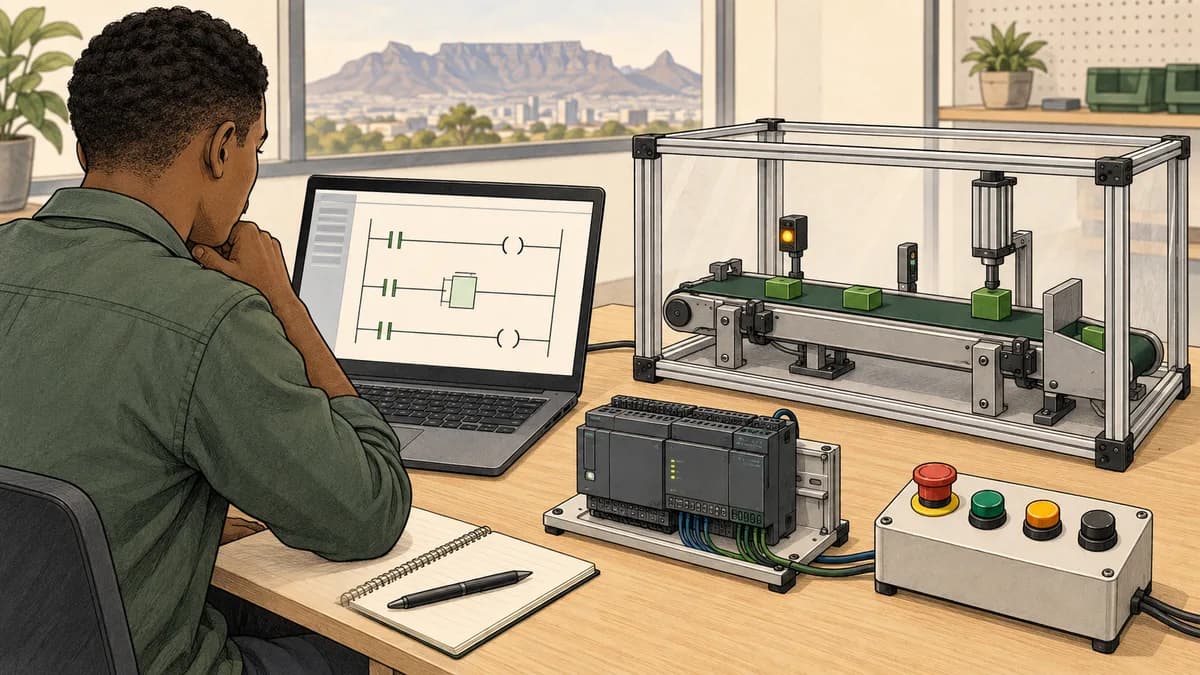
Omron PLC training in Johannesburg should give you a way to investigate what a controller actually did, not only a sequence of editor steps to copy. If your goal is maintenance or fault-finding, ask how the practical teaches observation, data tracing and the limits of a slowly refreshed display. A condition can occur between observations without appearing on the screen you happened to watch.
This guide identifies an official Gauteng enquiry route and develops a fictional sampling exercise. It is intended to help learners ask better questions about native practical work. The example is a mathematical observation model, not a test of an Omron controller, a prescribed trace configuration or proof of a physical input's behaviour.
Start with the manufacturer enquiry in Modderfontein
Omron's South African contact page lists its Johannesburg-area office at 22 Friesland Drive, Longmeadow Office Park, Longmeadow South, Modderfontein. Use that contact to discuss the controller and course you need. The address is not automatic confirmation of a classroom venue, date or available seat.
The TC51 Sysmac Control Basic outline is relevant to an NJ/NX learning enquiry. The separate TC03 PL3 advanced PLC outline includes topics such as subroutines, interrupts and high-speed counters, with a prior-course requirement. Confirm the actual software route instead of treating all advanced PLC titles as Sysmac courses.
The public material reviewed on 12 September 2026 identifies content and a contact route. It does not establish a current Johannesburg intake price or the exact equipment you will operate. Ask for the selected course's outline, delivery arrangements and assessment in writing before comparing it with another offer.
The Johannesburg PLC training guide provides wider local options. For a learner working across Gauteng, the right course depends on the installed controller and the task to be learned. Unsupported claims about regional brand dominance or salary premiums are not a sound substitute for that information.
Describe the diagnostic task before choosing the course
A useful enquiry might say that you need to investigate a brief request that appears to be missed, or explain why an HMI value disagrees with an internal condition. Those are concrete diagnostic tasks. They help the provider identify whether the practical includes the tools and reasoning you need.
If you are new to PLCs, establish the foundations first: Boolean conditions, execution sequence, variable types and the difference between a request and an accepted result. The Omron training hub and Sysmac variables guide help organise that preparation. Native observation makes more sense when you know which value you are trying to inspect.
Ask whether each learner will configure an observation and explain its limitations. Watching an instructor's trace is useful, but it does not demonstrate that you can choose the correct source, interval and trigger yourself. A good assessment also asks what the recorded data does not establish.
Keep the environment explicit. A value observed in a general exercise, a native simulator and a physical controller represents different evidence. The results can support different conclusions. Label them accurately rather than letting a screenshot's appearance imply that a hardware test occurred.

Native traces and ordinary screen updates answer different questions
Omron's Sysmac Studio specifications describe data tracing with selected variables, sampling conditions and triggered or continuous collection. They also describe exporting trace results. Use the supported configuration for the actual controller and software version when planning a native practical.
A watch view, an HMI display and a configured trace may observe or present information at different stages. Do not assume that a visible screen refresh is the same as a controller task execution or an input update. Identify where the observation is taken and what timing information accompanies it.
For a short event, ask whether the measurement method could miss the event entirely. For an apparently repeated event, ask whether multiple displayed samples represent one long occurrence or several separate occurrences. These questions come before a conclusion about whether the application logic is correct.
The communication troubleshooting guide helps distinguish transport and display issues from application behaviour. A slow display is not evidence that the underlying controller never changed. Conversely, a changing display does not prove that every intermediate transition was captured.
Worked exercise: a six-millisecond pulse can disappear from a record
Assume a fictional Boolean signal is false except during the interval from 12 milliseconds inclusive to 18 milliseconds exclusive. It is true at time 12, remains true before time 18 and is false at time 18. The pulse therefore lasts six milliseconds. These exact endpoints are part of the model.
A fictional observer records the signal only at its scheduled sample instants. It does not remember transitions between those instants and does not alter the signal. Start with samples at zero, ten, twenty and thirty milliseconds. Every recorded value is false, because none of those instants lies inside the true interval.
The correct conclusion is that the signal was false at the sampled instants. It is not that the signal stayed false throughout the whole thirty-millisecond period. The pulse exists in the declared model even though this observation schedule records no true sample.
This distinction matters when a learner says that a request never happened because it was not seen on a screen. The observation method must be capable of supporting that conclusion. In the exercise, the coarse record cannot distinguish the six-millisecond pulse from a signal that was always false.
Compare three observation schedules
| Schedule | Sample instants in milliseconds | Recorded values |
|---|---|---|
| Ten-millisecond interval, zero offset | 0, 10, 20, 30 | False, False, False, False |
| Five-millisecond interval, zero offset | 0, 5, 10, 15, 20, 25, 30 | False, False, False, True, False, False, False |
| Ten-millisecond interval, four-millisecond offset | 4, 14, 24 | False, True, False |
The second schedule captures the pulse at time 15. The third captures it at time 14 despite having the same interval as the first. Alignment matters as well as interval. A single successful capture does not prove that the same interval would capture every pulse with a different start time.
Now move the pulse to the interval from 22 inclusive to 28 exclusive, retaining the original duration. The zero-offset ten-millisecond schedule still misses it. The five-millisecond schedule captures it at time 25, and the four-offset schedule captures it at time 24. The expected results follow from interval membership, not from a particular PLC instruction.

A captured sample does not reveal the exact pulse width
Suppose all you have is the five-millisecond record: false at ten, true at fifteen and false at twenty. Under an assumption of one contiguous pulse in that span, the rising transition occurred after ten and no later than fifteen. The falling transition occurred after fifteen and no later than twenty. The record does not identify the exact 12 and 18 endpoints.
Drawing a line between plotted samples can make a chart easier to read, but it does not create unobserved timing evidence. A learner should distinguish the sample values from any visual interpolation. If exact duration is needed, choose a measurement method and resolution that can support that requirement.
The model's true duration is known because it was declared in advance. That knowledge is useful for evaluating the observer. It should not be confused with a duration recovered uniquely from the sparse sample record. This is a common distinction in testing: the independent expected behaviour can contain information that the instrument under test fails to capture.
For a native practical, record the timing source and sampling settings alongside the trace. A chart without those details can be difficult to interpret later. The PLC troubleshooting guide develops the broader habit of preserving the conditions under which an observation was made.
Two pulses are not the same as two true samples
Extend the fictional signal so it is true during both 12–18 milliseconds and 22–28 milliseconds, with the same inclusive-start, exclusive-end convention. The ten-millisecond zero-offset schedule again records only false values. The five-millisecond schedule records true at fifteen, false at twenty and true at twenty-five.
That faster record distinguishes two observed true periods separated by an observed false state. Now consider one longer pulse from 12 inclusive to 28 exclusive. The same five-millisecond schedule records true at fifteen, twenty and twenty-five. Three true samples describe one continuous pulse in the declared model, not three separate rising events.
A wrong event-count implementation that increments once for every true sample would count three for that longer pulse. A sampled rising-edge detector can avoid counting repeated true samples as separate events, but it still cannot detect a pulse that occurs entirely between samples. Fixing one defect does not remove the observation limitation.
The one-shot instruction guide helps explain related edge reasoning. Apply it with the correct execution and input assumptions. An edge detector works on the values it actually receives; it is not a device that reconstructs every unobserved physical transition automatically.
Compare a remembered event with a count
Suppose an independent event-capture mechanism correctly detects both short pulses before a later reader looks. A single Pending flag could tell the reader that at least one event occurred. If the flag was already true when the second event occurred, it would still be true. The flag alone does not preserve the count of two.
A counter can represent two detected events if the capture mechanism increments it once per event and the counting contract handles its limits. That is a different representation from a Boolean history flag. The choice depends on whether the consumer needs existence, quantity, timing or the data associated with each event.
This discussion assumes the independent capture mechanism actually detects the events. It does not claim that setting a flag inside the same slow observation loop solves missed pulses. If that loop never sees true, it has no event to remember. Keep the capture stage separate from the later reporting stage in the explanation.

Choose tests that expose the observation error
Use the six-millisecond pulse with the coarse schedule as a missed-event case. Use the same pulse with the four-millisecond offset to show that a successful capture can depend on alignment. Use the longer 12–28 pulse to expose an implementation that counts true samples instead of rising events.
Include the exact endpoint at time 18. The signal is false there because the end is exclusive. A version that uses an inclusive end changes the declared model. The test may appear minor, but it establishes that the implementation follows the written requirement rather than a loosely remembered sketch.
Include a sample exactly at time 12, which is true. This complements the end test and makes both sides of the interval explicit. A version that uses strict comparisons at both ends would reject the intended start instant. Carefully chosen endpoint tests are more informative than repeatedly sampling the middle of the pulse.
For each wrong version, record the smallest input schedule that distinguishes it from the intended one. This keeps the exercise reviewable. The point is not to accumulate a large test count; it is to demonstrate why each test can expose a specific misunderstanding about timing or event representation.
A faster schedule needs a justified requirement
In the idealised model, a regular sample interval shorter than the six-millisecond pulse duration will encounter at least one true sample in every such pulse, assuming continuous sampling and no missing observations. A five-millisecond interval satisfies that mathematical condition. This is a statement about the ideal observer, not a guarantee for a deployed system.
An actual signal path can include filtering, input updates, task timing, communication and presentation. Determine which stage the trace observes and what guarantees apply. If observations can be delayed or missing, a nominal five-millisecond setting alone does not establish the ideal model's continuous regular schedule.
Do not select a native interval from this article without considering the actual requirement and supported equipment. Instead, use the exercise to ask a precise question: what is the shortest event that must be observed, and what evidence shows the chosen method can capture it? A course provider should be able to explain the scope of its demonstration.
The timers and counters guide provides related preparation on elapsed time and events. Keep those concepts distinct from the observation schedule. A timer value displayed occasionally may have been updated more often than it was shown, and an event counter may preserve information that a live Boolean view does not.
Make the native practical reproducible
Record the exact variable being observed and its owning program or interface. Record the project revision, controller model and relevant software version. Then record sampling configuration, trigger conditions and the source of the test stimulus. These details allow another learner to distinguish a changed program from a changed observation method.
If the trace shows no event, repeat the reasoning before changing the logic. Is the source correct? Could the event occur outside the recorded window? Could the sampling schedule miss it? Is the value an internal condition, a processed input or an HMI copy? Each question suggests a different next observation.
A useful practical compares a known stimulus with the resulting record, just as this fictional model does. If the stimulus itself is uncertain, state that limitation. Avoid declaring a measurement system correct merely because its output looks smooth or because the software reports no error.
For a Johannesburg course buyer, ask whether assessment includes explaining one of these limitations. The course requirements guide helps identify preparation needs, while the training-centre guide helps organisations evaluate access and individual assessment. The result should be an explanation a learner can defend with evidence.

Compare the complete course offer
Request a written quotation for the actual intake and learning route. Confirm whether software, materials, equipment access and assessment are included. Use the South African PLC course price guide to organise the comparison. A general advanced-course title is not enough to compare two offers fairly.
If travelling within Gauteng, obtain the teaching venue rather than using the office address as an assumption. Ask about the start and finish times and required pre-course setup. A learner who spends the first practical resolving access problems has less time for the diagnostic exercise the course was meant to teach.
If the course is delivered remotely, establish whether you can operate a native environment yourself and how the instructor reviews your work. Watching a shared trace can explain an idea, but it does not necessarily provide the same assessment evidence as configuring and analysing your own recording. Choose the delivery according to the outcome you need.
Questions about Omron training in Johannesburg
Is the Modderfontein address a confirmed classroom?
The official contact page identifies the manufacturer office. Confirm the selected course's venue and date directly. The office is a useful enquiry route, but the address alone does not establish an available training session.
Does an advanced PLC course automatically mean Sysmac?
No. Match the exact software and controller route to the course outline and prerequisites. The reviewed catalogue contains separate course families. Ask the provider to explain which one supports your intended maintenance or programming task.
If a watch window never shows true, did the event never happen?
That conclusion needs evidence about the observation method. In the fictional example, the signal is true for six milliseconds but the ten-millisecond zero-offset samples are all false. The record proves the sampled values, not every state between them.
Can a one-shot recover a pulse that was never sampled?
Not merely by detecting an edge in the same sampled values. If those values are always false, the detector has no observed rising transition. An appropriate capture mechanism may preserve events for later reading, but its capability must be established separately.
Where can I prepare the reasoning before a native practical?
This site is commercially connected with PLC Simulation Software. Its PLC program testing resources and Structured Text learning resources offer related general preparation. Check current features; they do not establish native Sysmac trace execution or measurement of physical pulses.
Take an observation question into the course
Keep the declared signal, sample schedule, expected values and conclusions together. Add a note stating which conclusions the record cannot support. Include a changed offset and a longer pulse so that your explanation covers alignment and event counting, not only one successful capture.
Return to the Omron training hub to plan the next native step. A useful Johannesburg course should help you connect the requirement, the observation method and the evidence, so that an unexpected screen value leads to a focused investigation rather than a guessed program change.
