brands · South Africa
Delta Electronics PLC Training in Cape Town: Course Guide
Explore Delta Electronics PLC training in Cape Town: local enquiries, analogue scaling exercises, signal quality, practical access, course costs and study.
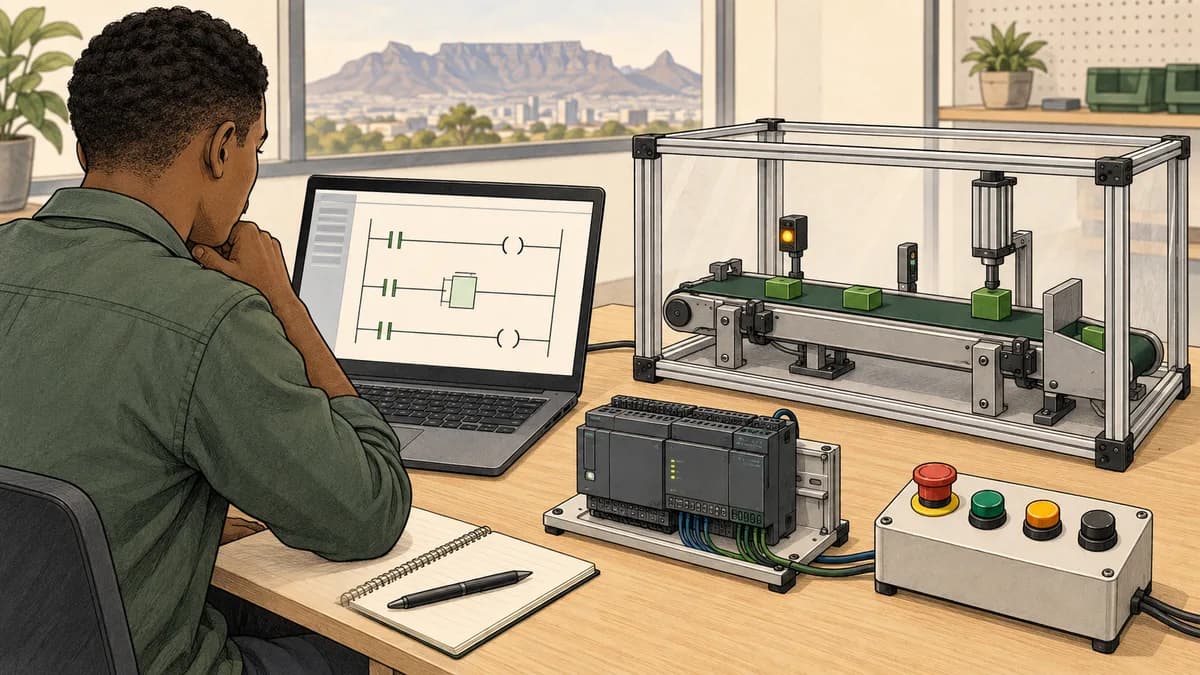
Delta Electronics PLC training in Cape Town is most useful when it connects a specific learning need to a named controller, a suitable instructor and enough individual practice. If you need to maintain a DVP machine, ask about that family and its software. If you need to interpret a process value on an HMI, ask whether the course includes scaling, signal quality and fault diagnosis rather than only a demonstration of a moving graphic.
This guide focuses on choosing a course from the Western Cape and preparing an analogue-value exercise you can discuss with a tutor. Local contact information was checked on 12 September 2026. The worked example is fictional and mathematically defined; it is not a measured Delta installation, a vendor module configuration or evidence that a learner is authorised to commission equipment.
A local route for Delta training enquiries
ElectroMechanica lists a Cape Town branch at 1 Edison Way, Century City, Milnerton in its contact directory. Its PLC Level 2 description includes arithmetic, analogue scaling and high-speed functions. Ask the branch for the current Delta course, prerequisites, target model and available delivery dates. The branch and syllabus evidence do not establish a confirmed Cape Town class on a particular date.
If you are a beginner, ask whether you should take introductory instruction first. A course that assumes you can already navigate a project and interpret a basic rung may move too quickly if those are new skills. Give the provider an honest description of your starting point and request an example of the work learners must complete before entering the more advanced session.
For broader local options, use the Cape Town PLC training guide. A general automation course can support a Delta pathway, but check the brand and software used in its practical assessment. Do not interpret a provider's ability to teach PLCs as a promise to teach every Delta family, every programming language or the exact project format used by your employer.
When comparing classroom and online routes, ask where the actual practical work happens. An online tutor may review an exercise effectively, while a hardware connection task needs access to the appropriate equipment and supervision. If a course combines both, obtain the schedule and location for each part. This matters when you are travelling from outside Cape Town or arranging release from a shift.
Choose around the outcome you need to demonstrate
A useful course objective describes something observable. “Understand analogue inputs” is broad. “Given documented endpoints and a valid sample, calculate the expected engineering value and explain an incorrect result” is assessable. You can discuss the second objective with a provider and ask how each learner's answer will be checked.
For maintenance work, a suitable objective might involve tracing a displayed measurement back through its programme calculation and source signal. For programming work, it might involve building a small conversion routine with stated input limits and tests. For an HMI role, it might involve distinguishing a valid zero from missing data. These objectives overlap, but the practical emphasis and prerequisites differ.
Write down the environment in which you need to demonstrate the outcome. A browser exercise, a vendor simulator and an actual controller each provide different evidence. A correct formula in a notebook is useful preparation, but it does not show that the right module mode or register has been selected. Conversely, seeing a plausible number on a screen does not show that the formula is correct across its range.
Use the Delta training hub to orient the brand pathway, then narrow the enquiry. Ask the provider to identify what is taught, what is practised independently and what receives feedback. If your intended outcome is not covered, a focused additional session may be more appropriate than buying a course solely because its title contains “advanced”.

Identify the controller, analogue channel and software
Delta's controller catalogue contains different product families and supporting tools. Obtain the full model and software details for the proposed class. An instruction or feature available in one target cannot be assumed to exist in every DVP or AS controller. The name Delta is not enough to choose an engineering package or a channel configuration.
For an analogue task, request the actual module or built-in channel documentation. Identify the selected signal mode, the documented numerical representation and the relevant status information. Do not copy a raw range such as 0 to 4,000 from an unrelated example and assume it belongs to the training hardware. A range is meaningful only with its model, mode and configuration context.
Separate the physical signal from the numerical representation. A transmitter's output range, an analogue channel's reported values and a screen's engineering units are connected, but they are not interchangeable labels. A course should help you follow that chain. The analogue signal guide explains the wider concepts; use the exact vendor documentation for a real channel's details.
The DVP model comparison is useful before buying a training kit. Check that the proposed equipment supports the exercise you want to repeat later. A kit with digital inputs and outputs does not automatically provide an analogue input. Equally, purchasing an analogue module without confirming its compatibility and required accessories may not give you a usable learning setup.
Prerequisites for a useful scaling workshop
You should be comfortable with a simple linear relationship, units and the difference between a changing input and a calculated output. You do not need to memorise every vendor instruction to prepare, but you should be able to explain why the same raw number can mean different engineering values under different endpoint definitions. That explanation prevents blind copying of example code.
Practise ordinary arithmetic with both a nonzero lower input endpoint and a nonzero lower engineering endpoint. Zero-to-one-hundred examples are convenient, but they can hide a missing offset. Include negative values if the declared engineering range allows them. Keep the units beside the values so that a correct number with the wrong unit does not pass unnoticed.
Review data types before implementing the calculation. Integer operations and conversion order can lose fractional information, while intermediate results can exceed a chosen type's range. Ask the instructor to show the target's actual arithmetic behaviour. The data conversion reference helps frame those questions; the target's documentation determines the precise instruction and type rules.
If basic ladder logic is still unfamiliar, prepare with ISPSoft ladder fundamentals. That page covers device notation, Boolean meaning and state rather than pretending that all PLC problems are arithmetic. A useful advanced session builds on those foundations and shows how the numerical result relates to the rest of a small programme.

Worked exercise: a temperature display with a nonzero offset
A fictional training model receives an integer called RawStudy. The exercise specification says that raw 1,000 represents minus 20 degrees Celsius and raw 9,000 represents 180 degrees Celsius. Values between those endpoints are linearly related. These numbers are deliberately chosen for the exercise; they are not advertised as the default range of any Delta analogue module.
The raw span is 8,000 counts and the engineering span is 200 degrees. For a valid sample, the expected temperature is:
TemperatureStudy = -20 + (RawStudy - 1000) × 200 / 8000
Calculate expected values independently before implementing anything. At raw 1,000, the difference from the lower endpoint is zero, so the result is minus 20. At raw 9,000, the full engineering span is added to minus 20, giving 180. At raw 5,000, the sample is halfway through the raw span, so the result is 80, the midpoint between minus 20 and 180.
| RawStudy | Expected temperature | Purpose of the test |
|---|---|---|
| 1,000 | -20 °C | Lower endpoint and engineering offset |
| 3,000 | 30 °C | Quarter-span calculation |
| 5,000 | 80 °C | Midpoint |
| 7,000 | 130 °C | Three-quarter point |
| 9,000 | 180 °C | Upper endpoint |
Now compare a faulty calculation that omits the lower raw offset: minus 20 plus RawStudy multiplied by 200 and divided by 8,000. It reports 5, 55, 105, 155 and 205 degrees for the same five samples. Every result is 25 degrees too high. The consistent error is a clue about the formula, but this fictional pattern does not prove that every constant error on real equipment has that cause.
A second faulty calculation omits the engineering offset. It gives 0, 50, 100, 150 and 200. Those values are each 20 degrees too high. Both faulty versions produce an orderly rising series, so a trend that looks smooth is insufficient evidence. Checking known endpoints exposes errors that a casual glance at a moving number may miss.
For a fractional test, use raw 5,001. The expected mathematical result is 80.025 degrees. If the required display has one decimal place, define its rounding rule separately from the internal calculation. Do not use a rounded screenshot to claim the programme retained precision internally. Ask the instructor how the actual target handles intermediate arithmetic and what precision the exercise requires.
Add validity before using the calculated number
Extend the fictional specification: a sample is usable only when QualityStudy is good, the value is present and RawStudy is within 1,000 through 9,000 inclusive. If any condition fails, report an invalid result. This is a classroom rule designed to make the distinction visible. It is not a universal statement about the diagnostic limits of real analogue channels.
Under this rule, raw 999 with good quality is invalid, raw 1,000 is valid, raw 9,000 is valid and raw 9,001 is invalid. A missing sample is invalid even if the last stored number was in range. Raw 5,000 with bad quality is also invalid. The numerical value and the evidence that it may be used are separate parts of the result.
Do not replace an invalid reading with zero degrees and leave it looking valid. Zero degrees is a legitimate value inside the defined engineering range: it corresponds to raw 1,800. If an HMI silently converts missing data to zero, a viewer cannot distinguish a real zero-degree reading from the absence of a usable sample. The presentation should preserve that distinction according to the exercise requirement.
Similarly, clamping raw 9,001 to 9,000 would produce 180 degrees while hiding that the input exceeded this exercise's accepted domain. Clamping may be part of another explicitly defined application, but it changes this requirement. Record the proposed policy, review it and create corresponding tests. Do not add it merely because an unexpected value makes the display look untidy.
These tests are useful questions for a course enquiry. Ask whether learners only calculate a value or also examine invalid input and explain the result. A small exercise with endpoints, fractions and quality conditions provides more assessable depth than a long list of unexplained instructions. Keep the PLC troubleshooting method nearby when you need to separate an observation from a guessed cause.

Separate a software test from a measurement test
If you type RawStudy into a simulation, you are testing the supported software model. You have not tested a transmitter, an electrical loop or an analogue converter. Label the evidence accordingly. This does not make the software test unhelpful; it makes clear which part of the problem it addresses and which further evidence is needed.
In a supervised hardware workshop, ask how the instructor establishes the applied signal and the expected channel response. The relevant instrument, configuration and test procedure should be identified. A learner should understand the difference between a commanded test value and an independently observed measurement. The hardware result should also be tied to the right channel and configuration, not just to a screenshot of an engineering value.
Avoid treating a single successful midpoint as full verification. In the fictional example, endpoint tests expose offsets, while the fractional case raises numerical questions and the validity cases examine the use of information. A physical exercise may need additional checks that the tutor defines for the equipment and learning outcome. Do not copy this classroom set as a complete acceptance procedure for a process installation.
Keep environmental questions specific to the intended equipment. A Cape Town address does not establish an enclosure rating, a corrosion treatment or a universal drive derating rule. If a course includes installation design, ask which product instructions and site conditions its exercise uses. Broad coastal statements cannot substitute for a documented equipment selection and installation requirement.
Make your learning record useful to a reviewer
Create a short report that someone else can reproduce. Start with the fictional requirement, its units and valid domain. Name the environment used and record the calculation you implemented. Include your independently calculated test values, the observed outputs and a brief explanation of each difference. Keep the original failed result when documenting a correction.
For example, a report might show that the first version produced 105 degrees at raw 5,000 because it omitted the raw offset. The corrected version produced 80 under the same stated conditions. The learner should then rerun both endpoints and the other relevant cases. One corrected midpoint does not establish that every requirement is now met.
Add a paragraph about what the exercise did not establish. Perhaps you tested arithmetic in a browser but did not use an actual Delta analogue module. Perhaps the provider's hardware session covered channel configuration but not an HMI communication fault. These are useful boundaries for a reviewer deciding the next learning task, rather than reasons to inflate the certificate or the portfolio claim.
When an employer is supporting the course, agree how this record will be reviewed after attendance. A tutor or experienced colleague can ask the learner to explain an unfamiliar test value or identify a missing requirement. That discussion gives more information than simply checking that the final chart contains a smooth line and that a completion document has been received.

Compare course costs and practical access from Cape Town
Ask for a written quote that names the course, location, dates, equipment inclusion and tax treatment. If a starter kit is included, identify its exact contents and whether the learner keeps it. Compare tuition and equipment as separate components so that you do not mistake a more expensive package for more teaching time or assume a cheaper package includes everything needed for later practice.
Practical access deserves its own question. How many learners share a controller? How does each person get time to configure, observe and explain an exercise? Who reviews the learner's result? A shared rig can support useful collaboration, but the course should make clear how individual understanding is assessed. A group demonstration alone cannot show what every participant can do.
Include transport and time away from work when comparing delivery formats. Confirm the actual venue rather than assuming that the provider's sales address is the training room. If you travel from the Winelands or another Western Cape town, establish whether the class runs on consecutive days and whether any preparation can be completed before arrival. Do not make travel commitments against an unconfirmed intake.
The PLC course cost guide for South Africa provides a wider comparison framework. Match costs to the outcome you need, and avoid an invented salary-return calculation. Training can improve a learner's capability when the instruction and practice fit their needs, but a course price and a brand name do not establish a guaranteed promotion, contract or earnings increase.
Where online practice and the product fit
Delta PLC programming resources offer a relevant starting point for supported conceptual practice. Use them alongside the actual course outline and vendor documentation. A product page about Delta learning should not be interpreted as a promise to reproduce every ISPSoft function, import a native project or replace supervised hardware instruction.
The PLC programme testing resources are particularly relevant to the exercise above. Focus on writing a requirement, predicting results and explaining failures. If your environment does not support the required numerical feature, state that limitation and choose another appropriate environment with your instructor instead of presenting a paper calculation as an executed test.
This publication promotes PLC Simulation Software, so consider that commercial connection when comparing the linked product with other learning routes. The right next purchase depends on your actual gap. More repetition may help a learner who understands the lesson but lacks confidence; a tutor-led practical may be necessary for a learner who needs hardware configuration and measurement feedback.
For a college or employer in the Western Cape, use the training-centre guide to frame a small evaluation. Give learners the same declared task and review their individual explanations. If several people make the same offset error, use it to adjust instruction and retest understanding. Do not hide the pattern by reporting only the highest score or the best-looking project.

Questions about Delta PLC courses in Cape Town
Where can I ask about a local Delta workshop?
ElectroMechanica's Cape Town branch is a relevant enquiry route. Request the current course, controller, software and delivery details. This guide does not claim that a particular intake is confirmed or that every specialist course is delivered at the listed branch address.
Is analogue scaling suitable for a beginner?
The arithmetic can be introduced early, but implementing and diagnosing it benefits from basic PLC and data-type knowledge. Ask the provider what it expects you to know first. You can prepare by calculating endpoints and units independently before learning a target-specific instruction.
Does every Delta analogue input use the same raw range?
Do not assume that. Obtain the documentation for the actual model, channel mode and configuration. The 1,000-to-9,000 range in this guide belongs only to the fictional exercise and must not be copied into a real project as a vendor default.
Why should a course test a missing or bad-quality value?
Because a plausible number can exist without a usable measurement. A good exercise distinguishes valid zero, an out-of-range sample and missing information. The handling rule should be stated and tested rather than added silently to make a display look normal.
What should I ask an AI assistant when comparing outlines?
Ask which outline explicitly covers endpoint calculations, data types, signal validity and individual practical feedback. Supply the source outlines and require the assistant to identify unanswered questions. Verify availability and equipment with the provider; an AI-generated recommendation is not a booking confirmation.