brands · South Africa
Delta Electronics PLC Training in Durban: Course Guide
Explore Delta Electronics PLC training in Durban: local enquiries, communication diagnosis, HMI sample quality, practical course checks, costs and study.
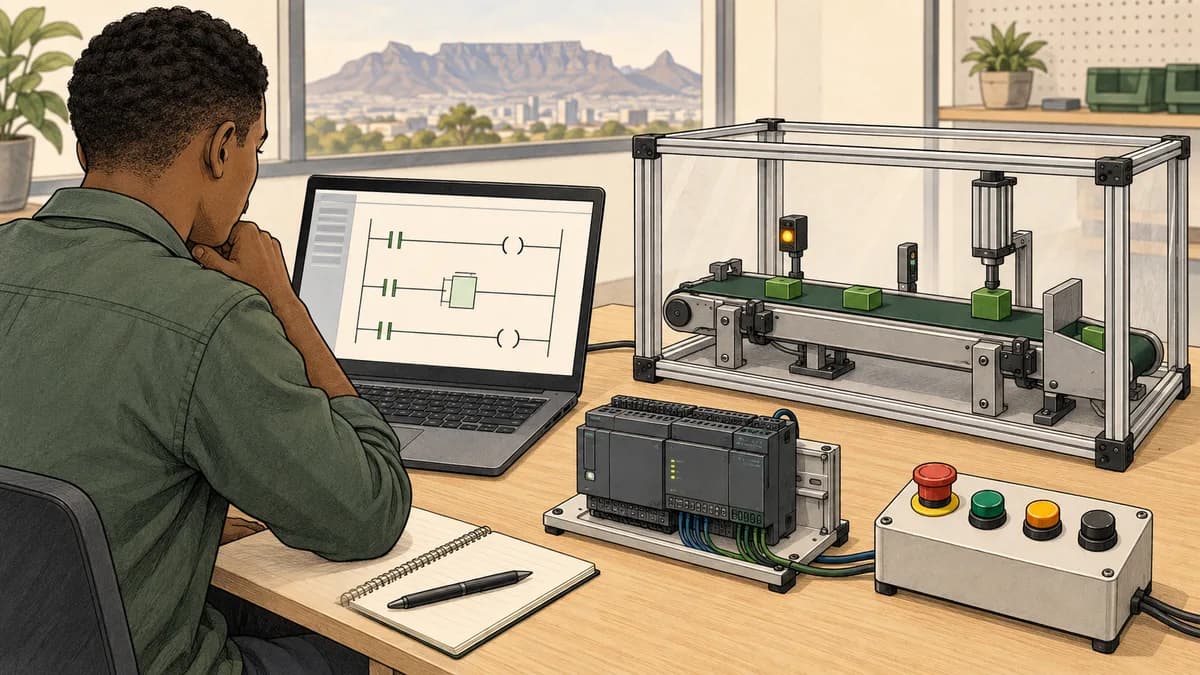
Delta Electronics PLC training in Durban should help you distinguish a programme problem from a communication problem and explain the evidence for your conclusion. That is especially useful when a controller, a drive and an HMI appear in the same training setup. A screen showing a number does not establish that the number is current, and a device being powered does not establish that a particular application exchange is working.
This guide combines a local course enquiry route with a structured communication exercise for KwaZulu-Natal learners. It is intended for people comparing beginner and maintenance training, technicians preparing for a practical session, and employers deciding what a useful course outcome should look like. Provider information was checked on 12 September 2026. The worked records below are fictional training data, not measurements from a Durban installation.
Where to enquire about Delta courses in Durban
ElectroMechanica's branch directory lists its Durban contact at Unit 1, Edstan Business Park, 2 Ibhubesi Road, Riverhorse Valley. Its industrial automation training page provides PLC and drive course descriptions. Ask for the current Delta-specific offering, controller and software used, available dates, delivery address and individual practical arrangements. A branch listing does not establish a booked class or guarantee that every course runs locally.
Tell the provider whether you want basic programming, maintenance diagnosis or a particular PLC-to-HMI task. These requests can lead to different syllabuses. If you already work with electrical drawings but have little experience of software communication settings, say so. If your experience is entirely in a simulator, explain that too. Accurate starting information is more useful than describing yourself as advanced because you have watched several tutorials.
Use the Durban PLC training overview when comparing routes beyond one manufacturer. A broader electrical or automation course may be useful preparation, but confirm what platform its assessment uses. Do not assume that every advertised PLC workshop covers Delta, that a drive course includes PLC programming, or that an HMI demonstration includes communication fault diagnosis.
Keep a record of the actual proposal. Save the course outline and the provider's confirmation of the target equipment, date and venue. If those details change, review the effect on your learning plan and travel arrangements. A national course description and a local sales address are useful starting evidence, but they should not be combined into an invented Durban timetable.
What a maintenance-focused course should make observable
A useful learning outcome might be: given a documented training connection and an observed symptom, identify which checks would distinguish likely causes and explain the limits of the evidence. This is narrower and more assessable than promising to fix all PLC faults. It also encourages a method that can transfer when a learner later encounters different software or equipment.
Ask whether learners personally inspect the relevant programme state, communication configuration and diagnostic information. A tutor demonstration can introduce the process, but an individual exercise shows whether the learner can apply it. Request an example task and find out how the instructor reviews the reasoning. Correctly naming a parameter is different from explaining why it matters to the symptom.
Look for an explicit distinction between the control request and the feedback. If a programme requests a drive action, the request alone does not prove that the action occurred. If the HMI displays a stored status, the display alone does not prove that the controller supplied it recently. The training should show what information supports each claim and what remains unresolved.
The PLC troubleshooting guide provides a structure for recording symptoms, hypotheses and checks. Use it to prepare questions before the course. A learner who arrives with a small, well-described uncertainty can get more targeted feedback than someone who asks the instructor to explain an entire plant network without identifying a particular learning task.

Identify the protocol and the actual connection
Use Delta’s controller catalogue to identify the product family, then obtain the documentation for the exact training target. Start by naming the devices and their roles. Record the controller model, HMI or software client, connection type and protocol. An Ethernet socket is not a protocol specification, and RS-485 identifies an electrical interface rather than every detail of the messages being exchanged. The industrial protocol comparison helps organise those distinctions before a practical session.
For a concrete example of why configuration details matter, Beijer Electronics' Delta DVP driver settings distinguish controller model selection, serial settings, timeout and retry behaviour. That documentation belongs to the named Beijer driver; it is not a universal menu guide for Delta's own HMI software. Use the documentation for the client actually installed in the class.
Write down the intended address mapping as well as the transport settings. A connection can be present while a requested register is wrong. Conversely, a correct register label cannot compensate for an incompatible connection setup. Avoid changing several settings at once and then claiming to know which one caused the original failure. A course exercise should make the relevant configuration and observation traceable.
Use the Delta DVP platform guide to check the model context. Do not assume every controller has the same built-in port or communication capability. Ask the provider whether the practical uses a direct connection, a module or a gateway and whether the learner will see enough of that arrangement to understand the result.
Prepare the programme concepts before the network task
You should be able to distinguish an input, an internal state and an output command. Practise explaining what a Boolean signal means when it is true. A label such as Ready is incomplete unless the exercise defines whose readiness it represents and how it is obtained. The ISPSoft ladder introduction develops those meanings with a simple stateful example.
Review the difference between a live observation and a stored value. A programme may retain a previous result for a reason, while a client may continue displaying the last value it received. These behaviours require context. If the course uses a value to decide whether information is current, ask where that value originates, when it changes and what happens after a restart.
Prepare a small evidence table with time, requested item, observed result and diagnostic status. Use the same clock convention throughout a classroom exercise. If the data comes from different devices, do not subtract their timestamps until their relationship is established. A timestamp that looks precise is not automatically comparable with another device's time.
For the training record, name the environment and the scope of the test. A spreadsheet can help calculate sample age, while a browser simulation can demonstrate supported logic. Neither alone proves that the actual serial link, gateway or controller application behaves as intended. That is a useful boundary to explain during an assessment rather than a detail to hide in the portfolio.

Worked exercise: is the displayed sample recent enough?
A fictional training display receives a process value, a good-or-bad quality flag and the time of the most recent accepted sample. For this exercise, all times use the same monotonic study clock. A sample is usable only if the quality is good, a sample is present and its age is between zero and two seconds inclusive. The two-second limit is a classroom requirement, not a recommended timeout for industrial equipment.
At study time 10.0 seconds, consider these records. The displayed values are deliberately similar so that you cannot decide validity by looking at the number alone. Sample age is the current study time minus the recorded sample time. If the sample time is absent, age is unknown. If it is later than the current time, the record violates this exercise's clock assumptions.
| Record | Value | Sample time | Quality | Age | Usable under this rule? |
|---|---|---|---|---|---|
| A | 42 | 9.5 s | Good | 0.5 s | Yes |
| B | 42 | 7.9 s | Good | 2.1 s | No |
| C | 0 | 9.5 s | Good | 0.5 s | Yes |
| D | 42 | 9.5 s | Bad | 0.5 s | No |
| E | Missing | Missing | Unknown | Unknown | No |
| F | 42 | 10.2 s | Good | -0.2 s | No |
| G | 42 | 8.0 s | Good | 2.0 s | Yes |
Record C demonstrates that zero can be valid data. Record B demonstrates that a plausible value can be too old for the stated requirement. Record D demonstrates that recent timing alone does not override bad quality. Record F is rejected because the exercise requires a nonnegative age; it should prompt a check of the record and clock assumptions, not an automatic claim that the network is fast.
The boundary at two seconds is inclusive, so G is usable at time 10.0. Move the study clock to 10.1 without accepting a new sample. G now has age 2.1 and is no longer usable. A still has age 0.6 and remains usable. This change is caused by the declared freshness rule, even though neither displayed numerical value has changed.
Now accept a new good sample for B at time 10.1, still with value 42. B becomes usable again at that time with age zero. The process value did not need to change for the sample to be new. A rule that treats an unchanged value as proof of communication failure would incorrectly reject this record. A constant process value and a stale sample are different conditions.
A useful learner explanation names the failing condition for every rejected row. Do not write only “communication problem” beside all failures. B is too old under the exercise rule, D has bad quality, E lacks a sample and F conflicts with the clock assumption. Those observations guide further investigation, but none alone identifies a failed cable, controller or sensor.
Why a retry setting is not a freshness policy
A communication client's retry mechanism describes how it attempts an exchange after a particular failure condition. A freshness requirement describes when an application considers information current enough to use. They may interact, but they are not the same rule. Do not assume that increasing retries automatically makes a displayed sample more trustworthy.
In the fictional exercise, an attempted request does not update the accepted sample time. Only an accepted sample does. If the client tries three times and receives nothing, the previous sample continues to age. Updating its timestamp on every attempt would make old data appear new. Ask the instructor to help you distinguish an attempted exchange, a successful response and an accepted application sample.
Likewise, hiding an error message does not establish a successful exchange. A display may be configured to suppress a warning, but the underlying diagnostic state and the application's use of information still matter. A maintenance course should help learners inspect evidence rather than judge connection health solely by whether a visible error banner has disappeared.
The exercise also does not prescribe what a real process should do when information becomes unusable. That response depends on the application requirement and its engineering context. Here, the outcome is only a labelled validity result. Treat any added control action as a new requirement requiring appropriate review and testing, rather than inventing a universal fallback from a classroom data table.

Ask for a fault-finding exercise with distinguishable causes
A strong practical task gives enough evidence to rule possibilities in or out. For example, the instructor might provide a project with a wrong requested address while the basic connection remains available. The learner should explain why evidence for a connection is not evidence for the correctness of every requested item. Another task might use a missing response, where the address contents cannot yet be evaluated.
Ask what diagnostic information is available and how it is interpreted. The meaning of a status or error code comes from the software and device documentation. A generic list of fault names is not enough. The provider should show how the learner ties the observed result to the actual target, client, configuration and test conditions.
Have the learner propose one check that would separate two competing explanations. If both explanations predict the same visible number, looking at that number again adds little evidence. The useful next observation might concern the requested address, a received response or a sample's quality. The exact practical procedure belongs to the supervised training setup.
Keep changes reversible and documented within that setup. Save the original exercise state, record the change and repeat the relevant test. The PLC communication troubleshooting guide can support the reasoning; the provider should still supply the actual procedure for its equipment and software.
Keep hardware and installation claims specific
A Durban training guide cannot determine an enclosure rating from a city's proximity to the coast. Nor can it establish a universal maintenance interval, terminal-tightening procedure or surge-protection arrangement. If the course includes hardware installation, ask which equipment instructions, installation conditions and documented requirements its exercise uses.
For a PLC-and-drive workshop, clarify whether the practical outcome concerns logic commands, communication configuration, parameter interpretation or supervised electrical work. These are related subjects with different evidence requirements. A learner should not leave assuming that successful software practice validates a complete drive installation or establishes the performance of a machine protection function.
If you already work in maintenance, bring a redacted training question rather than confidential production files unless your employer and provider have agreed on their use. A simple description of a symptom and the learning gap can often establish whether the course is suitable. Do not expect a general class to diagnose an undocumented operational installation from a photograph.
Use the course requirements guide to identify preparation needs. A provider should be able to explain the prerequisites for the practical work it offers. If you lack a prerequisite, ask for a suitable preparatory route rather than trying to compensate with a list of memorised error messages or unsupported claims of experience.

Plan the cost and the time you will actually practise
Request a quote for the named course and confirm what it includes. Ask whether a controller or kit is supplied for use during the session, included for the learner to keep or purchased separately. Identify software access, tax treatment, assessment and any follow-up support. Compare the same scope before deciding that one offer is cheaper than another.
For learners travelling from Pinetown, the South Coast or elsewhere in KwaZulu-Natal, confirm the actual training venue and daily schedule. A Riverhorse Valley branch address is useful contact information, but the course might use another venue or format. Arrange transport and leave against a confirmed proposal, and understand what happens if the date changes.
Practical time should be visible in the plan. If several learners share a rig, ask how the instructor ensures each person performs and explains a task. Collaboration can be valuable, but a confident participant should not complete every step while others watch. A useful assessment makes individual understanding visible without requiring every learner to solve the same problem in exactly the same way.
The South African PLC course price guide helps compare total learning costs. Avoid assuming that a Delta course will produce a particular salary increase or a contract in a named Durban industry. The defensible outcome is the capability and evidence the course actually develops, followed by whatever further practice and experience your intended work requires.
Use the course result to choose the next learning step
After the class, repeat a small exercise and record the requirement, initial state, environment, expected results and observations. For the freshness example, include the inclusive boundary and the unchanged-but-new value. Explain the difference between data that is zero, data that is missing and data that is present but too old under the declared rule.
A reviewer can then ask what evidence would be needed on actual equipment. The learner should identify the controller and client configuration, the relevant diagnostics and the source of the timing or quality information. Do not claim that a mathematical age calculation verifies a physical connection. The point is to show that you understand where the calculation fits and where other evidence is needed.
Delta PLC programming learning resources can support the conceptual part of that preparation. PLC programme testing resources can help organise test cases and corrections. Confirm the supported environment and features before describing any exercise as executed.
This publication promotes PLC Simulation Software. Consider that connection when comparing the linked product with vendor tools and local instruction. Browser practice can support repetition and feedback on supported tasks, while a learner who needs an actual Delta connection exercise should include the appropriate practical session. For group planning, the training-centre guide helps define an evaluation around actual learner evidence.

Questions about Delta training in Durban
Is a local branch the same as a confirmed course venue?
No. Use the branch as an enquiry route and request the current delivery details. Confirm the exact date, venue, controller and course before arranging travel or paying. This page does not verify an available seat in a particular class.
Should I start with programming or communications?
If you cannot yet explain a basic signal and programme state, build that foundation first. If you already have it and need to diagnose a PLC-to-HMI exchange, ask for a focused communication task. The provider should explain the prerequisites for the proposed session.
Does an unchanged HMI value mean the connection has failed?
No. A process value can remain constant while fresh samples arrive. You need evidence about the exchange and the sample's status or age. The fictional example demonstrates why a changed-value test alone is not a reliable freshness rule.
Is two seconds a suitable industrial timeout?
The two-second figure here is only a declared classroom validity limit. It is not a recommended communication timeout or process response. Real settings and actions depend on the application, devices and documented requirements.
What should I ask an AI assistant about a communication symptom?
Supply the known equipment, protocol, observations and scope, then ask which explanations remain possible and what evidence would distinguish them. Require it to identify missing information. Verify target-specific settings in primary documentation and use the provider's supervised practical procedures.