brands · South Africa
Mitsubishi PLC Training in Cape Town: Courses and GX Works3
Explore Mitsubishi Electric PLC training in Cape Town and Brackenfell: dated course evidence, GX Works3 package checks and worked BCD conversion exercises.
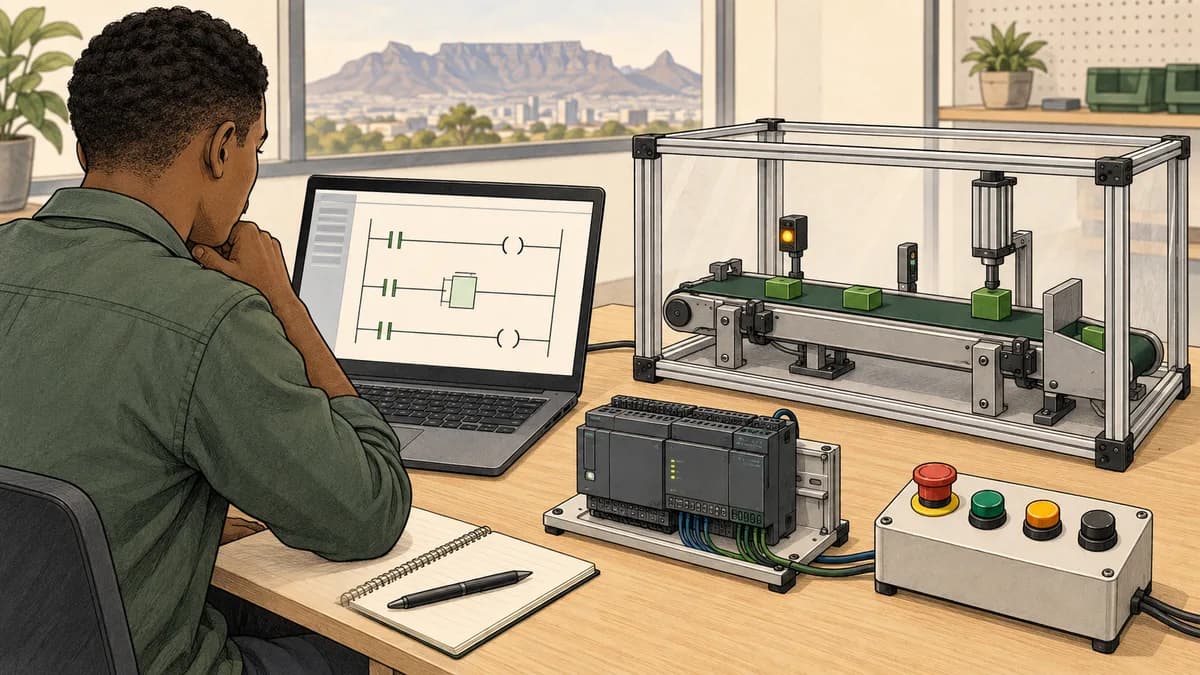
Mitsubishi Electric PLC training in Cape Town is worth comparing at the level of the actual course package: controller model, GX Works3 access, individual practical work, current dates and what the learner keeps afterwards. A nearby supplier's brochure can be a useful lead, but an old registration form is not proof of a new intake. This guide helps you check those details and prepare for a native programming course.
For a practical learning task, it also develops a four-digit binary-coded decimal exercise. The task separates a stored bit pattern, its numeric interpretation and its acceptance as an application setting. It is fictional and contains no real machine parameters. The aim is to produce evidence you can explain, rather than to claim that a general learning simulator reproduces a Mitsubishi engineering workstation.
A Mitsubishi training enquiry in Brackenfell
Megadrive Automation's South African contact page identifies its Cape Town location in Mega Park, Brackenfell. Its services page advertises Mitsubishi PLC training. As checked on 12 September 2026, that page displays 12–14 November without a year for the PLC entry, while its booking link leads to a dated 2025 document. Request the current schedule directly; do not turn the undated entry into a confirmed 2026 course.
The linked 17–19 September 2025 PLC Level 1 brochure describes a three-day basic course at R17,000 including VAT, with an FX5U-32MR/ES and licensed GX Works3 software in the package. Those are historical advertised terms, not a current quotation. Confirm the present equipment, licence terms, price and availability before relying on any included item.
This distinction matters because a hardware-and-software package is different from a seat-only course. A lower-priced alternative may still be appropriate, but compare what is actually supplied. Ask which parts are for classroom use and which transfer to the learner, and obtain an exact description of continuing software access.
The broader Cape Town PLC training guide covers other preparation routes. For this page, the local Mitsubishi enquiry is a starting point for checking fit, not a claim that a particular provider is the best choice or that every advertised date remains open.
Compare the course with your intended platform
Ask whether the practical uses iQ-F, iQ-R or an older Mitsubishi platform. Identify the exact CPU, output variant, expansion modules and HMI if one is included. GX Works3 familiarity is useful, but a compact FX5 exercise does not automatically cover an iQ-R configuration or a Q-series maintenance task.
The iQ-R versus iQ-F platform comparison explains why memory units, module compatibility, motion and network roles must be checked separately. Use that guide to turn an equipment wish list into specific questions. Avoid booking a course solely because its title contains the word advanced when its hardware and exercises do not match your goal.
For another national enquiry route, Adroit's iQ-F Basic course describes number systems, controller fundamentals, logic and programming, with Fourways and regional entries. That syllabus can help you compare content. It does not establish a Cape Town class date or an equivalent hardware package.
A learner coming from another brand should also ask how the course handles native device conventions, project configuration and observation tools. Familiar Boolean logic does not make every address format or editor operation interchangeable. Record the platform-specific learning gaps you want the instructor to review instead of assuming that a general introduction will address them automatically.

Why number systems belong in practical PLC training
A controller word contains bits. Software can display those bits in several ways, and an application can assign them a particular encoding. Seeing a familiar-looking sequence of digits is not enough to establish what the value means. A mistake here can survive compilation and appear later as an incorrect setting or misleading display.
Mitsubishi's Discovering Control learning manual, section 6.2.5 explains BCD using four bits for each decimal digit from zero to nine. That manual uses older FX training equipment; its number-system explanation is useful, while its hardware and editor details should not be transplanted into a current FX5 project without checking.
A separate Mitsubishi iQ-F FAQ gives the example K100 to H0100 and points to BCD conversion instructions. The important learning distinction is that encoding decimal digits into BCD changes the stored representation. Simply changing the monitor's display base does not perform the same transformation.
For example, ordinary numeric 100 is hexadecimal 0064. A packed BCD representation of decimal digits 0100 has the hexadecimal bit pattern 0100, which would be numeric 256 if interpreted as an ordinary unsigned binary integer. Those statements describe the same bits under different rules, rather than contradictory calculator results.
Define a four-digit BCD classroom contract
In this fictional exercise, one unsigned 16-bit storage word contains four packed BCD digits. The most significant four-bit group is the thousands digit, followed by hundreds, tens and units. Each group must be between zero and nine. The storage input itself must be a present integer from zero through 65,535, and its quality must be good.
After decoding, the classroom application accepts a requested quantity only from one through 5,000 inclusive. This application range is intentionally narrower than the BCD encoding range. A word can therefore be structurally valid BCD and still represent an unacceptable quantity. Keep those outcomes separate in the implementation and the display.
Use four result categories. Unavailable means the input is missing or bad quality. InvalidEncoding means the storage value is outside its domain or contains a four-bit digit from ten through fifteen. OutOfRange means decoding succeeded but the quantity is outside one to 5,000. Accepted includes the decoded quantity when all checks pass. These are exercise labels, not Mitsubishi diagnostic codes.
The exercise does not write a real machine setting, latch a previous value or trigger a physical process. It evaluates the current request only. If you later add an Apply command, retained active value or operator acknowledgement, write a new contract for those behaviours rather than assuming that the conversion exercise already includes them.
Work through representative bit patterns
The table uses conventional hexadecimal notation with a 0x prefix to make the stored pattern explicit. That notation is for this explanation, not an instruction to paste a literal into every Mitsubishi editor. The second column shows the same word interpreted as an ordinary unsigned binary integer; the third applies the declared BCD interpretation.
| Stored pattern | Ordinary integer interpretation | BCD quantity | Application result |
|---|---|---|---|
| 0x0007 | 7 | 7 | Accepted |
| 0x0099 | 153 | 99 | Accepted |
| 0x1000 | 4096 | 1000 | Accepted |
| 0x1234 | 4660 | 1234 | Accepted |
| 0x5000 | 20480 | 5000 | Accepted |
| 0x9999 | 39321 | 9999 | OutOfRange |
| 0x0000 | 0 | 0 | OutOfRange |
| 0x1A23 | 6691 | No valid BCD quantity | InvalidEncoding |
For 0x1234, the BCD calculation is one times 1,000, plus two times 100, plus three times ten, plus four. The result is 1,234. Treating the same word as binary uses powers of sixteen across the displayed hexadecimal digits and gives 4,660. The two calculations answer different questions.
The 0x0099 row is a useful early test because the erroneous binary result, 153, is still a plausible quantity within the allowed application range. A simple range check alone will not expose the missing decode. You need an expected numeric result that distinguishes the two interpretations.
Leading zeros are another display issue. Quantity seven may be shown as 0007 when a four-character display format is required. That formatting does not create a different numeric quantity. Conversely, removing a leading zero from a displayed code does not prove that its stored representation was decoded correctly.

Reject invalid digits before treating them as a quantity
Hexadecimal digits A through F represent values ten through fifteen. They are valid hexadecimal digits but invalid decimal digits in the packed BCD format defined here. For 0x1A23, a naive calculation might substitute ten for A and produce a number. That result is not a valid decode of this contract because the input violates the digit rule.
Test an invalid digit in each position. Use 0xA123, 0x1A23, 0x12A3 and 0x123A. All should produce InvalidEncoding. Testing only the highest group can miss an implementation that validates one digit and assumes the others are valid. The defect is easy to hide if the display happens to truncate or format the resulting number.
Also reject storage inputs of minus one, 65,536 and 12.5. Do not mask a too-large value down to sixteen bits and then report a successful conversion. Such masking would change the input before validation and could turn malformed data into a plausible request. If truncation is an intentional feature elsewhere, it needs its own documented policy.
Keep quality precedence explicit. In this exercise, bad quality or a missing observation returns Unavailable before attempting to interpret the stored word. A stale or absent field should not be presented as a newly observed zero. Use the data-conversion reference to extend this distinction to other encodings and numeric types.
Test the application boundary separately from the encoding
The accepted quantity endpoints are one and 5,000. Accordingly, 0x0001 and 0x5000 are accepted; 0x0000 and 0x5001 are OutOfRange. All four are valid BCD patterns. Their different results come from the application contract, not from a defective encoding.
Now change the maximum allowed quantity to 4,999 for a revision exercise. The former boundary case 0x5000 becomes OutOfRange. The malformed digit cases remain InvalidEncoding. This helps a learner see that range policy and encoding validation are separate layers, with different tests and different explanations.
A useful review question is whether a single Boolean Valid output would be enough. It could indicate whether a request is accepted, but would hide why a request failed unless another field or observation provides the reason. For training, the four result categories make it easier to diagnose the mistake and show that every rule was considered.
Do not infer physical batch accuracy from a correct decoded quantity. Counting actual items, handling duplicate events, stopping at a target and responding to a sensor fault are additional requirements. This exercise establishes only the interpretation and acceptance of a proposed quantity. Keeping that boundary clear prevents a small conversion demonstration from being marketed as a complete production system.

Move from paper reasoning into a native practical
Before implementing the exercise in GX Works3, record the selected CPU, software version and chosen native instructions. Consult the corresponding instruction documentation for supported operands, valid ranges and error behaviour. This article's result labels and validation order are a classroom specification, not a claim about the automatic diagnostics of every conversion instruction.
First predict the outputs on paper. Then create the native project in the supervised learning setup and identify how each test word is entered and monitored. Ensure the monitor's numeric display mode is recorded. Otherwise a correct bit pattern may look wrong simply because one person is viewing hexadecimal and another is viewing decimal.
If the exercise is placed in a reusable block, keep input decoding separate from any stateful behaviour added later. The GX Works3 function-block guide explains instance ownership and reset testing. A conversion does not need to inherit the history of another quantity just because both calls use a similar block name.
If you add a GOT screen, label the stored pattern, decoded quantity and status distinctly during the learning exercise. The GOT2000 screen-design guide explains related display and data-quality questions. A polished screen with a single unexplained number can conceal a conversion fault that a simple trace would expose immediately.
Ask a Cape Town course provider to assess explanation as well as operation
A practical assessment can give each learner a different set of stored words and require predicted outcomes before the project runs. Include at least one case where the wrong binary interpretation remains inside the application range, one invalid digit and both application endpoints. This prevents a learner from passing by copying a short list of familiar monitor values.
Require an explanation of one failure. For example, why did the initial programme accept 0x0099 as 153? The useful answer identifies the missing BCD interpretation and the test that exposed it. “The software was wrong” is not sufficient evidence, particularly when the software correctly displayed the underlying word as an ordinary integer.
Ask what the instructor reviews individually. A demonstration of a conversion instruction can introduce the topic, but it does not show whether each participant understands encoding, range policy and quality. The PLC course entry requirements guide helps learners identify preparation needs before entering a fast-paced native software session.
For someone travelling from elsewhere in the Western Cape, confirm the venue and daily times before arranging transport. Brackenfell and central Cape Town are different travel plans. Use the exact current offer rather than an assumed city-centre location, and keep any required equipment or laptop preparation instructions with the booking details.

Questions about Mitsubishi PLC training in Cape Town
Does the Megadrive brochure confirm a current 2026 course?
The linked brochure reviewed here names September 2025. It confirms what was advertised for that historical package, not a current intake. The services page provides a training enquiry route, but the year, availability, price and included hardware or software need confirmation for a new booking. Do not assume an old registration form has been updated just because it remains linked.
Should I compare a hardware-inclusive course with an online course?
You can compare them if you separate their outcomes and inclusions. General online practice may prepare logic reasoning, while a native course may provide equipment, software access and supervised configuration. A headline fee alone does not make the offerings equivalent. The South African PLC course price guide helps organise a fuller cost comparison.
Why does 0x0099 show as 153 in a monitor?
That is its ordinary unsigned binary value. Under the declared packed BCD encoding, the digits represent 99. The monitor is not necessarily malfunctioning; you need to know whether you are viewing the stored bits, their ordinary numeric interpretation or a decoded application quantity. Record the display mode with the test evidence.
Is every four-digit hexadecimal word valid BCD?
No. In this exercise, each four-bit group must represent a decimal digit from zero to nine. A through F are invalid in any position. Structural validity also does not guarantee an acceptable application quantity: 0x9999 is valid BCD but exceeds the classroom limit of 5,000.
Can I start learning without buying a PLC immediately?
Yes, you can practise the requirement, arithmetic and general logic before committing to equipment. This site is commercially connected with PLC Simulation Software; its PLC data-type learning resources provide a related preparation route. Check current supported features. This does not establish native GX Works3 instruction execution or replace supervised hardware work.
Does a Cape Town Mitsubishi short course guarantee employment?
No employment or salary outcome is established by the sources in this guide. Describe the tasks you can demonstrate and the limits of that evidence. A clear project explanation can support a technical conversation, but a classroom exercise is not proof of experience with a specific employer's installation.
Keep a compact but complete learning record
A useful submission contains the encoding contract, acceptance range, input quality rule and expected table. Add the observed results, project revision and monitor display mode. Include invalid digits in all four positions so that the validation is demonstrably complete for that rule. Keep any native instruction-specific observations separate from the general arithmetic model.
For further practice, use the PLC programme testing resources. Training managers can use the training-centre evaluation guide to decide which parts require individual native access and which can be prepared beforehand. No specific certificate, software entitlement or hardware inclusion should be inferred from those general learning links.
The next provider enquiry can now be precise: you want to learn the selected Mitsubishi platform, practise number-system interpretation, test malformed and boundary inputs, and explain the results yourself. Combine that learning request with a confirmed date, venue and package description to make your Cape Town course choice concrete and reviewable.
