brands · South Africa
Mitsubishi PLC Training in Durban: GX Works3 and GOT Courses
Explore Mitsubishi Electric PLC training in Durban: regional course enquiries, GX Works3 and GOT preparation, alarm-state exercises and practical evidence.
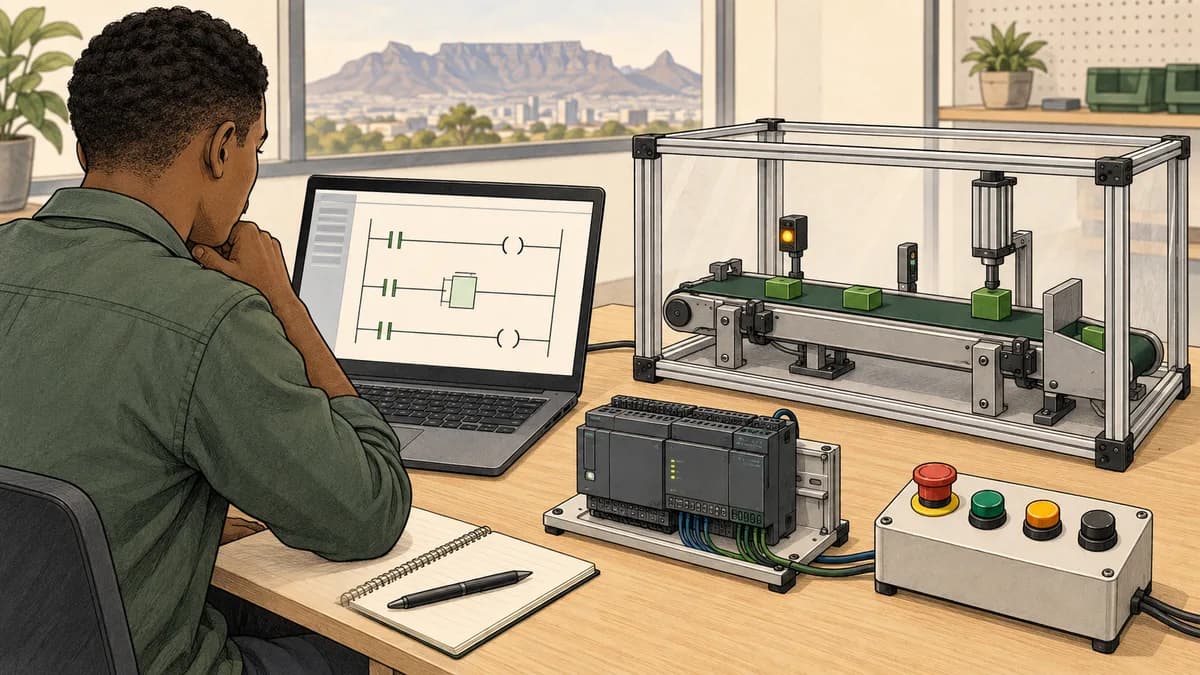
Mitsubishi Electric PLC training in Durban should connect the controller programme to the evidence a technician actually needs: input conditions, programme state, operator commands and the information shown on an HMI. A course that teaches only how to make a screen look correct can miss the difference between an active condition, an acknowledged message and a condition that has returned to normal.
This guide helps KwaZulu-Natal learners compare Mitsubishi course enquiries and prepare a practical alarm-state exercise. The exercise is fictional, with its own declared rules. It is not a GOT default configuration, an industrial alarm standard or a safety function. Use it to practise precise requirements and testing before implementing a native project under the conditions of your chosen course.
Where to start a Durban Mitsubishi training enquiry
Adroit's contact page lists a Durban/Richards Bay regional contact, while its training site publishes separate Mitsubishi course descriptions. The contact listing establishes an enquiry route; it does not establish a scheduled Durban classroom intake. Ask whether the required course can be delivered locally, remotely or through a confirmed out-of-town arrangement.
The Mitsubishi GOT Basic course description includes GT Designer3, screen creation, debugging, alarms and simulator checks. It names Mitsubishi PLC Basic Training as a prerequisite and lists Fourways and regional delivery. For PLC preparation, the iQ-F Basic course is a separate offering. Confirm the current sequence and exact practical equipment with the provider.
Historical resources need their own date check. A 2021 introductory GX Works3 resource page describes videos, a manual, an assignment and an FX5U requirement for its introductory arrangement. It is useful background, but does not confirm that the same submission process, certificate arrangement or free class is currently available. Request the present terms instead of treating the old post as a current booking offer.
Sources were checked on 12 September 2026. For general preparation and other learning routes, see the Durban PLC training overview. No source used here establishes that Mitsubishi dominates Durban's installed base or that one brand course produces a particular local salary.
Choose the PLC and HMI scope together
Describe the intended controller family before choosing a course level. An iQ-F learning rig, an iQ-R system and an older Q-series installation can share concepts while requiring different configuration and maintenance knowledge. The iQ-R versus iQ-F comparison explains why exact modules and network roles matter.
For HMI work, ask which GOT model and GT Designer3 version are used. Ask whether the learner creates and tests the screen individually, how it connects to the controller and which observations are recorded. A guided demonstration of an alarm object is not the same assessment as diagnosing a misleading acknowledgement sequence yourself.
Keep the controller and screen responsibilities explicit. One project may calculate a condition in the PLC and display it in the HMI. Another may use configured HMI alarm facilities. The course should identify which component owns each state and what happens when communication is interrupted. Do not let a generic diagram imply that all implementations behave identically.
The GOT2000 screen-design guide covers labels, numeric interpretation and testing. Use it to prepare concrete questions about mapping and quality, then use the native practical to learn the actual settings. A browser learning exercise does not establish that a particular GOT project has been compiled, transferred or tested on hardware.

Distinguish an alarm condition from an acknowledgement
Mitsubishi's GOT2000 alarm-function overview distinguishes controller communication/system alarms from user-created alarms. It describes grouping and diagnostic context, with model restrictions on some functions. Check the function and model documentation for the actual project rather than assuming every GOT supports every diagnostic detail.
For the classroom exercise below, an alarm condition is simply a Boolean observation supplied by a test driver. Acknowledgement is a separate event that records recognition of an occurrence. Neither action repairs a physical fault. The test has no output that commands equipment, clears a drive trip or grants permission to restart anything.
This separation is easy to lose when an interface uses a button labelled Reset for several unrelated actions. Does the button acknowledge a message, clear a stored record, request a device reset or change the programme state? A learner should ask that question before wiring it to a variable. A familiar label is not a complete behavioural specification.
A returned condition can also remain relevant to the operator. If it became active and then disappeared before acknowledgement, the exercise retains a visible returned-unacknowledged state. This is a deliberate teaching choice. It does not claim that every alarm application should use the same policy.
Define a four-state classroom model
Use four states: Normal, ActiveUnacknowledged, ActiveAcknowledged and ReturnedUnacknowledged. Begin in Normal with the previous condition false. Inputs on each explicit evaluation are Condition and AckEvent. AckEvent means a single acknowledgement event supplied to the model; it is not a held button level.
The rules are:
- A new false-to-true condition occurrence enters ActiveUnacknowledged. A simultaneous acknowledgement event does not acknowledge that new occurrence in this model.
- While the condition remains true, acknowledgement changes ActiveUnacknowledged to ActiveAcknowledged. Without acknowledgement, the state remains unchanged.
- If the condition becomes false while unacknowledged, the state becomes ReturnedUnacknowledged. If acknowledgement is also supplied in that evaluation, it becomes Normal.
- If the condition becomes false after acknowledgement, the state becomes Normal.
- In ReturnedUnacknowledged, an acknowledgement while the condition remains false clears the outstanding occurrence to Normal. A new occurrence instead takes priority and enters ActiveUnacknowledged.
- Acknowledgement in Normal with no condition has no effect and cannot pre-acknowledge a later occurrence.
These rules include an explicit event-order choice. A different specification could resolve simultaneous inputs differently, but its expected results would change. Do not describe this model's priority as an automatic property of GX Works3 or a built-in GOT alarm object.
Trace an occurrence that returns before acknowledgement
Start from Normal. Apply the sequence below, recording the state after every evaluation. Condition is the observed classroom condition, and AckEvent is the separate acknowledgement event. There is no input-quality model in this first trace; all supplied Boolean observations are treated as available.
| Evaluation | Condition | AckEvent | Expected state |
|---|---|---|---|
| 1 | False | False | Normal |
| 2 | True | False | ActiveUnacknowledged |
| 3 | True | False | ActiveUnacknowledged |
| 4 | False | False | ReturnedUnacknowledged |
| 5 | False | False | ReturnedUnacknowledged |
| 6 | False | True | Normal |
Evaluation 4 exposes an important defect: a programme that simply hides the message whenever Condition becomes false loses the unacknowledged occurrence. Under this contract, return-to-normal and acknowledgement are separate events. The retained state explains why the message remains visible even though the current condition is false.
A second defective implementation might clear the state only while Condition is true. It would then become impossible to acknowledge a returned occurrence. Evaluation 6 catches that error. This is why a practical test should include the order “occurs, returns, then acknowledged,” rather than testing only an acknowledgement during an active condition.
Keep the raw condition visible during the exercise. A reviewer should be able to distinguish “Condition false, outstanding occurrence still unacknowledged” from “Condition true, fault still active.” A single red lamp cannot communicate that distinction clearly enough for the learning objective.

Trace acknowledgement while the condition remains active
Reset the model to its defined initial state. Apply Condition true with no acknowledgement: the state becomes ActiveUnacknowledged. On the next evaluation, keep Condition true and apply AckEvent: the state becomes ActiveAcknowledged. On a third evaluation, keep Condition true with no new acknowledgement. It remains ActiveAcknowledged.
The condition has not disappeared. If the screen presents this state as Normal, it incorrectly treats acknowledgement as repair. In the fourth evaluation, set Condition false. The state now becomes Normal because the occurrence was already acknowledged. Record the condition and state separately to make the reasoning visible.
Next test acknowledgement before any occurrence. With Condition false in Normal, an AckEvent leaves the state Normal. A later false-to-true occurrence without acknowledgement must enter ActiveUnacknowledged. An implementation that stores an acknowledgement indefinitely may wrongly start the new occurrence as acknowledged.
Also test a new occurrence and AckEvent in the same evaluation. The declared priority keeps the new occurrence unacknowledged. This case catches a common branch-order mistake where a general acknowledgement assignment runs after occurrence detection and immediately hides the new event's unacknowledged status.
Test a repeat occurrence and simultaneous return
Create ReturnedUnacknowledged by allowing an unacknowledged condition to appear and then return. Before acknowledging it, make Condition true again and supply AckEvent in the same evaluation. The new occurrence takes priority, so the state is ActiveUnacknowledged. This contract does not maintain a separate queue of every historical occurrence; it only tracks the current outstanding state.
Now consider an already ActiveUnacknowledged occurrence that returns in the same evaluation as acknowledgement. Rule three gives Normal. This differs from a new occurrence arriving with acknowledgement because the event being acknowledged already existed before the evaluation. Recording previous condition and starting state makes that distinction reviewable.
These tests are more informative than repeatedly pressing acknowledgement while watching a fixed active condition. They expose interactions between history, current input and event priority. A learner who can predict them has demonstrated state reasoning rather than only knowledge of a screen button.
For an extension, add an event-history list with occurrence identifiers. That would need rules for storage capacity, repeated occurrences, timestamps and acknowledgement identity. Do not claim the four-state exercise already preserves a complete audit trail or supports multiple concurrent alarms. Those are separate features with their own tests.

Keep the model separate from the native implementation
When implementing the learning task in GX Works3, identify where previous condition and alarm state are stored. If each monitored object needs independent state, it should own the intended instance. The GX Works3 function-block guide explains why calling the same stateful instance for unrelated channels can mix their histories.
The native project also needs to define how a button action becomes AckEvent. A held input level can behave differently from one event per intended press. The one-shot instruction reference develops that general distinction. Confirm the applicable native instruction and execution conditions instead of copying a pulse implementation from another platform without review.
If you use a GOT's configured alarm functions, compare their documented options with the learning contract. Either configure and test an equivalent behaviour where supported or explicitly revise the exercise to match the intended native design. Do not put the classroom state names beside a screenshot and imply they are vendor option names.
Record the CPU, GOT, software versions, project revisions and observation points. A valid paper state trace proves the contract is understandable; a native software test provides evidence about that implementation. Hardware and communication tests establish additional facts. Keep those evidence levels distinct in the submission.
Diagnose a misleading display with observations
Suppose the screen says Normal while the PLC test variable Condition remains true. Start by checking whether the screen is displaying the raw condition or a derived acknowledgement state. Inspect the mapping and the current programme state. Do not immediately assume a communication cable fault simply because two displayed items disagree.
If the mapped variable is wrong, document the source and corrected destination. If the mapping is correct but the programme state is wrong, inspect the transition and input-event trace. If values are stale, investigate communication and data quality. The PLC communication troubleshooting guide provides a broader sequence for that investigation.
This exercise initially assumes available Boolean observations. A real implementation needs a separate policy for lost communication or bad input quality. Reusing the last value, declaring an unknown state or applying another approved behaviour are design choices that must be specified. A displayed false value should not silently stand in for an unavailable observation.
Avoid diagnosing every Durban installation through generic coastal claims. Actual environmental conditions, component ratings, inspection requirements and manufacturer guidance matter. This article does not prescribe an enclosure rating, terminal-maintenance interval or universal surge-protection arrangement based only on the city's name.

Compare practical access, assessment and costs
Ask the provider to identify what every learner will do individually. For this topic, a useful outcome is to create or configure an alarm behaviour, predict transition traces, introduce a defect and explain the correction. Watching the instructor acknowledge a message does not establish the same capability.
If a regional class requires a group booking, obtain the current conditions and full quotation. Confirm the exact Durban-area venue, dates, equipment and any minimum attendance requirement rather than assuming them. For remote delivery, confirm how native practical access works and what support is available during the scheduled session.
The South African PLC course price guide helps compare complete scope. Include travel when the confirmed practical is outside KwaZulu-Natal, and check tax treatment and software access separately. Do not compare a historical introductory resource with a current multi-day hardware course as though their advertised costs purchase the same outcome.
Training managers can use the training-centre evaluation guide to separate foundation study from native equipment assessment. If a qualification outcome is required, request evidence for the exact offering. Neither a manufacturer name nor a course attendance document by itself establishes the broader recognition an employer may require.
Questions about Mitsubishi PLC and GOT training in Durban
Is the regional Adroit contact a confirmed Durban training venue?
No. It is a route for discussing regional support and training arrangements. Ask for a dated course offer with the actual venue or delivery format. The published course descriptions and the regional contact should not be combined into an invented calendar entry.
Should I complete PLC basics before a GOT course?
The GOT Basic description reviewed here names Mitsubishi PLC Basic Training as a prerequisite. Confirm the provider's current requirements and any recognition of equivalent experience. Understanding signal meaning, variables and simple programme behaviour helps when diagnosing a display, but the provider should decide whether your preparation meets its entry conditions.
Why is an acknowledged alarm still active?
In the classroom contract, acknowledgement records recognition of an occurrence. It does not make Condition false. ActiveAcknowledged is therefore a valid state until the condition returns. A display that hides that distinction can mislead the learner into thinking a fault was cleared when only the message was acknowledged.
Why retain a returned but unacknowledged occurrence?
The exercise requires visibility of an occurrence that disappeared before acknowledgement. That is why it includes ReturnedUnacknowledged. This is a defined teaching policy, not a universal industrial requirement or a claim about every native GOT setting. Test the actual policy selected for a real project.
Can an online HMI exercise prepare me for the practical?
It can help with state explanations and observation design. This site is commercially connected with PLC Simulation Software; its HMI simulator learning resources offer a related general preparation route. Check the current feature scope. They do not establish native GOT project compatibility or an approved implementation of this specific state model.
What should I show an assessor or potential employer?
Show the requirement, transition traces, implementation identity and observed results. Include a defect that confuses acknowledgement with return-to-normal and explain the test that found it. Describe the environment accurately. A general simulation exercise supports a discussion of reasoning, but does not prove experience on a particular production installation or guarantee a job.
Produce a small evidence pack with clear boundaries
Keep the four-state contract and both principal traces in the same document. Add the simultaneous-event cases and the pre-acknowledgement test. Record which inputs are events, which are levels and which state variables persist between evaluations. These details make the example reproducible by another learner.
For further practice, use the PLC programme testing resources, then take the resulting questions to the native training provider. Your enquiry can now specify that you want to learn controller-to-HMI mapping, alarm-state interpretation and independently reviewed fault diagnosis, alongside the exact Mitsubishi platform you need.
That gives the course selection a practical purpose: you are choosing access and instruction that help you explain what happened, where the evidence came from and which parts remain untested. It is a stronger basis for a Durban learning plan than a generic promise of advanced automation skills.
